
Search the Site with

|
Search the Site with
|
 General Characteristics History Image Gallery to end of page
 |  |
Named in 1977, MYSTIC was the first of the two Deep Submergence Rescue Vehicles of the Navy designed to perform rescue operations on submerged, disabled submarines of the U.S. Navy or foreign navies. The DSRV operated from Attack Submarines which were able to carry them on their decks at 15 knots. Retired on September 30, 2008, MYSTIC is now preserved at the U.S. Naval Undersea Museum at Keyport, Washington.
| General Characteristics: | Launched: January 24, 1970 |
| In service: 1971 | |
| Stricken: September 30, 2008 | |
| Builder: Lockheed Missiles and Space, Co., Sunnyvale, Calif. | |
| Propulsion system: Electric motors, silver/zinc batteries | |
| Propellers: one | |
| Length: 49 feet (15 meters) | |
| Beam: 8 feet (2.4 meters) | |
| Displacement: approx. 38 tons | |
| Speed: 4 knots/8 hours | |
| Transit: 2.5 knots/14hours | |
| Search: 1.5 knots/18 hours | |
| Maximum diving depth: 5,000 feet (1524 meters) | |
| Armament: none | |
| Life support: 36 hours | |
| Crew: two pilots, two rescue personnel and the capacity for 24 passengers |
 back to top go to the end of the page
MYSTIC History:
After the loss of the nuclear-powered submarine USS THRESHER (SSN 593) on April 10, 1963, during deep-diving trials off the U.S. east coast, the U.S. Navy concluded that existing rescue systems such as the McCann rescue chamber were unable to reach the depths at which modern attack submarines now operated. In 1964, the Navy therefore established the Deep Submergence Systems Project to develop a new generation of deep-submergence rescue vehicles capable of reaching disabled submarines resting thousands of feet below the surface and bringing their crews to safety. Out of this program came two highly capable battery-powered submersibles, later designated DSRV-1 and DSRV-2, which would eventually be named MYSTIC and AVALON.
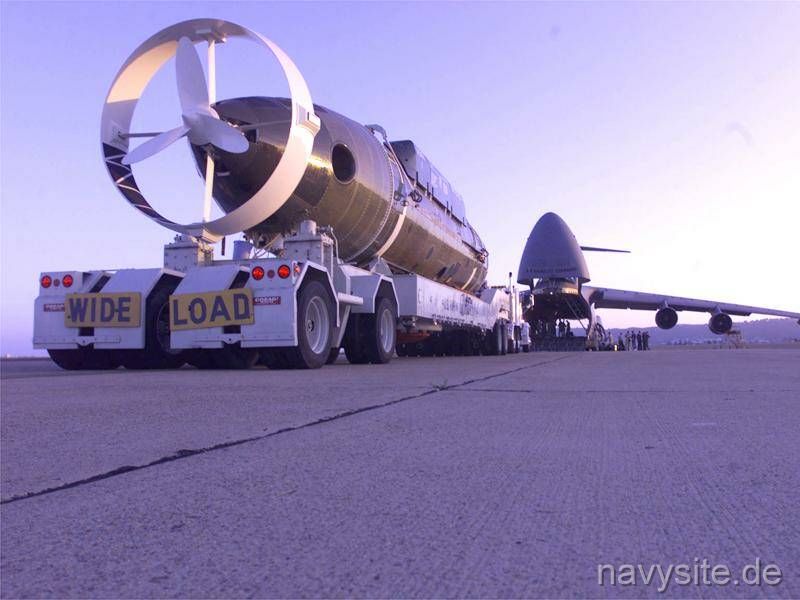
Construction of the first of these vehicles was contracted to Lockheed, drawing on that company's experience with deep-diving research craft. DSRV-1 was built for the Navy at a cost of about 41 million dollars and designed from the outset to be air-transportable, compact enough to fit inside a large cargo aircraft and light enough to travel by road on a special trailer.
The vehicle's outer hull was a streamlined fiberglass fairing, beneath which sat a pressure hull composed of three interconnected high-strength steel spheres linked by short tunnels, providing separate compartments for the pilots, support crew, and rescued submariners. MYSTIC was about 49-50 feet long, roughly 8 feet in diameter, displaced around 37-39 tons submerged, and was powered by electric motors driving a single main propeller plus multiple fore-and-aft thrusters for precise station-keeping. She could operate down to about 5,000 feet, deeper than the collapse depth of U.S. submarines, and could carry 24 survivors at a time in addition to a crew of three to four.
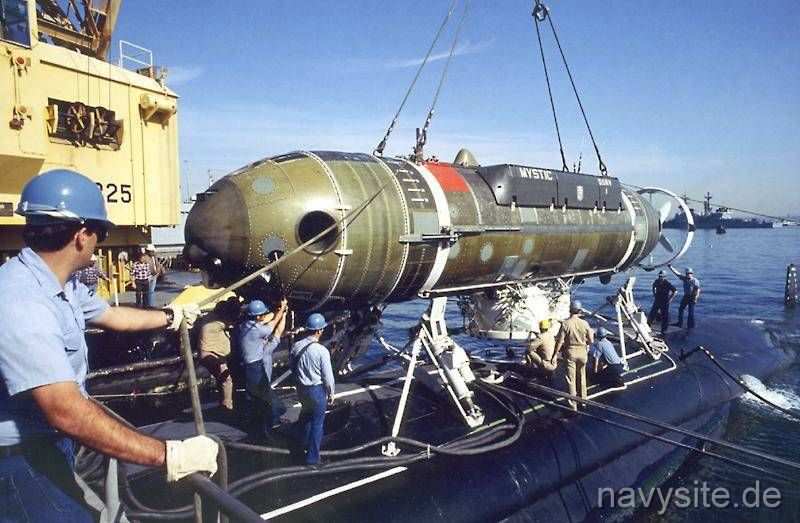
DSRV-1 was launched at a Lockheed facility in San Diego on January 24, 1970, and loaded onto a flatbed trailer for transport to an airfield, demonstrating at the very beginning of her career the fly-away concept that underpinned the program: a rescue vehicle that could be moved rapidly by truck or aircraft to almost any port.
The Navy formally acquired the vehicle in mid-1971, by which time it had already absorbed considerable development and construction costs and had begun to represent a substantial investment in deep-sea rescue capability.
Sea trials and evaluation occupied the first years of DSRV-1's life. In early 1971, the new vehicle participated in its first practical rescue exercises, proving that it could locate, approach, and "mate" with the escape trunk of a submarine on the bottom, then return to the surface with rescued personnel. Later that year, DSRV-1 conducted further exercises with the attack submarine USS HAWKBILL (SSN 666), testing how a front-line submarine configured as a "mother boat" could carry, launch, and recover the rescue vehicle without compromising combat capability.
These early evolutions validated not only the design of the vehicle, but also the broader concept of pairing it with either a dedicated rescue ship or a specially modified attack submarine that could deliver it to a disabled submarine anywhere in the world.
Throughout the mid-1970s, DSRV-1 underwent extensive additional trials and refinements as part of the Deep Submergence Systems Project. The vehicle's complex control system - described in later museum accounts as more intricate than the guidance computer used for the Apollo 11 lunar landing - was tuned to allow exceptionally fine maneuvering, so that the DSRV could hover in strong currents and hold position over a submarine's escape hatch to within less than an inch.
The Navy also developed standardized "rescue seats" that could be fitted to U.S. and allied submarines, enabling the DSRV to form a watertight seal regardless of minor differences in hull lines and fittings.
Following these years of testing, DSRV-1 completed an operational evaluation that included a complete simulated rescue mission and, in 1977, was declared fully operational and formally named MYSTIC during Fleet Acceptance Ceremonies.
From that point forward MYSTIC, together with her sister submersible AVALON, served as the Navy's primary deep-submergence rescue system. Both vehicles were based with the Deep Submergence Unit at Naval Air Station North Island in San Diego, California, from where they could be moved by road to a nearby airfield for loading into a C-5 Galaxy or other heavy-lift aircraft, or embarked aboard a submarine or dedicated rescue ship.
During the late 1970s and throughout the 1980s, MYSTIC's role was to remain at very high readiness while regularly participating in training and evaluation exercises. Defense budget documents from the mid-1980s emphasize ongoing technical and logistics support to maintain the readiness of MYSTIC and AVALON to respond to submarine-rescue requirements anywhere in the world, reflecting the Navy's determination that the painful lessons of THRESHER and the later loss of USS SCORPION (SSN 589) would not be repeated.
In those decades, there were no actual deep-sea submarine disasters requiring the deployment of the vehicles, but the absence of real emergencies did not lessen the need for practice. MYSTIC was repeatedly exercised with U.S. attack submarines and rescue ships, drilling scenarios in which she would locate a disabled submarine on the ocean floor, maneuver into position, seal onto a rescue seat, embark two dozen survivors, and shuttle them back to a surface support ship or mother submarine for decompression and medical care.
By the 1990s, the DSRV program had matured into a key element of the Navy's global submarine-safety architecture alongside the SUBSAFE program, decompression systems, and submarine escape training. DSRVs like MYSTIC remained a niche capability - highly specialized, expensive to maintain, and hopefully never needed in anger - but they also became increasingly important in multinational exercises as more navies fielded larger submarine forces and sought interoperability in rescue operations. MYSTIC's ability to be flown rapidly to distant locations, coupled with her deep-diving capability, made her an ideal centerpiece for coalition drills that tested both technical compatibility and command-and-control arrangements among allies.
One of the first well-documented multinational exercises involving MYSTIC in this period took place in 2000. By September of that year, the attack submarine USS DALLAS (SSN 700) had visited Aksaz Naval Base on Turkey's Aegean coast to participate in the NATO triennial submarine escape and rescue exercise SORBET ROYAL 2000. DALLAS carried MYSTIC and worked with rescue specialists and associated naval units from Italy, Turkey, and the United States, conducting a variety of training evolutions that rehearsed the full sequence of a potential NATO submarine rescue - from distress call and mobilization of the DSRV system to simulated extractions of submariners from a "disabled" boat and their transfer to safety.
The choice of Aksaz, near the city of Marmaris, placed the exercise in strategically significant waters at the junction of the Aegean and eastern Mediterranean, underscoring NATO's interest in being able to respond to a submarine casualty in congested, politically sensitive sea lanes.
In 2001, MYSTIC deployed to northern Europe for another major multinational drill, this time in colder waters. During Operation SEDGEMOOR 01, a submarine-rescue exercise conducted off Scotland, MYSTIC was flown from San Diego to Royal Air Force Prestwick aboard a U.S. Air Force C-5 Galaxy, then transported by road to Kyle of Lochalsh on Scotland's west coast. There, she was embarked on the British ballistic-missile submarine HMS VANGUARD, which served as her mother submarine. Operating in the Raasay Inner Sound near the Isle of Skye, MYSTIC's four-person crew maneuvered the 50-foot vehicle off VANGUARD's back and carefully mated it to the Swedish submarine HMSwS GOTLAND, which lay on the bottom simulating a disabled boat at a depth of roughly 450 feet. After completing the mating sequence and a simulated transfer of rescued sailors, MYSTIC detached and returned to VANGUARD, remating successfully and validating the interoperability of the U.S. rescue vehicle with both British and Swedish submarines.
SEDGEMOOR 01 also involved the British rescue submersible LR-5 and the Swedish diving and submarine-rescue ship HMSwS BELOS, as well as the British Submarine Parachute Assistance Group, which parachuted into the sea near a mock disabled submarine to coordinate surface recovery of escaping submariners. A British frigate, HMS MONMOUTH, served as a medical platform for further drills, including the evacuation of a dummy casualty by helicopter for simulated treatment of decompression and radiation-exposure scenarios. MYSTIC's participation, teamed with British and Swedish assets, demonstrated how the U.S. Deep Submergence Unit could integrate its fly-away DSRV system into a broader NATO rescue architecture and highlighted the importance of technical and procedural compatibility among different nations' systems.
MYSTIC next moved to the western Pacific, where in April 2002 she took part in the multilateral exercise PACIFIC REACH 2002. Photographs from Sasebo, Japan, show the LOS ANGELES-class attack submarine USS LA JOLLA (SSN 701) leaving harbor on April 25, 2002, with MYSTIC attached to her deck and escorted by Japanese Coast Guard craft. LA JOLLA and MYSTIC headed to sea to participate in PACIFIC REACH 2002, operating with surface ships and submarines from the United States, Japan, Australia, the Republic of Korea, and the Republic of Singapore.
The exercise focused on submarine-rescue scenarios in the waters around Japan, practicing the procedures for locating a distressed submarine, deploying multiple rescue vehicles - including Japanese assets - and coordinating the transfer of survivors between different nations' platforms. For the DSRV program, PACIFIC REACH 2002 marked a major demonstration of its ability to work with Asian partners whose submarine designs, operating areas, and support infrastructures differed markedly from those of NATO navies.
Two years later, MYSTIC again deployed to East Asia for a follow-on iteration of the same series. On April 29, 2004, at Naval Air Station North Island in California, the vehicle was carefully loaded onto a Russian-built Antonov An-124 Condor heavy-lift aircraft operated by the Volga-Dnepr Group. Sailors from the Deep Submergence Unit worked alongside the Antonov's crew to secure MYSTIC and the equipment needed for her deployment. Thirteen members of her crew accompanied the vehicle as the aircraft carried them to the Republic of Korea for PACIFIC REACH 2004, an exercise held out of Jinhae on South Korea's southeastern coast and scheduled to run through May 13, 2004.
During PACIFIC REACH 2004, the United States operated MYSTIC alongside the attack submarine USS LA JOLLA and the rescue and salvage ship USS SAFEGUARD (ARS 50), while navies from South Korea, Japan, Singapore, and Australia provided additional submarines and rescue units. Observers from many other countries - including Canada, China, France, India, Indonesia, Malaysia, Russia, Thailand, the United Kingdom, Vietnam, Chile, and others - monitored the evolutions. The exercise aimed to strengthen cooperation and interoperability in submarine-rescue operations across a vast region with both arctic and tropical operating conditions. For MYSTIC, the deployment reaffirmed the core mission defined decades earlier: to provide a quick-reaction, worldwide, all-weather capability to rescue personnel from disabled submarines at depths up to roughly 2,000 feet, with the design margin to operate down to about 5,000 feet.
Even as these large, media-visible exercises unfolded, MYSTIC continued to spend most of her time in quiet readiness at North Island, maintained by the Deep Submergence Unit. The Navy's rescue concept assumed that, on receiving a distress call, the vehicle and its support crew could be loaded into a transport aircraft within hours, flown to the nearest suitable port, transferred onto a submarine or surface ship configured as a mother vessel, and then deployed to the stricken submarine. There, using sonar and precise thrusters, MYSTIC would locate the disabled submarine, land on its rescue seat, and form a watertight seal so that trapped submariners could be transferred into the DSRV in groups of up to twenty-four for each trip back to the surface. Although the Navy conducted numerous exercises of this kind over nearly four decades, the DSRVs were never called on to perform an actual rescue; no American submarine sank during the years in which the DSRV program was in service.
By the mid-2000s, the Navy had decided to replace MYSTIC and AVALON with a new, more modular and easily deployable system. The Submarine Rescue Diving and Recompression System (SRDRS), centered on the pressurized rescue module FALCON, offered a lighter, more flexible "fly-away" capability, with a remotely operated rescue vehicle and integrated decompression facilities for survivors.
AVALON was decommissioned in 2000, and on September 30, 2008, MYSTIC formally left service as the last active DSRV in the U.S. Navy. Deactivation work began the next day, October 1, 2008, as the Navy transitioned fully to the SRDRS concept for future submarine-rescue operations.
For her contributions over nearly four decades of service - maintaining a continuous deep-sea rescue capability, participating in numerous multinational exercises, and acting as a powerful deterrent against the human cost of submarine accidents - MYSTIC received several collective awards, including the Meritorious Unit Commendation with three stars, the Navy "E" Ribbon three times, and the National Defense Service Medal with star. These decorations reflect the sustained readiness and professionalism of the Deep Submergence Unit's crews rather than any single high-profile event, since the DSRV program's value lay precisely in being prepared for catastrophes that fortunately never occurred.
After decommissioning, MYSTIC's story shifted from operational readiness to preservation and public education. In October 2014, the Navy donated the vehicle to the U.S. Naval Undersea Museum at Keyport, Washington, part of the Naval History and Heritage Command's museum system. There she was placed on outdoor display alongside other historic undersea vehicles and artifacts. Restoration work, including corrosion control and cosmetic refurbishment, proceeded over several years and was completed in February 2021, returning MYSTIC to a condition close to her operational appearance. Today, MYSTIC rests ashore at Keyport, no longer poised to descend five thousand feet into the ocean but still representing the technological and organizational response to some of the most tragic episodes in submarine history.
back to top go to the end of the pageMYSTIC Image Gallery:
 |  |
back to top Back to DSRV site. Back to ships list. Back to selection page. Back to 1st page.