
Search the Site with

|
Search the Site with
|
 General Characteristics Crew List Memorabilia Accidents aboard the Ship History Image Gallery to end of page
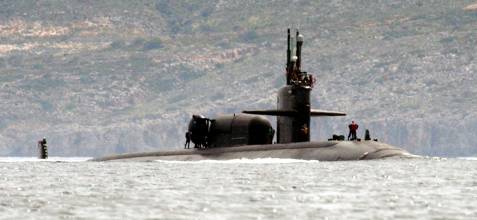 |  |
USS DALLAS was the 13th LOS ANGELES class nuclear powered attack submarine. The boat plays a very prominent part in Tom Clancy’s "Hunt for Red October". On March 24, 2017, the DALLAS departed her homeport Groton, Conn., enroute to Bremerton, Wash., where she arrived on May 22, 2017. DALLAS subsequently commenced her year-long inactivation process. The submarine was both decommissioned and stricken from the Navy list on April 4, 2018.
| General Characteristics: | Awarded: October 31, 1973 |
| Keel Laid: October 9, 1976 | |
| Launched: April 28, 1978 | |
| Commissioned: July 18, 1981 | |
| Inactivated: June 15, 2017 | |
| Decommissioned: April 4, 2018 | |
| Builder: Electric Boat Division of General Dynamics Corporation, Groton, CT | |
| Propulsion system: one nuclear reactor | |
| Propellers: one | |
| Length: 360 feet (109.73 meters) | |
| Beam: 33 feet (10 meters) | |
| Draft: 32,15 feet (9.8 meters) | |
| Displacement: Surfaced: approx. 6,000 tons | |
| Submerged: approx. 6,900 tons | |
| Speed: Surfaced: approx. 15 knots | |
| Submerged: approx. 32 knots | |
| Armament: four 533 mm torpedo tubes for | |
| Cost: approx. $900 million | |
| Crew: 12 Officers, 115 Enlisted |
 back to top go to the end of the pageback to top go to the end of the page
Crew List:
This section contains the names of sailors who served aboard USS DALLAS. It is no official listing but contains the names of sailors who submitted their information.
back to top go to the end of the pageback to top go to the end of the pageAccidents aboard USS DALLAS:
| Date | Where | Events |
|---|---|---|
| August 27, 1981 | Andros Island, Bahamas | USS DALLAS damages the lower portion of its rudder when it runs aground while approaching the Atlantic Underwater Test and Evaluation Center site at Andros Island, Bahamas. The submarine works itself free after several hours and returns to Groton, CT, on the surface for repairs. |
back to top go to the end of the page back to top go to the end of the page
USS DALLAS History:
The history of USS DALLAS began when the Navy awarded the construction contract to the Electric Boat Division of General Dynamics at Groton, Connecticut, on October 31, 1973. Her keel was laid down in the same yard on October 9, 1976, and she was launched on April 28, 1979, sponsored by Rita Crocker Clements, the wife of former Deputy Secretary of Defense Bill Clements. After fitting-out and sea trials, DALLAS was commissioned at Groton on July 18, 1981, under the command of Captain Donald R. Ferrier. She was the first LOS ANGELES-class submarine to be built from the start with an all-digital fire control and sonar suite, making her an important test platform for the class' new combat systems. From commissioning she was assigned to Submarine Development Squadron TWELVE (SUBDEVRON 12), based at New London, to support research and development work and to evaluate the new digital systems in operational conditions.
Within weeks of entering service, DALLAS suffered one of the most notable incidents of her early career. On August 27, 1981, while operating near the Atlantic Undersea Test and Evaluation Center (AUTEC) range off Andros Island in the Bahamas, she ran aground and damaged her lower rudder as she approached the range area. The submarine was able to work herself free after several hours and, following standard safety procedures, remained on the surface for the transit back to New London for repairs. The incident did not involve casualties, but it highlighted the risks inherent in operating a new class of high-performance submarines in confined, instrumented range waters.
By the beginning of 1982, DALLAS was ready to move from initial shakedown into the more formal yard period that typically follows commissioning. On January 2, 1982, she departed Naval Submarine Base New London for a five-month Post-Shakedown Availability (PSA) at Newport News, Virginia. This availability was used to correct deficiencies discovered during her initial operating period, refine the installation of the new all-digital fire control and sonar systems, and incorporate early lessons from her work with SUBDEVRON 12. The PSA kept her in the yard through the first half of 1982, after which she conducted post-availability sea trials and returned to New London to resume operations with the Atlantic Fleet submarine force.
From the completion of the PSA through 1983, DALLAS remained based at New London and continued to operate under SUBDEVRON 12. Open sources do not provide a detailed, week-by-week description of her activities in these years, but they do show that she was heavily involved in research and development projects and in the kind of Atlantic training and evaluation operations typical for an early-career LOS ANGELES-class boat. She served as an important fleet platform for proving the new digital combat system in realistic conditions and for refining tactics for the growing LOS ANGELES-class as the United States and the Soviet Union continued their intense undersea competition in the North Atlantic and Norwegian Sea in the final decade of the Cold War.
Her first major long-range deployment came in 1984 and was one of the defining events of her early service. On May 18, 1984, DALLAS departed her homeport for a deployment to the Indian Ocean that also served as a global circumnavigation, intended in part to demonstrate the range and endurance of nuclear-powered attack submarines and to support U.S. and allied naval presence in the Indian Ocean at a time when the Iran-Iraq War and Soviet maritime activity were reshaping the strategic balance in the region. Over the next six months, she rounded the Cape of Good Hope into the Indian Ocean, operated with two carrier battle groups and a maritime patrol squadron, and then continued eastward, eventually returning to the Atlantic via the Panama Canal. According to later historical work drawing on official Navy records, this cruise ran from May 18 to December 8, 1984, and included port visits to Diego Garcia in the British Indian Ocean Territory and to Perth and Albany in Western Australia. The deployment underscored the ability of LOS ANGELES-class submarines to support global operations, while also strengthening ties with Australia at a time when U.S., British, and allied submarines were using the Indian Ocean and approaches to Southeast Asia to monitor Soviet and regional naval forces.
After returning to New London in December 1984, DALLAS entered a period of post-deployment stand-down, maintenance, and training. The 1985 command history, as summarized in later references, notes that the year opened with the completion of the Indian Ocean deployment and a change of command on February 4, 1985, when a new commanding officer relieved Captain Ferrier after the demanding world cruise. Through the remainder of 1985, DALLAS remained in the western Atlantic, conducting fleet exercises, evaluations, and local operations as the crew reset from the long deployment and prepared for further overseas commitments. This period also allowed the submarine to consolidate experience with her digital combat systems and to incorporate lessons from the circumnavigation into tactics and procedures for future deployments.
In early 1986, DALLAS deployed to the Mediterranean as part of the U.S. Sixth Fleet at a time of heightened tension with Libya. Contemporary U.S. Navy accounts record that she returned to New London in May 1986 after a five-month Mediterranean deployment, placing her departure in roughly January of that year. During this deployment, she played a role in Operations Attain Document III and Eldorado Canyon, U.S. freedom-of-navigation and strike operations aimed at countering Libyan attempts to control the Gulf of Sidra and to respond to Libyan-sponsored terrorism. Working alongside the attack submarine USS DACE (SSN 607), DALLAS formed part of an undersea barrier intended to monitor and contain Libyan diesel-electric submarines while U.S. surface forces and carrier air wings conducted operations against Libyan targets. Official award documentation later associated DALLAS with qualifying service between February 7 and April 26, 1986, for an expeditionary award, reflecting the period of most intense operations off Libya. The deployment combined covert undersea surveillance and deterrence with the more visible air and surface strike component of Eldorado Canyon, and it contributed to DALLAS receiving the Battle Efficiency "E" for fiscal year 1986 in recognition of her overall readiness and performance.
Following her 1986 Mediterranean cruise, DALLAS returned to a pattern of Atlantic-based operations and preparations for further deployments. In 1988, she completed a North Atlantic deployment that, according to later congressional remarks and Navy award records, earned her a Meritorious Unit Commendation for her performance.
In early October 1988, after several years of operations with Submarine Development Squadron Twelve, DALLAS began the Navy's first Depot Modernization Period (DMP) at Portsmouth Naval Shipyard in Kittery, Maine. Official records place the start of the availability in the first days of October 1988, and Naval History and Heritage Command later summarized that the boat "completed a depot modernization period" between early October 1988 and September 1989. This new type of year-long availability was designed to carry out a deep overhaul of a LOS ANGELES-class submarine without the full scope of a refueling overhaul. For DALLAS, it meant a prolonged period in dry dock while shipyard workers renewed and modernized many of her combat systems and engineering plant components, following the general DMP pattern of extensive weapons-system upgrades, updated fire-control and sonar equipment, and major work on the propulsion plant and auxiliary machinery. During this yard period, she was formally reassigned to Submarine Squadron Two in New London, Connecticut, which became her administrative home for the rest of her career.
By September 1989, DALLAS completed this first-of-its-kind DMP and began the familiar post-availability sequence of sea trials and shakedown operations to prove the modernized ship. Her 1989 command history identifies Commander Carl B. Dunn as commanding officer and notes that after the yard, the submarine returned to sea for a mix of local operations and exercises. In late 1989, she took part in an antisubmarine warfare exercise designated ASWEX 1-90, a fleet-level training event in the Atlantic, reflecting the continuing priority on tracking and countering Soviet (and then Russian) submarines even as the Cold War neared its end.
In December 1989, DALLAS began Chief of Naval Operations Project 01387-07, an operational evaluation of the new BQQ-5D sonar system. That program used the freshly modernized submarine as an at-sea test platform for improved digital sonar processing, with a series of dedicated underway periods in the western Atlantic to collect acoustic data and to compare the new system’s performance against existing equipment.
In 1990, DALLAS transitioned from test and evaluation work to crisis-driven operational deployment. A biographical sketch from the decommissioning book of the submarine tender USS L. Y. SPEAR (AS 36) indicates that a new commanding officer took over DALLAS in March 1990, when she was homeported in Groton, and that under his command the boat would go on to be singled out within the Atlantic Fleet for high performance.
Through the first half of 1990, the submarine continued the BQQ-5D operational evaluation and routine Atlantic patrols, while the geopolitical environment in the Middle East deteriorated. On August 2, 1990, Iraq invaded Kuwait; just days later, on August 7, 1990, DALLAS departed New London for a scheduled six-month deployment with the Sixth Fleet in the Mediterranean Sea. This deployment quickly shifted from a peacetime Med cruise to wartime support for Operation Desert Shield and, later, Operation Desert Storm as the United States and a broad coalition assembled naval and air forces to deter further Iraqi action and to prepare for the liberation of Kuwait.
Operating as part of the submarine element of the Sixth Fleet's contribution to the coalition, she provided the capabilities typical of a LOS ANGELES-class attack submarine at the time: covert intelligence and surveillance, antisubmarine and antisurface warfare coverage for the carrier battle groups and amphibious forces in the Mediterranean, and a Tomahawk cruise-missile strike capability if called upon. The deployment kept the boat at sea for extended periods, interspersed with short, routine logistics visits to Sixth Fleet ports whose specific details remain largely absent from unclassified sources. By early 1991, after the coalition air and ground campaigns had pushed Iraqi forces out of Kuwait and a ceasefire was declared in late February, DALLAS concluded her Desert Storm deployment and returned to New London, closing her first decade of service with a mix of experimental work and real contingency operations.
The aftermath of that deployment was reflected in the boat's awards and retention record. For fiscal year 1991 DALLAS received the Battle Efficiency "E", recognizing her overall combat readiness and performance among Atlantic Fleet submarines.
In January 1992, the crew's reenlistment and personnel programs were recognized with the "Golden Anchor" award for 1991, a fleet-wide retention honor that indicated unusually strong crew stability at a time when the Navy was shrinking rapidly after the Cold War. During this period, the submarine's record of unit commendations also accumulated: by the end of her first ten years she had received two Meritorious Unit Commendations and two Navy Unit Commendations for earlier deployments and operations, placing her among the better-decorated units in the attack-submarine force.
On December 18, 1992, command of DALLAS passed to Commander John J. Schwanz, who would lead the boat through a sequence of high-tempo peacetime deployments. A later Navy biography notes that under his command, DALLAS completed three major deployments, though the unclassified summary does not spell out their exact destinations. Given the overall pattern of her career and contemporary accounts of LOS ANGELES-class operations, these were almost certainly a mix of North Atlantic and Mediterranean patrols in support of allied exercises, surveillance missions, and post-Desert Storm presence in waters important to NATO and U.S. interests, but specific dates and port visits remain largely unrecorded in publicly available documents.
What is clear from surviving command histories is that the early 1990s were years of sustained excellence for the submarine. The 1993 command history records that DALLAS earned the Battle Efficiency "E" for a third consecutive year and that Commander, Submarine Force Atlantic nominated her for the Battenberg Cup, awarded to the best all-around ship in the Atlantic Fleet.
Fleet headquarters cited her as "the best all-around" ship in the force, an unusual distinction for an attack submarine in a surface-ship–dominated competition. Later summaries and press accounts confirm that the Battenberg Cup nomination and the string of Battle "E" awards in 1991, 1992, and 1993 became key reference points in how the Navy remembered her 1990s performance. The individual deployment chronologies for 1993 and 1994 are not fully available in open sources, but summaries indicate that DALLAS spent substantial time underway in the Atlantic Ocean during 1994, conducting operations and training with the rapidly changing post-Cold War Atlantic Fleet.
By mid-1995, the Navy was preparing DALLAS for the next major step in her life cycle: a full Engineered Refueling Overhaul (ERO) that would refuel her S6G reactor and give the hull a new lease on life well into the 2000s. On August 1, 1995, Commander John C. Kamp relieved Commander John J. Schwanz as commanding officer of DALLAS.
Shortly thereafter, in September 1995, DALLAS entered Portsmouth Naval Shipyard again, this time for the lengthy ERO that would combine reactor refueling with a major modernization of combat systems and, crucially, physical modifications to allow the boat to carry a Dry Deck Shelter (DDS) for special operations forces. The refueling and modernization kept DALLAS largely in the shipyard through 1996 and 1997. An ERO for a LOS ANGELES-class submarine typically involves cutting into the pressure hull to access the reactor compartment, replacing the reactor core - in this case changing from the original D1G-2 core to the more powerful and longer-lived D2W core - and overhauling major propulsion and auxiliary systems, together with extensive work on combat systems and habitability. For DALLAS, this availability also included structural and piping changes aft of the sail to accept the removable DDS module, with its own electrical, air, and hydraulic connections. In February 1998, according to a congressional tribute, she became the first LOS ANGELES-class submarine formally fitted to carry a DDS, marking her as a key platform for special operations support in addition to her traditional attack-submarine roles.
By mid-1998, the physical work was largely complete. A U.S. Navy factsheet on the DDS shows DDS-01S mounted atop DALLAS in June 1998, describing this as the first fit-up of a DDS to a LOS ANGELES-class submarine. Around the same time, a detailed public-affairs article by Journalist Second Class Joseph Rehana explained that DALLAS had recently completed her sea trials after ERO and DDS installation and was entering the final phases of pre-deployment work-ups as the first attack submarine to carry a DDS. The article notes that the actual installation of the shelter was completed in August 1998 and that the submarine had already conducted two major certification exercises with embarked SEAL teams, refining procedures for launch and recovery of special operations forces and their swimmer delivery vehicles while submerged.
With the D2W core now fueling the reactor, the boat regained essentially full nuclear endurance, and the addition of the DDS expanded her mission set to include covert insertion and extraction of special operations forces via SEAL Delivery Vehicles or inflatable craft.
In the late 1990s, DALLAS resumed a deployment rhythm, now with enhanced capabilities. Summaries of her awards indicate that she earned another Battle Efficiency "E" in 1999, along with Engineering "E" and Medical "M" departmental awards that year, which together suggest that, soon after leaving the shipyard, the submarine was again operating at a high standard of material readiness and crew proficiency. Although detailed unclassified deployment logs for 1998 and 1999 are not published, these awards, combined with the timing of her ERO completion and DDS certification, imply that the boat spent much of 1999 at sea on exercises and operational taskings that exercised both her traditional antisubmarine roles and her new special-operations functions.
The year 2000 brought the most visible demonstration of the post-refueling DALLAS's new profile. DALLAS departed Naval Submarine Base New London on April 4, 2000, for a scheduled six-month Mediterranean deployment, once again under the operational control of the Sixth Fleet. This deployment combined routine presence and training with a major NATO submarine-escape and rescue exercise. Congressional remarks later summarized that in 2000, the submarine "completed a Mediterranean deployment and supported the NATO submarine escape and rescue exercise program", a clear reference to the triennial exercise Sorbet Royal 2000. For Sorbet Royal 2000, DALLAS acted as the "mother ship" for the deep submergence rescue vehicle MYSTIC (DSRV-1). Photographic and caption evidence from both Navy and NATO sources show that on August 30, 2000, at Aksaz Naval Base on Turkey's Mediterranean coast, sailors carefully lowered MYSTIC onto DALLAS's deck and secured the rescue vehicle for the upcoming exercise. In early September 2000, images document the submarine arriving at Aksaz Naval Base carrying MYSTIC, as the boat and DSRV prepared to conduct submarine escape and rescue drills with participating navies from Turkey, Italy, and the United States under NATO auspices.
The exercise scenario involved simulating the rescue of crews from a disabled submarine on the seabed. Contemporary news coverage from the exercise notes that MYSTIC made repeated approaches to the Turkish submarine TCG HIZIRREIS in difficult conditions and approached Italian diesel-electric submarine GIULIANO PRINI, providing valuable training for both the rescue crews and the sonar operators on the host and target submarines. Throughout Sorbet Royal 2000, DALLAS operated as the primary platform for launching and recovering MYSTIC, using her DDS-modified deck and associated support systems to manage the rescue vehicle's operations.
After completing Sorbet Royal and the remainder of her Mediterranean patrol - whose specific port visits and exercises remain only lightly documented in open sources - DALLAS returned to New London in the autumn of 2000, roughly six months after her April departure.
After SORBET ROYAL 2000, DALLAS returned to her routine of Atlantic-based tasking out of New London. Photographs place her at the submarine base in March and April 2002, indicating that early 2002 was spent at least partly inport in Connecticut between deployments. In 2003, the submarine tender USS EMORY S. LAND (AS 39) recorded performing a significant propulsion motor hoist-cylinder overhaul on DALLAS, a job described in the tender's command history as previously considered too complex for a forward-deployed Fleet Maintenance Activity. Even though the underlying report is not easily accessible in full, the surviving extract shows that by 2003, DALLAS was receiving heavy maintenance support while deployed overseas rather than having to return to a major shipyard, underlining how intensively the boat was being used in the fleet's operational pattern.
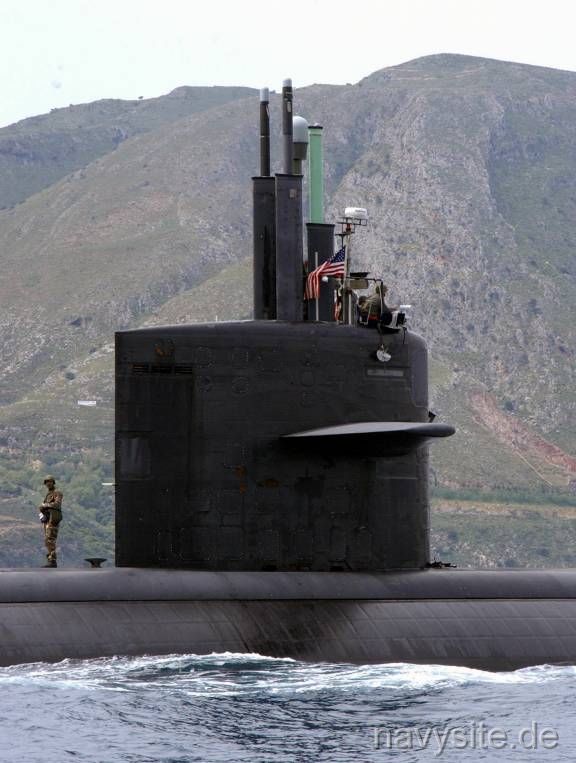
The boat's activities are better documented again from 2004. On April 12, 2004, DALLAS arrived in Souda Bay, Crete, for a brief port visit while on a routine deployment. U.S. Navy photography from that day shows her entering the harbor with the large Dry Deck Shelter clearly visible aft of the sail. The port call came at a time when U.S. submarines were regularly supporting operations in both the Mediterranean and the Middle East as part of broader post-Cold War and post-9/11 tasking. On July 19, 2004, she is documented again at Souda Bay, this time departing the harbor after another brief visit, still with the DDS embarked and described as being on a "routine deployment" from Groton. Those two Souda Bay appearances frame a deployment of several months in the U.S. Sixth Fleet area. Other ports and patrol areas for that cruise are not identified in publicly available material, though later crew recollections mention calls at places such as Bahrain and La Maddalena on DALLAS deployments in this general era without tying them to specific dates.
In early 2006, DALLAS is recorded at Naval Station Norfolk in Virginia, where a SEAL Delivery Vehicle was loaded into her Dry Deck Shelter in February. This evolution, captured in Navy imagery, illustrates the boat's continuing role as a special operations platform: once the SDV and associated gear were embarked, DALLAS could deploy with Naval Special Warfare teams for clandestine insertion and recovery missions. Later that year, she again operated in the eastern Mediterranean. Maritime photography and ship-spotting records show her arriving at Souda Bay on September 18, 2006, with the DDS still fitted, and departing the same port on September 21, 2006 after a short visit. As in 2004, the published record only notes the port call and the presence of the shelter; the nature of her patrols in the region and any operations with allied navies remain undisclosed.
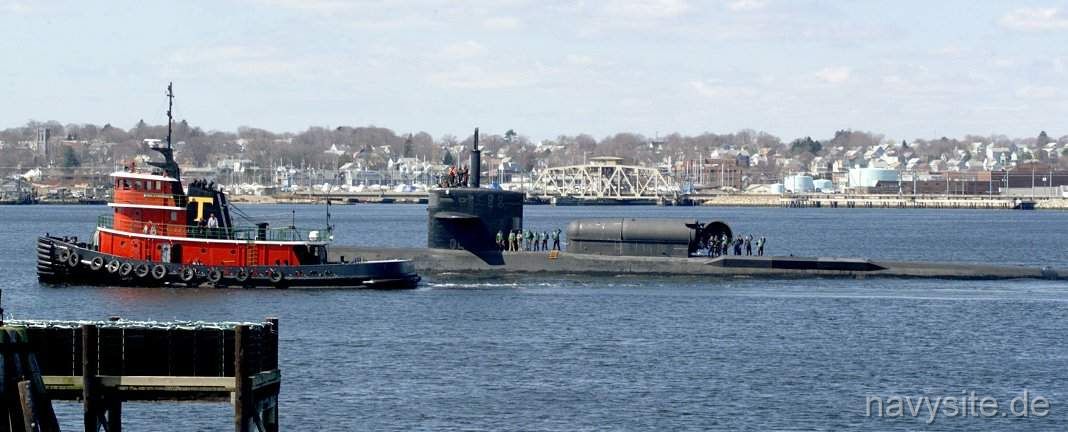
By 2008, DALLAS was operating further east. Photographic databases place her at Diego Garcia in the British Indian Ocean Territory in May 2008, indicating a deployment into the U.S. Fifth Fleet area. That same deployment's end is documented by a series of photographs and captions showing her arriving back at Submarine Base New London on August 21, 2008. Annotation for that homecoming notes explicitly that the Dry Deck Shelter had been removed by the time she returned, suggesting that either shortly before or during that period the Navy shifted DALLAS away from the dedicated DDS role and began using her in a more conventional attack-submarine posture. Open sources do not spell out the operational pattern between May and August 2008 beyond the Diego Garcia port call and the return to Groton, but the combination of locations confirms that she spent that summer deployed in the Indian Ocean region.
For the years immediately after 2008, the public record is again fragmentary. Photographic sequences show her alongside at Groton in August 2008 and then again in December 2011, which mark periods between deployments but do not themselves describe her operations. Her next clearly documented overseas period comes in 2011. Navy image archives record DALLAS in Diego Garcia again in September 2011, indicating another deployment to the Indian Ocean and the broader U.S. Fifth Fleet area of responsibility. After this period overseas, she is photographed at New London in December 2011, back at her homeport. As with earlier deployments, no public sources give a full itinerary of ports or specific exercises, but the pattern of a mid-year presence in Diego Garcia followed by a late-year return to Groton is consistent with a several-month patrol.
By 2013, DALLAS was approaching the end of her planned service life, but still deploying. Photos show her at New London in May 2013 and again in late November 2013, while reports record her at Diego Garcia in early October 2013 for a routine port call. Taken together, these data points indicate that she deployed from Groton in mid-2013, was in Diego Garcia by early October and was back in New London by late November, probably after a several-month patrol in the Indian Ocean and adjacent waters. Around this time, the Navy publicly announced that DALLAS would be retired in 2014, a decision later revised to extend her service to fiscal year 2017, reflecting both budgetary pressures and the continued demand for LOS ANGELES-class attack submarines.
In the spring of 2016 she left New London for what would become her final operational deployment, a cruise of approximately seven and a half months covering both the U.S. Sixth and Fifth Fleet areas of responsibility. When she returned to New London on November 22, 2016, she moored at Pier 8 South after having travelled about 37,000 nautical miles. During that last deployment, she made documented port calls at Brest in France, Hidd in Bahrain and Duqm in Oman, reflecting a patrol pattern that linked North Atlantic and European waters with the Arabian Gulf and Arabian Sea at a time of on-going coalition operations against terrorism and continued maritime security missions in the Middle East.
Once back from that cruise, DALLAS transitioned from active operations to inactivation. In 2017, she left her long-time homeport of Groton for the last time. A U.S. Navy photograph reproduced in regional press shows the submarine passing Seattle in Puget Sound on May 22, 2017, en route to Naval Base Kitsap-Bremerton to begin the inactivation and dismantling process at Puget Sound Naval Shipyard. The accompanying account notes that she had departed New London on March 24, 2017, and that during the transit she passed through the Panama Canal and conducted port calls at Port Canaveral, Florida, and San Diego, California before heading north to Washington State. Those calls were characteristic of decommissioning transits, which often include brief goodwill visits and opportunities for dependents and former crew to see the ship one last time.
At Puget Sound Naval Shipyard, DALLAS entered the Controlled Industrial Area to undergo inactivation and preparation for recycling under the Navy's Nuclear-Powered Ship and Submarine Recycling Program.
The ceremonial end of her commissioned life came on April 4, 2018, when the Navy held a formal decommissioning ceremony at Bremerton. Official releases describe the event in standard terms: department heads gave their final reports, the commissioning pennant was hauled down, and the crew left the ship, closing 38 years of active service. Senior officers at the ceremony highlighted her long career, her prominence in popular culture through "The Hunt for Red October", and the fact that many of her most important missions would remain unpublicized.
back to top go to the end of the pageUSS DALLAS Image Gallery:
 |  |  |  | |
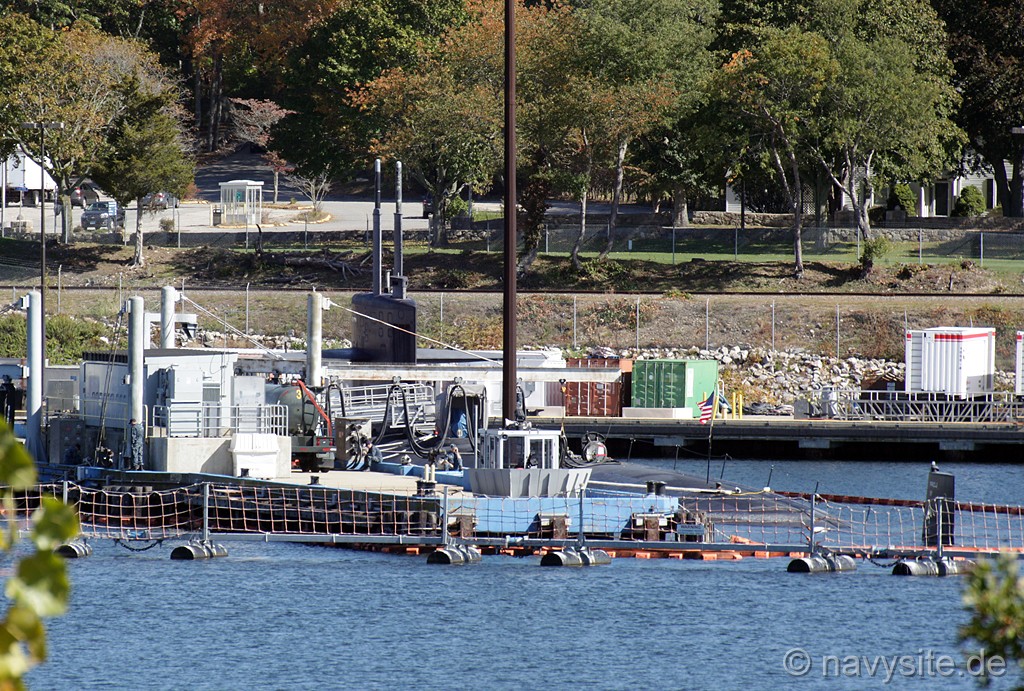
The photo below was taken by Michael Jenning and shows the DALLAS at Submarine Base Groton, Conn., on October 15, 2015.
 |
back to top Back to Submarines list. Back to ships list. Back to selection page. Back to 1st page.