![]() |
Search the Site with
|
![]() | ![]() |
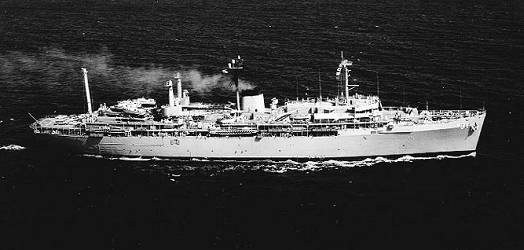
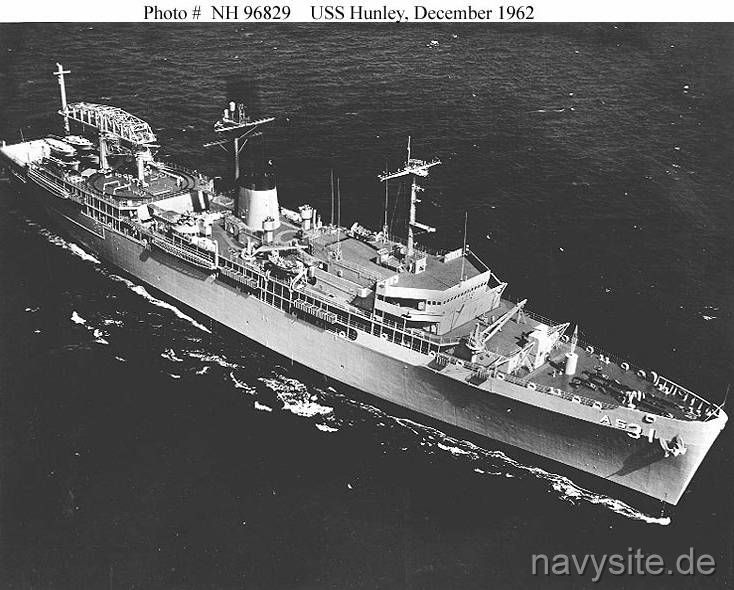
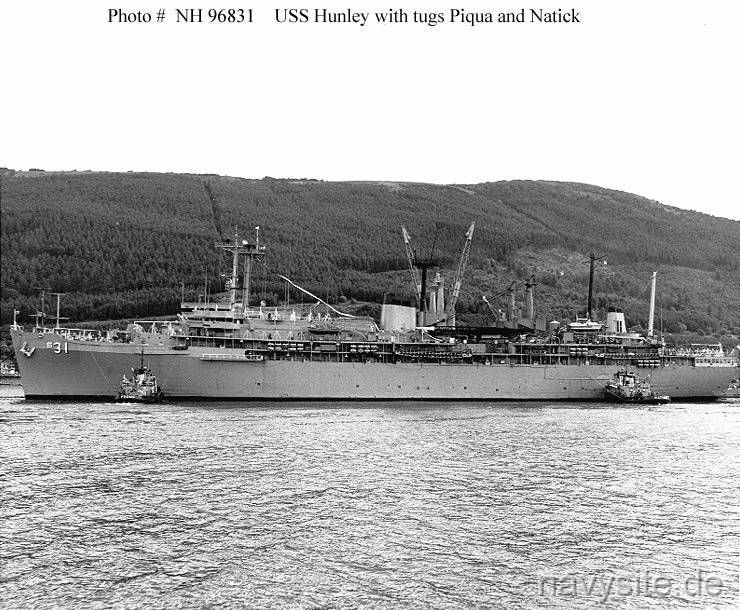
USS HUNLEY was the lead ship of the HUNLEY - class of submarine tenders. These ships were the Navy's first submarine tenders designed and built to service FBM submarines. Decommissioned on September 30, 1994, and stricken from the Navy list on May 3, 1995, HUNLEY was subsequently laid up on the James River as part of the Reserve Fleet at Fort Eustis, VA. The ship was finally sold for scrapping on January 5, 2007, to Southern Scrap Materials, New Orleans, LA.
| General Characteristics: | Awarded: November 16, 1959 |
| Keel laid: November 28, 1960 | |
| Launched: September 28, 1961 | |
| Commissioned: June 16, 1962 | |
| Decommissioned: September 30, 1994 | |
| Builder: Newport News Shipbuilding & Dry Dock Co., Newport News, Va. | |
| Propulsion System: Diesel electric, one shaft | |
| Propellers: one | |
| Length: 599 feet (182.6 meters) | |
| Beam: 83 feet (25.3 meters) | |
| Draft: 24 feet (7.3 meters) | |
| Displacement: approx. 18,300 tons | |
| Speed: 19 knots | |
| Armament: four 20mm guns | |
| Crew: 58 officers, 1,023 enlisted |
Crew List:
This section contains the names of sailors who served aboard USS HUNLEY. It is no official listing but contains the names of sailors who submitted their information.
USS HUNLEY Cruise Books:
Accidents aboard USS HUNLEY:
| Date | Where | Events |
|---|---|---|
| August 6, 1977 | Atlantic | USS HUNLEY suffers a major Class Bravo fire in the forward engine room. The response of the Duty Damage Control Party and action of other individuals aboard limited the fire to the forward engine room and extinguished it 25 minutes from its start. Fire, smoke and firefighting water damaged the number 2 main engine, numbers 1 and 2 main propulsion generators, numbers 1 and 2 ship service generators, numbers 1 and 2 low pressure aircompressors, number 2 force draft blower, number 2 evaporator and salinity indicating system, plus runs of electrical cable in the vincinity of the fire. The forward switchboard was grounded by firefighting water leaving the forward part of the ship without normal electrical power. |
About the Ship's Name:
Horace Lawson Hunley was born 29 December 1823, in Sumner County, Tenn. He early moved to New Orleans where he practiced law and represented Orleans Parish in the Louisiana State Legislature. On outbreak of the Civil War, he joined James R. McClintock and Baxter Watson in sponsoring the building of Confederate privateer submarine PIONEER, later scuttled to prevent capture when New Orleans fell.
The three men built a second submarine at Mobile, Ala., but it sank in Mobile Bay. Hunley then provided the entire means for building a third submarine named H. L. HUNLEY in his honor. This manual powered submarine had successful trials in Mobile Bay, then was shipped to General Beauregard for the defense of Charleston in August 1863.
When early submarine operations at Charleston failed to produce a sinking, Hunley provided a crew headed by Lt. George A. Dixon, CSA. But Hunley took charge in the absence of Dixon 15 October 1863, and perished with his entire crew of seven when the submarine failed to surface from a dive under CSS INDIAN CHIEF. Dixon raised and refitted CSS H. L. HUNLEY, armed her with a "Lee Spar Torpedo" and sank steam sloop-of-war HOUSATONIC off Charleston Harbor 17 February 1864. Though submarine and crew perished in this mission, H. L. HUNLEY was the first submarine to sink a warship In combat, casting a long shadow into the 20th century.
USS HUNLEY History:
USS HUNLEY was conceived at the end of the 1950s as the first submarine tender designed from the keel up to support the United States Navy's emerging force of nuclear-powered fleet ballistic missile submarines. The construction contract was awarded on November 16, 1959, to Newport News Shipbuilding and Dry Dock Company at Newport News, Virginia, and her keel was laid there on November 28, 1960. She was named in honor of Horace Lawson Hunley, the 19th-century submarine pioneer whose boat H. L. HUNLEY became the first submarine to sink an enemy warship, and she was intended to bring that spirit of technical innovation into the Polaris era.
HUNLEY was launched at Newport News on September 28, 1961, with Mrs. J. Palmer Gaillard, wife of the mayor of Charleston, South Carolina, as sponsor. After fitting out, she was commissioned on June 16, 1962, under the command of Captain Douglas N. Syverson. From the start, she was built around the requirements of the Polaris system: extensive weapons magazines, heavy-lift missile-handling gear, and workshops able to perform almost any repair short of a major shipyard overhaul, including sophisticated work on nuclear submarine combat systems and propulsion plant auxiliaries.
On July 25, 1962, HUNLEY sailed from the east coast for her shakedown cruise in the Caribbean, operating off Cuba until September 6, 1962. That initial period at sea tested her new workshops, cranes and logistics systems while she carried out drills with the submarines and surface ships of the Atlantic Fleet. After shakedown, she visited several Gulf and Atlantic ports, including Mobile and Charleston, demonstrating the capabilities of the new tender to local communities and reserve officers. She returned to Norfolk on September 28, 1962, for post-shakedown availability, remaining in the yards there for alterations and corrections until December 8, 1962. Immediately afterwards she made a three-day port visit to New York City to host the Naval Reserve Officers Seminar "New Ships for the Modern Navy", presenting herself as the prototype of the new generation of ballistic-missile-support ships.
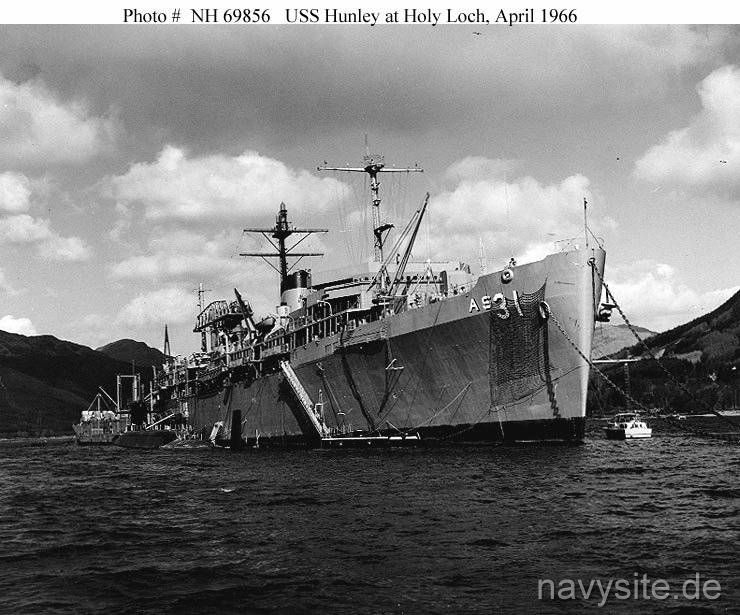
With her work-ups complete, HUNLEY stood out from Norfolk on December 29, 1962, bound for the NATO anchorage at Holy Loch, Scotland. She arrived there on January 9, 1963, joining the forward-deployed ballistic-missile submarine support complex that already included the floating dry dock LOS ALAMOS (AFDB 7) and the tender USS PROTEUS (AS 19). Almost immediately she began taking over refit and repair work from PROTEUS for the submarines of Submarine Squadron 14, starting with the arrival of USS THOMAS A. EDISON (SSBN 610) returning from patrol. HUNLEY officially relieved PROTEUS as primary tender for the squadron on March 15, 1963, marking the beginning of her first extended deployment at "Site One", as Holy Loch was known in Polaris terminology.
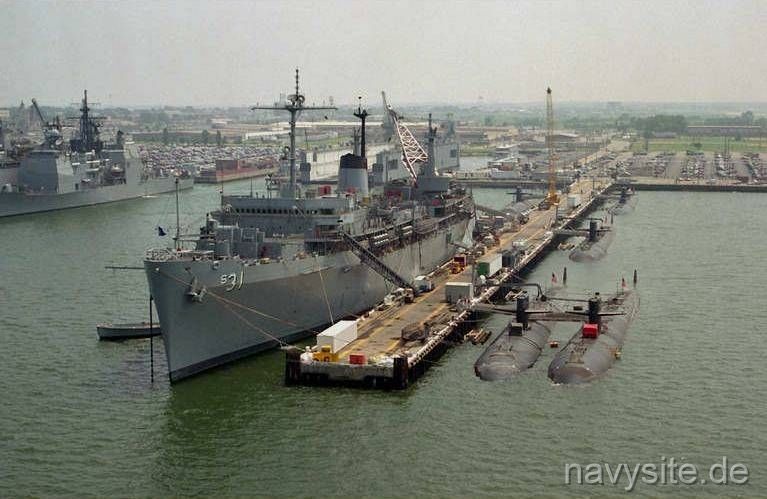
In Holy Loch, HUNLEY settled into the demanding rhythm of Polaris operations. Every few weeks another fleet ballistic missile submarine moored alongside to off-load missiles, receive maintenance ranging from routine servicing to complex systems work, embark a fresh crew, and reload her missile compartment before returning to sea. HUNLEY's workshops carried out jobs that previously had been thought too ambitious for a tender, including welding on pressure hulls and work on reactor plant fluid systems, which had traditionally been reserved for Navy shipyards. During her first tour, she also executed an auxiliary "Sub-Safe" package on USS THEODORE ROOSEVELT (SSBN 600), installing more than forty fittings and over one hundred feet of new piping in a major system, and in another case she replaced the main storage battery of USS ETHAN ALLEN (SSBN 608) in only eleven days. These evolutions demonstrated that forward-deployed maintenance at Holy Loch could sustain the ballistic-missile force at a very high tempo without bringing the submarines back to the United States.
On April 12, 1964, HUNLEY departed Holy Loch for a yard period to upgrade her missile-handling capability. She underwent conversion to support the newer A-3 variant of the Polaris missile, which required modifications to her magazines, cranes and support systems. After this work, she returned across the Atlantic and on June 15, 1964, resumed her duties at Holy Loch as tender to Submarine Squadron 14. Over the next eighteen months, she continued to support the squadron's nuclear-armed patrols at the height of the Cold War, when forward-based Polaris submarines formed a central pillar of NATO's strategic deterrent.
In December 1965, HUNLEY reached an important milestone when THOMAS A. EDISON came alongside again, this time for the 100th refit of a ballistic-missile submarine completed by the tender since her arrival in Holy Loch. That total represented roughly two hundred months of deterrent patrols supported without a single early return from sea for materiel reasons, a cumulative figure that underscored the significance of HUNLEY's contribution to continuous at-sea nuclear deterrence. Throughout this period, she worked in close coordination with LOS ALAMOS and the squadron staff to keep a stream of submarines on patrol while others refitted under her cranes and within her shops.
HUNLEY remained in Holy Loch until late 1966, when she was relieved as primary tender at Site One by USS SIMON LAKE (AS 33) and ordered back to the United States. She returned across the Atlantic and in 1967 operated mainly from Charleston, South Carolina, where her mission shifted towards supporting the growing Atlantic Fleet ballistic-missile force from a stateside base. During that year, she entered an overhaul that replaced her original aft-mounted 32-ton "hammer-head" missile crane with two modern cranes installed amidships, each initially rated at 30 tons and later uprated to 47.5 tons. These twin cranes increased flexibility, allowing simultaneous handling of heavy loads, more efficient deck arrangements, and better support for missile, torpedo and stores transfers to submarines alongside.
In January 1968, HUNLEY sailed westward again, this time for the Pacific. She relieved PROTEUS at Site Three, the Polaris base at Apra Harbor, Guam, while PROTEUS entered a repair period. At Guam, she tended the submarines of Submarine Squadron 15, providing the same range of maintenance services that she had perfected at Holy Loch but now in support of deterrent patrol areas in the western Pacific. She remained on station through the first half of 1968, then departed Guam in June and headed back to the Atlantic. After transiting back to the east coast she arrived at Charleston, where she relieved USS HOLLAND (AS 32) and resumed duty as Site Four tender, supporting the SSBNs of Submarine Squadron 18 operating from the South Carolina base.
On July 26, 1971, SIMON LAKE again relieved HUNLEY at Site Four. HUNLEY shifted to the west coast for a short period and then, on August 16, 1971, departed once more for Guam. She arrived there on September 27, 1971, and over the following month transferred personnel and materials from PROTEUS to prepare for another change of station. On October 27, 1971, HUNLEY formally relieved PROTEUS at Apra Harbor, again becoming the primary tender for Submarine Squadron 15. She maintained that role through January 1973, continuing to support Polaris patrols in the Pacific at a time when US strategic posture and basing arrangements were being adjusted in response to detente, arms-control negotiations, and the winding down of the Vietnam War. For her performance at Guam during this early-1970s tour, HUNLEY received a Meritorious Unit Commendation, reflecting the intensive repair and logistics work carried out by her crew.
HUNLEY departed Guam on January 31, 1973, beginning a transit that combined operational movement with diplomacy and crew morale. She made a port visit to Sydney, Australia, and then continued across the Pacific en route to Puget Sound Naval Shipyard at Bremerton, Washington, where she was scheduled for a major conversion. During the passage from Sydney, a minor incident drew public attention: two teenage girls from New Zealand, who had stowed away aboard after a port call, were discovered hiding in one of HUNLEY's missile-crane cabs when a sailor was seen carrying food up the ladder. The tender diverted to Brisbane to disembark the stowaways, and several sailors involved were disciplined, but the episode had no lasting operational consequences.
From 1973 into early 1974, HUNLEY underwent an extensive overhaul and conversion at Puget Sound Naval Shipyard to support the larger C-3 Poseidon missile. The work included major changes to her missile magazine, which was removed and replaced as a prefabricated module to provide increased volume and new handling arrangements for the Poseidon system. Additional modifications were made to her cranes, weapons shops and electronics facilities so that she could service both the new missiles and the more complex fire-control and navigation equipment carried by the upgraded ballistic-missile submarines. The conversion reflected Navy decisions made in 1971-1972 to extend Poseidon capability to selected tenders, including HUNLEY.
When the conversion was completed in early 1974, HUNLEY departed Puget Sound and worked her way back to the Atlantic through a succession of port calls. She visited San Francisco and San Diego on the California coast and then headed south to Acapulco, Mexico. After transiting the Panama Canal she made stops at Guantanamo Bay, at Fort Lauderdale, and at Cocoa Beach, Florida, before proceeding to Goose Creek near Charleston. On June 27, 1974, she arrived there and again took up duty as Site Four tender, this time explicitly equipped to support Poseidon-armed SSBNs of Submarine Squadron 18. Contemporary imagery shows submarines such as USS SUNFISH (SSN 649) alongside her, illustrating that she also worked regularly with attack submarines that used Charleston as a support port.
Through the mid-1970s, HUNLEY remained based at Charleston, providing refit, maintenance and logistic support to Atlantic Fleet submarines. Her Poseidon conversion allowed her to service the newer boats entering the force while still handling older missile variants, and she continued to perform complex repairs afloat, maintaining the high standards established during her Holy Loch years. In May 1978, she entered dry dock at Boston for roughly a month, where shipyard workers carried out hull cleaning, hull-valve work and other underwater maintenance. During this Boston period, HUNLEY was "reverse-converted" in missile terms: her facilities were adjusted so that she could fully support both the earlier A-3 Polaris missiles and the C-3 Poseidon rounds, a flexibility intended to match the mixed loadouts of submarines then in service. Returning to Charleston in June 1978, she was recognized with the Captain Edward F. Ney Memorial Award for having the best enlisted dining facility in her category, reflecting attention to crew support as well as to technical performance.
In August 1978, HUNLEY departed Charleston once more for Guam. Rather than transit the Panama Canal she followed a route around South America, calling at ports there and passing through the Strait of Magellan before crossing the Pacific via Hawaii, retracing in part the historic route of Magellan's expedition. In November 1978, she relieved PROTEUS yet again at Site Three in Apra Harbor. Over the next nineteen months, she tended the submarines of Submarine Squadron 15 and was recognized with a series of awards, including another Meritorious Unit Commendation for her Guam service from October 18, 1978, to June 1, 1980, as well as Battle Efficiency and Engineering "E" awards, a Golden Anchor for retention, and a Navy Environmental Protection Award. These decorations reflected both her role in sustaining deterrent patrols and her performance as a large, complex repair ship operating far from continental shipyards.
HUNLEY left Guam in June 1980, again combining operational transit with port visits. She called at Pearl Harbor, stopped at Acapulco, and transited the Panama Canal, adding another visit to Fort Lauderdale before reaching Charleston Naval Shipyard. There, she underwent an extensive dry-dock period that included hull work and a comprehensive renovation of crew living spaces to reflect lessons learned over nearly two decades of forward-deployed service. After this yard period, she completed a 30-day refresher-training deployment and an Operational Readiness Inspection, preparing her to resume frontline duties. In September 1981, she relieved USS CANOPUS (AS 34) at Charleston and once again assumed responsibility as tender for Submarine Squadron 18 at Site Four.
Later in 1981, HUNLEY was relieved at Site Four by another tender and shifted within the Charleston area to make preparations for a new extended deployment to Europe. In January 1982, she crossed the Atlantic and relieved HOLLAND at Site One, returning to Holy Loch nearly twenty years after her first arrival there. From January 1982 until June 1987, she served as the principal tender for Submarine Squadron 14 at Holy Loch, now supporting Poseidon- and later Trident-era SSBN operations in the eastern Atlantic. During this second Scottish tour, she again handled intensive refit cycles in cooperation with the floating dry dock LOS ALAMOS and shore support elements, and she received, among other recognitions, a Silver Anchor award for personnel-retention excellence. Her presence in Holy Loch during the last decade of the Cold War linked her early Polaris service with the final years of forward-based SSBN operations from Scotland.
In June 1987, SIMON LAKE relieved HUNLEY at Holy Loch. HUNLEY then sailed west for Norfolk, Virginia, making a port visit at Halifax, Nova Scotia, en route. After her arrival in Norfolk, she was assigned as tender to the fast-attack submarines of Submarine Squadron 6, marking a shift from primarily ballistic-missile support to a focus on LOS ANGELES-class and other attack submarines operating in the western Atlantic and beyond. Her repair shops and logistics departments now concentrated on a broader range of weapons and sensors, including torpedoes and emerging systems suited to submarine operations in the multi-mission environment of the late 1980s.
In August 1989, HUNLEY temporarily left Norfolk to relieve USS FRANK CABLE (AS 40) at Charleston, supporting the attack submarines of Submarine Squadron 4. Late in September 1989, she put to sea to avoid Hurricane Hugo as it approached the South Carolina coast, then returned to port as soon as conditions allowed in order to assist local authorities and Navy activities with cleanup and recovery efforts. In November 1989, she returned to Norfolk, where she became the tender for Submarine Squadron 8, at that time one of the largest and most active attack-submarine squadrons in the fleet.
On May 23, 1990, HUNLEY made a port visit to Annapolis, Maryland, which provided midshipmen at the Naval Academy an opportunity to see submarine-support operations at close range. She then spent the following year continuing to service Squadron 8 submarines at Norfolk. During this period, the ship earned multiple type-commander awards in the Battle Efficiency Award competition, including recognition for excellence in communications (the Green "C") and seamanship and deck operations (the White "D"). These awards reflected the tender's adaptation to changing post-Cold War missions while maintaining high operational standards.
Between July 1991 and January 1992, HUNLEY was temporarily tasked to support submarines from both Submarine Squadron 6 and Submarine Squadron 8 while USS L. Y. SPEAR (AS 36) deployed to the Persian Gulf in the aftermath of Operation Desert Storm. During this period, HUNLEY completed two port visits to Port Canaveral, conducted a weapons off-load at Yorktown, Virginia, and carried out additional training operations. She received another Communications Green "C", a Medical Yellow "M", and in 1992 again earned the Ney Award for food-service excellence, underscoring her ability to sustain high standards even while covering for another tender on distant deployment.
On August 17, 1992, HUNLEY departed Norfolk for a port visit to Halifax, returning on August 28. Almost immediately upon her return, she was ordered south to join Joint Task Force 28 in Miami, Florida, in response to the devastation wrought by Hurricane Andrew. Before sailing she embarked more than 310 tons of relief cargo and got underway in less than six hours. In Miami, she served as a support and logistics platform for disaster-relief operations, providing berthing and services for personnel and using her repair capabilities ashore as well as afloat. By the time she departed Miami for Norfolk on September 18, 1992, HUNLEY had been directly involved in refurbishing and reopening sixteen schools and one orphanage and in processing more than 5,000 claims under federal emergency legislation. For this work, the ship and crew later received the Humanitarian Service Medal, in addition to recognition from civilian organizations.
In April 1993, HUNLEY returned to Annapolis, this time specifically in support of the attack submarine USS MINNEAPOLIS-SAINT PAUL (SSN 708) during midshipman indoctrination visits, providing repair and logistics services while the submarine hosted academy visitors. After leaving Annapolis, she again called at Miami, where the Greater Miami Chamber of Commerce organized an event to thank the crew for their earlier hurricane-relief work. The Points of Light Foundation recognized the ship's efforts, and the governor of Florida presented Distinguished Service Awards to members of the crew. Later that year, HUNLEY hosted the newly appointed Secretary of the Navy, John Dalton, accompanied by the Commander in Chief, U.S. Atlantic Fleet, Admiral Leon Edney's successor Admiral Henry Mauz, as part of Dalton's familiarization tour. In November 1993, HUNLEY made another port visit, this time to Cape Canaveral. For fiscal year 1993, the Commander in Chief, U.S. Atlantic Fleet, awarded her the Golden Anchor for excellence in retention and personnel-program management, and she again received the Ney Award, giving her consecutive years of top-rated food service.
In March 1994, HUNLEY visited Key West, Florida, on what would be her last liberty port of call. Her final operational assignment, from 1992 through 1994, was to tend the units of Submarine Squadron 8, by then described as the largest submarine squadron in the world, providing repair and logistics support primarily to LOS ANGELES-class fast-attack submarines. She was finally relieved of active tending responsibilities in May 1994. Even as she entered inactivation status between May and September 1994 she continued to provide limited services when needed, reflecting her still-relevant capabilities. As a capstone to her service, the Secretary of the Navy awarded HUNLEY another Meritorious Unit Commendation for submarine-tender operations at Norfolk from August 1, 1992, to September 30, 1994.
On September 15, 1994, HUNLEY mustered her crew for the final time. At 10:00 the decommissioning order was read, the watch was secured, the national ensign and commissioning pennant were hauled down and presented, and the last deck-log entry was signed before the crew departed the ship. Administratively, she is recorded as having been decommissioned on September 30, 1994, and she was stricken from the Naval Vessel Register on May 3, 1995. In 1999, she was transferred to the Maritime Administration and laid up in the James River Reserve Fleet near Fort Eustis, Virginia, joining other retired auxiliaries awaiting final disposition.
HUNLEY remained in the quiet backwaters of the James River until early 2007, when she was towed to Southern Scrap Materials in New Orleans, Louisiana, after being sold for scrapping on January 5, 2007. The dismantling process was completed in 2011. While awaiting or undergoing recycling, she was involved in one last widely noticed event: during the night of August 31-September 1, 2008, as Hurricane Gustav approached the Louisiana coast, HUNLEY and another former navy vessel, USNS AMERICAN EXPLORER, broke loose from their moorings in New Orleans' Inner Harbor and drifted against the Florida Avenue Bridge and nearby concrete barriers protecting a pump station. Contemporary reports note that the decommissioned ships caused little or no significant damage before being secured again, but the incident briefly returned HUNLEY to public attention long after her formal naval service had ended.
USS HUNLEY Image Gallery:
![]() | ![]() | ![]() | ![]() | ![]() |
![]() |
Back to Submarine Tenders list.
Back to Ships list.
Back to selection page.
Back to 1st page.