![]() |
Search the Site with
|
![]() | ![]() |
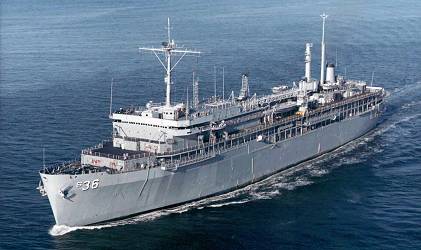
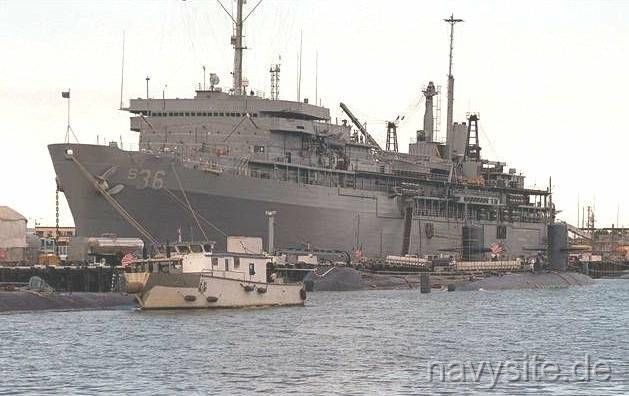
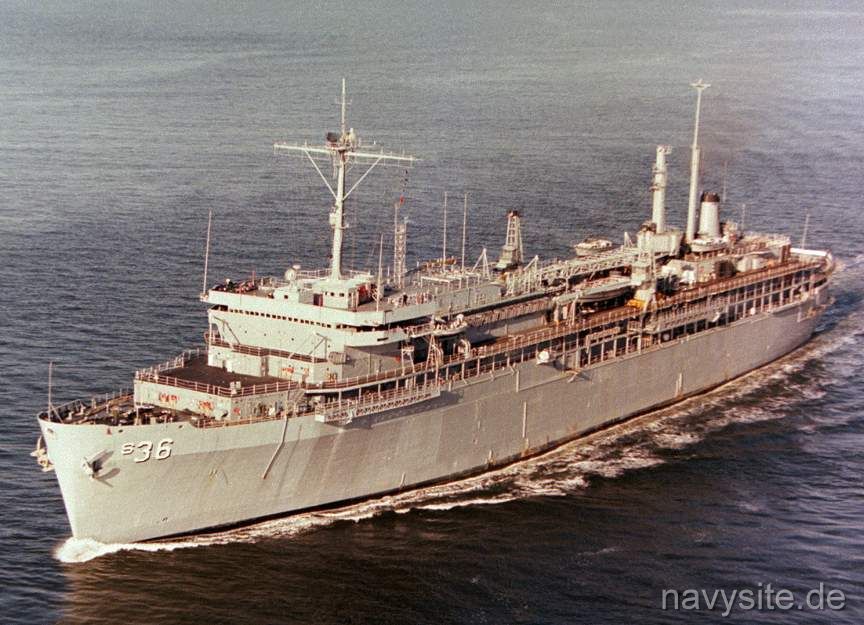
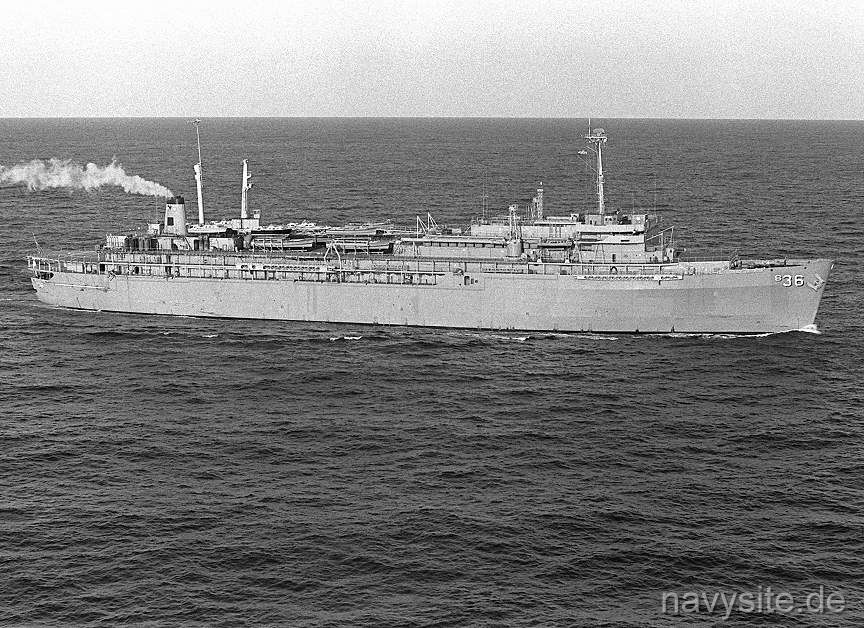
USS L. Y. SPEAR was the first ship in the L. Y. SPEAR - class of submarine tenders designed and fitted to accommodate attack submarines and service up to four submarines moored alongside simultaneously. The L. Y. SPEARS was the first ship in the Navy to bear the name.
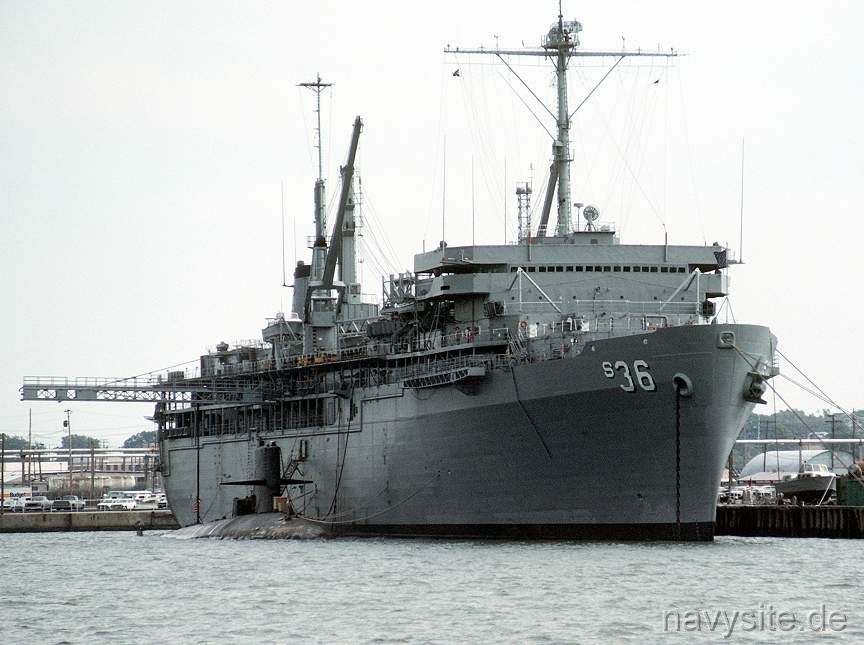
Decommissioned on September 6, 1996, and stricken from the Navy list on May 3, 1999, the L. Y. SPEAR spent the following years laid up at the Norfolk Naval Shipyard in Portsmouth, Va. In July 2010, she was sold for scrapping to ESCO Marine of Brownsville, Tx.
| General Characteristics: | Awarded: May 12, 1965 | |||
| Keel laid: May 5, 1966 | ||||
| Launched: September 7, 1967 | ||||
| Commissioned: February 22, 1970 | ||||
| Decommissioned: September 6, 1996 | ||||
| Builder: General Dynamics' Quincy Shipbuilding Division, Quincy, Mass. | ||||
| Propulsion System: two boilers, steam turbines, one shaft | ||||
| Propellers: one | ||||
| Length: 643 feet (196 meters) | ||||
| Beam: 85 feet (25.9 meters) | ||||
| Draft: 29 feet (8.8 meters) | ||||
| Displacement: approx. 23,300 tons | ||||
| Speed: 20 knots | ||||
| Armament: two 40mm guns, four 20mm guns | ||||
| Crew: 87 officers, 1,235 enlisted |
| Date | Where | Events |
|---|---|---|
| February 22, 1978 | Mississippi River | USS L. Y. SPEAR and the Liberian merchant ship ZEPHYROS receive minor damage in a collision in the Mississippi River. |
| May 4, 1980 | Diego Garcia | Ensign Agustin Tuazon Guiao Jr. is killed in an incident involving cables attached to a boom while the ship lay at Diego Garcia. |
About the Ship's Name:
Lawrence York Spear, born in Warren, Ohio, 23 October 1870, graduated second in his class at the Naval Academy in 1890. He served as an ensign in Pensacola, Baltimore (0-8), and Charleston (0-2) in the Atlantic and South Pacific for nearly 2 years.
In 1891, due to his ability and enthusiasm in the project of modernizing the Navy, he was transferred to the Construction Corps and sent to the University of Glasgow, Glasgow, Scotland. Returning with a B.S. in 1893, he spent most of the next 9 years acquiring construction experience in shipyards across the country. While Superintendent of Construction at Crescent Shipyard, Elizabethport, N.J., from 1898 to 1002, he helped build five Holland-designed submarines, first of the U.S. undersea fleet.
In 1902, he resigned his commission as lieutenant to join the Electric Boat Co., successor to the Holland Torpedo Boat Co., founded by inventor John P. Holland. Spear then devoted more than 48 years to the construction of submarines. He is credited with six basic design concepts which are an integral part of all modern naval submarines, including double hull amidships, single hull ends, and propelling apparatus. His great faith in the importance of the submarine was more than justified by the decisive role the Navy's undersea fleet played in destroying the power of the Japanese in the Pacific during World War II. As company president, 1942 to 1947, he directed the production of more than half of the submarines completed during the war.
Spear retired in 1947 to serve as board chairman for the next 3 years, and died at Groton, Conn., 9 September 1950.
USS L. Y. SPEAR History:
USS L. Y. SPEAR was the lead ship of a new generation of submarine tenders designed to support nuclear attack submarines through the heart of the Cold War and into the post-Cold War era. From her commissioning in 1970 until decommissioning in 1996 she spent almost her entire active life based at Norfolk, providing logistics, maintenance and technical support to the Atlantic submarine force, with two notable Indian Ocean deployments, one in 1980 and another during the Gulf War in 1991.
The ship was ordered on May 12, 1965, when the Navy awarded a contract to the General Dynamics Quincy Shipbuilding Division at Quincy, Massachusetts, to build a new class of large submarine tenders. Her namesake, Lawrence York Spear, had been a naval officer and later a leading designer and builder of submarines at Electric Boat, ultimately serving as the company's president and then chairman before his death at Groton, Connecticut, on September 9, 1950. In recognition of his influence on modern submarine design, the Navy chose to name the first of the new tenders for him. Construction of USS L. Y. SPEAR began with the laying of her keel at Quincy on May 5, 1966. She was launched on September 7, 1967, with the wife of Vice Admiral Arnold F. Schade, then commander of the submarine force, Atlantic Fleet, as sponsor.
After fitting out and trials, the Navy formally acquired the completed ship on February 11, 1970, and she was commissioned later that month at Norfolk, Virginia, on February 28, 1970. Designed to support as many as twelve submarines and to service four alongside simultaneously, she was assigned from the outset to Submarine Squadron 6 with Norfolk as her home port and quickly assumed duties as squadron flagship.
In the months following commissioning, USS L. Y. SPEAR went through the usual post-construction trials and training. Former crew and association sources describe a roughly six-week shakedown cruise to Guantanamo Bay, Cuba, followed by about three months in Charleston, South Carolina, where the ship exercised her repair departments and logistics organization while supporting local submarine units. This early period was focused on proving that the new tender could deliver the full range of services - machinery repairs, electronic and weapons maintenance, medical and supply support - expected of the ship in peacetime and crisis alike.
Through the first half of the 1970s, USS L. Y. SPEAR remained based at Norfolk, working primarily as an alongside tender for attack submarines assigned to the Atlantic Fleet. In 1974, the tender's crew earned the Captain Edward F. Ney Memorial Award for outstanding food service in the afloat category, indicating a high standard of daily shipboard administration during this era. The ship's daily life in the mid-1970s centered on a steady flow of submarines coming alongside the destroyer and submarine piers at Norfolk for upkeep periods ranging from a few days to several weeks. Aerial photographs from the period show USS L. Y. SPEAR moored with multiple attack submarines berthed outboard, while vehicles, cranes and maintenance tents crowded the pier between them. Crews carried out complex mechanical work, weapons handling, and routine habitability repairs, while the tender also provided training spaces, medical and dental clinics, and administrative support for the submarines' crews.
On February 22, 1978, while transiting the Mississippi River, USS L. Y. SPEAR was involved in a collision with the Liberian merchant ship ZEPHYROS. Both ships sustained only minor damage, and the incident did not significantly interrupt the tender's career, but it stands out as one of the few recorded navigation mishaps in her long service life. Shortly afterward, she returned to her normal base-port routine. That same year she conducted another Guantanamo Bay refresher training period, part of the Navy's regular program of exercises to ensure that engineering and damage-control standards remained high on major auxiliaries.
A major change in the ship's internal life came in late 1978, when USS L. Y. SPEAR became one of the first ships in the fleet to embark women as a permanent part of the crew. In November 1978, the Navy began assigning female sailors to the tender, and by March 1979 there were 102 women aboard, integrated across departments within a total complement of roughly 1,700. This reflected broader policy changes as the service experimented with gender integration in non-combatant ships while still maintaining restrictions on women serving in combat roles. Crew recollections and association material from this period emphasize the adjustments in berthing, watch organization and daily routines required to make the mixed-gender crew work smoothly, all while the ship continued to perform high-tempo submarine support in Norfolk.
In 1979, USS L. Y. SPEAR briefly entered popular culture when portions of the television disaster film "The Death of Ocean View Park" used the ship's mess decks as a filming location, standing in for spaces on the fictional passenger ship featured in the movie. The production was a short interlude in an otherwise routine year dominated by repair work and preparation for a major deployment that would highlight the tender's operational capabilities.
On March 31, 1980, USS L. Y. SPEAR departed on an Indian Ocean deployment that would last until August 12, 1980, a period documented in the ship's official cruise book. The geopolitical background was the surge of tension in the broader region at the start of the 1980s, including the Soviet invasion of Afghanistan and the continuing instability around the Arabian Sea, which drove an expanded and more visible United States naval presence in the Indian Ocean. The tender's deployment placed a full repair and logistic capability close to forward-operating attack submarines and other fleet units at a time when the navy was still building up shore facilities in the region.
During this 1980 cruise, USS L. Y. SPEAR operated primarily from Diego Garcia in the British Indian Ocean Territory, where photographs show her in a two-point moor inside the lagoon, and where she tended submarines such as USS MEMPHIS (SSN 691) during upkeep periods. The ship's repair departments supported major maintenance for these submarines between patrols, and contemporary newsletters from the deployment describe shipboard sports competitions with other commands on the island, indicating an extended presence there through late spring and early summer. On May 4, 1980, a serious industrial accident on board claimed the life of Ensign Agustin Tuazon Guiao Jr., who was killed in an incident involving cables attached to a boom while the ship lay at Diego Garcia.
The Navy recognized the 1980 Indian Ocean deployment with both a Navy Meritorious Unit Commendation and the Navy Expeditionary Medal for the period from April to July 1980, reflecting the forward-deployed nature of the tender's work and its contribution to extended fleet operations far from established naval bases.
After completing the deployment and returning to Norfolk on August 12, 1980, USS L. Y. SPEAR resumed her peacetime routine as the main Atlantic Fleet submarine tender, the memory of Diego Garcia and Indian Ocean service becoming a touchstone for many crew members of that era.
Throughout the early and mid-1980s, the ship continued to operate primarily from Norfolk, conducting pier-side repair periods for a succession of attack submarines and occasionally participating in exercises and regional deployments as the Atlantic submarine force rotated through training cycles and operations. Navy records show that the tender again received a Navy Meritorious Unit Commendation for the span from February 1984 through May 1986, indicating sustained performance at a level above that expected of a standard support ship, as well as Battle "E" awards in 1983 and 1984 for overall combat-readiness and efficiency.
By the end of the 1980s, USS L. Y. SPEAR and her sister submarine tenders formed the backbone of the Navy's submarine tender force, even as the Cold War entered its final years. Her mission and operating patterns remained largely unchanged, but events in the Middle East were about to pull the ship back into forward operations. On August 2, 1990, Iraq invaded Kuwait, leading to Operation Desert Shield and, subsequently, Operation Desert Storm. The United States deployed significant naval forces to the Arabian Gulf and northern Arabian Sea, and although tenders normally remained close to home, demand for repair and logistic support near the theater of operations led to a decision to send USS L. Y. SPEAR forward.
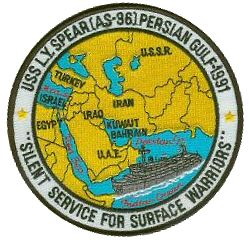
In 1991, the ship deployed from Norfolk to the Indian Ocean and Persian Gulf region in support of Operation Desert Shield and Desert Storm. USS L. Y. SPEAR became the first submarine tender to deploy to the Indian Ocean specifically in support of Desert Storm. This deployment earned her the Southwest Asia Service Medal for service between August and November 1991, as well as another Navy "E" for efficiency in 1990 and 1991. A key hub during this deployment was Jebel Ali in the United Arab Emirates. Photographs show USS L. Y. SPEAR in August 1991 moored in Jebel Ali while simultaneously tending the guided-missile cruiser USS LONG BEACH (CGN 9), the dock landing ship USS COMSTOCK (LSD 45) and the tank landing ship USS BRISTOL COUNTY (LST 1198), illustrating the tender's versatility in supporting not only submarines but also surface combatants and amphibious ships in a forward logistics role.
A chronology maintained by the ship's association records the tender departing Jebel Ali and, on September 5, 1991, arriving at Bahrain, where she continued to provide repair and logistic services as coalition forces moved from combat operations into post-war presence missions in the region. The ship did not operate alone in potentially vulnerable waters. A 1991 command history for the frigate USS ELROD (FFG 55) notes that after a tender availability in Jebel Ali, ELROD escorted USS L. Y. SPEAR safely through the constrained waters of the central Arabian Gulf, underlining the degree to which even a large auxiliary could require protection in a region where mines and small-boat threats remained a concern even after the end of major hostilities.
Following the end of combat operations, personnel from USS L. Y. SPEAR contributed to a lesser-known humanitarian effort. An article in Naval History magazine later described how sailors from the tender volunteered to help rebuild the Kuwait City Zoo, which had been devastated during the occupation and fighting, as part of broader post-war reconstruction and outreach activities undertaken by deployed navy units in the region. This work formed part of the ship's legacy from the Gulf War alongside her directly military contributions to keeping submarines and surface ships operational in theater.
In May 1992, USS L. Y. SPEAR took part in New York's Fleet Week, sailing into New York Harbor with other Atlantic Fleet units and anchoring off Manhattan with the twin towers of the World Trade Center visible in the background, as preserved in an official Navy photograph. For this event she joined major combatants such as the aircraft carrier USS JOHN F. KENNEDY (CV 67), frigates and amphibs, representing the support side of the fleet to the public and hosting visitors on board to demonstrate the workings of a submarine tender.
The mid-1990s saw USS L. Y. SPEAR continue her core mission from Norfolk. At the same time, the Navy recognized her sustained performance with additional Navy Meritorious Unit Commendations covering the periods June 1993 to September 1994 and October 1994 to September 1996, as well as further Battle "E" awards in 1993. By the mid-1990s, a shrinking submarine force and changing maintenance concepts reduced the requirement for large tenders, and the Navy began drawing down the class. USS L. Y. SPEAR remained in service as flagship of Submarine Squadron 6 until 1996, continuing to serve alongside submarines at Norfolk's destroyer and submarine piers and occasionally appearing in public-affairs photography that emphasized her status as a long-serving Cold War auxiliary now nearing the end of her career. On September 6, 1996, after more than twenty-six years in commission, she was decommissioned at Naval Base Norfolk. She was struck from the Navy list on May 3, 1999, and placed in inactive status at Norfolk Naval Shipyard in Portsmouth, Virginia.
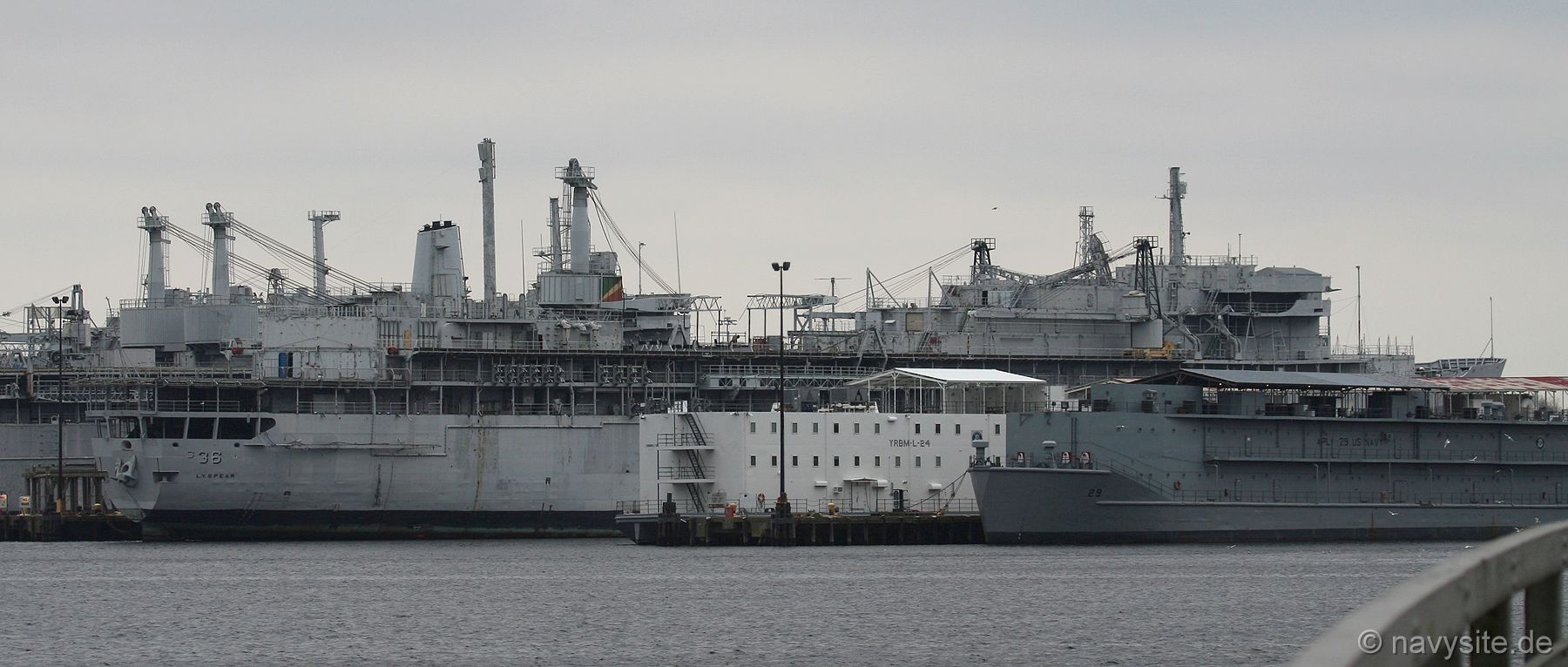
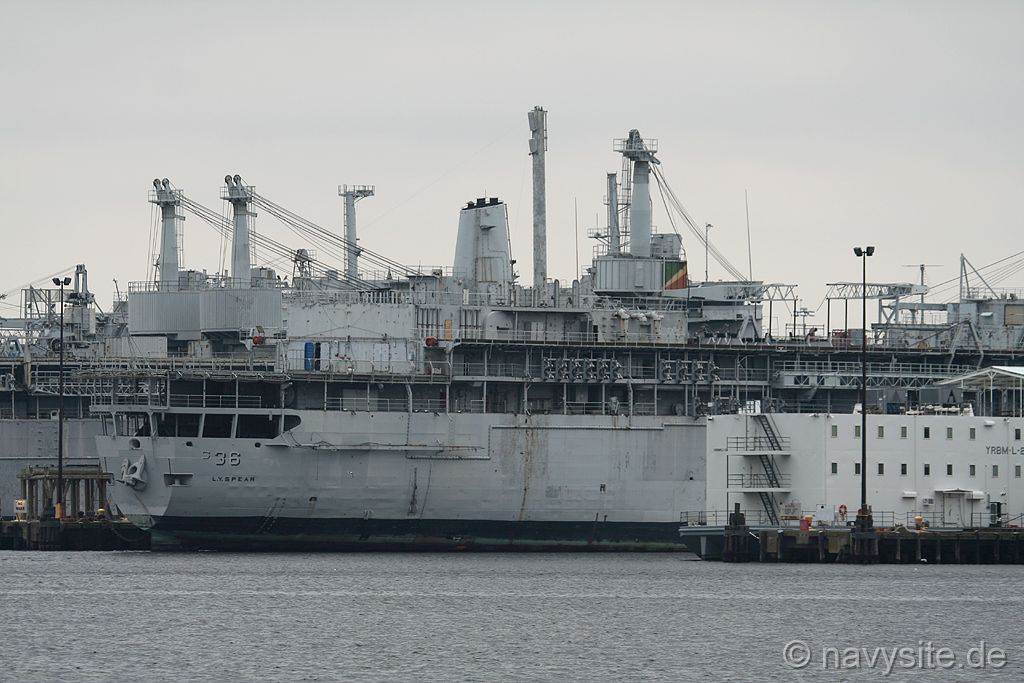
For over a decade after decommissioning, USS L. Y. SPEAR remained laid up at Norfolk, her long hull becoming a familiar sight to those transiting the Elizabeth River. Photographs taken on February 3, 2009, show her still intact but clearly inactive, moored with minimal crew and awaiting final disposition. On July 9, 2010, the Navy awarded a dismantling contract to ESCO Marine of Brownsville, Texas, and later that summer the former tender departed Norfolk under tow for the Gulf of Mexico. By July 14, 2011, the scrapping process was complete, bringing the physical life of the ship to an end after more than forty-five years from keel-laying.
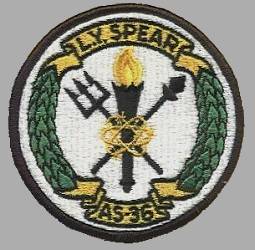
USS L. Y. SPEAR Patch Gallery:
![]() |
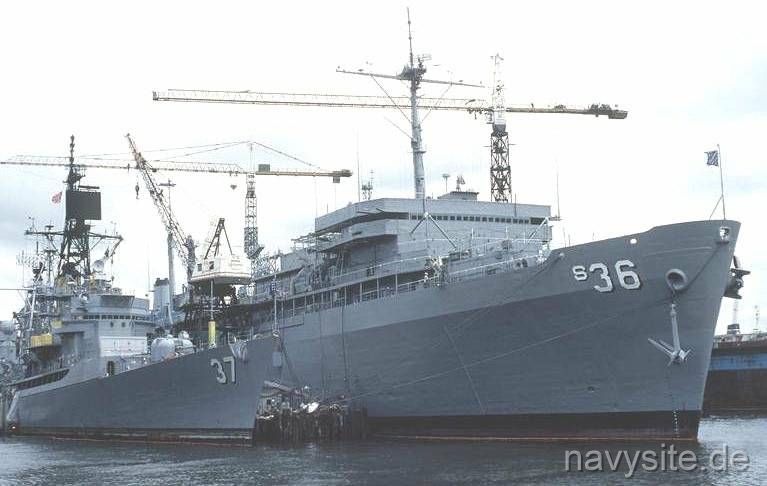
USS L. Y. SPEAR Image Gallery:
![]() | ![]() | ![]() | ![]() | ![]() |
The photos below were taken by me and show the L. Y. SPEAR laid up at Norfolk, Va. The photos were taken on February 3, 2009.
Back to Submarine Tenders list.
Back to Ships list.
Back to selection page.
Back to 1st page.