Search the Site with 
General Characteristics Crew List Memorabilia Cruise Books Accidents aboard the Ship History Homeports of USS Canopus Image Gallery to end of page

USS Canopus (AS 34)

- decommissioned -

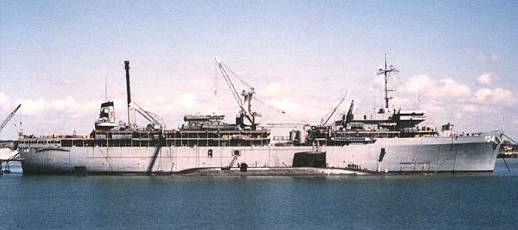
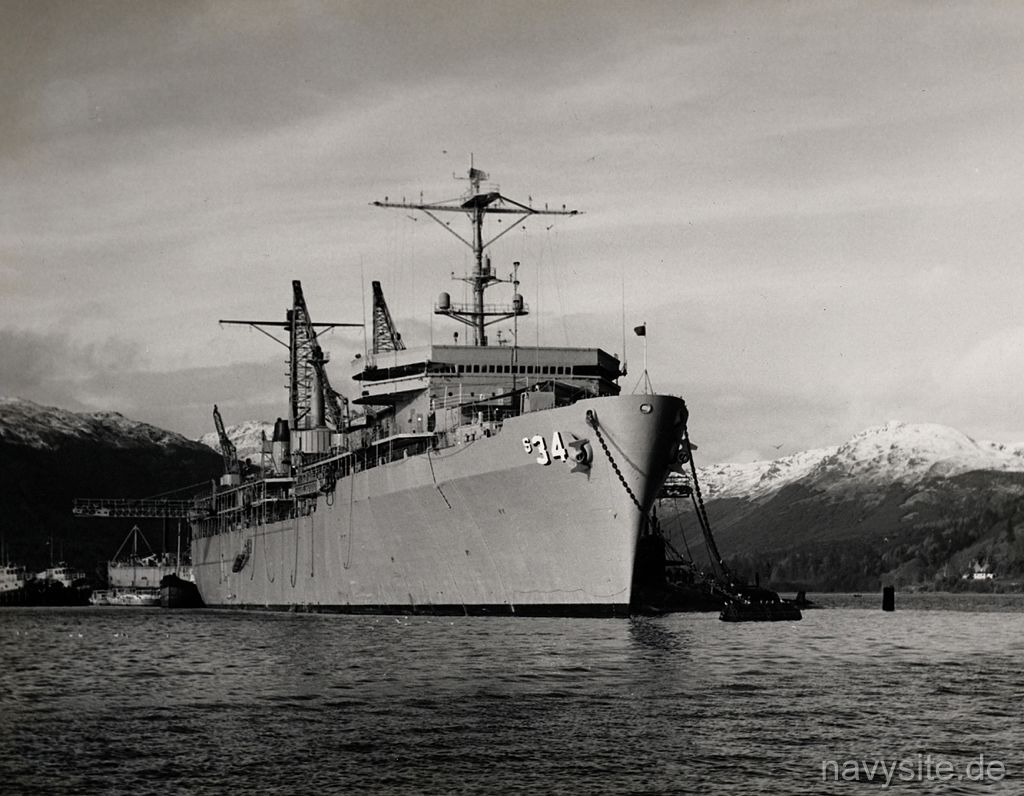
USS CANOPUS was the second SIMON LAKE - class submarine tender. Decommissioned on November 30, 1994, and stricken from the Navy list on May 3, 1995, the CANOPUS spent the next years laid up in the National Defense Reserve Fleet, James River, Fort Eustis, Va. She was later sold for scrapping to Able, UK, Teeside, England. On October 16, 2003, the CANOPUS left the James River and was towed to England for scrap.

General Characteristics:Awarded: September 19, 1963
Keel laid: March 2, 1964
Launched: February 12, 1965
Commissioned: November 4, 1965
Decommissioned: November 30, 1994
Builder: Ingalls Shipbuilding Corp., Pascagoula, Miss.
Propulsion System: two boilers, steam turbines, one shaft
Propellers: one
Length: 643.7 feet (196.2 meters)
Beam: 85 feet (25.9 meters)
Draft: 30 feet (9.1 meters)
Displacement: approx. 20,000 tons
Speed: 18 knots
Armament: four 20mm guns
Crew: approx. 1,200


Back to topback to top  go to endgo to the end of the page


Back to topback to top  go to endgo to the end of the page

Crew List:

This section contains the names of sailors who served aboard USS CANOPUS. It is no official listing but contains the names of sailors who submitted their information.


back to top  go to the end of the page


Back to topback to top  go to endgo to the end of the page

USS CANOPUS Cruise Books:


Back to topback to top  go to endgo to the end of the page

Accidents aboard USS CANOPUS:


DateWhereEvents
November 29, 1970Holy Loch, Scotland
Fire breaks out in a baggage storeroom in the stern of USS CANOPUS while the ship is in the Holy Loch Naval Base. The Daily Telegraph reports that the CANOPUS was carrying nuclear-armed missiles and that two SSBN, the USS FRANCIS SCOTT KEY (SSBN 657) and the USS JAMES K. POLK (SSBN 645), were moored alongside. The FRANCIS SCOTT KEY cast off, but the POLK remained alongside. The fire was brought under control after four hours. Three men were killed and the cause of the fire was unknown. US Navy documents record that "damage was extensive in the small area in which the fire was contained," but "repairs were effected on site and the CANOPUS was never 'off the line' ".


Back to topback to top  go to endgo to the end of the page

USS CANOPUS History:

USS CANOPUS was a SIMON LAKE-class submarine tender built to sustain the United States Navy's Polaris and later Poseidon ballistic-missile submarine force, and through nearly three decades of service she followed the geographical arc of the Cold War at sea: from the American east coast to Spain, Scotland, back to the United States, and finally into the post-Cold-War reserve and "ghost fleet" before scrapping in the United Kingdom.

The ship's story began at Ingalls Shipbuilding in Pascagoula, Mississippi, where her keel was laid on March 2, 1964, as part of the Navy's rapid expansion of support infrastructure for the fleet ballistic-missile submarine program. She was launched less than a year later, on February 12, 1965, and completed and delivered to the Navy on October 25, 1965, an unusually fast build for a complex auxiliary of her size. CANOPUS joined Submarine Squadron 18 at Charleston, South Carolina, and was commissioned there on November 4, 1965, taking her name from the bright star Canopus, long used as a navigational reference in southern skies.

After fitting out in Charleston, CANOPUS began her shakedown employment in support of the Polaris deterrent force. On January 7, 1966, she sailed for the Caribbean and conducted shakedown training out of Guantanamo Bay, Cuba, a standard pattern for newly commissioned ships at the time, allowing the crew to exercise engineering casualties, damage control, gunnery, and replenishment in warm-weather waters away from congested homeport traffic. She completed this phase and returned to Charleston Naval Shipyard on February 24, 1966, for the post-shakedown availability in which deficiencies uncovered during trials were corrected and final adjustments were made to her extensive repair shops, weapons magazines, and missile-handling gear.

By mid-April 1966, CANOPUS had completed her acceptance trials and was ready to take up her primary mission: refitting and supporting fleet ballistic-missile submarines. On June 24, 1966, after final loading and outfitting, she deployed only a short distance to the Cooper River Fleet Ballistic Missile Replenishment Site near Charleston. There, she started refitting submarines of Submarine Squadron 18, acting as a floating maintenance and logistics base for Polaris boats rotating through between Atlantic deterrent patrols. This early period established routines that would characterize most of her career: moored in a sheltered anchorage or alongside a pier, CANOPUS provided hull, machinery, weapons, communications, and hotel services to multiple submarines simultaneously, turning them around rapidly so they could return to patrol stations in the North Atlantic and Mediterranean.

The Navy's strategic posture required more forward-based support in Europe, and CANOPUS was soon sent across the Atlantic. On September 24, 1966, she sailed from Charleston for Rota, Spain, arriving there on October 10, 1966. At Rota, she relieved the earlier tender and reported to the commander of Submarine Squadron 16, one of the two major Polaris squadrons assigned to the Atlantic theater. From this anchorage on the Bay of Cadiz, American Polaris submarines could quickly enter or leave the Mediterranean or North Atlantic while remaining under the logistical "umbrella" of a full-capability tender. CANOPUS rapidly became a high-throughput industrial platform: contemporary accounts and later summaries note that during her Rota tour she completed more Polaris refits than any other tender in a comparable time span, reflecting both the tempo of submarine patrols and the maturity of her repair organization.

By 1969, the Polaris force was transitioning to the more capable Poseidon missile system, and the Navy needed at least one tender able to support the new missiles and associated submarine modifications. On April 20, 1969, CANOPUS was relieved at Rota by USS HOLLAND (AS 32) and sailed for Bremerton, Washington, transiting the Panama Canal to reach Puget Sound Naval Shipyard. There, she underwent an extensive overhaul and conversion that reconfigured her weapons magazines, handling gear, and test equipment for Poseidon support, making her the first submarine tender in the United States Navy capable of refitting and maintaining submarines equipped with the Poseidon missile system. This overhaul period, set against the backdrop of the late-1960s escalation of the strategic arms race and the beginning of Strategic Arms Limitation Talks, turned CANOPUS from a purely Polaris support ship into a bridge between the first and second generations of American sea-based strategic missiles.

After completion of the conversion, CANOPUS again transited the Panama Canal and headed for the North Atlantic. In May 1970, she arrived at Holy Loch on the west coast of Scotland, where she relieved USS SIMON LAKE (AS 33) as the primary tender for Submarine Squadron 14. Holy Loch, known within the program as "Site One", had been the principal forward base for Atlantic Polaris submarines since the early 1960s, giving the Western alliance a continuous at-sea deterrent presence within reach of Soviet targets while reducing the need for long transits back to the United States. Moored in the sheltered loch and working alongside the large floating dry dock and a constellation of barges and small craft, CANOPUS provided refits, minor overhauls, and logistic support to the squadron's Polaris and, increasingly, Poseidon boats through the first half of the 1970s.

CANOPUS's time at Holy Loch included one of the better-documented nuclear-related shipboard accidents of the era. On November 29, 1970, a serious fire broke out in the chief petty officers' baggage room while the ship lay in Holy Loch with two fleet ballistic-missile submarines, USS FRANCIS SCOTT KEY (SSBN 657) and USS JAMES K. POLK (SSBN 645), moored alongside. As the fire spread, FRANCIS SCOTT KEY cast off to move clear, while JAMES K. POLK remained alongside during firefighting efforts. The blaze burned out of control for roughly four hours, filling compartments with smoke and ultimately killing three men and injuring ten others before being suppressed. Although the tender and the submarines carried Polaris missiles and nuclear warheads, contemporary analysis and later declassified studies emphasize that the fire did not reach the missile or warhead spaces, and no nuclear hazard occurred, but the incident highlighted the risks inherent in concentrating multiple nuclear-armed units at a single afloat support site.

Despite the fire, CANOPUS continued as the heart of operations at Holy Loch for more than five years. She remained based there until November 1975, completing on-schedule refits for all assigned submarines during a 67-month tour and helping to implement new maintenance concepts, including extended refit periods designed to reduce the frequency of more disruptive shipyard overhauls in the United States. In her final year at Holy Loch, she received several formal recognitions: the Ney Award for the best large afloat food service operation, a second consecutive Battle Efficiency "E" for overall readiness, the Atlantic Fleet Golden Anchor Award for personnel retention, and a Navy Unit Commendation for her role in the first extended refit period for a fleet ballistic-missile submarine. These awards reflected not combat action but sustained logistical performance in support of the deterrent force during a period when Holy Loch was a focal point of European debate over nuclear deployments.

When her long tour in Scotland ended, CANOPUS returned to the United States. In 1976, she underwent another major refit at Charleston Naval Shipyard, updating her machinery and repair facilities and incorporating lessons learned from the Holy Loch years. Following completion of this overhaul, she again went south to Guantanamo Bay for refresher training and shakedown, exercising the crew in engineering drills, damage control, and weapons handling under the guidance of the training group based there. Later in 1976, she redeployed to Rota, arriving in December to resume support of Submarine Squadron 16. This return to Spain took place during a delicate political transition: following the death of Francisco Franco and Spain's move toward democracy, the 1976 Treaty of Friendship and Cooperation set conditions for continued U.S. basing but also contained provisions that ultimately required withdrawal of the Polaris/Poseidon squadron from Rota by mid-1979. CANOPUS's presence there through the late 1970s thus coincided with the final phase of Rota's role as a forward FBM support site.

The treaty-driven restructuring of basing arrangements led to the development of a new Atlantic fleet ballistic-missile submarine refit site at Kings Bay, Georgia, and the relocation of tenders to support this shift. On June 10, 1979, CANOPUS departed Rota for "Site IV", the FBM tender facility at Naval Weapons Station Charleston on the Cooper River, and there relieved SIMON LAKE, which sailed on to become the first tender at the newly activated Kings Bay refit site. At the same time, the Kings Bay facility officially activated on July 2, 1979, marking the relocation of the squadron's home-in-port refit operations from Spain to the southeastern United States. From mid-1979 onward, CANOPUS, now reporting again to Submarine Squadron 18, served as the main tender at Charleston, supporting Poseidon-armed submarines rotating through between patrols and participating in the careful drawdown of operations at Rota.

Life at Charleston in the early 1980s combined routine refit cycles with periodic training deployments and liberty movements. In January 1980, CANOPUS took her crew about 200 miles off the U.S. coast to conduct at-sea drills, exercising navigation, replenishment, and battle-problem responses after years spent largely confined to protected anchorages. In March 1980, she made a liberty cruise to Cape Canaveral, Florida, giving the crew shore leave at a stateside port while remaining available as a support platform. Photographs from the period show CANOPUS moored at Charleston with fleet ballistic-missile submarines such as USS JOHN ADAMS (SSBN 620) alongside, underscoring her role as the fixed logistical centerpiece of Squadron 18's deterrent cycle during the late Poseidon era.

By the mid-1980s, the Navy was shifting again, this time from Polaris and Poseidon to the much larger OHIO-class submarines and the Trident missile system centered at Kings Bay. In 1984, USS HOLLAND (AS 32) relieved CANOPUS at Charleston, freeing her for another extensive overhaul at Charleston Naval Shipyard that lasted into 1985. As before, this yard period updated her engineering plant, habitability, and repair shops to keep pace with the changing submarine fleet. After completion, she once again underwent refresher training and shakedown out of Guantanamo Bay. In July 1985, CANOPUS sailed north to Naval Submarine Base Kings Bay, where she relieved SIMON LAKE and assumed upkeep and refit duties for the submarines of Submarine Squadron 16, which had by then become a core component of the Atlantic strategic deterrent.

From 1985 through the end of the Cold War, CANOPUS remained at Kings Bay, tied into a rapidly expanding complex of shore infrastructure that included the Trident Training Facility, Strategic Weapons Facility Atlantic, and the Trident Refit Facility. Through the late 1980s, she supported Poseidon-armed submarines still in service and helped bridge the transition as the OHIO-class Trident submarines USS TENNESSEE (SSBN 734) and USS PENNSYLVANIA (SSBN 735) arrived and Kings Bay matured into the primary East Coast base for the sea-based leg of the American nuclear deterrent. Her role was largely continuous with earlier decades - turning submarines around between deterrent patrols - but the scale and sophistication of the shore complex around her grew as the United States shifted focus from older Polaris-era bases like Holy Loch and Rota to the purpose-built Trident facilities in Georgia.

The end of the Cold War and the 1991 presidential initiative to withdraw non-strategic naval nuclear weapons from deployment began to reshape the environment in which CANOPUS operated. By the early 1990s, many older Polaris and Poseidon submarines she had supported for years were decommissioned or converted, and Kings Bay's emerging infrastructure reduced the need for an afloat tender as the central maintenance node. CANOPUS remained at Kings Bay into the first half of the decade, providing support to the remaining ballistic-missile submarines and participating in the routine of refits, upkeep periods, and local operations as the strategic submarine force adjusted to post-Cold-War force levels and arms-control limits.

On October 7, 1994, the Navy marked the end of CANOPUS's active career with a ceremony at Warrior Wharf in Kings Bay. The event commemorated 29 years of service, after which she was decommissioned from active service. Contemporary summaries indicate that she was formally taken out of service and stricken from the Naval Vessel Register in 1995, ending her status as a commissioned U.S. Navy ship. Following decommissioning, CANOPUS joined the ranks of laid-up ships in reserve. She was berthed with other inactive auxiliaries in the James River Reserve Fleet off Fort Eustis, Virginia, one of the "mothball fleet" anchorages maintained for possible reactivation or disposal. As debates over environmental standards for shipbreaking intensified in the late 1990s and early 2000s, the U.S. Maritime Administration contracted with Able UK, a yard at Graythorpe near Hartlepool in northeast England, to dismantle a group of aging American auxiliaries sometimes referred to collectively as a "ghost fleet". CANOPUS was among the four initial ships selected, together with ex-USS COMPASS ISLAND (AG 153), ex-USS CANISTEO (AO 99), and ex-USS CALOOSAHATCHEE (AO 98).

In late 2003, CANOPUS was towed across the Atlantic and arrived at Able UK's facility at Hartlepool, where her presence and that of her sister "ghost ships" sparked legal and environmental controversy. British environmental groups and local authorities challenged the import permits, citing concerns about asbestos and other hazardous materials aboard the aging hulls. A BBC report on November 27, 2003, noted her arrival and the fact that, unlike the earlier ships, she drew little public protest on the day she docked, even as court proceedings continued over whether dismantling could begin. For several years, CANOPUS lay moored at Graythorpe with the other ships, visible from shore and frequently photographed as symbols of the wider debate over transatlantic scrapping of obsolete naval vessels.

After protracted legal and regulatory proceedings, Able UK obtained the necessary permissions and began scrapping operations on the U.S. ships. Demolition of CANOPUS was completed by 2010, bringing to a close the physical existence of a ship that had spent nearly three decades as a critical, if often unseen, enabler of the United States' sea-based nuclear deterrent. From her early days refitting Polaris submarines at Charleston and Rota, through her long tenure at Holy Loch during some of the most tense years of the Cold War, and finally to her service at Charleston and Kings Bay as the Navy transitioned to the Trident era, USS CANOPUS functioned as a mobile industrial base.


Back to topback to top  go to endgo to the end of the page

Homeports of USS CANOPUS:

PeriodHomeport
commissioned at Charleston, SC.
1965 - 1966Charleston, SC.
1966 - 1969Rota, Spain
overhaul at Bremerton, WA., 1969-70
1970 - 1975Holy Loch, Scotland
overhaul at Charleston, SC., 1976
1976 - 1979Rota, Spain
1979 - 1985Charleston, SC.
1985 - 1994Kings Bay, GA.


Back to topback to top  go to endgo to the end of the page


Back to topback to top


Back to Submarine Tenders list. Back to Ships list. Back to selection page. Back to 1st page.