Search the Site with 
General Characteristics Crew List Memorabilia Cruise Books History of USS Inchon Accidents aboard USS Inchon Patch Gallery Image Gallery to endend of page

USS Inchon (MCS 12)

- formerly LPH 12 -
- decommissioned -
- sunk as a target -


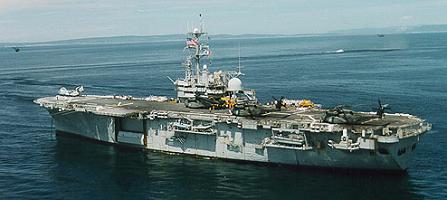
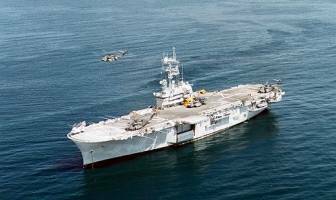
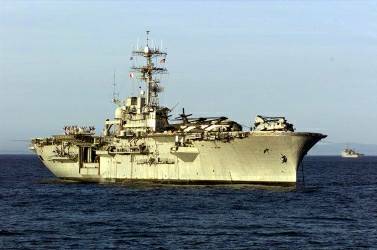
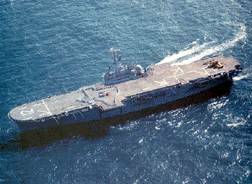
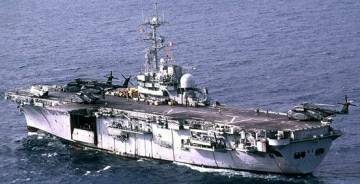
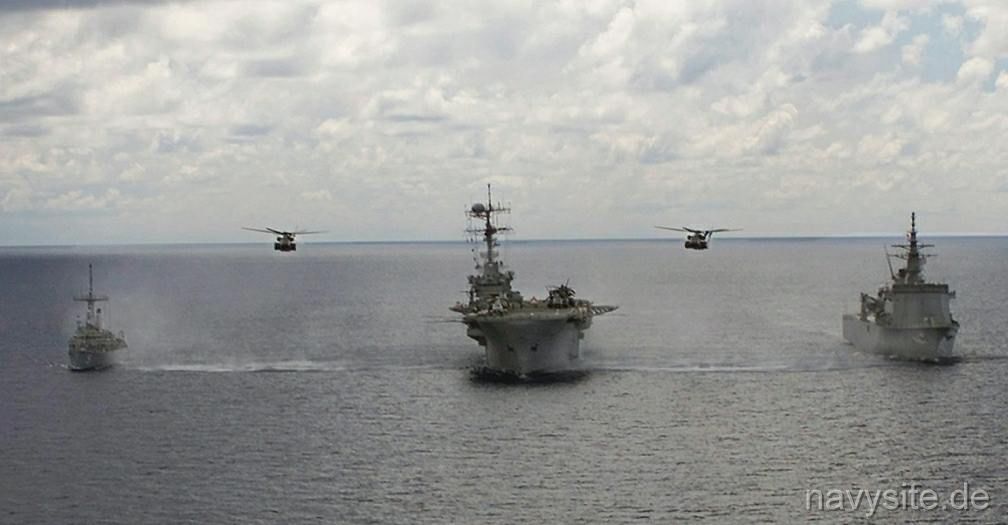
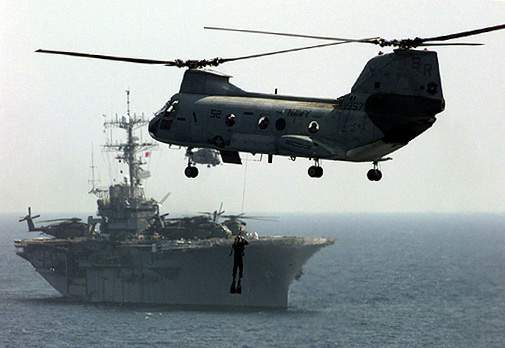
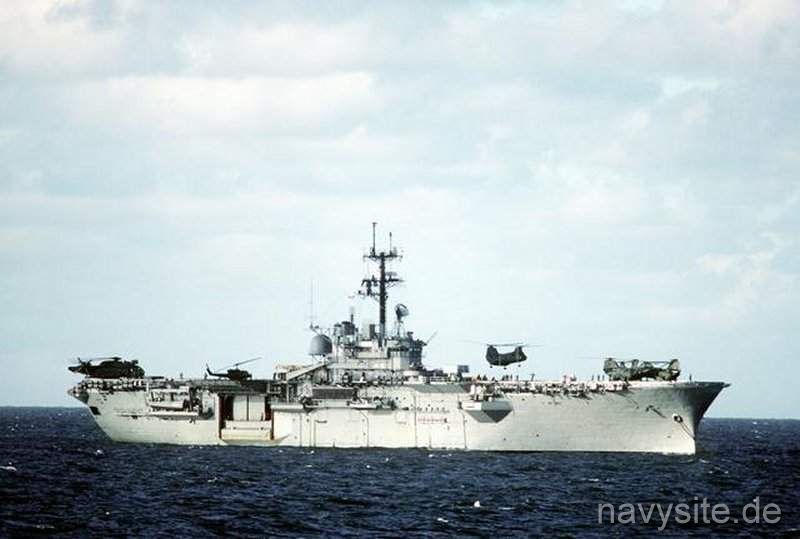
USS INCHON was the last ship in the IWO JIMA class of helicopter carriers. USS INCHON was specifically designed to conduct amphibious force landings by providing helicopter support to transport troops and assist in establishing air superiority in the designated landing area. Helicopter detachments that embarked aboard INCHON included the CH-53E Super Stallions, CH-46 Sea Knights, UH-1 Hueys and AH-1 Cobras. Additionally, a U. S. Marine Corps Battalion Landing Team (BLT) consisting of 2,000 troops and their equipment, embarked for INCHON's deployments.

INCHON, the first ship to bear the name, was named in honor of the highly successful historic amphibious landing by General Douglas MacArthur at Inchon, Korea on September 15, 1950.

In November 1994 the contract to convert INCHON to a Mine Countermeasures Support Ship was awarded to Ingalls. In 1996 the conversion was finished and INCHON was commissioned as a Mine Countermeasures Support Ship homeported in Ingleside, TX. Decommissioned on June 20, 2002, and stricken from the Navy list on May 24, 2004, the INCHON sunk as a target on December 5, 2004, 207 nautical miles northeast of Virginia Beach, Va.

General Characteristics:Keel Laid: April 8, 1968
Launched: May 24, 1969
Commissioned: June 20, 1970
Decommissioned: June 20, 2002
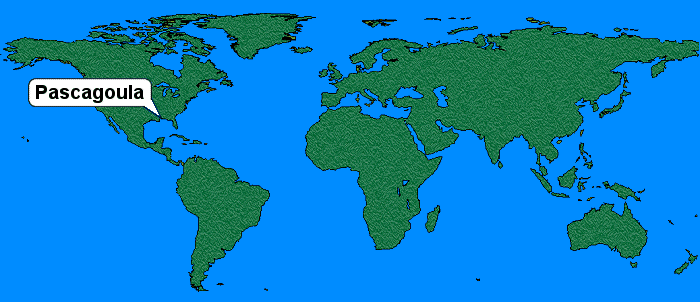
Builder: Ingalls Shipbuilding, West Bank, Pascagoula, Miss.
Propulsion System: Two 600 PSI Steam Boilers, 1 shaft, 22,000 shaft horsepower
Propellers: one
Length: 603, 65 feet (184 meters)
Beam: 104 feet (31.7 meters)
Draft: 25,9 feet (7.9 meters)
Aircraft elevators: two
Displacement: approx. 19,500 tons full load
Speed: 21 knots
Aircraft: 2 UH-46D Sea Knight Helicopters and 8 MH-53E Sea Stallion Helicopters
Armament: two Phalanx CIWS, four MK-38 25mm Chain Guns, four .50 cal lightweight guns, Stinger missiles
Additional Equipment: six MK-105 mine sweeping sleds
Crew: 122 officers, 1,321 enlisted


Back to topback to top  go to endgo to the end of the page


Back to topback to top  go to endgo to the end of the page

Crew List:

This section contains the names of sailors who served aboard USS INCHON. It is no official listing but contains the names of sailors who submitted their information.


back to top  go to the end of the page


Back to topback to top  go to endgo to the end of the page

USS INCHON Cruise Books:


Back to topback to top  go to endgo to the end of the page

History of USS INCHON:

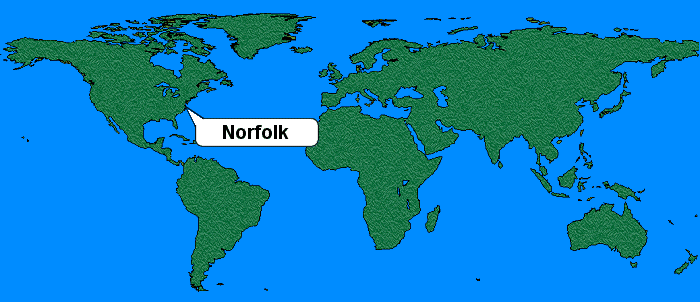
USS INCHON was ordered in June 1966 as the last unit of the IWO JIMA-class landing platform helicopter ships, intended to give the Atlantic Fleet a modern helicopter assault capability that reflected lessons from the Korean War and early Vietnam operations. Her keel was laid on April 8, 1968, at Ingalls Shipbuilding in Pascagoula, Mississippi, she was launched on May 24, 1969, with Charlotte Brooks, wife of congressman Jack Brooks, as sponsor, and commissioned on June 20, 1970, at Pensacola, Florida, with Captain Arthur H. Cummings Jr. in command. Builder's trials took place in the Gulf of Mexico in May 1970, after which the ship joined the Atlantic Fleet amphibious forces with Norfolk, Virginia, as her homeport, beginning a pattern of deployments that would revolve around the Mediterranean, the North Atlantic and, later, the Middle East.

During her first years in service, USS INCHON completed shakedown and training with helicopter squadrons and embarked Marine units, working up in the western Atlantic before being committed to major overseas operations. In 1972-1973, she carried out a globe-circling deployment, steaming from the Atlantic through the Caribbean and South Atlantic into the Indian Ocean and Pacific before returning to Norfolk via the Panama Canal, which she transited for the first time during this cruise and would pass through many more times during her career. This long deployment positioned the ship and her embarked helicopters for subsequent mine-warfare duties in Southeast Asia after the end of major U.S. combat operations in Vietnam.

In February 1973, USS INCHON joined Task Force 78 for Operation End Sweep, the U.S. Navy effort to remove American-laid mines from the approaches to North Vietnamese ports following the Paris Peace Accords. Operating in the Gulf of Tonkin and the Gulf of Haiphong, she served as an aviation and logistics base for airborne minesweeping helicopters clearing channels into Haiphong and other ports to reopen them to merchant shipping. Minesweeping was temporarily suspended between April 17 and June 17, 1973 because of political and technical issues, then resumed on June 18; the operation was formally completed on July 18, 1973. Photography from the period shows USS INCHON anchored in Haiphong harbor in June 1973, underscoring her direct involvement in these post-war clearance operations and linking the ship to the broader effort to normalize maritime traffic in North Vietnam after a decade of conflict.

After returning to the Atlantic, USS INCHON shifted back to the Mediterranean and Middle Eastern focus that would characterize much of her career. In 1974, she deployed with the 34th Marine Amphibious Unit and helicopter squadron HMM-162, operating in the Mediterranean during a period marked by the aftermath of the October 1973 Arab-Israeli war and the reopening of the Suez Canal. Based for a time at Alexandria, Egypt, she supported U.S. participation in multinational minesweeping and clearance operations associated with the Suez Canal, rotating with sister ship USS IWO JIMA (LPH 2) and using British bases such as Dhekelia in Cyprus as forward operating points while mine-warfare equipment was transferred at Port Said.

In July 1974, the ship and her embarked Marine and helicopter units were drawn into the crisis that followed the Turkish intervention in Cyprus. On July 22, 1974, CH-46 and CH-53 helicopters from the amphibious group began evacuating civilians from the British Sovereign Base at Dhekelia, transporting a total of 466 people, including 384 American citizens, to the amphibious transport dock USS CORONADO (LPD 11) and other ships for onward passage to Beirut. Official Marine Corps and Navy accounts also note USS INCHON herself as one of the principal platforms involved in the evacuation, operating alongside ships such as USS TRENTON (LPD 14) while carrier USS FORRESTAL (CVA 59) provided fighter cover overhead. These helicopter airlifts, conducted over several days in July, removed U.S. and other nationals from a deteriorating security situation on the island and illustrated the ship's role as a contingency platform for rapid non-combatant evacuation operations in the eastern Mediterranean.

USS INCHON continued to make regular Mediterranean deployments through the mid-1970s. From April to October 1974 she operated with the 34th Marine Amphibious Unit in the Mediterranean, followed by a deployment from September 1975 to March 1976 with the 32nd Marine Amphibious Unit and HMM-261 embarked. During this 1975-1976 tour, more than 100 sailors and marines from USS INCHON and the amphibious transport dock USS SHREVEPORT (LPD 12) fought a damaging fire aboard a Spanish merchant ship at Palma de Mallorca on July 9, 1975, an incident that highlighted the close interaction between U.S. naval units and commercial shipping in busy Mediterranean ports. Later that year, on December 16, 1975, USS INCHON and the oiler USS CALOOSAHATCHEE (AO 98) were involved in a minor collision during an underway refueling evolution in rough seas west of Italy. Sources describe only minor damage and no serious injuries. A further Mediterranean deployment followed from April to October 1977 with the 34th Marine Amphibious Unit embarked, and in June-August 1978 the ship shifted temporarily to the South Atlantic with the 32nd Marine Amphibious Unit and helicopter squadron HMM-362, extending her reach into the southern hemisphere during a period of growing U.S. attention to Atlantic sea lines of communication.

The early 1980s brought a mix of accidents and high-profile operational commitments. On February 5, 1980, while conducting an underway refueling in the Atlantic en route to the Mediterranean, USS INCHON collided with the dock landing ship USS SPIEGEL GROVE (LSD 32). Her port aircraft elevator gashed into the other ship's superstructure and damaged one of SPIEGEL GROVE's cranes, although contemporary accounts report no casualties and only limited damage to both ships. On September 29, 1981, the ship's aircraft handling officer, Lieutenant Commander Kenneth Wessel, was killed when a UH-1 helicopter he was flying crashed off Virginia Beach. Three other crew members survived and were rescued. Just days later, on October 7, 1981, USS INCHON suffered a boiler explosion while preparing to get underway from Norfolk, an incident that underscored the strains of prolonged operations on aging steam-propulsion plants.

Despite these setbacks, the ship took on one of the most significant deployments of her career during the Lebanese civil war. From September 1982 to March 1983, she deployed to the Mediterranean with the 24th Marine Amphibious Unit and helicopter squadron HMM-263, and from October 29, 1982 to February 15, 1983, USS INCHON served as flagship of Amphibious Squadron 6 while on station off Beirut. During this period, she supported the U.S. contingent of the multinational peacekeeping force in Lebanon, acting as a command platform and aviation base as Marines went ashore near Beirut International Airport and maintained patrols in and around the city. Helicopter flights from the ship also provided logistics support between Lebanon and staging points such as Larnaca in Cyprus, while the presence of USS INCHON and the amphibious group at sea gave American commanders flexibility to adjust the size and posture of the force ashore as the security situation evolved.

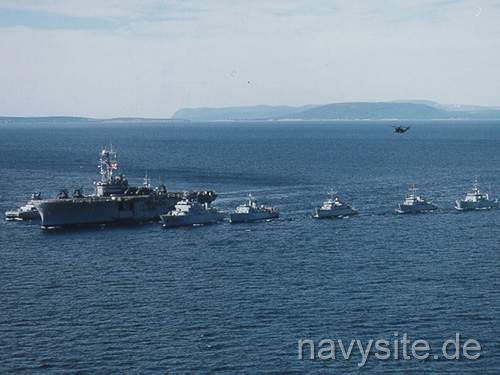
Following this Lebanon deployment, USS INCHON undertook further operations in the North Atlantic and Mediterranean that reflected the broader Cold War focus on NATO reinforcement and maritime control. From August to October 1983, she embarked the mine warfare helicopter squadron HM-16 for exercises in the North Atlantic, and from July 1984 to February 1985, she again deployed to the Mediterranean with the 22nd Marine Amphibious Unit and HMM-264, conducting amphibious training and presence missions with Sixth Fleet. In 1986, she participated in the NATO exercise Northern Wedding in the North Atlantic, a large-scale reinforcement and convoy-protection drill. A subsequent deployment from November 1986 to May 1987 saw her back in the Mediterranean with the 26th Marine Amphibious Unit and HMM-261 embarked, continuing the pattern of rotation that kept a Marine amphibious ready group continuously available to respond to crises from the western Mediterranean to the Levant.

The ship also experienced notable engineering and safety incidents in the later 1980s. On August 13, 1986, while en route to Morehead City, North Carolina, USS INCHON suffered a casualty to her evaporators that forced her to return to Norfolk for repairs and temporarily interrupted her deployment schedule. In November 1989, a fire broke out in her hangar deck during maintenance in Norfolk, injuring 31 people, a reminder of the hazards inherent in shipboard repair periods. Nevertheless, she remained heavily tasked, and imagery from March 1988 shows her operating at sea with a full complement of helicopters and defensive systems such as the Sea Sparrow missile launcher and 3-inch gun mounts, representative of the mid-1980s configuration of the IWO JIMA-class assault ships.

With the end of the Cold War, USS INCHON's operations shifted toward regional crises and peace support missions. From August 1990 to March 1991, she deployed to the Mediterranean with the 26th Marine Expeditionary Unit (Special Operations Capable) and helicopter squadron HMM-162 embarked. During this cruise, she played a central role in Operation Sharp Edge, the evacuation of civilians from Liberia as the country descended into civil war, using her embarked helicopters and landing craft to bring large numbers of American and other nationals off the beach at Monrovia and transfer them to safety. Immediately afterward, the ship remained in the southern Mediterranean, positioned for possible emergency evacuations as the U.S. and coalition forces built up for Operation Desert Shield and then launched Operation Desert Storm against Iraq. Photographs from March 1991 show USS INCHON returning to Norfolk after these operations, reflecting her contribution as an amphibious and contingency platform during the turbulent early 1990s.

From December 1991 to June 1992, the ship completed another Mediterranean deployment with the 24th Marine Expeditionary Unit and HMM-266, participating in exercises such as Dragon Hammer that rehearsed large amphibious assaults and multinational operations. In March-May 1993, she took HM-14, another airborne mine countermeasures squadron, to the North Atlantic for mine warfare and exercise duties. The following year marked one of her busiest operational cycles: between January and June 1994, USS INCHON deployed with the 24th Marine Expeditionary Unit to the Mediterranean and Indian Ocean, supporting Operation Continue Hope off Somalia in the wake of the United Nations intervention there and contributing to Operation Deny Flight over Bosnia through her role in the naval component that backed the no-fly zone and related peace enforcement measures. After returning to Norfolk, she remained in home port for only two weeks before being sent again to sea in July-August 1994, this time to waters off Haiti in support of international efforts that culminated in Operation Uphold Democracy, aimed at restoring an elected government and stabilizing the country.

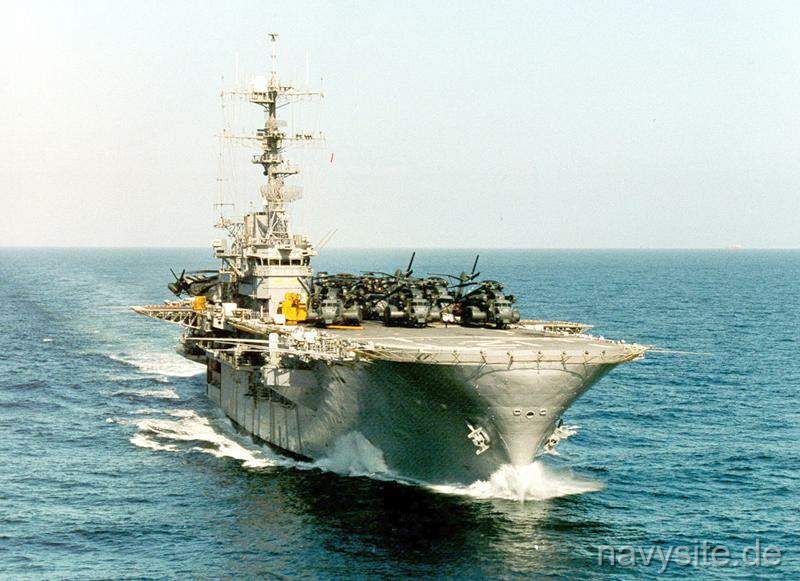
Recognizing the growing importance of mine warfare, the Navy decided to convert USS INCHON into a dedicated mine countermeasures support ship. On March 1, 1995, she was reclassified as MCS 12 and entered a 15-month conversion and overhaul at Ingalls Shipbuilding in Pascagoula, returning to her original builder. The work, completed between March 1995 and June 1996, involved installation of an extensive C4I suite for command, control, communications, computers and intelligence, reinforcement and modification of the flight deck and elevators to handle up to eight MH-53E Sea Dragon mine-sweeping helicopters along with additional utility helicopters, and the creation of workshops and support spaces capable of maintaining AVENGER-class mine countermeasures ships, OSPREY-class coastal minehunters and their specialized gear. Her defensive armament was modernized with upgraded Phalanx close-in weapon systems and 25-mm gun mounts. After the conversion, USS INCHON shifted homeport in July 1996 to Ingleside, Texas, the center of the Navy's mine warfare community, and on September 30, 1996, she was assigned to the active Naval Reserve Force while remaining the fleet's primary mine countermeasures command and support ship.

USS INCHON's first deployment in her new role ran from March to July 1997. During this period, she embarked mine countermeasures helicopters and supported surface mine warfare vessels, demonstrating in forward areas that a single large platform could provide command, logistics, maintenance and aviation facilities for a dispersed mine countermeasures group. In 1999, she deployed again from April through August, embarking helicopters from squadrons such as HM-14 and HM-15. Initially she conducted mine countermeasures exercises with allied navies in the Mediterranean and Persian Gulf, but with the outbreak of the Kosovo crisis, she and her embarked MH-53E helicopters were diverted to the Adriatic Sea. There, they supported Operation Shining Hope, the humanitarian relief effort for refugees from Kosovo, using their heavy-lift capacity to move supplies and equipment in support of NATO and international relief operations while continuing to be available for mine clearance tasks if required.

The ship's final operational period came at the beginning of the twenty-first century. Her last deployment began in April 2001 when she undertook a WESTPAC deployment that took her from the Gulf of Mexico, through the Panama Canal in April, and across the Pacific to Southeast Asia, where she served as a mine countermeasures command-and-control ship. Embarked with MH-53E Sea Dragon helicopters from HM-15, she acted as the flagship and coordination platform for Western Pacific Mine Countermeasures Exercise 2001 off Singapore in June, directing and supporting multinational MCM forces from more than a dozen regional and extra-regional navies. During the exercise, she hosted deck-landing training for Singaporean and Indonesian helicopters and coordinated combined minehunting, sweeping and neutralization drills in congested regional sea lanes, demonstrating how a dedicated MCM support ship could knit together air, surface and underwater mine warfare assets from multiple nations in Southeast Asian waters.

On October 19, 2001, while moored at Naval Station Ingleside and operating her engineering plant for in-port trials after maintenance, a fuel leak in the main boiler room led to an extensive fire in the bilges. The blaze, which filled the space with smoke, was brought under control after concerted efforts by shipboard and shore-based firefighting teams, but one sailor, Machinist's Mate Third Class Ronnie Joe Palm Jr., died and several others were injured. The damage to the aging steam propulsion plant was severe, and after assessing repair costs, the Navy decided to decommission rather than rebuild the ship. USS INCHON was formally decommissioned at Ingleside on June 20, 2002, exactly thirty-two years after her commissioning, and was stricken from the Naval Vessel Register on May 24, 2004. Towed by the fleet ocean tug USNS MOHAWK (T-ATF 170) to Philadelphia and then out to sea, she was sunk as a target on December 5, 2004, in deep water east of Virginia Beach, closing the career of the Navy's only mine countermeasures support ship and the last of the IWO JIMA-class helicopter assault ships to serve in front-line roles.


Back to topback to top  go to endgo to the end of the page


Back to topback to top  go to endgo to the end of the page

Accidents aboard USS INCHON:

DateWhereEvents
December 16, 1975west of Italy
USS INCHON and USS CALOOSAHATCHEE (AO 98) are in a minor collision during refueling in rough seas west of Italy.
February 5, 1980Atlantic
USS INCHON collides with USS SPIEGEL GROVE (LSD 32) while refueling in the Atlantic en route to the Mediterranean Sea, with reportedly no injuries and only minor damage.
October 7, 1981Norfolk, Va.
USS INCHON suffers a boiler explosion while preparing to get underway from Norfolk, Va.
June 11, 1984off North Carolina
During work-ups off the coast of North Carolina USS INCHON develops a leak in the fuel oil transfer system and returns to Norfolk, Va., for repairs.
August 13, 1986off the US East Coast
USS INCHON suffers a casualty to the ship's evaporators while underway to Moorehead City, NC, causing the ship to return to Norfolk, Va., for two days of repairs.
November 14, 1989Norfolk, Va.
A fire in the hangar deck of USS INCHON injurs 31 people while the ship is docked for maintenance in Norfolk, Va.
October 19, 2001Naval Station Ingleside, TX.
A fire was discovered in the ship's Boiler Room at approximately 5:42 p.m. (local time). Firefighting crews from INCHON and Naval Station Ingleside Fire Department responded to the scene, assisted by rescue and assistance teams from several other ships based at the naval station. Crews extinguished the fire at approximately 6:26 p.m. One crew member, Machinist's Mate Third Class Ronnie Joe Palm Jr., was killed and seven other sailors were injured. Six of them were treated for minor burns or smoke inhalation and released; one remained hospitalized in a local facility.
USS INCHON had completed tests of its engineering and operational systems after a regularly scheduled planned maintenance availability at Naval Station Ingleside at the time of the incident.

Back to topback to top  go to endgo to the end of the page

USS INCHON Patch Gallery:
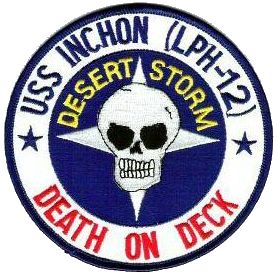
Operation Desert Storm


Back to topback to top  go to endgo to the end of the page


Back to topback to top


Back to Mine Countermeasure Ships site. Back to ships list. Back to selection page. Back to 1st page.