Search the Site with 
General Characteristics Crew List Memorabilia Cruise Books Accidents aboard the Ship About the Ship's Name History Image Gallery to end of page

USS Barbey (FF 1088)

- decommissioned -
- formerly DE 1088 -


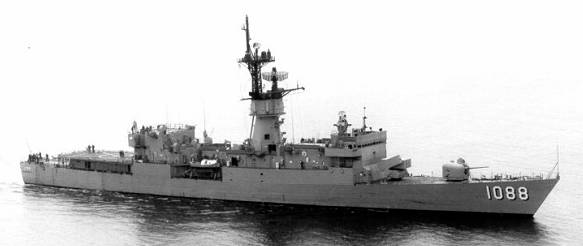
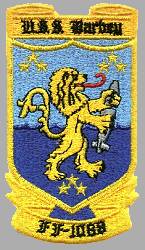
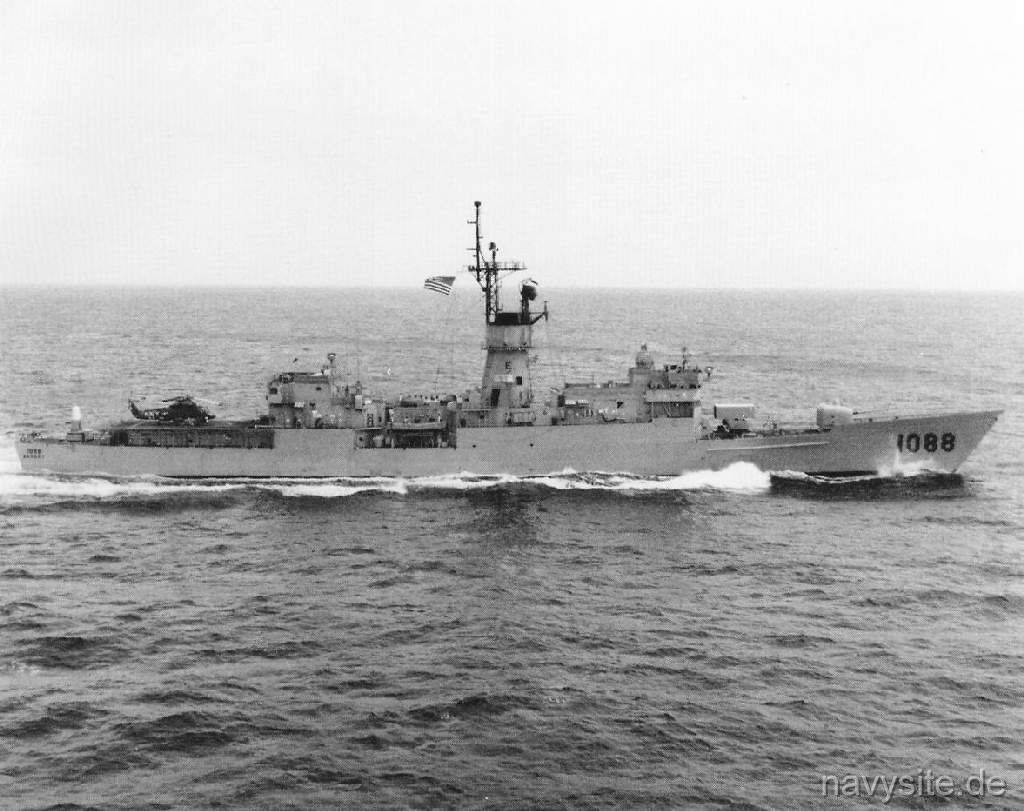
USS BARBEY was the 37th KNOX-class frigate. Decommissioned on March 20, 1992, the BARBEY was leased to Taiwan in 1994 and was commissioned as HWAI YANG there. Stricken from the Navy list on January 11, 1995, the BARBEY was finally sold to Taiwan on September 29, 1999.

General Characteristics:Awarded: August 25, 1966
Keel laid: February 5, 1971
Launched: December 4, 1971
Commissioned: November 11, 1972
Decommissioned: March 20, 1992
Builder: Avondale Shipyards, New Orleans, La.
Propulsion system: 2 - 1200 psi boilers; 1 geared turbine, 1 shaft; 35,000 shaft horsepower
Length: 438 feet (133.5 meters)
Beam: 47 feet (14.4 meters)
Draft: 25 feet (7.6 meters)
Displacement: approx. 4,200 tons full load
Speed: 27 knots
Armament: one Mk-16 missile launcher for ASROC and Harpoon missiles, one Mk-42 5-inch/54 caliber gun, Mk-46 torpedoes from single tube launchers, one 20mm Phalanx CIWS
Aircraft: one SH-2F (LAMPS I) helicopter
Crew: 18 officers, 267 enlisted


Back to topback to top  go to endgo to the end of the page


Back to topback to top  go to endgo to the end of the page

Crew List:

This section contains the names of sailors who served aboard USS BARBEY. It is no official listing but contains the names of sailors who submitted their information.


back to top  go to the end of the page


Back to topback to top  go to endgo to the end of the page

USS BARBEY Cruise Books:


Back to topback to top  go to endgo to the end of the page

Accidents aboard USS BARBEY:

DateWhereEvents
June 27, 1983USS BARBEY loses her helicopter when it is washed over board while the ship is steaming in heavy seas. The helicopter was being moved from the flight deck into the hangar when the mishap happened. An investigation later finds out that the cause of the accident were BARBEY's improper course and speed (in regard to the heavy seas) and insufficient securing of the helicopter.


Back to topback to top  go to endgo to the end of the page

About the Ship's Name:

Vice Admiral Daniel Edward Barbey was born 23 December 1889 in Portland, Oregon. He was appointed to the Naval Academy in 1909 and commissioned Ensign in 1912. He then served in the battleship CALIFORNIA and the destroyer LAWRENCE. During World War I, he served in the gunboat ANNAPOLIS and the destroyer STEVENS. His first international political experience was gained in the aftermath of World War I while on the staff of Admiral Mark Bristol, U. S. High Commissioner to Turkey. In 1921 he was "borrowed" to serve the AIlied Commission of Trade with Turkey, and was an observer with the White Russian armies during the Crimean Campaign.

Following duty for Barbey included command of destroyer USS LEA; First Lieutenant in battleship NEW YORK; command of destroyer RAMAPO. He took command of Detroyer Division 1 7 and commanded the battleship NEW YORK.

As a captain and Chief of Staff, Service Force, Atlantic Fleet, he earned the Legion Of Merit for developing and executing the first overall large-scale amphibious operations involving both army and naval forces. He became a member of Admiral King's staff in May 1942 designing, testing and developing new beaching craft (LST, LCT, LCI) as well as the Dock Landing Ship (LSD). In January 1943 he became Commander, Amphibious Force, Southwest Pacific. Throughout the remainder of the Pacific War, Vice Admiral Barbey personally led his Amphibious Force, planning and directing the amphibious assault landings upon which depended the success of the campaigns on New Britain, New Guinea, Morotai, Leyte and Luzon. He also served with the Eighth Army landing in the Southern Philippines and North Borneo. He planned and led 56 major amphibious attacks against the enemy. VADM Barbey was awarded the Navy Cross, Three Distinguished Service Medals, and the Legion Of Merit.

At the close of World War II, VADM Barbey landed the occupational forces in Korea and carried out the mission of redistributing troops in China, Korea and Manchuria. Later he was Commander, Caribbean Sea. Frontier (1947-1950). He retired 30 June 1951 after 43 years of naval service as Commandant 13th Naval District. VADM Barbey died 11 April 1969.


Back to topback to top  go to endgo to the end of the page

USS BARBEY History:

USS BARBEY was a KNOX-class ocean escort built for the U.S. Navy during the later Cold War. The building contract was awarded to Avondale Shipyards, Inc., on August 25, 1966, and the keel was laid at Westwego, Louisiana, on February 5, 1971. The ship was launched and christened on December 4, 1971, sponsored by Mrs. Daniel E. Barbey, the widow of the admiral whose name the ship carried. After fitting out and completion of builder's work, USS BARBEY was commissioned at Long Beach Naval Shipyard, California, on November 11, 1972, with Commander Theodore B. Shultz in command. She was assigned to Destroyer Squadron 29 at Long Beach.

USS BARBEY's first months in commission were devoted to the normal post-commissioning progression of trials, training, corrections, and preparation for fleet duty. On February 4, 1973, she got underway for shakedown training in the Hawaiian Islands. Before entering her formal post-shakedown availability, she made a three-day liberty visit to Acapulco, Mexico, served as plane guard for USS HANCOCK (CVA 19), and conducted acoustic testing at Seattle, Washington. On May 12, 1973, she began her post-shakedown availability at Long Beach Naval Shipyard. The availability became a substantial yard period. From June 5 to October 9, 1973, USS BARBEY was in drydock at Long Beach, where her flight deck and hangar were modified to support LAMPS helicopter operations and where she received an experimental controllable-pitch propeller. Testing, adjustment, and correction of that new propeller installation occupied her through January 1974 and made propulsion evaluation a major theme of her early service life rather than a brief post-shakedown detail.

In February 1974, USS BARBEY again operated in the Seattle area for acoustic trials. Early in March 1974, she served for two days as plane guard for USS HANCOCK. On March 8, 1974, she embarked Commander, Destroyer Squadron 13, and entered the joint United States-Canadian Composite Training Unit Exercise 2B-74. During the following six days, she stood by to recover pilots if needed during flight operations from USS RANGER (CVA 61). She then returned to San Diego for upkeep and minor repairs. The work at this stage included installation of equipment associated with Chief of Naval Operations project DS 523, most visibly a large steel spherical structure mounted above the helicopter hangar, and correction of an oil leak in the controllable-pitch propeller hub. On May 2, 1974, USS CREE (ATF 84) towed USS BARBEY to drydock at Long Beach Naval Shipyard for about ten days of additional propeller repairs. She returned to San Diego on May 16 and resumed local operations, including plane-guard service for USS CONSTELLATION (CVA 64). On July 9, 1974, Commander Timothy R. O'Keefe relieved Commander Shultz as commanding officer. Late in June 1974, USS BARBEY operated for several days near Seattle with USS PLUNGER (SSN 595) and returned to San Diego on June 28. On July 12, she departed the West Coast for several weeks of refresher training in the Hawaiian operating area, conducting anti-submarine warfare training while en route. On August 30, 1974, after returning to San Diego, the experimental controllable-pitch propeller failed during tests when all of its blades were lost, and USS FLORIKAN (ASR 9) towed the ship to Long Beach Naval Shipyard.

During the first six months of 1975, USS BARBEY reinstalled the experimental controllable-pitch propeller and subjected it to extensive trials at sea. In late May and early June 1975, she interrupted that routine for refresher training at Pearl Harbor before returning to San Diego. On June 30, 1975, the U.S. Navy reclassified its destroyer escorts as frigates, and USS BARBEY became USS BARBEY (FF 1088). Local operations, training, inspections, and upkeep occupied the following months. On November 17, 1975, she began removal of the equipment associated with CNO project DS 523, including the conspicuous 35-foot structure that had marked her experimental configuration. During the first five days of December 1975, she conducted sonar sound trials and engineering drills, and for much of the following two weeks, she served in support of engineering and anti-submarine warfare school work. On January 6, 1976, USS BARBEY entered drydock at Long Beach Naval Shipyard for repairs and modifications. The most important change was the removal of the experimental controllable-pitch propeller and the installation of a standard fixed-blade propeller, ending a prolonged early-service engineering experiment that had repeatedly affected her schedule.

After sea trials, deperming, and preparation for renewed fleet work, USS BARBEY conducted refresher training from April 26 to May 7, 1976. Commander Compton Eugene Ward relieved Commander O'Keefe as commanding officer on June 4, 1976. The ship returned to San Diego, completed inspections and tests, passed through a combat readiness test in mid-June, and took part in readiness exercises in the eastern Pacific during the last week of June. Tests, inspections, and deployment preparation occupied July. On July 30, 1976, she embarked an anti-submarine helicopter detachment and got underway for her first major Western Pacific deployment. The opening phase took her to the Hawaiian Islands for Composite Training Unit Exercise 1-77, followed by a Pearl Harbor visit from August 12 to August 17. During the passage from Hawaii to the Philippines, her crew conducted multi-ship anti-submarine warfare exercises and tactical drills. USS BARBEY reached Subic Bay, Republic of the Philippines, on September 6, 1976, and began nearly three weeks of intensive upkeep at the U.S. naval support base that served as a major repair, logistics, and operating hub for Pacific Fleet ships in Southeast Asian and Western Pacific waters.

The next phase of the 1976 deployment took USS BARBEY south to operate with Australian forces. From October 12 to October 25, 1976, she participated in Exercise Kangaroo II off the east coast of Australia. The exercise placed her in a combined allied setting at a time when U.S. Pacific strategy depended not only on American carrier and escort forces but also on routine naval cooperation with regional partners. After the exercise, she visited Geelong, Australia, during the first week of November. She then returned to Subic Bay, where she remained for upkeep and replenishment until December 11. During the remainder of the deployment she operated primarily in the South China Sea, conducted anti-submarine warfare exercises, participated in Exercise Multiplex 1-77 and missile exercises, and returned again to Subic Bay. She closed 1976 with liberty in Hong Kong. In mid-January 1977, USS BARBEY served as plane guard for USS ENTERPRISE (CVN 65) during readiness exercises. She then spent about three weeks in upkeep and replenishment at Guam and made a briefing stop at Kaohsiung, Taiwan. Late in February 1977, she took part in Exercise Sharkhunt XX, followed by a brief liberty visit to Kaohsiung and another short period at Subic Bay. USS BARBEY returned to San Diego on March 21, 1977, completing a deployment that had included Hawaii, the Philippines, Australia, Hong Kong, Guam, and Taiwan, as well as allied exercises and repeated anti-submarine warfare training.

Following her return, USS BARBEY resumed the cycle of upkeep, local operations, and fleet exercises typical of Pacific Fleet escorts between deployments. During the first two weeks of June 1977, she operated in the Pacific Northwest for tactical exercises and made a goodwill visit to Portland, Oregon. On October 8, 1977, Commander Richard Allen Gregor relieved Commander Ward as commanding officer. In mid-October, the ship made a brief visit to Aberdeen, Washington. The rest of the year was spent largely at San Diego and in nearby operating areas, where she conducted drills, exercises, and routine maintenance. On January 23, 1978, USS BARBEY began an eleven-month overhaul at Long Beach Naval Shipyard, and Long Beach became her homeport during the overhaul period. The work modernized her combat and engineering capability, including installation of the Harpoon missile system and improvements to combat systems and the engineering plant. Late in November and early in December 1978, she conducted sea trials for engineering and sonar systems. The first half of 1979 was then spent in upkeep, training, and drills. She successfully completed an operational propulsion plant examination late in June 1979, but in July, during refresher training, a problem with an emergency diesel generator forced her back to San Diego. She returned for additional overhaul work on July 27, completed that work on September 24, and resumed fleet exercises. During the fall, those exercises were interrupted by a brief liberty visit to New Westminster, British Columbia. After a month of upkeep at San Diego, USS BARBEY completed readiness exercises in November, including a combat systems readiness test, and in early December she took part in Composite Training Unit Exercise 1-80 in preparation for another major deployment. Commander James B. Greene Jr. relieved Commander Gregor as commanding officer on December 20, 1979.

On January 11, 1980, USS BARBEY departed San Diego for a Western Pacific and Indian Ocean deployment that soon became connected with the American response to the Iranian hostage crisis. She reached Pearl Harbor for a visit from January 19 to January 22 and then continued west. Her deployment placed her in support of naval contingency planning associated with Operation Eagle Claw, the April 1980 attempt to rescue American hostages held in Iran. In contemporary organizational terms, she operated in support of the 31st Marine Amphibious Unit, the later 31st Marine Expeditionary Unit. Her outward route took her to Yokosuka, Japan, from February 4 to February 10; Subic Bay from February 15 to February 24; Pattaya Beach, Thailand, from March 5 to March 9; and Singapore from March 12 to March 14. From March 19 to April 30, she operated in the Arabian Sea and Indian Ocean. Operation Eagle Claw took place on April 24, 1980. Although the rescue attempt failed ashore in Iran, USS BARBEY's deployment placed her within the wider naval posture supporting American contingency operations in the region.

On May 3, 1980, while bound for Diego Garcia, USS BARBEY crossed the equator at 00°00' north, 69°37.9' east. She reached Diego Garcia on May 5 and remained there until May 13. During that period, she was moored alongside USS L. Y. SPEAR (AS 36) for support work, particularly in engineering spaces, at the British Indian Ocean Territory base that had become increasingly important for U.S. naval operations in the Indian Ocean. Her return voyage took her to Perth, Australia, from May 23 to May 27; Subic Bay from June 6 to June 19; Apra Harbor, Guam, on June 23; and Pearl Harbor from July 2 to July 5. She arrived back at San Diego on July 12, 1980. The cruise covered roughly 37,000 miles. During the deployment, USS BARBEY conducted 30 daytime and two nighttime underway replenishments, received new personnel, food, parts, and mail through 13 extensive vertical replenishments and about 130 helicopter landings, and spent 122 days underway and 61 days in port, including 51 continuous days of steaming in the Indian Ocean. The crew received the Sea Service Deployment Ribbon and the Navy Expeditionary Medal, and the deployment contributed to the performance record that culminated in a Destroyer Squadron 5 Battle Efficiency award. During the remainder of 1980, USS BARBEY returned to the normal San Diego pattern of upkeep, availability, inspections, and training.

On May 12, 1981, USS BARBEY was photographed underway in the Pacific while en route to Hawaii. In August 1981, she was moored at Long Beach Naval Shipyard. Commander Lee Frederick Gunn relieved Rear Admiral-select Greene as commanding officer on December 17, 1981. USS BARBEY's 1981-1982 record included Western Pacific and Indian Ocean service, and a cruise book from that period was later published under the title Ready for Sea. Publicly documented imagery places USS BARBEY at Naval Station Subic Bay on March 15, 1982, moored at the U.S. Naval Ship Repair Facility. Additional contemporary imagery from June 15, 1982, places her at the Subic Bay repair facility. These documented appearances show that USS BARBEY continued to operate within the familiar Pacific Fleet pattern of Western Pacific deployment, Subic Bay upkeep, and Indian Ocean-related tasking during the early 1980s.

During the following mid-1980s period, USS BARBEY remained a Pacific Fleet frigate operating through the standard cycle of maintenance, local operations, training, and periodic deployment preparation. On June 27, 1983, the ship lost her embarked helicopter while steaming in heavy seas. The helicopter was being moved from the flight deck into the hangar when it was washed overboard. A later investigation attributed the mishap to the ship's course and speed in relation to the sea state and to insufficient securing of the helicopter. Commander Elwood Lloyd Gibson relieved Commander Gunn as commanding officer on December 9, 1983. Commander Jimmy W. Parker relieved Commander Gibson on February 8, 1986.

In January 1987, USS BARBEY was photographed at sea firing Harpoon missiles from her anti-submarine rocket launcher, evidence of the combat-system modernization introduced after her 1978 overhaul. On March 2, 1987, she was documented underway with the USS KITTY HAWK (CV 63) Battle Group. The deployment context was the late Cold War and the continuing instability of the northern Indian Ocean and Persian Gulf approaches during the Iran-Iraq War. Commander Thomas John Flaherty relieved Commander Parker as commanding officer on May 21, 1988. From December 12 to December 15, 1988, USS BARBEY operated with USS NIMITZ (CVN 68) and USS WADDELL (DDG 24) in a passing exercise with Omani forces near Wudam Naval Base, Oman. The exercise included air-to-air refueling, ship tactical maneuvering, anti-air warfare, target bombing, gunnery, and a War at Sea scenario, placing USS BARBEY in a combined Gulf of Oman training setting shortly after the most intense U.S. naval involvement of the Iran-Iraq War period. On June 8, 1989, USS BARBEY was photographed underway on the Columbia River near Portland, Oregon, showing her continued participation in Pacific Northwest port-visit and operating patterns.

USS BARBEY remained active into 1990. On February 10, 1990, she was photographed during a combined United States-Canadian naval exercise off Southern California. On April 1, 1990, she was again photographed at sea, underway before her final major overseas deployment. Commander Thomas Joseph Wilson III relieved Commander Flaherty as commanding officer on June 2, 1990. On June 19, 1990, USS BARBEY departed San Diego for a scheduled Middle East Force deployment. At departure, the deployment was planned as a normal Persian Gulf assignment, part of the continuing U.S. naval presence that had grown during the previous decade in response to regional conflict, oil-route security concerns, and the need to maintain access through the Arabian Sea and Persian Gulf. During her transit west, she made port visits in Hawaii, the Philippines, Singapore, and Penang, Malaysia. She arrived in the Persian Gulf on August 1, 1990. The next day, August 2, Iraq invaded Kuwait. USS BARBEY's deployment therefore changed immediately from a peacetime forward-presence cruise into a crisis deployment during the opening phase of what became Operation Desert Shield.

Working with her sailing mate for the transit, USS ENGLAND (CG 22), USS BARBEY was employed in naval operations enforcing sanctions specified by United Nations resolutions against Iraq. She embarked the HSL-35 helicopter detachment known as Magus 32, and her air detachment became an important part of her surveillance, identification, and interception capability. During the Persian Gulf phase of the 1990 deployment, USS BARBEY carried out maritime interception and escort operations during the buildup of U.S. and coalition forces for Operation Desert Shield. The ship's tasking reflected the immediate naval priorities of the crisis: to enforce sanctions, monitor shipping, protect maritime movement, and support the growing American and coalition posture in and around the Gulf before the start of the later combat phase. Contemporary accounts of the deployment credit USS BARBEY with more surface-ship interdiction intercepts than any other fleet unit in the Arabian Gulf during that period. After completing her Middle East Force assignment, she was relieved by USS MARVIN SHIELDS (FF 1066). Her return voyage included stops in the Philippines, Hong Kong, and Hawaii. USS BARBEY arrived back at San Diego on December 21, 1990. She then entered a repair availability.

On January 15, 1991, USS BARBEY was assigned to the Naval Reserve Force at San Diego. In April 1991, she conducted law-enforcement and drug-interdiction operations off Baja California and the central coast of Mexico. For that mission, she embarked an SH-2F helicopter detachment known as Sea Snake 11. During the operation, she also carried out three at-sea rescues, two of them involving foreign-registry merchant ships. After the law-enforcement and drug-interdiction assignment, she returned to fleet exercises and another repair availability. On June 6, 1991, USS BARBEY was present at Portland, Oregon, for the annual Rose Festival, tied up with other Pacific Fleet ships. This period marked the final stage of her U.S. Navy career. The Cold War was ending, the U.S. Navy was beginning to reduce and reorganize portions of its surface force, and older KNOX-class frigates were increasingly approaching retirement, transfer, or reserve-force roles.

USS BARBEY was decommissioned at Naval Station San Diego on March 20, 1992, after more than nineteen years of commissioned U.S. Navy service. After decommissioning, she was leased to Taiwan on June 21, 1994, renamed ROCS HWAI YANG (FF-937), struck from the U.S. Naval Vessel Register on January 11, 1995, and sold to Taiwan on September 29, 1999.


Back to topback to top  go to endgo to the end of the page


Back to topback to top


Back to Frigates List. Back to Ships List. Back to selection page. Back to 1st page.