![]() |
Search the Site with
|
![]() | ![]() |
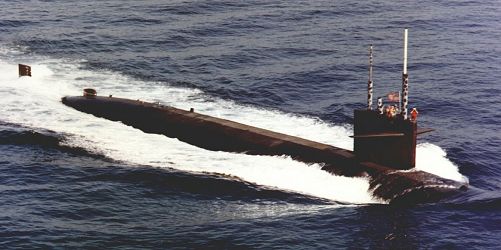
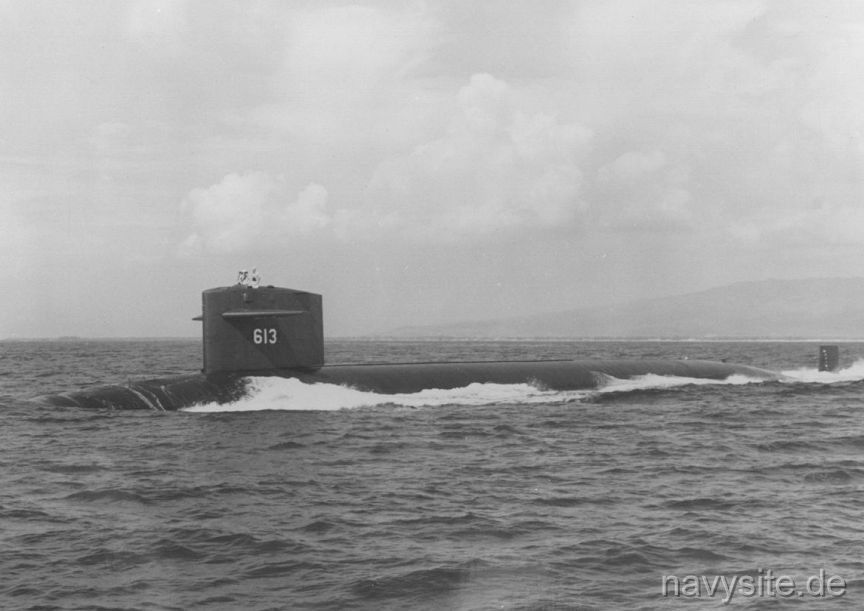
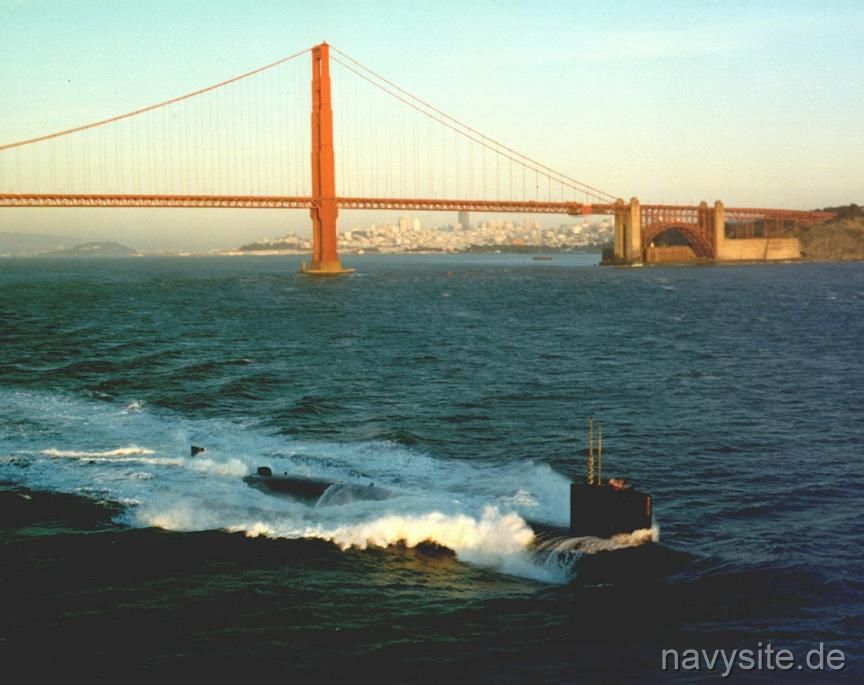
USS FLASHER was one of the PERMIT - class nuclear-powered attack submarines and the second ship in the Navy named after the fish. Both decommissioned and stricken from the Navy list on September 14, 1992, the FLASHER subsequently entered the Navy's Nuclear Powered Ship and Submarine Recycling Program at the Puget Sound Naval Shipyard, Bremerton, Wash. Recycling was completed on May 11, 1994.
| General Characteristics: | Awarded: June 9, 1960 |
| Keel laid: April 14, 1961 | |
| Launched: June 22, 1963 | |
| Commissioned: July 22, 1966 | |
| Decommissioned: September 14, 1992 | |
| Builder: Electric Boat Division of General Dynamics Corporation, Groton, CT. | |
| Propulsion system: one S5W2 nuclear reactor | |
| Propellers: one | |
| Length: 292.3 feet (89.1 meters) | |
| Beam: 32.15 feet (9.8 meters) | |
| Draft: 28.9 feet (8.8 meters) | |
| Displacement: Surfaced: approx. 3,900 tons Submerged: approx. 4,600 tons | |
| Speed: Surfaced: approx. 20 knots Submerged: approx. 30 knots | |
| Armament: four 533 mm torpedo tubes for SUBROC, Mk-48 torpedoes and Harpoon missiles | |
| Crew: 12 Officers, 91 Enlisted |
Crew List:
This section contains the names of sailors who served aboard USS FLASHER. It is no official listing but contains the names of sailors who submitted their information.
Accidents aboard USS FLASHER:
| Date | Where | Events |
|---|---|---|
| May 7, 1963 | Electric Boat Shipyard, Groton, Conn. | A fire occurs aboard the FLASHER at the Electric Boat shipyard at Groton, Conn., killing three and injuring two. Damage to the submarine is reportedly negligible. The fire occurred in the trimming tank of the FLASHER, scheduled to be launched on June 14. |
USS FLASHER History:
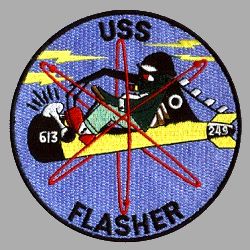
USS FLASHER was a PERMIT-class nuclear-powered attack submarine and the second United States Navy ship to carry the name FLASHER. Her name linked her to the earlier USS FLASHER (SS 249), a World War II fleet submarine that had served in the Pacific and whose record and insignia were deliberately carried forward when the later nuclear-powered submarine was created. The new submarine belonged to the generation of American nuclear attack submarines developed for Cold War operations in which endurance, submerged speed, acoustic performance, anti-submarine warfare, intelligence collection, and close support of fleet operations had become central requirements. Her construction contract was awarded on June 9, 1960, to the Electric Boat Division of General Dynamics at Groton, Connecticut, and her keel was laid there on April 14, 1961. During construction she was extensively modified. The modifications included lengthening the hull, lengthening the sail, and improving the watertight integrity of seawater systems. These changes were made in the same wider period in which the United States Navy, following the loss of USS THRESHER (SSN 593) on April 10, 1963, was placing new emphasis on submarine construction standards, testing, quality assurance, and survivability. USS FLASHER is commonly recorded as the first submarine certified under the Submarine Safety program, making her construction history closely connected with the post-THRESHER transformation of American submarine safety practice.
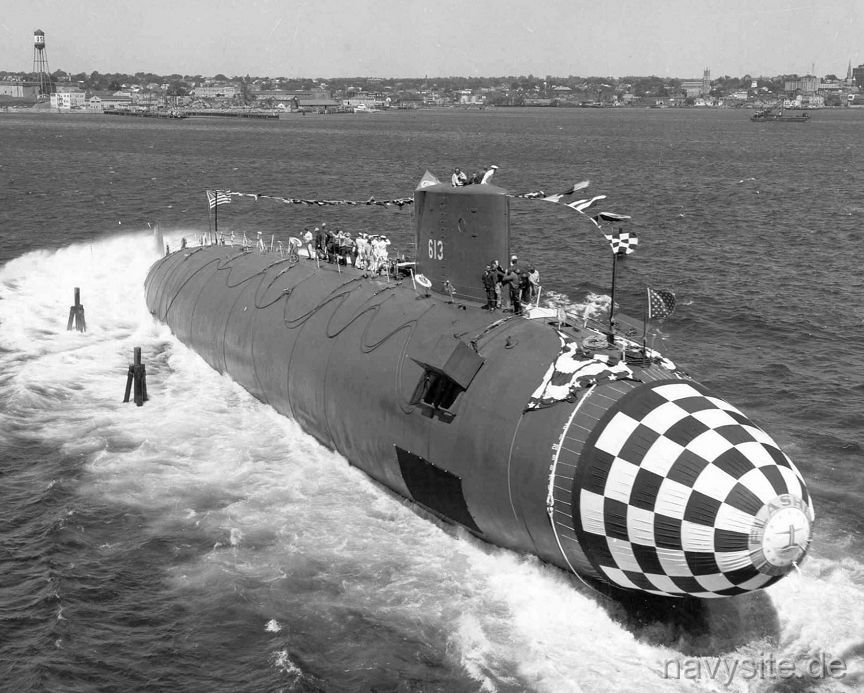
While still under construction at Electric Boat, USS FLASHER suffered a serious accident on May 7, 1963. A fire broke out in a trimming tank aboard the submarine at the Groton yard, killing three men and injuring two. The damage to the submarine itself was reported as limited, and construction continued. On June 22, 1963, USS FLASHER was launched in the nation's only simultaneous twin nuclear-submarine launching, together with USS TECUMSEH (SSBN 628). Mrs. Paul B. Fay Jr., wife of the Under Secretary of the Navy, christened USS FLASHER, and Vice Admiral Elton W. Grenfell, then Commander Submarine Force, United States Atlantic Fleet, delivered the principal address. The launch placed USS FLASHER visibly within the rapid expansion of the nuclear submarine fleet, but her long fitting-out and testing period also reflected the additional scrutiny and modifications that marked submarine construction after 1963.
After completion, trials, and acceptance work, USS FLASHER was commissioned at the United States Naval Submarine Base, Groton, Connecticut, on July 22, 1966. Commander Kenneth M. Carr became her first commanding officer. Representative George W. Grider of Tennessee, who had commanded the earlier USS FLASHER during World War II, gave the commissioning address, tying the new nuclear-powered submarine directly to the earlier submarine's wartime namesake.
Following commissioning, USS FLASHER shifted from the Atlantic building yard to the Pacific Fleet. She arrived at her new home port, Pearl Harbor, Hawaii, on September 23, 1966, and was assigned to Submarine Squadron Seven under the Pacific submarine force. Her move to Pearl Harbor placed her at one of the principal American submarine bases in the Pacific at a time when the Vietnam War was escalating, the Soviet Pacific Fleet was expanding, and the United States was maintaining a broad forward naval presence from Hawaii through Guam, Japan, Okinawa, and the Philippines. On October 7, 1966, shortly after her arrival, USS FLASHER received a visit from Eikichi Kambayashiyama, Director General of the Japanese Defense Agency, accompanied by Rear Admiral John H. Maurer, Commander Submarine Force Pacific. The visit reflected the role of Pearl Harbor-based submarines within the wider American-Japanese security relationship in the western Pacific.
During her first two years of commissioned service, USS FLASHER completed seven recorded operations, including a short deployment to the western Pacific. On July 14, 1967, Commander Arne C. Johnson relieved Commander Carr and became her second commanding officer. USS FLASHER's early operational years coincided with a period of high tension in Northeast Asia. On January 23, 1968, North Korea seized USS PUEBLO (AGER 2) off Wonsan, creating one of the sharpest Cold War crises in the region since the Korean War. USS FLASHER operated in the Sea of Japan in connection with the American naval response to the crisis. During this operation, she encountered a small ice floe that damaged the top of one of her periscopes. She proceeded to Guam for repairs, returned to the operating area, and later made a port visit to Yokosuka, Japan, before returning to Pearl Harbor. On April 25, 1968, she got underway for her first recorded western Pacific deployment in the formal deployment cycle. On July 4, 1968, she received her first Battle Efficiency "E" for overall combat excellence.
After a shipyard availability in December 1968, USS FLASHER successfully fired her first two Subroc missiles. Subroc was a nuclear-capable anti-submarine weapon intended to allow an attack submarine to engage an enemy submarine at standoff range, and its presence in USS FLASHER's early weapons suite reflected the Cold War emphasis on undersea conflict with the Soviet submarine force. From February 1969 through July 1969, USS FLASHER deployed to the western Pacific. On July 1, 1969, she was awarded her second consecutive Battle Efficiency "E", while operating as part of Submarine Division Seventy-One. On July 8, 1969, Commander Emsley F. Cobb relieved Commander Johnson and became the third commanding officer. During the remainder of 1969, USS FLASHER operated in Hawaiian waters, carried out pre-overhaul testing, and successfully fired another Subroc. On December 2, 1969, Rear Admiral Walter F. Small, Commander Submarine Force Pacific, presented USS FLASHER with a Meritorious Unit Commendation for operations conducted during the period from March 1967 through August 1968.
In 1970, USS FLASHER conducted another deployment before entering her first major overhaul. The exact operational details of that deployment are not publicly described but it was significant enough that later recognition of the submarine's work in this period included a Presidential Unit Citation. On June 15, 1970, USS FLASHER began a one-year major overhaul at Pearl Harbor Naval Shipyard. The overhaul took place while American naval forces were still heavily committed to the Vietnam War and to broader Cold War surveillance and deterrence missions in the Pacific. USS FLASHER completed the overhaul on June 12, 1971. On July 13, 1971, Secretary of the Navy John H. Chafee visited the submarine. From July 1971 to September 1971, she conducted post-overhaul shakedown operations and made port visits to Bremerton, Washington; San Francisco, California; and San Diego, California. These post-overhaul movements tested the ship after a long maintenance period and reintroduced her to operational service on the Pacific coast before her next forward deployment.
In November 1971, USS FLASHER deployed again to the western Pacific for operations with the United States Seventh Fleet. During this deployment she visited Guam in the Mariana Islands; White Beach, Okinawa; Yokosuka, Japan; Subic Bay, Philippines; and Hong Kong. These ports reflected the standard geography of American submarine support in the western Pacific during the Vietnam era: Guam as a mid-Pacific and western Pacific support base, Yokosuka as the major United States naval base in Japan, Subic Bay as a major repair and logistics base in the Philippines, and Hong Kong as a regular liberty and replenishment port for ships operating in Asian waters. USS FLASHER returned to Pearl Harbor in June 1972. On July 1, 1972, she was awarded her third Battle Efficiency "E". On August 19, 1972, Commander Roger F. Bacon relieved Commander Cobb and became the fourth commanding officer. On the same date, USS FLASHER received the Presidential Unit Citation for operations conducted in 1970. In September 1972, she took part in the Rim of the Pacific Exercise 1972, an anti-submarine warfare exercise involving naval units from the United States, Canada, Australia, and New Zealand. From September 1972 to November 1972, USS FLASHER was dry-docked at Pearl Harbor Naval Shipyard, after which she resumed local operations in the Hawaiian area.
On March 2, 1973, USS FLASHER was awarded a Navy Unit Commendation for operations conducted in 1970 and 1971. In 1973, she departed for another western Pacific deployment and again operated with the Seventh Fleet. During this deployment she visited Yokosuka, Japan; Subic Bay, Philippines; and Hong Kong. On July 1, 1973, she received her fourth Battle Efficiency "E". She returned to Pearl Harbor on December 24, 1973. This deployment occurred during the transition after the January 1973 Paris Peace Accords, when the United States had ended its direct ground combat role in Vietnam but continued to maintain substantial naval forces in the western Pacific.
Following local operations in the Hawaiian area, USS FLASHER was assigned to a special operation beginning in June 1974 and lasting two months. During this operation she visited Pusan, Korea, and Hong Kong. She returned in August 1974 and resumed local Hawaiian-area operations.
In January 1975, Commander Noel B. Henderson relieved Commander Bacon and became the fifth commanding officer. In February 1975, USS FLASHER left Pearl Harbor for the last time as her regular home port and proceeded to Mare Island Naval Shipyard at Vallejo, California, for her second major overhaul. The overhaul formally began on February 22, 1975. At the same time, her home port was changed to Mare Island and her administrative command shifted to Submarine Squadron Three. The overhaul modernized major systems aboard the submarine and included installation of a new long-endurance reactor core, an important change that extended the operational utility of the boat for the remainder of her career. On March 20, 1976, Commander William C. Rothert relieved Commander Henderson and became the sixth commanding officer. From September 1976 to December 1976, as the overhaul came to an end, USS FLASHER conducted shakedown operations in the San Francisco area. She completed the overhaul on December 16, 1976, left Mare Island for her new home port, and arrived at San Diego, California, on December 21, 1976. Her home port was changed to San Diego on December 22, 1976, and she then began operating from southern California.
From San Diego, USS FLASHER entered a new phase of her service. Her base at Point Loma placed her near the major southern California operating areas used for submarine training, weapons work, fleet exercises, and pre-deployment preparations. In August 1977, she attended the Seattle Seafarer Festival, one of the few publicly recorded civic or ceremonial appearances in her later 1970s record. From April 1978 through June 1978, she completed a three-month mid-Pacific special operation. In January 1979, USS FLASHER began a Selected Restricted Availability at Mare Island Naval Shipyard, and that work was completed on March 29, 1979. In June 1979, she attended the annual Rose Festival in Portland, Oregon. On July 1, 1979, she was awarded her fifth Battle Efficiency "E", and on July 13, 1979, Commander William C. Hughes Jr. relieved Commander Rothert and became the seventh commanding officer.
The next publicly identified operational recognition came on November 12, 1980, when USS FLASHER received her second Meritorious Unit Commendation for operations conducted from November 1979 through May 1980. On November 5, 1982, USS FLASHER received her third Meritorious Unit Commendation for operations conducted from July 1981 through January 1982. On the same date, Commander Ralph R. Morris relieved Commander Hughes and became the eighth commanding officer. Public summaries also identify another three-month mid-Pacific special operation from August 1982 through November 1982. These operations occurred during the early 1980s, when American attack submarines were central to United States maritime strategy, particularly in the tracking of Soviet submarines, protection of carrier and ballistic-missile-submarine forces, and collection of intelligence in areas where surface ships and aircraft could not operate with the same discretion.
On May 9, 1983, USS FLASHER began her third overhaul at Mare Island Naval Shipyard. This overhaul kept the submarine in the yard during a period when the United States Navy was expanding its forward maritime posture under the later Cold War naval buildup. USS FLASHER completed the overhaul on March 26, 1985, and shifted her home port back to San Diego.
In March 1986, USS FLASHER began another western Pacific deployment. During the deployment she visited Yokosuka, Japan; Guam; and Subic Bay, Philippines. These ports again show the established infrastructure of American submarine operations in the Pacific during the final decade of the Cold War. Yokosuka supported United States naval operations in Japan and the western Pacific, Guam provided a forward submarine-support location, and Subic Bay remained one of the most important American logistics bases in Southeast Asia. USS FLASHER completed the deployment in August 1986. On August 1, 1986, during this same period, Commander Paul W. Papineau relieved Commander Morris and became the ninth commanding officer.
On March 2, 1989, Commander Joel N. Weber relieved Commander Papineau and became the tenth commanding officer of USS FLASHER. USS FLASHER completed her final western Pacific deployment in April 1990. During that deployment she visited Guam; Yokosuka, Japan; Korea; and Hong Kong. Later in 1990, from August through October, she conducted a two-month special operation. From March 1991 through May 1991, USS FLASHER conducted one more two-month special operation. She was later awarded her fourth Meritorious Unit Commendation for this final special operation. This was her last recorded operational mission. The timing placed it just before the formal end of the Cold War and during the same year in which the Warsaw Pact dissolved and the Soviet Union ceased to exist. For USS FLASHER, whose construction had begun in the early 1960s and whose active career had been shaped almost entirely by Cold War submarine requirements, the 1991 operation closed the operational part of a career that had run across the most intense decades of nuclear-powered undersea competition.
On June 18, 1991, USS FLASHER held her inactivation ceremony at the United States Naval Submarine Base, San Diego. Commander Joel N. Weber was the commanding officer, and Lieutenant Commander Ronald R. Cox was executive officer. Vice Admiral Kenneth M. Carr, retired, USS FLASHER's first commanding officer, returned as principal speaker, creating a direct link between the commissioning crew of 1966 and the crew that closed the submarine's active service in 1991. The ceremony included the ceremonial hauling down of the commissioning pennant and the securing of the watch. It marked the end of USS FLASHER's active operational career after almost twenty-five years in commission.
After the June 18, 1991 inactivation ceremony, USS FLASHER moved through the final administrative, deactivation, and disposal process. After that, ex-USS FLASHER entered the Navy Nuclear Powered Ship and Submarine Recycling Program at Puget Sound Naval Shipyard, Bremerton, Washington. Recycling was completed on May 11, 1994.
USS FLASHER Image Gallery:
![]() | ![]() | ![]() |
Back to Submarines list.
Back to ships list.
Back to selection page.
Back to 1st page.