Search the Site with 
General Characteristics Crew List Memorabilia History Image Gallery to end of page

USS Francis Scott Key (SSBN 657)

- decommissioned -

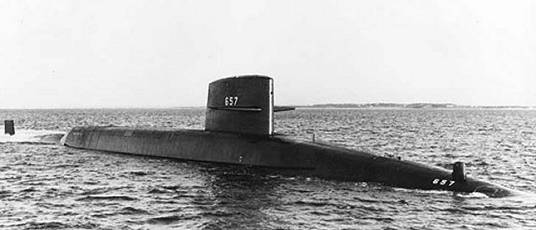
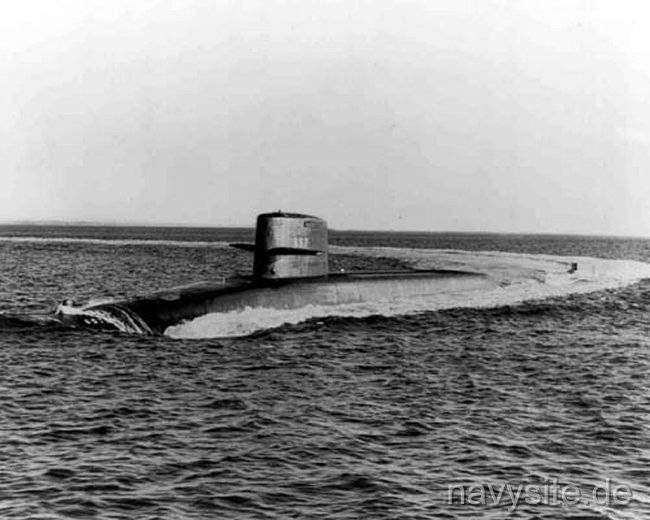
USS FRANCIS SCOTT KEY was the tenth BENJAMIN FRANKLIN - class nuclear powered fleet ballistic missile submarine. Generally similar to the LAFAYETTE - class, the twelve BENJAMIN FRANKLIN - class submarines had a quieter machinery design, and were thus considered a separate class.

Decommissioned and stricken from the Navy list on September 2, 1993, the FRANCIS SCOTT KEY subsequently entered the Navy’s Nuclear Powered Ship and Recycling Program at Bremerton, Washington. Recycling was finished on September 1, 1995.

General Characteristics:Awarded: July 29, 1963
Keel laid: December 5, 1964
Launched: April 23, 1965
Commissioned: December 3, 1966
Decommissioned: September 2, 1993
Builder: Electric Boat Division of General Dynamics Corp., Groton, CT.
Propulsion system: one S5W nuclear reactor
Propellers: one
Length: 425 feet (129.6 meters)
Beam: 33 feet (10 meters)
Draft: 31.5 feet (9.6 meters)
Displacement: Surfaced: approx. 7,250 tons; Submerged: approx. 8,250 tons
Speed: Surfaced: 16 - 20 knots;Submerged: 22 - 25 knots
Armament: 16 vertical tubes for Polaris or Poseidon missiles, four 21" torpedo tubes for Mk-48 torpedoes, Mk-14/16 torpedoes, Mk-37 torpedoes and Mk-45 nuclear torpedoes
Crew: 13 Officers and 130 Enlisted (two crews)


Back to topback to top  go to endgo to the end of the page


Back to topback to top  go to endgo to the end of the page

Crew List:

This section contains the names of sailors who served aboard USS FRANCIS SCOTT KEY. It is no official listing but contains the names of sailors who submitted their information.


back to top  go to the end of the page


Back to topback to top  go to endgo to the end of the page

USS FRANCIS SCOTT KEY History:

USS FRANCIS SCOTT KEY belonged to the BENJAMIN FRANKLIN-class, the final evolution of the original "41 for Freedom" fleet ballistic missile submarines that underpinned the United States' strategic deterrent during the Cold War. Ordered on July 29, 1963, from the Electric Boat Division of General Dynamics at Groton, Connecticut, her keel was laid there on December 5, 1964. She was launched on April 23, 1965, with two of Francis Scott Key's descendants, Marjory Key Thorne and William T. Jarvis's wife, acting as sponsors, and commissioned on December 3, 1966. Captain Frank W. Graham took command of the Blue Crew, while Lieutenant Commander Joseph B. Logan led the Gold Crew, establishing the dual-crew system that would allow the submarine to remain on deterrent patrol for much of its career while crews alternated between sea and shore.

After commissioning, USS FRANCIS SCOTT KEY conducted initial trials and shakedown out of New London, Connecticut, which functioned as her early homeport from the period of construction through January 1972. The shakedown period in the Atlantic and Caribbean combined basic propulsion and diving trials with the first live firings of her Polaris missiles. During this time, she visited ports like St Croix in the U.S. Virgin Islands, used as a liberty port during shakedown, and coastal communities near the Eastern Test Range at Cape Canaveral, including Cocoa Beach and Port Canaveral, which supported missile operations.

On April 3, 1967, she carried out her first recorded Polaris A3 launch from the Eastern Test Range off Florida, a roughly 1,000-kilometer ballistic flight that inaugurated her role as an operational launch platform. Additional Polaris A3 test and follow-on operational test (FOT) salvos followed, including a three-shot FOT series on April 26, 1968, and dual operational test shots on May 11, 1970, all flown from the Cape Canaveral area.

By June 1967, after these shakedown firings and post-shakedown availability, she commenced her first Polaris deterrent patrol, transitioning from a new construction unit into a fully integrated component of the strategic nuclear deterrent.

From 1967 onward, USS FRANCIS SCOTT KEY operated under Submarine Squadron 16 (SUBRON 16), with her crew families and administrative support tied initially to New London but with her patrol pattern centered on forward bases in Europe. She used Holy Loch, Scotland, as a principal overseas refit and crew-turnover site between 1967 and 1970, working alongside submarine tenders that provided maintenance and logistics support. Holy Loch was one of the key Royal Navy anchorages used by United States Polaris submarines to maintain continuous patrol coverage of Soviet targets during the tense years of the late 1960s, when the Vietnam War was ongoing and NATO-Warsaw Pact tensions remained high. Deterrent patrols typically followed a cycle: several weeks of refit and crew hand-over alongside a tender, then a submerged patrol of roughly two months, during which the submarine remained hidden in designated patrol areas before quietly returning for the next refit.

An important and potentially hazardous episode in USS FRANCIS SCOTT KEY's early history occurred on November 29, 1970, at Holy Loch. That day, a serious fire broke out aboard the submarine tender USS CANOPUS (AS 34) while she was moored in Scotland. USS FRANCIS SCOTT KEY and USS JAMES K. POLK (SSBN 645) were alongside the tender when the blaze erupted. FRANCIS SCOTT KEY cast off and moved clear while the tender and her crew struggled to contain the fire, which burned out of control for several hours, killed three men, and threatened a substantial stock of Polaris missiles and warheads held aboard the tender and the submarines.

Over these years, the submarine alternated between Holy Loch and Rota, Spain, another forward base used by SUBRON 16. Crew association material describes Rota as an "overseas home port", where a tender lay alongside a pier within a Spanish base, and where USS FRANCIS SCOTT KEY would refit and change crews roughly every 30 days between patrols. These patrols unfolded against the backdrop of late-1960s Cold War crises, the intensification and later wind-down of the Vietnam War, and early discussions that would lead to the Strategic Arms Limitation Talks (SALT I). Throughout this period, FRANCIS SCOTT KEY still carried Polaris A3 missiles, which represented the original ballistic missile armament of the 41 for Freedom boats.

By the early 1970s, the United States had begun shifting from Polaris to the more capable Poseidon C3 missile, which offered greater payload and improved accuracy. As part of that modernization, USS FRANCIS SCOTT KEY was scheduled for a first major overhaul and missile conversion. In 1971 and again in 1972, she transited the Panama Canal as she moved from the Atlantic to the Pacific and back, routing via San Diego, which she visited in February 1972 during her passage toward the Puget Sound Naval Shipyard at Bremerton, Washington.

Overhaul number one, conducted with a single combined crew rather than separate Blue and Gold crews, ran from February 1972 to May 1973 and included her conversion from Polaris to Poseidon C3, as well as extensive maintenance and modernization of her propulsion and ship systems.

On May 17, 1973, USS FRANCIS SCOTT KEY completed her Poseidon conversion at Puget Sound Naval Shipyard. She was the twentieth SSBN to receive C3 capability and the boat whose completion closed out the Fiscal Year 1972 Poseidon conversion program, marking a milestone in the transition of the Atlantic strategic submarine force from Polaris to Poseidon.

The Gold Crew subsequently carried out a Demonstration and Shakedown Operation (DASO) off Cape Canaveral, launching a Poseidon C3 missile on September 15, 1973, to validate both the ship's systems and crew proficiency. On December 10, 1973, FRANCIS SCOTT KEY deployed on her first operational Poseidon patrol following conversion, once again from the Eastern Test Range area, before resuming regular deterrent patrol cycles.

After returning to the Atlantic, USS FRANCIS SCOTT KEY's administrative homeport shifted to Charleston, South Carolina, which served as a major support base for fleet ballistic missile submarines. Photographs show her passing Fort Sumter in Charleston harbor in 1973, at the start of this new phase. From Charleston, her crews and families were supported while the boat herself routinely deployed forward to Rota and Holy Loch under SUBRON 16, continuing the pattern of trans-Atlantic strategic deterrent patrols. The early and mid-1970s saw the signing of SALT I and later SALT II, but the number of deterrent patrols remained high. In this period, FRANCIS SCOTT KEY carried Poseidon missiles, which allowed more warheads per missile, and thus greater flexibility in targeting. Crew association material and missile-program histories show her completing multiple Poseidon operational and test launches, building on the DASO of 1973, while filling a continuous schedule of submerged patrols.

Over the course of the 1970s, the submarine also accumulated a modest record of liberty and transit visits beyond her refit ports. She passed through the Panama Canal three times - twice in the early 1970s and once again in 1993 - and visited locations such as Bermuda and Annapolis during transit legs. One documented overseas port call occurred in Halifax, Nova Scotia, in 1978, reflecting North Atlantic activity at a time when NATO anti-submarine exercises and Soviet naval deployments in the region made the area strategically sensitive.

In the later 1970s, U.S. planners began to backfit a subset of Poseidon-armed SSBNs with the new Trident I C4 missile, intended as an interim step before the arrival of the larger OHIO-class submarines with Trident II. USS FRANCIS SCOTT KEY was selected as one of these backfit boats. In 1978, she began a period of modifications and preparations that would culminate in her becoming the first submarine to take Trident I C4 to sea on deterrent patrol. Missile-launch records and contemporary reporting show a detailed sequence of Trident I flight tests conducted from the boat in 1979 off the Eastern Test Range. On April 10, 1979, off Cape Canaveral, she executed the first submerged launch of a Trident I C4 missile, a highly publicized event demonstrating that an older BENJAMIN FRANKLIN-class hull could successfully deploy the new weapon.

Subsequent test launches followed: additional program evaluation missions in June and July 1979, culminating in complex multi-shot sequences on July 22 and July 31, and DASO shots in late August and late September as both crews proved their proficiency with the new weapon system.

Once the flight-test program validated the backfit, USS FRANCIS SCOTT KEY moved swiftly into Trident I operational service. By late 1979, she had completed the first deterrent patrol by any submarine armed with Trident I C4 missiles, a milestone noted in contemporary accounts of the Trident program.

In 1980, she conducted further operational test launches: on February 28, 1980, she fired a four-missile salvo as part of an operational test series, with each missile following a full-range trajectory from the Eastern Test Range. These launches were part of the broader evolution of the U.S. sea-based nuclear deterrent, as Trident-armed boats began to take over from Polaris and Poseidon and as the first OHIO-class SSBNs entered service. During this transition, the basing architecture of the Atlantic SSBN force also changed. SUBRON 16 and its boats, including USS FRANCIS SCOTT KEY, shifted from Rota and Charleston support infrastructure toward the rapidly developing base at Kings Bay, Georgia, which was designated as the primary East Coast home for Trident-armed submarines. By the end of the 1970s, SUBRON 16 had relocated from Rota to Kings Bay, and FRANCIS SCOTT KEY's deterrent patrols were increasingly supported from this new base, even as her crew families still had strong ties to Charleston.

During these years, a well-known series of photographs - used in public discussions of the Trident program - showed a Trident I missile launching from a submerged USS FRANCIS SCOTT KEY and the pattern of multiple re-entry vehicles descending into the Atlantic, visually embodying the MIRV concept and the growing sophistication of sea-based ballistic missiles.

By the early 1980s, after years of intensive deterrent operations, USS FRANCIS SCOTT KEY required a comprehensive refueling overhaul. According to official Trident program documentation, she commenced this refueling overhaul on February 1, 1983, at Newport News Shipbuilding and Drydock Company in Newport News, Virginia. As with her earlier overhaul at Bremerton, the Blue and Gold crews were combined for the duration of the yard period, and the submarine's homeport for administrative and family purposes shifted accordingly to Newport News. Crew association material records this second overhaul as running from February 1983 through August 1985, reflecting the time needed not only to refuel the reactor but also to upgrade combat systems, navigation equipment, and habitability features for a boat already approaching two decades of service.

As with any SSBN refueling overhaul, this process was crucial to allow the submarine to continue strategic operations into the 1990s. After the yard period, the boat conducted another Demonstration and Shakedown Operation to prove the integrity of her systems and the competence of her re-constituted crews. On December 7, 1985, she launched a Trident I C4 missile as part of Demonstration and Shakedown Operation 24, again from the Eastern Test Range off Florida, validating that the refueled and modernized submarine remained a fully capable strategic asset.

In the mid-1980s, during a period of renewed U.S.-Soviet tension but also early arms-control progress leading toward the Intermediate-Range Nuclear Forces (INF) Treaty, USS FRANCIS SCOTT KEY continued a pattern of deterrent patrols while also contributing to periodic test launches. U.S. Naval Institute's contemporary review of 1986 operations notes her participation in Trident I launch activity that year, reflecting continuing operational testing of the system.

Through the late 1980s, as the Cold War neared its end, FRANCIS SCOTT KEY maintained her deterrent role even while the geopolitical environment changed rapidly. Arms-control agreements and unilateral measures in the late 1980s and early 1990s began to reduce the total number of nuclear warheads at sea, but strategic ballistic-missile submarines remained central to U.S. deterrence policy. The crew association history records that in total she completed 72 strategic deterrent patrols, and that this sustained operational tempo - punctuated by two major overhauls and multiple missile conversions - essentially filled the years between commissioning in 1966 and the early 1990s.

By 1992, with the dissolution of the Soviet Union and the negotiation of the Strategic Arms Reduction Treaty (START I), the United States began drawing down the older fleet-ballistic-missile submarines. That year, the Gold Crew of USS FRANCIS SCOTT KEY conducted the submarine's final deterrent patrol, recorded as Patrol 72, marking the end of her operational contribution to the strategic deterrent. During her penultimate patrol in 1992, she undertook a rare publicized Mediterranean port visit: after transiting the Strait of Gibraltar submerged, she surfaced and entered Toulon, France, for a port call. This visit occurred against the backdrop of a transformed European security landscape, with NATO and the former Warsaw Pact states redefining their relationships in the aftermath of the Cold War.

Following the last patrol, USS FRANCIS SCOTT KEY's two crews were combined into a single crew as preparations began for inactivation. Her official homeport shifted from Charleston, South Carolina, to the Pacific in late 1992, a move that reflected both organizational realignment and the need to bring the boat into the Pacific for decommissioning at Bremerton, Washington. In 1993, she transited the Panama Canal for the third and final time in her career, moving from the Atlantic to the Pacific once more. En route and during the final months of her active life she also called at ports such as Pearl Harbor and, ultimately, Bremerton, which would be her last berth as an operational unit.

USS FRANCIS SCOTT KEY was decommissioned at Bremerton on September 2, 1993. On the same day she was stricken from the Naval Vessel Register, formally ending her career as USS FRANCIS SCOTT KEY (SSBN 657). Like other nuclear-powered submarines of her generation, she entered the Navy's Nuclear-Powered Ship and Submarine Recycling Program at Puget Sound Naval Shipyard, where her reactor compartment was removed and disposed of and the remaining hull structure was dismantled. The recycling process was completed on September 1, 1995, at which point the submarine ceased to exist as a physical ship.


Back to topback to top  go to endgo to the end of the page


Back to topback to top


Back to Ballistic Submarines list. Back to ships list. Back to selection page. Back to 1st page.