
Search the Site with

|
Search the Site with
|
 General Characteristics Crew List Memorabilia Cruise Books About the Ship's Name Accidents aboard the Ship History to end of page
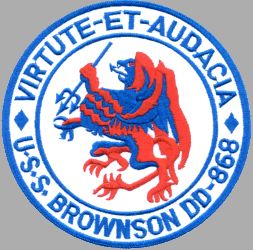 | 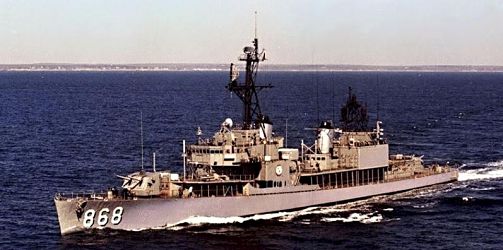 |
USS BROWNSON was one of the GEARING - class destroyers and the second ship in the Navy to bear the name. Both decommissioned and stricken from the Navy list on September 30, 1976, the BROWNSON was sold for scrapping on June 10, 1977, to North American Smelting, Bordentown, NJ.
| General Characteristics: | Awarded: 1943 |
| Keel laid: February 13, 1945 | |
| Launched: July 7, 1945 | |
| Commissioned: November 17, 1945 | |
| Decommissioned: September 30, 1976 | |
| Builder: Bethlehem Steel Co., Staten Island, N.Y. | |
| FRAM I Conversion Shipyard: Boston Naval Shipyard, Boston, Mass. | |
| FRAM I Conversion Period: 1963 - May 1964 | |
| Propulsion system: four boilers, General Electric geared turbines; 60,000 SHP | |
| Propellers: two | |
| Length: 391 feet (119.2 meters) | |
| Beam: 41 feet (12.5 meters) | |
| Draft: 18.7 feet (5.7 meters) | |
| Displacement: approx. 3,400 tons full load | |
| Speed: 34 knots | |
| Aircraft after FRAM I: two DASH drones | |
| Armament after FRAM I: one ASROC missile launcher, two 5-inch/38 caliber twin mounts, Mk-32 ASW torpedo tubes (two triple mounts) | |
| Crew after FRAM I: 14 officers, 260 enlisted |
 back to top go to the end of the pageback to top go to the end of the page
Crew List:
This section contains the names of sailors who served aboard USS BROWNSON. It is no official listing but contains the names of sailors who submitted their information.
back to top go to the end of the pageback to top go to the end of the pageUSS BROWNSON Cruise Books:
back to top go to the end of the pageAbout the Ship's Name:
Born in Lyons, N.Y., 8 July 1845, Willard Herbert Brownson graduated from the Naval Academy in 1865. He commanded the protected cruiser DETROIT at Rio de Janeiro, Brazil, during the revolution of 1893-94 and YANKEE during the Spanish-American War. From 1900 until 1902 he was Superintendent of the Naval Academy. He became Commander-in-Chief of the Asiatic Fleet 15 October 1906. After his retirement in July 1907 he continued on active duty as Chief of the Bureau of Navigation by order of President Theodore Roosevelt. Rear Admiral Brownson died at Washington, D.C., 16 March 1935.
back to top go to the end of the pageAccidents aboard USS BROWNSON:
| Date | Where | Events |
|---|---|---|
| November 8, 1950 | off Bermuda | USS BROWNSON and her sistership USS CHARLES H. ROAN (DD 853) collide during night operations, killing four. BROWNSON receives heavy damage to her bow. She receives a temporary bow at the US Naval Base at Bermuda before heading for the Boston Naval Shipyard for repairs. |
back to top go to the end of the pageUSS BROWNSON History:
USS BROWNSON was launched 7 July 1945 by Bethlehem Steel Co., Staten Island, N.Y.; sponsored by Miss Caroline Brownson Hart, granddaughter of Admiral Bronson; and commissioned 17 November 1945, Commander W. R. Cox in command.
BROWNSON conducted shakedown in the Atlantic and Caribbean and was then placed in a reduced operational status at Bath, Maine, for six months. Resuming active operations in October 1946, she participated in Operation High Jump between November 1946 and April 1947.
BROWNSON spent the summer and fall of 1947 operating out of Newport. In February 1948 she took part in the 2nd Fleet exercises in the Caribbean and then joined the 6th Fleet in the Mediterranean. She returned to Newport in June 1948 and spent June 1948 to May 1949 conducting reserve cruises.
In May 1949, she entered Boston Naval Shipyard for an extensive modernization which lasted until March 1950. She conducted refresher training in the Caribbean and in the summer of 1950 made a Midshipmen cruise in the Caribbean. She then participated in fleet exericses, operating out of Newport.
During night operations off Bermuda on 8 November 1950 BROWNSON collided with CHARLES H. ROAN (DD 853). She returned to Boston for repairs and further modernization. Leaving the yeard in February 1951 she joined the 6th Fleet in the Mediterranean. The period between October 1951 and August 1952 was spent in the vicinity of Newport. In August 1952, she went to the North Atlantic with the 2nd Fleet for NATO's Operation Mainbrace. In October 1952, she rejoined the 6th Fleet in the Mediterranean. Returning to Newport in February 1953, she operated along the Atlantic seaboard and in the Caribbean until August 1954, with the exception of one Midshipmen cruise and participation in Operation Springboard.
She departed Newport 2 August for an extended tour in the Far East with the 7th Fleet. In the Far East, BROWNSON cruised in Japanese, Philippine, and Korean waters until January 1955. Departing the Far East she returned to the east coast, via the Suez Canal, arriving at Newport 14 March 1955.
From mid-1955, USS BROWNSON settled into an Atlantic Fleet rhythm. Through the remainder of 1955 she operated from Newport along the east coast and in the Caribbean, alternating type training, gunnery shoots, and exercises with upkeep. The following year placed her in the Mediterranean at a tense moment: in late October-November 1956 she passed southbound through Suez only hours before Anglo-French military operations began. When President Nasser blocked the canal, BROWNSON was left in the Red Sea and remained there for roughly two months before continuing the long way around the globe to return home, a detour emblematic of the canal's closure and its effect on fleet movements.
By October 1958, BROWNSON had been reassigned to the newly formed Destroyer Development Group Two, the Atlantic Fleet's at-sea laboratory for anti-submarine warfare. In that role she became the first ship to carry an operable variable-depth sonar (VDS), towing a transducer from the stern to "look" beneath thermal layers that masked submarines from hull-mounted sets. Over the next years, she conducted repeated trials in the North Atlantic and off the U.S. northeast coast, including heavy-weather sorties specifically ordered to prove new sonar fairings and domes. The work demanded steady periods under way interleaved with calibrations pierside at Newport and short logistics calls in the Canadian Maritimes and the Caribbean as range schedules required.
In October 1962, BROWNSON shifted from test platform to front-line unit as the Cuban crisis peaked. She steamed to the Caribbean and took part in the naval quarantine during the high-risk fortnight beginning 24 October, screening, intercepting, and reporting in company with other Atlantic destroyers until tensions eased. The destroyer returned to her home waters in November and entered the Boston Naval Shipyard soon after for a comprehensive FRAM I conversion that ran through May 1964. The overhaul modernized her thoroughly: ASROC replaced older ahead-throwing weapons, twin Mk 32 torpedo tubes were installed, a DASH helicopter deck and hangar rose aft, and the No. 2 5-inch mount was removed to make room for the new ASW battery and electronics. Refresher training at Guantanamo followed, and in August 1964 she crossed to the Mediterranean for a Sixth Fleet cruise that mixed carrier screen duty and ASW exercises with port visits including Golfe-Juan, Naples and Livorno, Athens and Rhodes, Barcelona, Cagliari, and Pollenca Bay. She returned to Newport to resume test work with DESDEVGRU-2.
During 1965, BROWNSON ranged widely under NATO auspices in the North Atlantic, visiting a string of northern European ports while honing FRAM-era ASW tactics with allied escorts and carriers. In 1966, she first served as a destroyer school ship alongside GAINARD (DD 706) and HARLAN R. DICKSON (DD 708) in Narragansett Bay and the Caribbean, then prepared for an around-the-world Western Pacific deployment. Getting under way in October 1966, she reached the Gulf of Tonkin on 21 November and, with CHARLES P. CECIL (DD 835), joined FRANKLIN D. ROOSEVELT (CVA 42) at "Yankee Station". After plane-guard service through 29 November she shifted south to the I Corps coast for naval gunfire support. On 26 December she conducted ASW exercises with STODDARD (DD 566) and CARBONERO (SS 337), and while in Kaohsiung harbor the crew assisted in extinguishing a serious cargo-hold fire aboard the Panamanian merchantman SS ORIANA. She returned to Vietnamese waters in January 1967 for bombardments in the III Corps area, then completed the circumnavigation and arrived home in April 1967.
BROWNSON entered the Boston Naval Shipyard on 1 December 1967 for overhaul and installation of a large, low-frequency experimental sonar suite that gave her a distinctive profile and a new round of test obligations. On completing yard work she ran refresher training at Guantanamo Bay in mid-1968 and resumed sea trials and evaluations that autumn. Early in 1969, she deployed for six months to the Mediterranean and northern European waters and returned in early July. For her performance in intensive North Atlantic ASW exercises she received the Navy Meritorious Unit Commendation. On 1 July 1969, she joined Destroyer Squadron 10. That summer she also operated at high latitudes with WASP (CVS 18), VOGE (DE 1047), KOELSCH (DE 1049), O'HARE (DD 889), BORDELON (DD 881), and WILLIAM V. PRATT (DLG 13). In September, acting as plane guard for FRANKLIN D. ROOSEVELT in the Caribbean, she rescued two men overboard from the carrier and then helped search for two A-4 pilots after a mid-air near St. Croix. In October 1969, she returned to Boston for installation and calibration of additional experimental sonar equipment before resuming trials.
From 1970 into 1971, BROWNSON's schedule centered on operations out of Newport and recurring exercises in the Caribbean and off the Virginia Capes. She worked frequently with BASILONE (DD 824), CHARLES P. CECIL (DD 835), GARCIA (DE 1040), KOELSCH, BARRY (DD 933), and BELKNAP (DLG 26), blending fleet ASW problems with gunnery and underway-replenishment drills. The development-test mission continued alongside fleet tasks; with the twin-dome "PAIR" sonar suite she had been proving since 1967, her crews routinely ran structured evolutions in poor weather to validate acoustic performance.
In 1972 she again crossed to the Mediterranean, operating with the Sixth Fleet in the eastern basin - north of Egypt and through the Aegean - during a period of intensive NATO activity. Port calls included Rota and Naples, Sicilian anchorages, Aegean islands such as Chios, and Turkish ports associated with allied exercises and presence patrols. The cruise closed with her return to Newport. After first-half-1973 stateside operations she shifted home port to Mayport, Florida, in August 1973 to align with Atlantic Fleet tasking further south.
On 4 January 1974, BROWNSON departed Mayport for a winter deployment that threaded the Atlantic and European littorals: Rota, a January call at Rotterdam on 24 January, Plymouth on 14 February, then into the Mediterranean for exercises and port periods before returning to Mayport on 3 June 1974. The next spring she undertook the longest cruise of her late career. Getting underway on 15 April 1975, she headed for Africa and the Middle East with Commander, Middle East Force. After a four-day visit at Dakar she continued to Accra, where she hosted the new U.S. ambassador to Ghana, Shirley Temple Black. Upon departure on 9 May she crossed the equator at the Greenwich meridian, then pressed on for Red Sea and Persian Gulf waters at a time when regional basing and access were in flux. The deployment ran continuously until 2 October 1975, when she returned to Mayport, having completed a full Indian Ocean-Gulf presence circuit at a moment when Bahrain was redefining the terms of U.S. naval access and the Suez Canal, reopened in 1975, was restoring east-west transit options.
BROWNSON's final year was a wind-down of stateside operations, material preparations, and administrative steps leading to retirement. She decommissioned and was stricken on 30 September 1976 at Mayport, concluding three decades of service. She was sold for scrap on 10 June 1977.
back to top
 Back to Destroyers list. Back to ships list. Back to selection page. Back to 1st page.