
Search the Site with

|
Search the Site with
|
 General Characteristics Crew List Memorabilia History About the Ship's Name Image Gallery to end of page
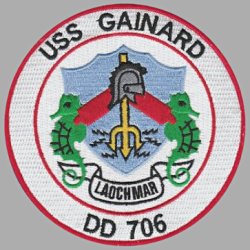 | 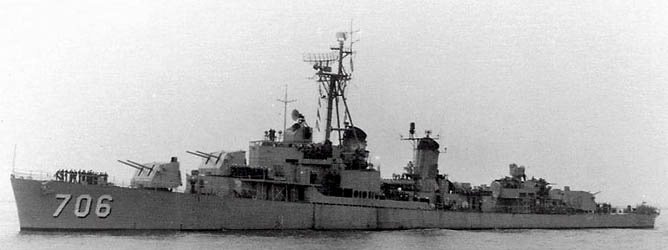 |
USS GAINARD was one of the ALLEN M. SUMNER - class destroyers and the first ship in the Navy to bear the name. Unlike many other ships in her class GAINARD did not receive a FRAM (Fleet Rehabilitation and Modernization) overhaul. Decommissioned and stricken from the Navy list on February 26, 1971, GAINARD was sold for scrapping to Boston Metal Corp., Baltimore, Md., on March 26, 1974.
| General Characteristics: | Awarded: 1942 |
| Keel laid: March 29, 1944 | |
| Launched: September 17, 1944 | |
| Commissioned: November 23, 1944 | |
| Decommissioned: February 26, 1971 | |
| Builder: Federal Shipbuilding & Drydock Co., Kearny, NJ. | |
| Propulsion system: four boilers, General Electric geared turbines; 60,000 SHP | |
| Propellers: two | |
| Length: 376.3 feet (114.7 meters) | |
| Beam: 41 feet (12.5 meters) | |
| Draft: 18.7 feet (5.7 meters) | |
| Displacement: approx. 3,300 tons full load | |
| Speed: 34 knots | |
| Armament: three 5-inch/38 caliber twin mounts, two 3-inch/50 caliber twin guns and one single 3-inch/50 caliber gun, two Mk-10 Hedgehogs, Mk-32 ASW torpedo tubes (two triple mounts) | |
| Crew: 336 |
 back to top go to the end of the pageback to top go to the end of the page
Crew List:
This section contains the names of sailors who served aboard USS GAINARD. It is no official listing but contains the names of sailors who submitted their information.
back to top go to the end of the pageback to top go to the end of the pageUSS GAINARD History:
USS GAINARD was laid down on 29 March 1944 at Kearney, N.J., by the Federal Shipbuilding & Dry Dock Co.; launched on 17 September 1944; sponsored by Mrs. Joseph A. Gainard, widow of the late Capt. Gainard; and commissioned at New York on 23 November 1944, Cmdr. Francis J. Foley in command.
After shakedown training off Bermuda, GAINARD departed New York on 1 February 1945 for operations out of San Diego and Pearl Harbor. She departed Pearl Harbor on 12 March and staged at Saipan for the forthcoming invasion of Okinawa, acting as a part of a decoy task force that made feints against the southeastern coast between 1 and 2 April while the landings were effected on the western beaches.
GAINARD operated as radar picket and fighter director ship throughout the Okinawa Campaign, detecting enemy air raids, providing early and continuous information to friendly forces, and initiating interception with a Combat Air Patrol unit that found her controlling an average of 10 planes from dawn to dusk with the assistance of a fighter director team on board. In 39 days on picket stations she was instrumental in the destruction of at least 28 suicide planes, four of which were shot down by her gunners.
On 27 occasions enemy aerial strikes of 50 or more planes attacked GAINARD and ships in her immediate vicinity. Seventeen of these attacks were close aboard the destroyer, and four nearby ships were hit by suicide planes. She manned the fighter director unit for initial landings at Iheya Shima, Aguni Shima, and Kume Shima. GAINARD also rescued the crew of a Navy patrol bomber which had run out of fuel and landed in the sea, and she directed two other damaged patrol planes back to their base. Though several times narrowly missed by determined runs of suicide planes, her skillful gunners and effective maneuvering prevented damage. She remained on station until 1 July 1945 when Okinawa was officially declared secured.
After patrol and convoy escort duty in approaches to Okinawa, she sailed on 21 July 1945 to the Philippines for logistics and upkeep. The destroyer arrived off Honshu, Japan, on 17 September and served as air-sea rescue ship until 21 February 1946 when she sailed for the United States. GAINARD reached San Pedro, Calif., on 15 March, then steamed via the Panama Canal to Casco Bay, Maine, arriving on 16 April.
Based out of Newport, R.I., her operations over the next 20 years have included nine deployments as an antisubmarine warfare specialist with the 6th Fleet; several cruises to northern Europe for the training of midshipmen; amphibious warfare exercises along the coasts of Virginia and North Carolina; plane guard duty for aircraft carriers off Mayport, Fla.; and combined Second Fleet exercises and antisubmarine tactics along the Atlantic seaboard and in the Caribbean.
As one of 150 warships from six NATO nations, in September 1957 GAINARD participated in Exercise Strikeback, large-scale combined fleet maneuvers that ranged over the North Atlantic to waters adjacent to the British Isles, between Iceland and the Faeroes, and into the Norwegian Sea and portions of the North Sea.
GAINARD's eighth tour with the Sixth Fleet (August 1960-February 1961) was interrupted by six weeks of combat readiness operations with the Middle East forces in the Indian Ocean. During her ninth Mediterranean tour (February-August 1962), she transited the Suez Canal for five days of battle rehearsals with units of the British and Iranian Navies and many days of realistic training in the Red Sea and the Persian Gulf. Other vital tasks included school ship duties for the Fleet Sonar School at Key West, Fla.; participation in Operation Mercy with carriers SHANGRI-LA (CVA 38) and ANTIETAM (CVS 36) in rendering assistance to thousands of flood-stricken victims of Hurricane Carla off the Texas coast during September-October 1961; gunnery school ship duties for the Fleet at Norfolk; and service as a unit of the Cuban Contingency Task Groups during the Cuban Missile Crisis of November-December 1962.
In May 1963, GAINARD served as support ship on recovery station during the successful launching of Faith 7, the ninth and final Project Mercury manned space flight, piloted by Astronaut L. Gordon Cooper. In addition, between 1963 and 1967 GAINARD has continued school ship and support services in the Caribbean and along the Atlantic and Gulf Coasts from Newport to New Orleans.
In late summer and early fall 1968, GAINARD crossed the Atlantic with a Sixth Fleet rotation at a moment defined by the Warsaw Pact invasion of Czechoslovakia (21 August 1968) and heightened NATO vigilance in the Mediterranean. By 11 October 1968, she was recorded at anchor off Rapallo, Italy, in company with the guided-missile escort USS RICHARD L. PAGE (DEG 5), one of several Italian Riviera liberty calls the fleet favored during that period. The pairing underscores GAINARD's integration into mixed surface groups of escorts and destroyers conducting presence operations, air-defense exercises, and replenishment evolutions in the central Mediterranean.
Through the remainder of that Mediterranean deployment - running into early 1969 - GAINARD operated under Sixth Fleet control in the central and western basin, cycling between underway periods for air-defense and antisubmarine training and short port visits that supported crew rest and logistics, before the destroyer returned to the western Atlantic to resume Newport-centered operations with the Second Fleet.
Across 1969 and into 1970, GAINARD continued Atlantic seaboard operations out of Newport - interleaving short underway periods that trained prospective destroyer department heads with fleet exercises in the Virginia Capes and Caribbean operating areas - while the Mediterranean remained active with Arab–Israeli "War of Attrition" naval episodes and persistent U.S.-Soviet shadowing at sea. GAINARD's school-ship function was well established earlier in the decade and remained part of her east-coast rhythm until inactivation preparations began. Officer training evolutions routinely paired GAINARD with other Newport destroyers such as USS HARLAN R. DICKSON (DD 708) to give students bridge-to-engine room experience under way.
On 26 February 1971 the Navy formally decommissioned and struck USS GAINARD from the Naval Vessel Register, ending more than a quarter-century of commissioned service. She entered the inactive fleet, and by 6 October 1973 she was photographed berthed at the Philadelphia Navy Yard following a transfer to Iranian custody - a Cold War policy pathway used for several retired U.S. destroyers then being evaluated for foreign transfer. Whatever the interim administrative status, the destroyer did not enter active Iranian service. Instead, the U.S. Defense Reutilization and Marketing Service disposed of the ship, with sale for scrapping recorded on 26 March 1974.
GAINARD received the Navy Unit Commendation for her extraordinary heroism in action off Okinawa (20 April-30 June 1945), and one battle star for her World War II service.
back to top go to the end of the pageAbout the Ship's Name:
Joseph Aloysius Gainard, born 11 October 1889 in Chelsea, Mass., enlisted in the US Naval Reserve Force 23 November 1917. He received the Navy Cross for distinguished service while Master of American merchant steamer CITY OF FLINT, seized by a German cruiser on the high seas 9 October 1939 but returned to him in a Norwegian fjord 3 November.
Recalled to active duty on 30 July 1941, he commanded submarine decoy ship BIG HORN (AO 45) in the Caribbean, then commanded attack transport BOLIVAR (APA 34) in the Pacific. Illness took Captain Gainard from this duty and he died in the US Naval Hospital at San Diego, Calif., 23 December 1943.
back to top go to the end of the page
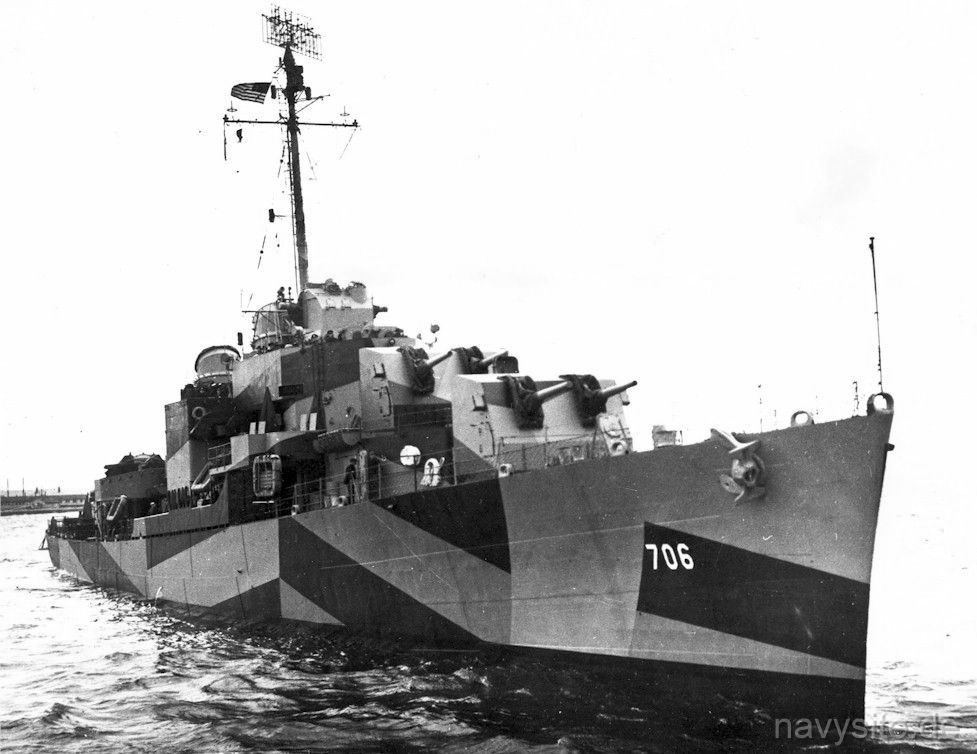
USS GAINARD Image Gallery:
 |  |  |
back to top
 Back to Destroyers list. Back to ships list. Back to selection page. Back to 1st page.