
Search the Site with

|
Search the Site with
|
 General Characteristics Crew List Memorabilia Cruise Books History About the Ship's Name Image Gallery to end of page
 |  |
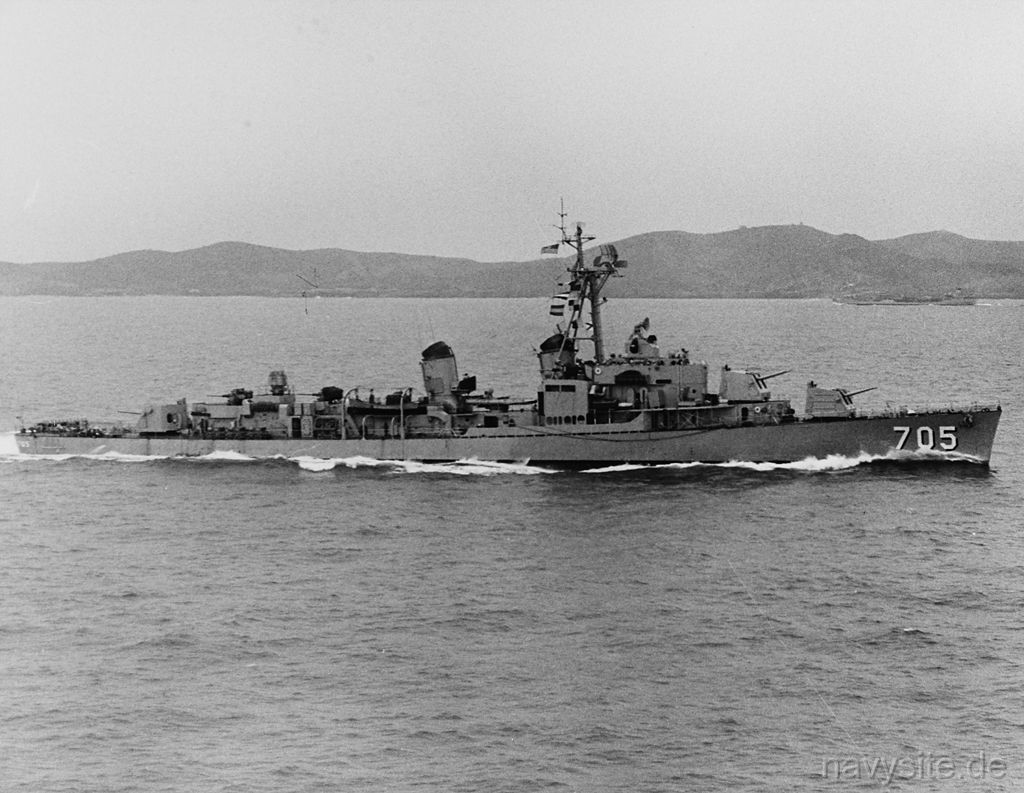
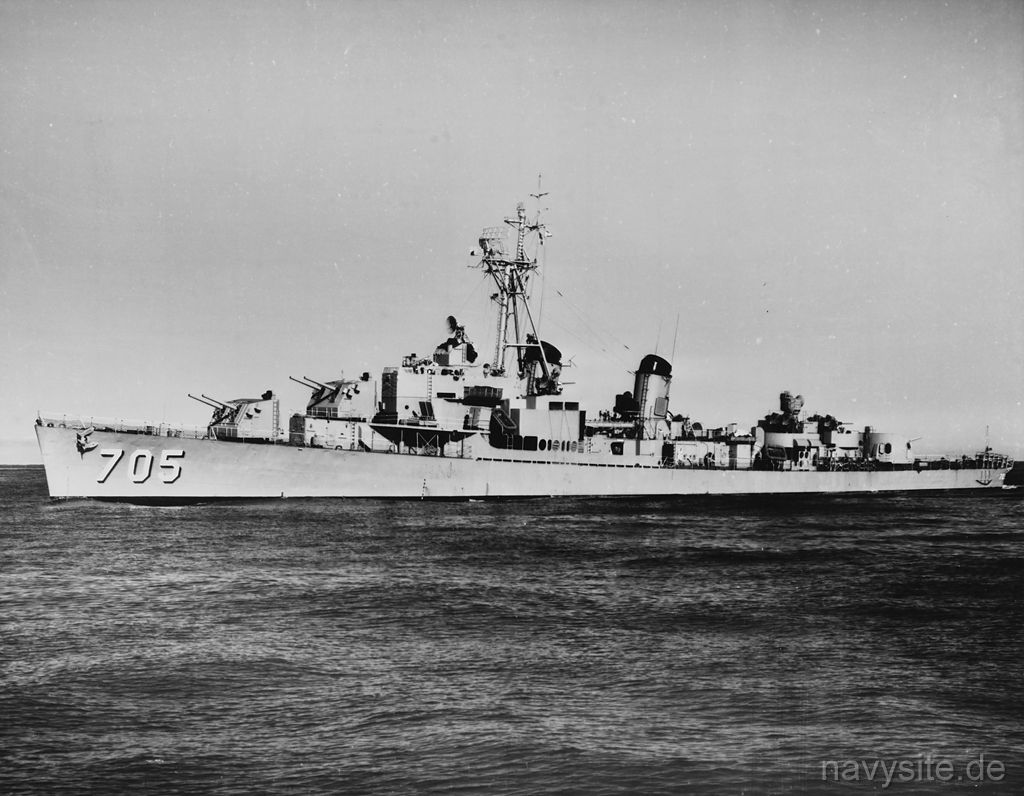
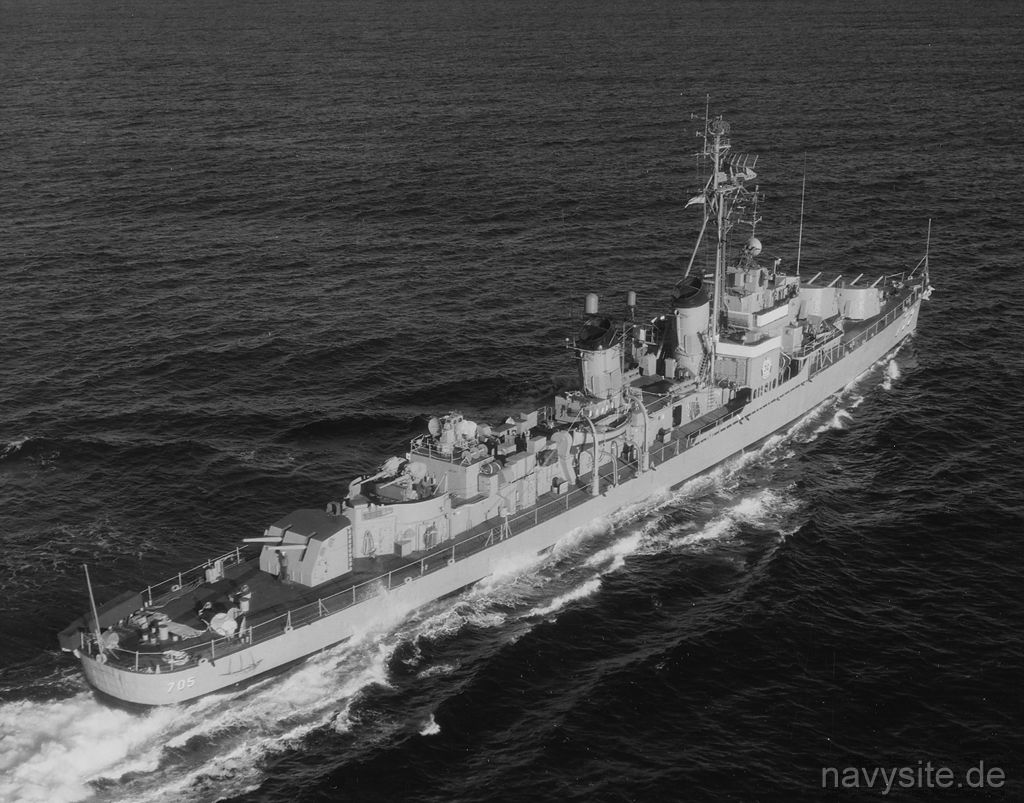
USS COMPTON was one of the ALLEN M. SUMNER - class destroyers and the first ship in the Navy to bear the name. Unlike many other ships in her class COMPTON did not receive a FRAM (Fleet Rehabilitation and Modernization) overhaul. Decommissioned on September 17, 1972, COMPTON was subsequently transferred to Brazil where she was recommissioned as MATO GRASSO. She remained in service until 1990 and was later scrapped.
| General Characteristics: | Awarded: 1942 |
| Keel laid: March 28, 1944 | |
| Launched: September 17, 1944 | |
| Commissioned: November 4, 1944 | |
| Decommissioned: September 17, 1972 | |
| Builder: Federal Shipbuilding & Drydock Co., Kearny, NJ. | |
| Propulsion system: four boilers, General Electric geared turbines; 60,000 SHP | |
| Propellers: two | |
| Length: 376.3 feet (114.7 meters) | |
| Beam: 41 feet (12.5 meters) | |
| Draft: 18.7 feet (5.7 meters) | |
| Displacement: approx. 3,300 tons full load | |
| Speed: 34 knots | |
| Armament: three 5-inch/38 caliber twin mounts, two 3-inch/50 caliber twin guns and one single 3-inch/50 caliber gun, two Mk-10 Hedgehogs, Mk-32 ASW torpedo tubes (two triple mounts) | |
| Crew: 336 |
 back to top go to the end of the pageback to top go to the end of the page
Crew List:
This section contains the names of sailors who served aboard USS COMPTON. It is no official listing but contains the names of sailors who submitted their information.
back to top go to the end of the pageback to top go to the end of the pageUSS COMPTON Cruise Books:
back to top go to the end of the pageUSS COMPTON History:
USS COMPTON was launched 17 September 1944 by Federal Shipbuilding and Drydock Co., Kearny, N.J.; sponsored by Mrs. L. Compton; and commissioned 4 November 1944, Commander R. O. Strange in command.
COMPTON cleared Norfolk 17 February 1945 for training at Pearl Harbor between 16 March and 5 April, when she sailed to escort ships to Kwajalein and Eniwetok. Sailing on to Ulithi, she cleared for Okinawa 20 April. As the operations there continued, COMPTON offered pinpoint gunfire support to forces ashore and served in the antisubmarine and antiaircraft screens protecting shipping off the island. On 12 May she covered the occupation of nearby Tori Shima, and while returning to her station off Okinawa was attacked by a lone Japanese plane which she splashed.
After repairs at Leyte from 17 May to 16 June 1945, COMPTON returned to Okinawa for continued operations until 4 July, when she sailed to escort a convoy to Guam, returning to Leyte Gulf 10 July. For the remainder of the month, she screened ships training in the Gulf, then returned to Okinawa, where she lay at anchor in Buckner Bay until 25 August. Sent then to carry mail to the 3rd Fleet at sea, COMPTON entered Sagami Wan 28 August. For the next 6 months, she served on patrol in the western Pacific, and acted as planeguard while air organizations were redistributed throughout the Far East. She cleared Yokosuka 21 February 1946 for San Pedro, Calif., arriving 15 March. Two weeks later she sailed to join the Atlantic Fleet, reaching Portland, Maine, 16 April. After overhaul, she operated along the northeast coast and in the Caribbean until 3 February 1947, when she sailed for her first tour of duty in the Mediterranean. COMPTON returned to her homeport, Newport, R.I., 14 August 1947.
Along with east coast operations, COMPTON cruised the Caribbean on intensive training and midshipmen cruises in the years that followed, as well as serving as schoolship and training members of the Naval Reserve. During her 1948-49 deployment to the Mediterranean, she had duty with the United Nations Palestine Patrol. She returned to the Mediterranean in 1951, and in the late summer of 1952 cruised in European waters in NATO Operation "Mainbrace". Assignment to duty with the 6th Fleet in the Mediterranean came once more in 1953 and 1955, and in the spring of 1956, COMPTON exercised off Bermuda with ships of the British Home Fleet in NATO operation "New Broom V".
COMPTON was serving at Bahrain in the Persian Gulf in the fall of 1956 when the Suez Crisis erupted, and stood by to evacuate American civilians in the Persian Gulf and Red Sea areas should that become necessary. With the Canal closed, COMPTON made her homeward passage by way of Mombasa, Durban, the Cape of Good Hope, Simonstown, Recife, and Trinidad, returning to Newport 8 January 1957. That fall, she again cruised off the British Isles in a series of NATO operations. From November 1957 to April 1958, she again served in the Mediterranean, the Persian Gulf and the Red Sea, and that summer cruised to Rotterdam and Bergen with midshipmen on board for training. From that time into 1960, her operations were coastwise and in the Caribbean, as she aided research and development projects, including major meteorological research and gave service to the Fleet Sonar School at Key West.
COMPTON again sailed for duty with the Sixth Fleet in the Mediterranean in August 1960. Through the autumn she fell into the familiar destroyer rhythm - carrier screen and plane-guard evolutions, anti-submarine exercises with allied navies, and periodic logistics or upkeep alongside tenders at forward anchorages - before returning to the U.S. East Coast to close the year in a maintenance and training posture. The 1960 deployment reflected the Navy's steady Cold War presence in the Mediterranean following the Suez shock and the maturing of NATO's maritime exercise architecture.
Stateside in 1961, COMPTON operated primarily with Second Fleet from Newport and Norfolk, punctuating local training with a high-profile national task late in the year. In November 1961, she deployed twice with TASK FORCE 140, the Atlantic recovery force for NASA's Mercury program, to support the MERCURY-ATLAS 5 mission that launched the chimpanzee Enos into orbit on 29 November 1961. Enos completed two Earth orbits and splashed down south of Bermuda the same day. COMPTON's TF-140 sorties provided sea-based surveillance, communications relay, medical and rescue contingency coverage, and picket duties amid a wide net of recovery ships built around the prime recovery carrier. The destroyer returned to Newport in early December to resume normal operations.
The tempo accelerated in October-November 1962 as the Cuban Missile Crisis broke. With President Kennedy's proclamation of a naval "quarantine" effective 24 October 1962, COMPTON shifted to Atlantic barrier operations and submarine-screening tasking. On 12 November 1962, she joined a hunter-killer anti-submarine group operating southeast of Bermuda - part of the layered quarantine force that combined surface screens, ASW carriers, and patrol aircraft to deter reinforcement of Cuba and to manage Soviet submarine activity on the approaches. Her patrols ran through the heart of the crisis window and into the November stand-down as Moscow agreed to withdraw offensive missiles, after which she returned to East Coast routines.
In early 1963, COMPTON remained with Second Fleet for Atlantic and Caribbean evolutions, then in March 1963 joined TASK GROUP BRAVO for contingency coverage of President John F. Kennedy's visit to San Jose, Costa Rica (18-20 March 1963). Operating with the anti-submarine carrier USS WASP (CVS 18) and in company with fellow destroyers including USS GAINARD (DD 706) and USS DAVIS (DD 937), she provided sea-control and ASW presence along the Central American approaches while the presidential summit proceeded ashore. The group then resumed ASW exercises in the Caribbean before COMPTON returned north for upkeep and inspections.
Through 1964-1967, COMPTON's record shows continued Atlantic-based operations with periodic Mediterranean duty and recurring NATO/SECNAV exercise phases characteristic of SUMNER-class destroyers in this era. She did not receive a FRAM conversion, but maintained reliability through tender periods and yard availabilities that kept her sensors, gunnery, and engineering plants in sound condition for plane-guard, screen, and anti-submarine roles with Sixth Fleet when tasked and Second Fleet when homeported. The pattern - short East Coast training cycles, Caribbean phases, and Sixth Fleet stretches - reflected the Navy's broader Cold War posture across the mid-1960s.
By 1968, COMPTON shifted to the Naval Reserve mission in the First Naval District (Boston). From 1968-1969 she embarked successive classes of reservists for two-week training cruises and frequent weekend drills. A typical syllabus saw COMPTON depart Boston, rendezvous with another destroyer and a submarine off New England, execute anti-submarine and formation exercises, and make a short liberty call - commonly Halifax, Nova Scotia - before returning to port. On board, reservists practiced navigation and seamanship, engineering casualty control, and weapons familiarization from the 5-inch batteries to depth-charge and Hedgehog procedures, closely mirroring active-duty routines.
The destroyer remained in Reserve Force service 1970-1972, continuing East Coast and Gulf of Maine sorties from Boston with periodic pier-side instruction and maintenance to preserve material readiness. With the SUMNER-class aging and newer escorts assuming primary fleet ASW roles, COMPTON's U.S. Navy career wound down in the summer of 1972. She was decommissioned on 17 September 1972, stricken on 27 September 1972, and that same day transferred to Brazil, where she entered service as Marinha Do Brasil's MATO GROSSO. Brazilian service continued until she was stricken in July 1990 and subsequently scrapped.
COMPTON received one battle star for World War II service.
back to top go to the end of the pageAbout the Ship's Name:
Lewis Compton was born in Perth Amboy, N.J., 7 November 1892, and enrolled in the Naval Reserve 22 March 1917. After active duty in World War I, he continued to take part in training until resigning from the Reserve 1 July 1932. After a career of public service in New Jersey, he became special assistant to the Assistant Secretary of the Navy. He himself was Assistant Secretary of the Navy from 9 February 1940 to 13 February 1941. He died in New York 24 October 1942.
back to top go to the end of the page
USS COMPTON Image Gallery:
 |  |  |  |  |
 |  |  |  |
back to top
 Back to Destroyers list. Back to ships list. Back to selection page. Back to 1st page.