
Search the Site with

|
Search the Site with
|
 General Characteristics Crew List History Image Gallery to end of page
 |  |
USS QUAPAW was one of the ABNAKI - class fleet ocean tugs and the first ship in the Navy to bear the name. Originally commissioned as AT 110, her designation was changed to ATF 110 on May 15, 1944. QUAPAW served during World War II, the Korean War and the Vietnam War and earned the Navy Unit Commendation and four battle stars for her World War II service, five battle stars for the Korean War and seven campaign stars for her Vietnam War service. She was decommissioned on August 30, 1985, and stricken from the Navy list in January 1992. Later, she was sold and renamed MV TIGER. The TIGER ended up at the port of Richmond, Calif., where her owners abandoned her. Due to her bad condition, the Port of Richmond took her over and scrapped her at the nearby former Mare Island Naval Shipyard, Vallejo, Calif., in fall 2012.
| General Characteristics: | Keel laid: December 28, 1942 |
| Launched: May 15, 1943 | |
| Commissioned: May 6, 1944 | |
| Decommissioned: April 30, 1948 | |
| Recommissioned: December 5, 1950 | |
| Decommissioned: August 30, 1985 | |
| Builder: United Engineers and Drydock Co., Alameda, Calif. | |
| Propulsion system: four GM Diesel engines | |
| Propellers: one | |
| Length: 205 feet (62.48 meters) | |
| Beam: 38.6 feet (11.73 meters) | |
| Draft: 15.4 feet (4.7 meters) | |
| Displacement: 1,589 tons | |
| Speed: 16.5 knots | |
| Armament: commissioned with one 3-inch/50 caliber gun, two twin 40mm guns, two 20mm guns | |
| Crew: 85 |
 back to top go to the end of the pageback to top go to the end of the page
Crew List:
This section contains the names of sailors who served aboard USS QUAPAW. It is no official listing but contains the names of sailors who submitted their information.
back to top go to the end of the pageUSS QUAPAW History:
USS QUAPAW, an auxiliary ocean tug, was laid down by United Engineering Co., Alameda, Calif. 28 December 1942; launched 15 May 1943; sponsored by Mrs. N. Lehman; and commissioned 6 May 1944, Lt. Comdr. N. H. Castle in command.
Redesignated ATF 110, 15 May 1944, QUAPAW steamed for San Francisco after shakedown out of San Pedro and San Diego, Calif., through 16 June. She departed San Francisco 21 June 1944, enroute the Admiralty Islands. After calling at Honolulu, where she delivered an Army barge, a dump scow, and a derrick, she steamed 12 July via the Ellice Islands and Milne Bay, New Guinea, arriving Manus, Admiralty Islands 14 August.
Following several harbor tow assignments, she departed 17 August with a deck cargo of 7,500 bbls. of aviation gasoline and 49 motor torpedo boat engines, and with a gasoline barge in tow. These she delivered to Mios Woendi Lagoon, whence she steamed to Maffin Bay where she received orders to stand by in preparation for the landings on Morotai Island.
With a convoy of liberty ships, minesweepers, and landing craft, together with screening destroyers, QUAPAW entered Morotai Harbor the morning of 16 September 1944. She remained through 1 October, primarily engaged in retracting LSTs from the beach of Pitoe Bay.
From 20 October 1944 through 1 January 1945, QUAPAW was operating in San Pedro Bay in support of the Leyte operation. Her assignments entailed salvage, firefighting, and towing operations.
Landings were made at Lingayen 9 January 1945 and QUAPAW was assigned patrol of both attack areas to render all necessary assistance. She retracted landing ships, made repairs and conducted towing operations until 21 February. She then steamed to Mindoro. She departed Mangarin Bay 26 February as a unit of Admiral W. M. Fechteler's TG 78.2, enroute Puerto Princesa, Palawan, for initial assaults against that island. Enroute, QUAPAW took LCI-683 in tow when the latter was unable to maintain convoy speed. The landing forces went asbore 28 February and QUAPAW retracted landing craft from the beaches east of Puerto Princesa and in the vicinity of the city jetty. She returned to Mangarin Bay, 5 March.
From 8 through 25 March, QUAPAW participated in salvage and demolition work, and assisted in clearing harbor wreckage, with intervening repair and tow missions at Zamboanga, Mindanao, P.I. Further salvage, tow, and repair missions preceeded overhaul at Hollandia, New Guinea, commencing 29 May. The tug departed 25 June for Espiritu Santo, New Hebrides, from where she steamed 6 July with one section of a battleship drydock in tow for Samar, P.I. With the end of hostilities she continued towing services between various ports of the Philippines, with frequent service to Manus and back through 28 April 1946.
QUAPAW departed Subic Bay for the United States 16 June 1946, arriving San Francisco, Calif. 14 July. After overhaul at Mare Island Naval Shipyard, the tug continued coastal and trans-Pacific towing operations until 21 December 1947. She was placed in an inactive status at San Francisco until 30 April 1948 when she was placed out of commission, in reserve.
QUAPAW recommissioned 5 December 1950 at Alameda, Calif., Lt. Fleming M. Christian in command. After refresher training out of San Diego through January 1951, she steamed via Bremerton, Wash. with a barracks ship in tow for Pearl Harbor. Arriving 14 February 1951, she commenced operations under Commander Service Force, Pacific.
The fleet tug provided services at Inchon, Korea 30 April-17 July 1951, and at Wonsan 19 July-3 August. Towing services at Sasebo and Yokosuka, Japan were interrupted by patrol duty at Wonsan, Korea 26 October-20 November 1952, and by operations in the areas of Cho Do and Taechong Do, Korea 17 January-14 February 1953. QUAPAW also conducted patrols in Korean waters in March and April of 1953.
In the months after the ceasefire of 27 July 1953 she remained under Commander, Service Force, Pacific, resuming a peacetime rhythm of towing and support runs across the mid-Pacific and the Western Pacific (WestPac), with Pearl Harbor as her operational hub. Contemporary summaries later noted that by 1970 her routine consisted of these WestPac periods punctuated by mid-Pacific assignments and occasional search-and-rescue duty staged from Adak, Alaska - an arrangement that effectively describes her post-Korean War decade and the run-up to the Vietnam era.
As U.S. involvement in Southeast Asia increased, QUAPAW shifted to Vietnam support. In June 1966, she entered the Saigon River and conducted towing runs with deliveries to the inland river base at Nha Be - one of the "brown-water" logistics nodes feeding the capital region - placing a seagoing fleet tug inside a constrained, defended waterway during a period of rising tempo ashore and afloat.
Her Vietnam presence continued through the later 1960s. A photograph taken at Cam Ranh Bay in April 1969 - during the long-running coastal interdiction and logistics support effort - shows QUAPAW alongside in that major U.S. port, which functioned as both an air base and a naval logistics complex.
In April 1975, as the Republic of Vietnam collapsed, QUAPAW was ordered into a highly specific salvage task that illustrates how tugs and rescue ships under Seventh Fleet were used to solve urgent problems while the geopolitical situation deteriorated by the hour. On 4 April, a C-5A Galaxy carrying refugees suffered an explosive decompression. To determine the cause, the U.S. Air Force needed the aft ramp and cargo door recovered from the South China Sea. QUAPAW, with ABNAKI (ATF 96) and DELIVER (ARS 23) under Commander Task Force 73, rapidly converged on the predicted impact area. Using side-scan sonar and a precision navigation setup improvised afloat because shore stations could no longer be secured, DELIVER and ABNAKI served as moored platforms for the navigation gear while QUAPAW carried the sonar and receivers. After round-the-clock searching in mounting refugee traffic and amid intensifying activity ashore, divers marked two contacts on 27 April. QUAPAW recovered the ramp first, then, at nightfall, the door, before Seventh Fleet ordered the area cleared as the situation in the Saigon region unraveled.
With the situation collapsing completely, QUAPAW joined the offshore force supporting Operation Frequent Wind, the helicopter evacuation of Saigon on 29-30 April 1975. She was listed among the auxiliary and support ships gathered off Vung Tau under Commander, Task Force 76, alongside a wide array of carriers, amphibious transports, and escorts that received evacuees and kept sea space clear for constant helicopter movements through the night of 29-30 April. In that massed effort - coordinated from BLUE RIDGE (LCC 19) with OKLAHOMA CITY (CLG 5) as Seventh Fleet flagship - Fleet tugs like QUAPAW provided readiness for towing, rescue, and small-craft control on the periphery while aviation ships conducted the lift.
After the evacuation and the war's end, QUAPAW returned to routine Pacific duty. On 6 February 1976, she and DELIVER (ARS 23) refloated the grounded merchant tanker SS AUSTIN near Sand Island off Honolulu - a pollution-risk salvage that underscored the post-Vietnam emphasis on maritime safety missions around the Hawaiian sea lanes.
In the early 1980s, QUAPAW's homeport shifted to the Naval Construction Battalion Center at Port Hueneme, California, where she provided West Coast salvage, rescue, and towing services. During the Navy's battleship reactivation program, she supported heavyweight ship movements on the U.S. West Coast: in May 1984 she assisted EDENTON (ATS 1) in the tow of MISSOURI (BB 63) out of Puget Sound for workups toward recommissioning, a notable example of a fleet tug augmenting a larger rescue-salvage ship during a complex capital-ship relocation.
Her last major tow became one of her most photographed. Preparations begun in November 1984 culminated on 28 May 1985 when QUAPAW took the decommissioned nuclear-powered submarine NAUTILUS (SSN 571) in tow under the Golden Gate Bridge, bound for hand-off at the Panama Canal to RECOVERY (ARS 43) and onward transit to Groton, Connecticut, where NAUTILUS would become a museum.
QUAPAW was decommissioned on 30 August 1985 after more than four decades in commission across three wars and a long Cold War aftermath. She was stricken from the Naval Vessel Register on 28 January 1992.
Following congressional approval in 1996 for non-profit transfer and a hand-over in late 1997 intended to support a Great Lakes rail-barge concept, the ship - by then renamed TIGER - never entered service in that role and remained laid up. On 11-12 December 2011, while moored in Richmond, California, the 205-foot former fleet tug sank at her berth, prompting a unified response led by the U.S. Coast Guard and California agencies to contain and remove residual fuel and oily water. The vessel was refloated in January-February 2012 and local authorities subsequently arranged for final disposition at Mare Island later that year.
One artifact from the ship's long career survives publicly ashore: by November 2013 her anchor had been placed on display at the Quapaw Tribal Museum in Quapaw, Oklahoma, creating a tangible link between the namesake people and the Navy tug that bore their name for more than forty years.
QUAPAW received four battle stars for World War II service and five for the Korean conflict.
back to top go to the end of the pageUSS QUAPAW Image Gallery:
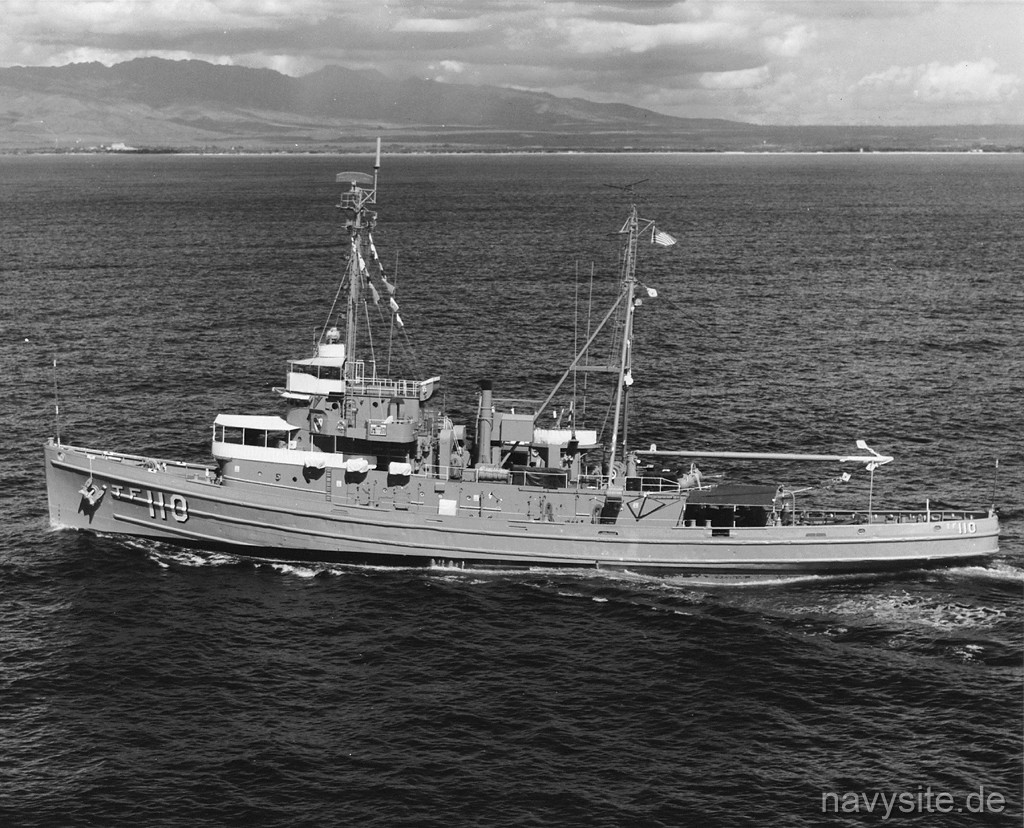 |
The photos below were taken by me and show the former QUAPAW (ATF 110) - now named TIGER - and her sistership ex MOCTOBI (ATF 105) - now named LION - laid up at Richmond, Calif., on March 28, 2010.
 |  |  |  |
The photos below were taken by me and show the former QUAPAW being scrapped in a drydock at the former Mare Island Naval Shipyard, Vallejo, Calif., on October 9, 2012. On the photo of the drydock, QUAPAW is the vessel on the left hand side. The vessel (or at least what's left of it) behind QUAPAW on the right hand side is her sistership ex MOCTOBI (ATF 105).
 |  |  |  |  |
back to top Back to Fleet Ocean Tugs Page. Back to ships list. Back to selection page. Back to 1st page.