
Search the Site with

|
Search the Site with
|
 General Characteristics Crew List History Image Gallery to end of page
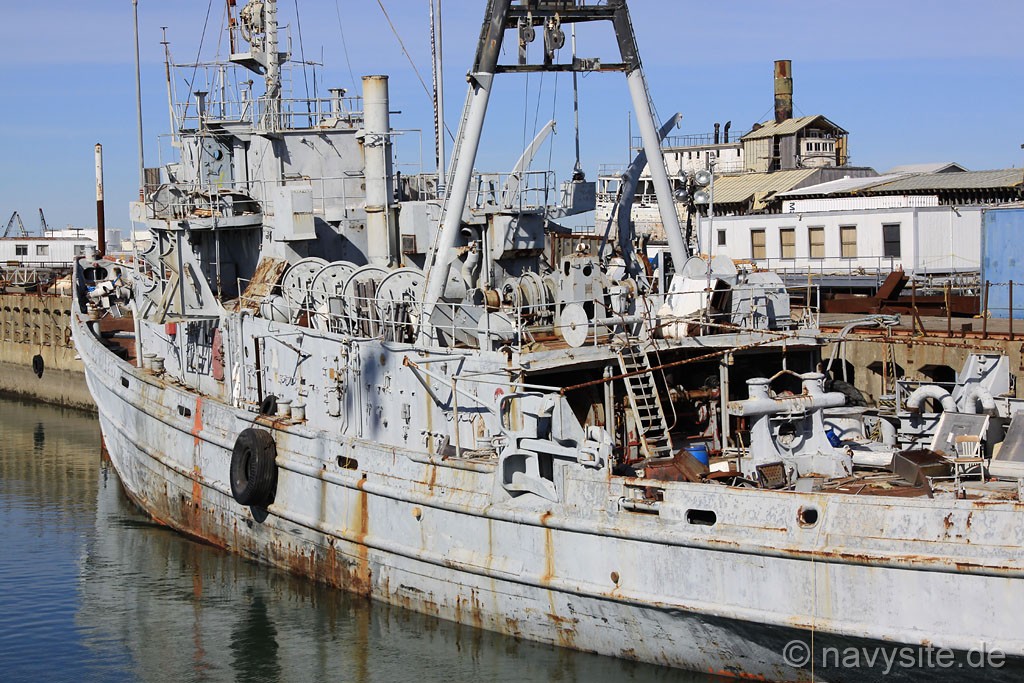
 |  Ex Moctobi (now MV Lion) at Richmond, Ca., on March 2, 2012. Photo by Thoralf Doehring |  |
USS MOCTOBI was one of the ABNAKI - class fleet ocean tugs and the first ship in the Navy named after the Native American tribe of Arizona. Originally laid down as AT 105, her designation was changed to ATF 105 on May 15, 1944. MOCTOBI served during World War II, the Korean War and the Vietnam War and earned two battle stars for the Korean War and two campaign stars for the Vietnam War. She was decommissioned on September 30, 1985, and was subsequently laid up at Bremerton, Wash. Stricken from the Navy list on January 27, 1992, the ship was sold on December 29, 1997, and renamed MV LION. The LION ended up at the port of Richmond, Calif., where her owners abandoned her. Due to her bad condition, the Port of Richmond took her over and scrapped her at the nearby former Mare Island Naval Shipyard, Vallejo, Calif., in fall 2012.
| General Characteristics: | Keel laid: October 7, 1943 |
| Launched: March 25, 1944 | |
| Commissioned: July 25, 1944 | |
| Decommissioned: June 30, 1948 | |
| Recommissioned: November 8, 1950 | |
| Decommissioned: September 30, 1985 | |
| Builder: Charleston Shipbuilding and Dry Dock Co., Charleston, S.C. | |
| Propulsion system: four GM Diesel engines | |
| Propellers: one | |
| Length: 205 feet (62.48 meters) | |
| Beam: 38.6 feet (11.73 meters) | |
| Draft: 15.4 feet (4.7 meters) | |
| Displacement: 1,589 tons | |
| Speed: 16.5 knots | |
| Armament: commissioned with one 3-inch/50 caliber gun, two twin 40mm guns, two 20mm guns | |
| Crew: 85 |
 back to top go to the end of the pageback to top go to the end of the page
Crew List:
This section contains the names of sailors who served aboard USS MOCTOBI. It is no official listing but contains the names of sailors who submitted their information.
back to top go to the end of the pageUSS MOCTOBI History:
USS MOCTOBI was laid down on 7 October 1943 at Charleston, S.C., by the Charleston Shipbuilding & Dry Dock Co.; launched on 25 March 1944; sponsored by Mrs. Wade C. Harrison; reclassified as ATF 105 on 15 May 1944; and commissioned at Charleston on 25 July 1944, Lt. Troy Braesher in command.
After shakedown in Chesapeake Bay, MOCTOBI was assigned to duty in the Pacific with ComServPac. Departing Norfolk on 1 September 1944, she stopped at New Orleans, La., where she took in tow a section of ABSD 3; thence, she sailed for the Marshalls on 8 September. She reached Eniwetok via Majuro on 21 November and steamed to Hawaii, arriving Pearl Harbor the 29th. On 12 December she sailed in convoy to Eniwetok with another ABSD section. After touching at Eniwetok the 29th, she departed on 2 January 1945 for Guam. She dropped off ABD 16 at Guam on 9 January; sailed for Ulithi the same day; and reached that important advance base two days later.
Assigned to Service Squadron 10, MOCTOBI operated out of Ulithi until the end of the war in the Pacific. There she carried out the harbor duties necessary to prepare ships of the task forces for their strikes against the enemy. During the Iwo Jima campaign she served on a standby basis with the Support Force and at the conclusion of the campaign towed MARL (IX 160) from Saipan to Ulithi.
On 30 March 1945, MOCTOBI sailed with units of the fast tanker fleet and joined the Logistic Support Group off Okinawa. During the next 47 days she provided at sea logistics support for ships of the Fifth Fleet, thence returned to Ulithi 12 to 16 May. After completing a run to Leyte Gulf and back, she departed Ulithi on 3 July with other ATFs and joined the Logistics Support Group for support of the Third Fleet Bombardment Force. She served at sea during the closing weeks of the war and arrived at Yokosuka, Japan, after the cessation of hostilities. She began supporting occupation operations on 29 August and aided in the landing of initial occupation forces in the Tokyo area. She towed U.S. and Japanese ships and supported demolition operations of Japanese suicide boats and submarines along the eastern coast of Honshu.
MOCTOBI sailed for Okinawa on 14 October 1945 and for more than two months aided in salvaging and refloating many ships damaged by typhoons. On Christmas Eve she sailed for Pearl Harbor with ARD 29 in tow. Upon arriving, she reported to ComServPac for continued duty out of Pearl Harbor. She returned to the west coast in May 1946 and later that year deployed once again to the Far East. She operated in the Philippines until June 1947, thence sailed to the United States. She began preinactivation overhaul at San Francisco on 1 December and decommissioned on 30 June 1948. Assigned to the Pacific Reserve Fleet on 27 August, she lay berthed at Alameda, Calif.
On 8 November 1950, MOCTOBI recommissioned at San Francisco, Lt. John M. Geortner in command. Following refresher training off the west coast, MOCTOBI steamed to the Far East. Between February and November 1951 she was underway almost constantly, touching Midway, Eniwetok, Kwajalein, Guam, Subic Bay, Sasebo, Yokosuka, Inchon, Pusan, Okinawa, Taiwan, and Taechong Do, Korea. In September 1951, she conducted salvage operations on the ROK frigate APNOK (ex-ROCKFORD (PF 48)) off Abru Somu Island, North Korea. She towed the damaged ship to Pusan thence to Yokosuka for repairs. She returned to Pearl Harbor in December 1951 for overhaul, thence between April and September 1952 made several towing trips to Johnston Island and the Marshalls.
In November 1952, MOCTOBI steamed to the northern Pacific for duty in the Aleutians. During the next several months she carried out towing and SAR duty from Dutch Harbor to Attu. She returned to Pearl Harbor in June 1953. Following operations between Hawaii and the west coast, she made another WestPac deployment in March 1954. Tug and towing assignments sent her from Japan to the Philippines and from Korea to French Indochina. In September, she steamed via Pearl Harbor to San Francisco, and during the next year she carried out tows along the west coast and to Pearl Harbor.
MOCTOBI maintained a busy tug and towing schedule throughout the Pacific for more than a decade. Although homeported in Pearl Harbor, she ranged the Pacific from the west coast to the Far East. She carried out towing duties to American bases throughout the Pacific and when requested, she provided emergency at sea tows for ships in distress. In addition she carried out SAR patrols and undertook special operations of a classified nature for the Atomic Energy Commission.
Following a three-month deployment to the Aleutians in mid-1963, MOCTOBI steamed to Seattle, Wash., on 15 October 1963 to prepare for an unusual towing assignment. On 28 October she departed for Honolulu, Hawaii, with the four-masted sailing ship FALLS OF CLYDE in tow. During the trip, which took 21 days, MOCTOBI encountered several severe storms with 40-knot winds and 20-foot seas. However, she delivered the wrought iron-hulled ship, earmarked for retention as a museum ship, safely to tugs off Honolulu on 21 November.
Beginning in 1964, MOCTOBI was still a Pearl Harbor-based fleet tug in nearly constant motion across the mid-Pacific and Western Pacific, shuttling heavy tows, standing search-and-rescue (SAR) watches, and taking the specialized salvage and diving capabilities of an ABNAKI-class tug wherever Commander, Service Force, Pacific, required them. By 1966, photographs place MOCTOBI at Alpha Dock, Naval Station Pearl Harbor. In this period, as the United States expanded its presence in Southeast Asia, fleet tugs like MOCTOBI were frequently assigned cross-Pacific tows that staged via Hawaii, Midway, Guam, and the Philippines, and remained on call for salvage and emergency tows to keep the amphibious and logistics pipelines moving.
Her Vietnam combat-zone work is firmly documented in 1967. During September-October 1967, MOCTOBI entered the Saigon River and provided tows and deliveries to the inland river base at Nha Be - putting a seagoing fleet tug into "brown-water" waterways amid heightened threat from mines and shore fire. The task supported the buildup of riverine and coastal operations around the capital region and earned the ship one of her Vietnam campaign stars for that year.
Through 1968 and into 1969, she continued WestPac support and cross-Pacific towing under Commander, Service Force, Pacific. In April 1969, she is repeatedly noted in WestPac photographs and crew records, consistent with a pattern of visits to Japanese and Philippine bases between assignments.
In November 1970, MOCTOBI was photographed in Lingayen Gulf, Republic of the Philippines, recovering a United States Air Force drone - an illustrative example of her at-sea salvage portfolio as U.S. services expanded target-drone and range operations in Philippine coastal waters. The following spring, she entered dry dock at Pearl Harbor for maintenance before returning to deployment cycles. These documented evolutions bookend the period in which DANFS credits MOCTOBI with her second Vietnam campaign star (1970).
On 3 August 1974, MOCTOBI figured in a high-stakes rescue in the Strait of Juan de Fuca after fleet tug LIPAN collided with another vessel and began to founder. Amphibious ship TUSCALOOSA (LST 1187) dispatched an 11-man rescue-and-assistance party to work alongside MOCTOBI; salvage control stabilized the casualty, and MOCTOBI then took LIPAN under tow for delivery to a repair yard at Seattle.
Another widely documented incident followed on 18-19 January 1978 off Southern California, when CREE (ATF 84) was mistakenly struck by three 500-pound bombs during a training mishap. After emergency explosive-ordnance disposal defused an unexploded bomb lodged aboard CREE, MOCTOBI provided pumps, fuel, and other supplies, then took the damaged tug in tow the next afternoon for return to San Diego on 19 January 1978 - closing a 27-hour struggle to keep the ship afloat.
Imagery and logs show MOCTOBI active into the late 1970s and early 1980s, including an "underway" series circa 1979-1982 and a mooring at Sasebo, Japan, consistent with continued WestPac towing and salvage readiness during the latter Cold-War years. Her profile in this phase - quiet, utilitarian, and wide-ranging - matches the class pattern: emergency tows, range support, harbor clearance and diving, and the movement of large service craft or barges between yards and forward bases.
MOCTOBI was decommissioned on 30 September 1985 at Long Beach and later struck from the Naval Vessel Register on 27 January 1992. Following Congressional authority for transfer (1996), title passed on 29 December 1997 to the Ontonagon County Economic Development Corporation on behalf of the Escanaba & Lake Superior Railroad for a proposed Lake Superior freight-barge service. Renamed MV LION, the veteran tug remained in lay-up as the project was abandoned in October 1999. She ultimately lay at Richmond, California, and - after local custody actions - was scrapped at the former Mare Island Naval Shipyard in fall 2012.
MOCTOBI received two battle stars for her World War II service, one for her participation in the Third and Fifth Fleet raids in support of the Okinawa Gunto operation (31 March-13 May 1945) and the second for taking part in Third Fleet operations against Japan (10 July-15 August 1945). In addition, she received two battle stars for her service in the Korean conflict (1951), and two for service in the Vietnam War (1967 and 1970).
back to top go to the end of the pageUSS MOCTOBI Image Gallery:
The photos below were taken by me and show the former MOCTOBI - now named LION - and her sistership ex QUAPAW (ATF 110) - now named TIGER - laid up at Richmond, Calif., on March 28, 2010.
 |  |  |  |
The photos below were taken by me and show the former MOCTOBI laid up at Richmond, Calif., on March 2, 2012.
 |  |  |  |  |
 |  |  |  |  |
 |  |  |
The photo below was taken by me and shows the former MOCTOBI being scrapped in a drydock at the former Mare Island Naval Shipyard, Vallejo, Calif., on October 9, 2012.
 |
back to top Back to Fleet Ocean Tugs Page. Back to ships list. Back to selection page. Back to 1st page.