![]() |
Search the Site with
|


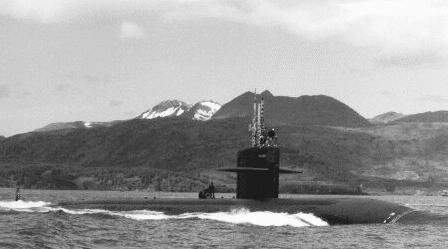
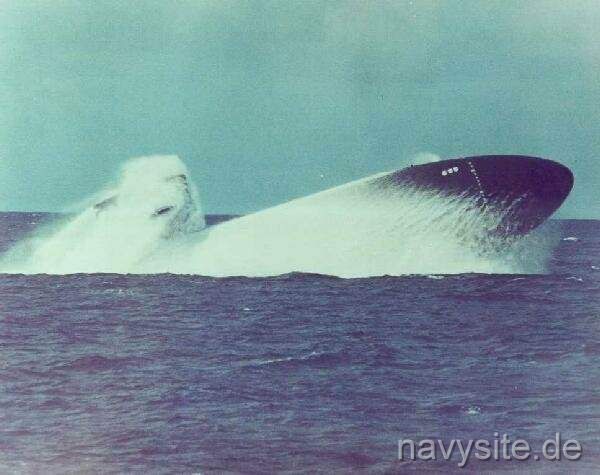
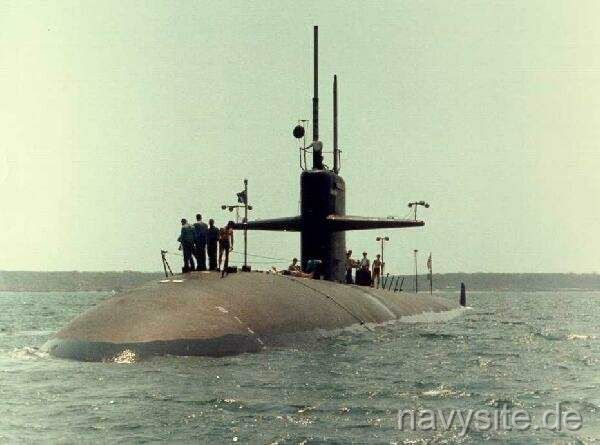
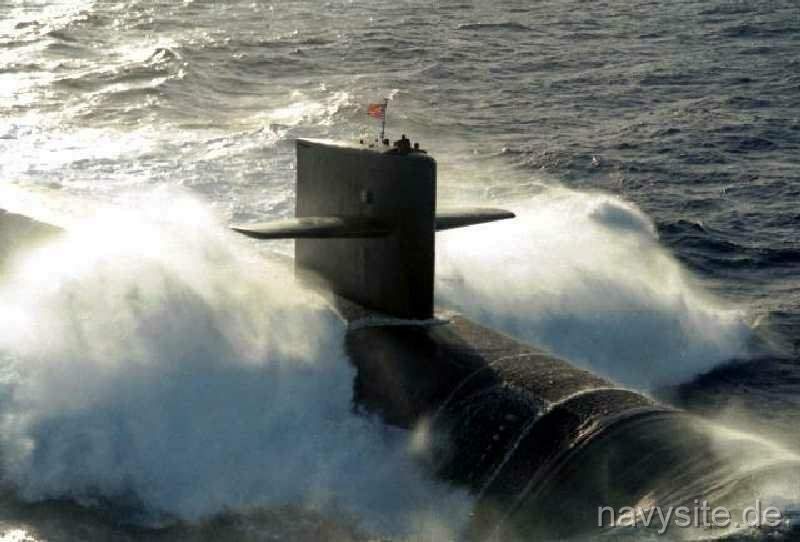
USS NEW YORK CITY was the ninth LOS ANGELES-class attack submarine and the first vessel in the Navy named specifically for the city of New York, NY. Stricken from the Navy list on April 30, 1997, the submarine was later disposed of by submarine recycling.
| General Characteristics: | Awarded: January 24, 1972 |
| Keel Laid: December 15, 1973 | |
| Launched: June 18, 1977 | |
| Commissioned: March 3, 1979 | |
| Decommissioned: April 30, 1997 | |
| Builder: Electric Boat Division of General Dynamics Corporation, Groton, CT. | |
| Propulsion system: one nuclear reactor | |
| Propellers: one | |
| Length: 360 feet (109.73 meters) | |
| Beam: 33 feet (10 meters) | |
| Draft: 32,15 feet (9.8 meters) | |
| Displacement: Surfaced: approx. 6,000 tons | |
| Submerged: approx. 6,900 tons | |
| Speed: Surfaced: approx. 15 knots | |
| Submerged: approx. 32 knots | |
| Armament: four 533 mm torpedo tubes for | |
| Cost: approx. $900 million | |
| Crew: 12 Officers, 115 Enlisted |
Crew List:
This section contains the names of sailors who served aboard USS NEW YORK CITY. It is no official listing but contains the names of sailors who submitted their information.
USS NEW YORK CITY History:
USS NEW YORK CITY was an early member of the LOS ANGELES-class nuclear-powered attack submarines, and the only U.S. Navy ship named specifically for the city of New York. Ordered during the high point of the Cold War and decommissioned in the post-Cold War draw-down, her career from the early 1970s through the late 1990s followed the arc of U.S. undersea strategy in the Pacific: repeated forward deployments to the western Pacific, operations in the northern Pacific against the Soviet Navy, technological trials in the eastern Pacific, and finally early retirement as newer variants of the class came into service.
The contract to build the submarine was awarded on January 24, 1972, to General Dynamics' Electric Boat Division in Groton, Connecticut, as part of the first "flight" of LOS ANGELES-class boats. Her keel was laid at Groton on December 15, 1973, at a time when the U.S. Navy was investing heavily in fast, quiet attack submarines to counter the growing capabilities of the Soviet Pacific Fleet. After a protracted construction period, reflecting both normal complexity and program-wide issues with changing requirements and quality control at Electric Boat, she was launched on June 18, 1977. The launch was sponsored by Rachel Line Schlesinger, wife of former Secretary of Defense James R. Schlesinger, underscoring the political prominence of the ship's namesake city.
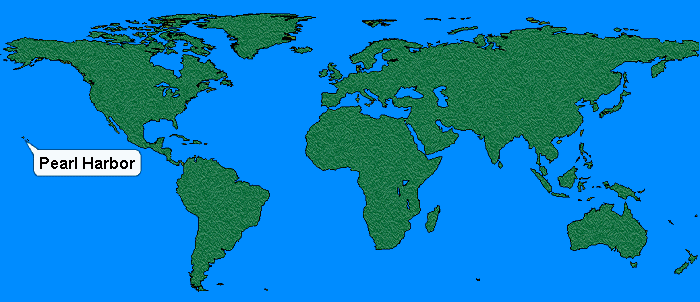
Following fitting-out and sea trials in New England waters, NEW YORK CITY was delivered to the Navy on January 23, 1979, and commissioned at Groton on March 3, 1979, with Commander James A. Ross as her first commanding officer. Like other newly built LOS ANGELES-class submarines, she spent her initial months in a post-delivery shakedown period, correcting deficiencies discovered at sea, qualifying crews in engineering and tactical watchstations, and conducting standard acoustic and weapons trials. After this workup, she carried out an inter-fleet transfer from the Atlantic to the Pacific and established her long-term homeport at Pearl Harbor, Hawaii, joining the U.S. Pacific Fleet during an era when American strategy emphasized forward submarine presence in the western Pacific and northern Pacific.
By 1981, NEW YORK CITY was ready for sustained operational employment. Between 1981 and 1985 she completed four deployments to the western Pacific in support of U.S. Seventh Fleet operations, each typically lasting several months and separated by maintenance and training periods in Hawaii. These Western Pacific deployments or WestPacs, coincided with a period of intense undersea competition with the Soviet Union, whose ballistic-missile and attack submarines operated from bases in the Far East. During these cruises, NEW YORK CITY took part in numerous fleet exercises, working with carrier battle groups and surface task forces to practice antisubmarine warfare, intelligence collection, and strike support. While many details of her patrols remain classified, open sources indicate that she participated in complex multi-unit exercises such as the recurring Rim of the Pacific (RIMPAC) series and readiness exercises in the western Pacific approaches to Japan and the Philippines, where U.S. and allied navies rehearsed responses to potential crises on the Korean Peninsula or in Southeast Asia.
Life between deployments followed the rhythm common to Pearl Harbor-based attack submarines. After a return from WestPac, NEW YORK CITY would enter a post-deployment stand-down period for crew leave and minor maintenance, shift into intermediate maintenance and training, and then spend weeks at sea in the Hawaiian operating areas conducting local operations: weapons certification shots, acoustic trials, and tactical development exercises. These periods also allowed new crew members to complete submarine qualification requirements. In 1983, the boat's day-to-day standards of life aboard earned outside recognition when her food service division won second place in the Navy-wide Captain Edward F. Ney Memorial Awards program in the "small afloat" category, an evaluation based on inspections and records of food quality and sanitation across the fleet.
By 1985, after roughly half a decade of sustained patrols and exercises, NEW YORK CITY was scheduled for a major modernization overhaul. She entered a long regular overhaul and modernization period at Pearl Harbor in December 1985. This overhaul, which lasted until February 1988, reflected both the normal mid-life maintenance needs of a nuclear-powered submarine and a broader initiative to upgrade early LOS ANGELES-class boats with improved combat systems and weapons, including support for Harpoon anti-ship missiles and Tomahawk land-attack and anti-ship cruise missiles, as reflected in later descriptions of her armament.
The work encompassed reactor and propulsion-plant maintenance, hull and tank inspections, sonar and fire-control upgrades, and habitability improvements, leaving the submarine better suited to the evolving tactical environment of the late Cold War.
During calendar year 1986, while still in this extended yard and post-yard period, NEW YORK CITY achieved a notable internal milestone: every officer on board qualified in submarines, earning the right to wear the gold "dolphins" insignia. For this unusual accomplishment the boat was authorized to fly the "Gold Dolphin" flag, a distinction recorded later in her official historical evaluation. This reflected sustained emphasis on submarine-specific professional development even while much of the crew's daily work involved overseeing modernization and testing.
When the overhaul concluded in early 1988, NEW YORK CITY returned to sea in a markedly changed strategic environment. General Secretary Mikhail Gorbachev's reforms and arms-control initiatives had begun to ease tensions with the Soviet Union, but the U.S. Navy continued to emphasize northern Pacific operations aimed at monitoring Soviet naval activity and ensuring the survivability of American and allied forces. In November-December 1988, NEW YORK CITY deployed to the northern Pacific, using her renewed quieting and sensor suite to conduct operations in those cold, acoustically challenging waters. Although specific patrol areas are not published, northern Pacific deployments typically focused on routes used by Soviet submarines transiting from bases on the Kamchatka Peninsula and the Sea of Okhotsk into the wider Pacific.
After returning to Pearl Harbor and completing post-deployment maintenance and training, NEW YORK CITY deployed again in 1989, this time on a renewed Western Pacific deployment. Her operations that year occurred against the backdrop of a rapidly shifting geopolitical landscape: in the spring and summer of 1989 protests in China culminated in the Tiananmen Square crackdown, while later that year the fall of the Berlin Wall signaled the approaching end of the Cold War. For Seventh Fleet submarines like NEW YORK CITY, the period demanded continued readiness to support carrier battle group operations, monitor Soviet and other regional naval activities, and conduct exercises with allies such as Japan and South Korea, even as broader East-West tensions began to decline.
In early 1990 NEW YORK CITY once more deployed to the northern Pacific, her second such deployment since overhaul. This deployment, coming just before the formal dissolution of the Warsaw Pact and the Soviet Union's escalating internal crises, extended the pattern of U.S. undersea presence in high-latitude Pacific waters. Afterward, she returned to Hawaii for maintenance, inspections, and tactical training. During this period, officers who later wrote about their service recalled "extensive deployments to the Western and Northern Pacific" aboard NEW YORK CITY even as analysts and planners began to shift from a bipolar confrontation with the Soviet Navy to a more fluid regional focus.
Despite the waning Cold War, 1991 was one of the submarine's busiest years. Sources indicate that NEW YORK CITY completed two Western Pacific deployments in 1991, reflecting the continued demand for attack submarines in the Seventh Fleet as the United States fought the Gulf War and managed the withdrawal of its long-standing bases in the Philippines. During one of these deployments she was in port at Subic Bay in the Philippines in mid-June 1991 when Mount Pinatubo erupted about 20 miles to the north, devastating the surrounding region and heavily damaging nearby U.S. facilities. A former weapons officer later described standing duty on board NEW YORK CITY as ash fall and severe weather from a concurrent typhoon complicated harbor conditions, illustrating the kind of unexpected natural events that could affect forward-deployed ships even in peacetime. In the aftermath, the submarine, like other U.S. vessels in the area, supported evacuation and recovery efforts as her operational schedule permitted before resuming her deployment pattern.
By 1992, the strategic emphasis for many Pacific Fleet attack submarines had begun to shift toward experimentation, tactical development, and regional engagement with allies beyond the former Soviet focus. In 1992 and again in 1993, NEW YORK CITY carried out deployments in the eastern Pacific rather than the traditional western Pacific circuit. These eastern Pacific cruises involved extensive operations from West Coast and Alaskan waters, including participation in the development of new acoustic measurement facilities. During the early 1990s, as part of the first trials of a new sound-testing center near Back Island in Southeast Alaska, NEW YORK CITY became the first submarine to conduct acoustic trials on the new underwater range near Ketchikan.
Over several days, she repeatedly transited above a fiber-optic cable laid on the floor of western Behm Canal, while instrumentation ashore at the Southeast Alaska Acoustic Measurement Facility recorded her noise characteristics for Navy scientists studying submarine quieting and detection. These trials reflected the Navy's growing emphasis on measuring and reducing acoustic signatures in a post-Cold War environment where undersea stealth remained central to deterrence and regional presence.
In addition to technical trials, eastern Pacific deployments in this period included standard fleet exercises with carrier and surface forces training in the waters off California, Alaska, and sometimes Canada. After each deployment, NEW YORK CITY returned to Pearl Harbor for scheduled maintenance availabilities and inspections, including operational reactor safeguards examinations and tactical readiness evaluations designed to ensure that both engineering and combat systems met contemporary standards.
In 1994 and 1995, NEW YORK CITY returned to a pattern of alternating western and eastern Pacific operations. A multinational timeline of submarine deployments records her participation in a Western Pacific deployment running approximately from September 6, 1994 to March 3, 1995. During this deployment, the submarine again supported Seventh Fleet missions, providing covert surveillance, antisubmarine warfare capability, and exercise participation with regional navies. Evidence from surface-ship command histories indicates that during 1995, NEW YORK CITY operated in company with surface combatants in at least one major bilateral exercise. In a report for that year, the frigate USS CURTS (FFG 38) notes that she, the destroyer USS FIFE (DD 991), and NEW YORK CITY detached from a carrier battle group to continue south to participate in MEKAR 95, a joint exercise with regional partners. This suggests that the submarine's 1995 WestPac deployment included coordinated operations with surface units in Southeast Asian waters, supporting combined training in antisubmarine and surface warfare under real-world environmental conditions.
Between these deployments the boat cycled through maintenance availabilities and local operations out of Pearl Harbor, maintaining crew proficiency in navigation, weapons employment, and emergency procedures. As the submarine aged, she, like other early LOS ANGELES-class boats from the initial "Flight I" group, did not receive the vertical launch system fitted to later hulls, a factor that weighed in long-term force-structure planning as post-Cold War defense budgets tightened.
Over the course of her service, NEW YORK CITY accumulated a series of formal recognitions. A Naval Sea Systems Command historic evaluation lists four Meritorious Unit Commendations, a Navy Expeditionary Medal, and a Secretary of the Navy Letter of Commendation among her awards, reflecting sustained operational performance in demanding environments as well as participation in designated expeditionary operations. These awards were earned across multiple deployments in the 1980s and 1990s, although publicly available documentation does not always specify which particular patrols or exercises correspond to each citation.
As the 1990s progressed, the Navy faced choices about whether to refuel older LOS ANGELES-class submarines or retire them as newer units entered service. NEW YORK CITY, a non-VLS Flight I boat approaching the point at which a reactor refueling would be required, was selected for early retirement rather than refueling and modernization. After completing her final operating period in the mid-1990s, she transited to the Pacific Northwest for inactivation and decommissioning preparations. On April 30, 1997, she was formally decommissioned and stricken from the Naval Vessel Register, ending just over eighteen years of commissioned service.
Following decommissioning, the hull of NEW YORK CITY entered the Navy's Ship-Submarine Recycling Program at Puget Sound Naval Shipyard in Bremerton, Washington, where her reactor compartment and other radioactive components were removed and the remaining structure dismantled in accordance with environmental and safety regulations.
USS NEW YORK CITY Image Gallery:
![]() | ![]() | ![]() | ![]() |
The photo below was taken by me and shows the NEW YORK CITY laid up behind the decommissioned USS NARWHAL (SSN 671) at the Puget Sound Naval Shipyard, Bremerton, Wash. The photo was taken on March 14, 2010.
![]() |
Back to Submarines list.
Back to ships list.
Back to selection page.
Back to 1st page.