
Search the Site with

|
Search the Site with
|
 General Characteristics Crew List Memorabilia Accidents aboard the Ship History Patch Gallery to end of page
| Sorry, no coat of arms available. | 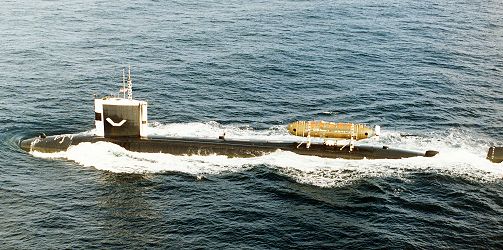 |
USS PINTADO was one of the STURGEON - class attack submarines and the second ship in the Navy to bear the name. Both decommissioned and stricken from the Navy list on February 26, 1998, the PINTADO subsequently the Navy's Nuclear Powered Ship and Submarine Recycling Program at the Puget Sound Naval Shipyard at Bremerton, Wash. Recycling of the submarine was finished on October 27, 1998.
| General Characteristics: | Awarded: December 29, 1965 |
| Keel Laid: October 27, 1967 | |
| Launched: August 16, 1969 | |
| Commissioned: September 11, 1971 | |
| Decommissioned: February 26, 1998 | |
| Builder: Mare Island Naval Shipyard, Vallejo, Calif. | |
| Propulsion system: one S5W2 nuclear reactor | |
| Propellers: one | |
| Length: 292 feet (89 meters) | |
| Beam: 31.7 feet (9.65 meters) | |
| Draft: 29.2 feet (8.9 meters) | |
| Displacement: Surfaced: approx. 4,250 tons | |
| Submerged: approx. 4,700 tons | |
| Speed: Surfaced: approx. 15 knots | |
| Submerged: approx. 30 knots | |
| Armament: four 533 mm torpedo tubes for | |
| Crew: 12 Officers, 95 Enlisted |
 back to top to end of the page
Crew List:
This section contains the names of sailors who served aboard USS PINTADO. It is no official listing but contains the names of sailors who submitted their information.
back to top go to the end of the pageback to top to end of the pageAccidents aboard USS PINTADO:
| Date | Where | Events |
|---|---|---|
| May 1974 | off Petropavlovsk, Soviet Union | USS PINTADO reportedly collides almost head-on with a Soviet YANKEE - class nuclear-powered ballistic missile submarine while cruising 200 feet deep in the approaches to the Petropavlovsk naval base on the Kamchatka Peninsula.The Soviet submarine surfaced immediately, but the extent of damage was not known. The PINTADO departed from the area at top underwater speed and proceeded to Guam where it entered drydock for repairs lasting seven weeks.The collision smashed much of PINTADO's detection sonar, a starboard side torpedo hatch was jammed shut and a diving plane received moderate damage. The PINTADO was on an intelligence gathering mission in Soviet territorial waters. |
| December 6, 1977 | off Korea | USS PINTADO suffers damage to the top of her rudder in a minor collision with a South Korean Navy ship during an exercise. The PINTADO initiated emergency deep dive procedures when the surface ship turned toward PINTADO at close range. |
back to top to end of the pageUSS PINTADO History:
USS PINTADO was the second United States Navy ship to bear the name Pintado. The name referred to a large mackerel-like fish whose markings suggested the Spanish word for "painted". USS PINTADO was ordered from and built by Mare Island Naval Shipyard at Vallejo, California. Her contract date is recorded as December 29, 1965. Her keel was laid down on October 27, 1967. She was launched on August 16, 1969, sponsored by Mrs. Bernard A. Clarey, wife of Admiral Bernard A. Clarey, who had commanded the first USS PINTADO (SS 387) during the Second World War and later served as Vice Chief of Naval Operations and Commander in Chief, Pacific Fleet. The new USS PINTADO was commissioned at Mare Island on September 11, 1971, with Commander William J. Holland Jr. in command. After commissioning she joined the United States Pacific Fleet and was assigned San Diego, California, as her home port. A ship history prepared for her inactivation later noted that she served as flagship for Admiral Clarey while he was Commander in Chief, Pacific Fleet, an unusual distinction for a submarine and described there as the only case of its kind.
After commissioning, USS PINTADO spent her first year completing trials, training, crew qualification, and the normal transition from new construction to operational fleet service. Under Commander Holland, she began her first operational deployment to the United States Seventh Fleet in the Western Pacific in late October 1972. The deployment continued until April 1973. This took the new submarine into the Western Pacific during the final phase of the Vietnam War and at a time when the Pacific Fleet remained heavily engaged in regional operations, deterrence, surveillance, and support of American alliances in the western Pacific. Commander Holland remained in command until July 20, 1973, when Commander J. Guy Reynolds relieved him.
USS PINTADO's second operational deployment was running from March 1974 to October 1974. During that Western Pacific operating period under Commander Reynolds, USS PINTADO became involved in one of the more widely noted submarine incidents of the Cold War. In May 1974, while operating in the approaches to the Soviet naval base at Petropavlovsk-Kamchatsky on the Kamchatka Peninsula, USS PINTADO collided with a Soviet YANKEE-class ballistic-missile submarine. USS PINTADO was submerged at about 200 feet and the collision damaged much of her bow sonar sphere, jammed a starboard-side torpedo hatch, and damaged a diving plane. The Soviet submarine surfaced immediately, but the extent of her damage was not publicly known. USS PINTADO remained submerged, departed the area at high speed, and proceeded to Guam, where she entered dry dock for repairs lasting about seven weeks. The event occurred in a strategically sensitive area because Petropavlovsk was a major Soviet Pacific Fleet submarine base and because Soviet ballistic-missile submarines were a central part of the Soviet nuclear deterrent. The incident therefore illustrates the close, hazardous surveillance environment in which American and Soviet submarines sometimes operated during the Cold War.
After returning from the 1974 deployment and completing repairs, USS PINTADO resumed training and local operations from San Diego. From late October 1974 into 1975 she conducted routine training in the San Diego operating area. In March 1975, USS PINTADO became the first submarine to successfully launch the Harpoon missile. This was an important weapons-development milestone because Harpoon gave submarines a standoff anti-surface capability against ships, complementing torpedoes and reflecting the Navy's effort to broaden submarine weapons options against surface combatants. In August 1975, USS PINTADO changed home port to Bremerton, Washington, and entered Puget Sound Naval Shipyard for upgrades and repairs. The yard period was completed ahead of schedule, and she returned to San Diego in June 1976, where she resumed local operations and preparation for further deployment.
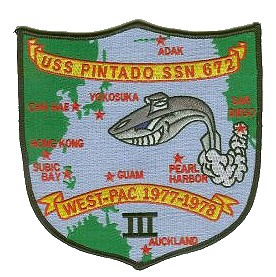
On April 28, 1977, Commander John J. McDonald Jr. relieved Commander Reynolds as commanding officer. Public Navy imagery from March 28, 1977, shows USS PINTADO operating off San Diego with DSRV-1 embarked, conducting submarine rescue exercises. That event places USS PINTADO within the Navy's deep-submergence rescue program, in which attack submarines and specially designed rescue vehicles trained to provide emergency rescue capability for distressed submarines. In August 1977, following her first overhaul and training cycle, USS PINTADO deployed again to the Western Pacific. Contemporary Navy imagery from the deployment shows her entering Hong Kong harbor and leaving Naval Station Subic Bay in the Philippines, confirming those port visits during the 1977-1978 deployment. The deployment occurred in a Western Pacific still shaped by the aftermath of the Vietnam War, continuing Cold War competition, the strategic importance of Japan, South Korea, and the Philippines, and the United States Navy's need for a forward undersea presence in the Pacific.
During this 1977 Western Pacific deployment, USS PINTADO was involved in a second collision, this time with an allied surface ship. On December 6, 1977, while operating with Republic of Korea Navy vessels, a South Korean surface ship abruptly turned toward her. USS PINTADO executed a crash dive, but the two ships collided, and USS PINTADO sustained damage to the top of her rudder. She returned to San Diego in February 1978. From February to September 1978, she conducted local training operations in the San Diego area, repairing, training, and preparing for a very different operating environment: the Arctic.
From September to November 1978, USS PINTADO operated under the polar ice. On October 10, 1978, she surfaced at the North Pole. Arctic submarine records identify USS PINTADO under Commander J. J. "Jack" McDonald as operating in the Arctic in 1978. Under-ice operations required specialized navigation, sonar interpretation, ship control, communications planning, and surfacing procedures. Strategically, the Arctic mattered because it lay close to Soviet northern approaches and because under-ice routes could conceal submarine movement. For a Pacific Fleet attack submarine, the 1978 Arctic operation also demonstrated the ability to operate far beyond ordinary coastal and Western Pacific training areas.
In September 1979, USS PINTADO deployed to the Indian Ocean. During that deployment she supported Carrier Battle Groups Alpha and Bravo during the early weeks of the Iranian hostage crisis. The crisis began after the seizure of the United States Embassy in Tehran on November 4, 1979, and it sharply increased American military attention to the Indian Ocean and Arabian Sea. USS PINTADO's deployment placed her in a region that had become strategically important because of the Iranian Revolution, the Soviet invasion of Afghanistan later in December 1979, energy security concerns, and the need for United States naval forces to support presence and contingency planning. USS PINTADO returned to San Diego in February 1980. On January 10, 1981, Commander Robert J. Labreque relieved Commander McDonald as commanding officer.
From February to August 1981, USS PINTADO conducted another Western Pacific deployment. The deployment earned her a Navy Unit Commendation. In June 1982, USS PINTADO entered Pearl Harbor Naval Shipyard for a 16-month regular overhaul and refueling. During this availability, her combat systems were extensively upgraded. The overhaul continued into late 1983, and the ship resumed operations from San Diego in December 1983. The shipyard period was one of the major maintenance and modernization events of her career and restored her for further Cold War service.
On July 30, 1984, Commander Richard P. "Dick" Vidosic relieved Commander Labreque as commanding officer. From September to November 1984, USS PINTADO returned to the Arctic Ocean, operating under the polar ice in company with USS GURNARD (SSN 662). On November 12, 1984, USS PINTADO and USS GURNARD became the third pair of submarines to surface together at the North Pole. Arctic submarine records also identify USS GURNARD and USS PINTADO under Commander Vidosic as the third pair of submarines to conduct a rendezvous at the North Pole. The paired surfacing was significant because it required not only individual under-ice navigation and surfacing skill but also coordinated submarine operations in a demanding polar environment. The operation took place during a period when the Cold War was still intense and when Arctic submarine operations remained directly tied to strategic undersea access, Soviet Northern Fleet monitoring, and United States submarine experience under ice.
From July 1985 to January 1986, USS PINTADO completed her fifth operational deployment to the United States Seventh Fleet in the Western Pacific. During this deployment, she steamed more than 33,000 miles and conducted numerous fast-paced operations. After returning to San Diego, she completed repairs and alterations and celebrated the fifteenth anniversary of her commissioning. During the autumn of 1986, USS PINTADO conducted more than 50 days of operations as the Commander, Submarine Force, Pacific ready nuclear-powered attack submarine. That role meant that she was maintained at a high state of readiness for Pacific Fleet tasking. The broader setting was still late Cold War Pacific competition, with Soviet Pacific Fleet activity, American alliance commitments to Japan and South Korea, and continuing requirements for submarine readiness in the Western Pacific.
From May to July 1987, USS PINTADO again conducted Arctic operations. On June 16, 1987, she surfaced at the North Pole for the third time. On August 28, 1987, Commander Richard W. Talipsky relieved Commander Vidosic as commanding officer. Under Commander Talipsky, USS PINTADO conducted another Arctic deployment from May to June 1988. Public Arctic records list USS PINTADO as conducting Arctic operations in 1987, and the inactivation command list records the 1988 Arctic deployment under Commander Talipsky.
On June 22, 1989, Commander Thomas A. Thompson relieved Commander Talipsky. In July 1989, USS PINTADO entered Mare Island Naval Shipyard for a regular overhaul. The overhaul carried the submarine through the final stage of the Cold War. The Berlin Wall fell on November 9, 1989, while USS PINTADO was in or entering this major maintenance phase, and the Soviet Union dissolved on December 26, 1991, just as the overhaul period ended.
In January 1992, USS PINTADO's home port was changed to Pearl Harbor, Hawaii, and she became a member of Submarine Squadron One. On May 8, 1992, Commander Gary L. Graf relieved Commander Thompson as commanding officer. From August to October 1992, USS PINTADO conducted her fourth Arctic operation. On August 23, 1992, she marked her 1,000th surfacing and dive. On September 4, 1992, she surfaced at the North Pole for the fourth time, a record described in public ship histories as unprecedented for a submarine at that time. She returned to Pearl Harbor in November 1992 after circumnavigating North America and steaming more than 20,000 miles. The 1992 Arctic operation took place in the early post-Cold-War transition, when the Soviet Union no longer existed but Arctic submarine operations remained technically important and strategically relevant for navigation, under-ice proficiency, and continued knowledge of polar operating environments.
In July 1993, USS PINTADO departed on a six-month Unitas deployment in company with several United States Navy surface units. During this deployment, she circumnavigated South America, visited numerous ports, and worked extensively in exercises with South American navies. Unitas was a long-running series of multinational naval exercises intended to build interoperability, improve anti-submarine warfare proficiency, strengthen maritime coordination, and maintain professional naval relationships between the United States and Latin American partners. Public reporting from August 1993 places Unitas XXXIV activity at Rodman Naval Station in Panama and refers to sailors from USS PINTADO in that setting. The deployment continued into January 1994. A submarine's role in Unitas was especially useful because South American navies could train against a nuclear-powered attack submarine while USS PINTADO gained experience in littoral and regional exercise environments around South America.
On April 11, 1995, Commander Alfred H. Gonzalez Jr. relieved Commander Graf as commanding officer. From January to July 1996, USS PINTADO conducted her sixth and final Western Pacific deployment. During this final deployment, she conducted operations vital to national security and participated in several exercises with the Japanese Maritime Self-Defense Force and the Republic of Korea Navy. These exercises reflected the post-Cold-War but still strategically important security structure of the Western Pacific. The United States remained committed to defense relationships with Japan and South Korea, while regional submarine and maritime capabilities continued to grow.
In March 1997, USS PINTADO changed home port to Bangor, Washington, and entered the final phase of her service life. Her inactivation ceremony was held on September 26, 1997, at Naval Submarine Base Bangor. The ceremony recognized that the ship was preparing for the end of commissioned service and that the formal decommissioning would follow during the final shipyard period. At the time of the ceremony, Commander Gonzalez remained her commanding officer. The inactivation program listed decommissioning as planned for March 1998, but the formal Navy date came slightly earlier. USS PINTADO was decommissioned and stricken from the Naval Vessel Register on February 26, 1998.
After decommissioning, ex-USS PINTADO entered disposal through the Navy's Nuclear Powered Ship and Submarine Recycling Program at Puget Sound Naval Shipyard, Bremerton, Washington. The program was the standard process for dismantling retired nuclear-powered submarines, removing and disposing of reactor compartments under controlled procedures, and recycling the remaining hull structure. Recycling of ex-USS PINTADO was completed on October 27, 1998. From commissioning on September 11, 1971, to decommissioning on February 26, 1998, she served for more than twenty-six years.
back to top to end of the pageUSS PINTADO Patch Gallery:
 |
back to top Back to Submarines list. Back to ships list. Back to selection page. Back to 1st page.