Search the Site with 
General Characteristics Crew List Memorabilia Accidents aboard the Ship History to end of page

USS Jack (SSN 605)

- decommissioned -

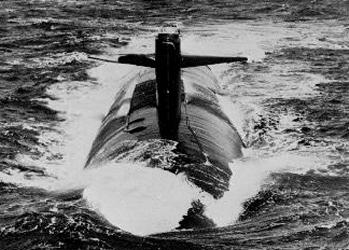
USS JACK was one of the PERMIT - class nuclear-powered attack submarines and the second ship in the Navy named after the fish. The JACK was the only submarine in her class equipped with an experimental direct-drive plant with counter-rotating propellers on a single shaft. The engine spaces were lengthened by ten feet and the shaft was lengthened by seven feet to accomodate this additional equipment. Although counter-rotating propellers had previously produced impressive gains in speed on the experimental ALBACORE (AGSS 569), in this instance the results were disappointing and led to the abandoment of this approach in subsequent submarine design. Both decommissioned and stricken from the Navy list on July 11, 1990, the JACK subsequently entered the Navy's Nuclear Powered Ship and Submarine Recycling Program at the Puget Sound Naval Shipyard, Bremerton, Wash. Recycling was completed on June 30, 1992.

General Characteristics:Awarded: March 13, 1959
Keel laid: September 16, 1960
Launched: April 24, 1963
Commissioned: March 31, 1967
Decommissioned: July 11, 1990
Builder: Portsmouth Naval Shipyard, Kittery, ME.
Propulsion system: one S5W2 nuclear reactor
Propellers: two
Length: 293.6 feet (89.5 meters)
Beam: 32.15 feet (9.8 meters)
Draft: 28.9 feet (8.8 meters)
Displacement: Surfaced: approx. 3,600 tons     Submerged: approx. 4,500 tons
Speed: Surfaced: approx. 20 knots     Submerged: approx. 30 knots
Armament: four 533 mm torpedo tubes for SUBROC, Mk-48 torpedoes and Harpoon missiles
Crew: 12 Officers, 91 Enlisted


Back to topback to top  go to endgo to the end of the page


Back to topback to top  go to endgo to the end of the page

Crew List:

This section contains the names of sailors who served aboard USS JACK. It is no official listing but contains the names of sailors who submitted their information.


back to top  go to the end of the page


Back to topback to top  go to endgo to the end of the page

Accidents aboard USS JACK:

DateWhereEvents
approx. early 1977western Atlantic
During post-overhaul sea trials in heavy North Atlantic weather, seawater entered through the induction mast, overflowed the induction sump, and entered the battery breaker room, causing an explosion and fire. USS JACK nevertheless completed sea trials and returned to Groton.
April 27, 1981Alexandria, Egypt
During a five-day port visit, the USS TRENTON (LPD 14) and USS JACK are slightly damaged when the JACK, moored alongside, surges against the TRENTON in a sea swell.
April 1983Portsmouth Naval Shipyard, Kittery, Maine
While USS JACK was in drydock, a shipyard accident occurred during a hydrostatic test of oxygen banks. Freon was being used as the test fluid because it would leave no residue after evaporation, but one shipyard worker was unable to leave the engineering space in time and died from oxygen deprivation.


Back to topback to top  go to endgo to the end of the page

USS JACK History:

USS JACK was contracted on March 13, 1959, and laid down on September 16, 1960, at Portsmouth Naval Shipyard in Kittery, Maine. She was a PERMIT-class nuclear-powered attack submarine and the second United States Navy ship to bear the name Jack, following the World War II submarine USS JACK (SS 259). Her predecessor had received the Presidential Unit Citation and seven battle stars for service in the Pacific War, and the new nuclear-powered USS JACK carried the name into the Cold War attack-submarine force. USS JACK belonged to the THRESHER/PERMIT design line, but she was not a completely standard member of the class. She was fitted with an experimental direct-drive propulsion plant with counter-rotating propellers, which required lengthened machinery spaces and shafting compared with other PERMIT-class boats. The arrangement was intended to improve acoustic performance, but it did not become the standard solution for later submarines, making USS JACK one of the technically distinctive submarines of her generation.

USS JACK was launched on April 24, 1963, sponsored by Mrs. Leslie R. Groves, wife of Lieutenant General Leslie R. Groves, who had directed the Manhattan Project during World War II. After a long fitting-out and testing period at Portsmouth, she was commissioned on March 31, 1967, with Commander Louis T. Urbanczyk Jr. in command. Rear Admiral James F. Calvert, who had served in the wartime USS JACK (SS 259), was the principal speaker at the commissioning ceremony. USS JACK then joined the Atlantic Fleet and was assigned to Commander Submarine Squadron Ten, homeported at New London, Connecticut. Submarine Squadron Ten was one of the central Atlantic Fleet organizations for nuclear-powered attack submarines, and New London placed USS JACK within a major submarine operating and training community during a period when the United States Navy was refining its deep-diving, quiet, nuclear-powered attack-submarine force against the background of Soviet submarine expansion.

After commissioning, USS JACK conducted shakedown training in the Caribbean. These early operations tested her propulsion plant, diving systems, sonar, weapons systems, fire-control equipment, ship-control arrangements, communications, navigation, and crew proficiency. The Caribbean gave the Atlantic Fleet deep-water operating areas and weapons ranges suitable for a new submarine that combined the standard PERMIT-class sonar and weapons concept with a distinctive propulsion arrangement. After shakedown, USS JACK took her place in the operating fleet, where she could be used both as an operational submarine and as a demanding target for surface ships, aircraft, and other submarines practicing antisubmarine warfare.

During 1968, USS JACK participated in several fleet exercises. Her most visible early operation came in September and October 1968, when the North Atlantic Treaty Organization held Exercise Silver Tower, one of the largest combined naval exercises of the period. Silver Tower brought together aircraft and about 200 ships from Belgium, Canada, Denmark, the Netherlands, Norway, Portugal, the United Kingdom, the United States, and West Germany. Soviet naval units shadowed the exercise, which was built around a scenario involving political and military pressure against Norway. USS JACK played the role of an opposing submarine and operated against replenishment groups and a large fast-carrier task force. Shipboard material credited her with a simulated sinking tonnage of 319,000 tons. After the exercise, representatives of participating ships assembled at Rosyth Dockyard in Scotland for a review of results, and USS JACK received special mention for her performance. The exercise placed her in a classic Cold War North Atlantic setting: allied reinforcement planning, sea-lane defense, carrier protection, and the problem of locating a modern nuclear-powered submarine in waters that would have been critical in any conflict with the Soviet Union.

After Exercise Silver Tower, USS JACK returned to Portsmouth Naval Shipyard late in 1968 for a four-month post-shakedown shipyard availability. This yard period corrected defects and incorporated changes identified during her first year of fleet operations. She completed the availability in March 1969 and then participated in Exercise Springboard in the Caribbean. As a result of her performance during Springboard, her weapons department received the Efficiency "E" for fire-control excellence. Later in 1969, she took part in exercises with helicopters and fixed-wing aircraft from Commander Anti-Submarine Forces Atlantic. These exercises used USS JACK as a modern nuclear-powered submarine target against which aircraft could practice detection, localization, tracking, and simulated attack.

Also during the summer of 1969, USS JACK evaluated a warshot torpedo against a real target. The target was the decommissioned World War II destroyer escort ex-USS SNOWDEN (DE 246). On June 26, 1969, USS JACK tested the performance of an armed Mark 16 torpedo by sinking the old destroyer escort. Such weapons tests provided practical information that could not be obtained from purely simulated firings. They also linked older World War II-era hulls to the development of Cold War undersea weapons. For USS JACK, the event formed part of a year in which she moved from post-shakedown availability into weapons evaluation, fleet exercises, and special operations.

After an extensive training and readiness period in preparation for overseas movement, USS JACK departed for extended independent submarine operations. The exact details of that operation remain publicly limited, but the ship received the Meritorious Unit Commendation afterward. Commander David G. Smith, her commanding officer, was awarded the Meritorious Service Medal. The award citation described an important and difficult independent submarine operation that achieved results of great importance to national defense.

In December 1969, USS JACK participated in Operation Squeeze Play, a Chief of Naval Operations program established to evaluate a dedicated force of ships in certain phases of antisubmarine warfare. This work again reflected the central role of nuclear attack submarines in the Navy's effort to understand and counter the Soviet undersea threat.

In January 1970, after gaining experience during the high-tempo Squeeze Play program, USS JACK departed home waters on an extended deployment. During the summer of 1970, while engaged in midshipmen training at the United States Naval Academy in Annapolis, Maryland, USS JACK received the Battle Efficiency "E" from Commander Submarine Force, U.S. Atlantic Fleet. Midshipmen training cruises allowed future officers to experience submarine operations directly, while also keeping the boat active in a training and readiness role.

In the fall of 1970, USS JACK participated in a scheduled exercise supporting ballistic-missile submarine security. The protection of fleet ballistic missile submarines was a central Cold War naval requirement, because the survivability of the sea-based nuclear deterrent depended on keeping those submarines secure from hostile detection and interference. While en route to New London for a holiday leave period, USS JACK was diverted to perform a special mission for the Chief of Naval Operations. After completing that mission, she returned to New London for rest and preparation for overhaul. The year again showed the mixed character of her service: training, exercises, strategic-submarine support, and special operations.

In February 1971, USS JACK entered Portsmouth Naval Shipyard for a fourteen-month regular overhaul. The overhaul was completed in April 1972. During this yard period, the submarine was removed from the normal operating cycle while shipyard personnel and crew addressed machinery, hull, electrical, sonar, weapons, and reactor-support work. Toward the end of the overhaul, the Atlantic Fleet Operational Reactor Safeguards Examining Board inspected the ship. The examination included interviews, observation of drills, review of records, and testing of crew knowledge. USS JACK received the highest grade awarded by the examining board. After the overhaul, she completed shakedown and refresher training and began preparations to join Commander Sixth Fleet for deployed operations.

During the preparation period in 1972, Commander Thomas F. Wiener relieved Commander David G. Smith as commanding officer. USS JACK left New London in July 1972 for a six-month Mediterranean deployment. In August 1972, she entered La Maddalena, Sardinia, and became the first nuclear-powered submarine to use the advance submarine base that was being developed there. La Maddalena became an important forward support location for American submarines in the Mediterranean, allowing nuclear-powered attack submarines to remain closer to Sixth Fleet operating areas and reducing the need to return to the United States for upkeep between patrol periods. USS JACK's visit therefore marked an early step in the regular forward support of nuclear-powered attack submarines in the Mediterranean.

During the 1972 Mediterranean deployment, USS JACK participated in several fleet exercises, including National Week, conducted independent operations, and made port visits to Taranto and Naples, Italy, and Rota, Spain. She also had an upkeep period at La Maddalena. The Mediterranean was a complex operating environment for submarines: confined waters, heavy merchant traffic, varied acoustic conditions, allied and Soviet naval activity, and frequent regional crises. USS JACK returned to New London in January 1973 after completing the deployment. After a month of post-deployment standdown, she spent the remainder of 1973 operating with air, submarine, and surface units of the Atlantic Fleet and participating in fleet exercises.

After extensive predeployment training, USS JACK departed for the Mediterranean again in April 1974. This deployment lasted six months. During the cruise, she made port visits to Gibraltar; Naples; Athens, Greece; and La Spezia, Italy. While at sea, she participated in North Atlantic Treaty Organization and United States fleet operations. Two upkeep periods were held at La Maddalena, Sardinia. During the first of these upkeep periods, Commander Wiener was relieved by Commander Richard K. Westfahl in June 1974. This was the first change of command held at the advance submarine base at La Maddalena. USS JACK returned to New London on September 28, 1974. The rest of the year was spent in upkeep at New London, independent operations, and providing services in the western Atlantic.

In January 1975, USS JACK departed New London for six weeks of participation in Operation Springboard 75 in the Caribbean. Springboard exercises gave Atlantic Fleet ships, submarines, and aircraft access to warmer waters and extensive training areas during the winter months. For a submarine, Springboard could include sonar training, weapons exercises, antisubmarine warfare drills, and services to surface and aviation units. After returning from Springboard, USS JACK continued the Atlantic Fleet cycle of upkeep, local operations, and preparation for major maintenance.

From October 1975 to January 1977, USS JACK underwent a major overhaul at Portsmouth Naval Shipyard, including main-engine overhaul and reactor refueling. This yard period was one of the major maintenance events of her career. It renewed reactor core life and addressed the engineering and combat-system requirements of an early PERMIT-class submarine after years of Atlantic, Caribbean, and Mediterranean service. During post-overhaul sea trials in heavy North Atlantic weather, seawater entered through the induction mast, overflowed the induction sump, and entered the battery breaker room, causing an explosion and fire. USS JACK nevertheless completed sea trials and returned to Groton.

After the overhaul and trials, USS JACK went through sound trials, Mark 48 weapons certification, and a series of training missions during 1977 and 1978. The Mark 48 heavyweight torpedo was becoming the central American submarine torpedo of the late Cold War, and certification ensured that the ship and crew could employ the weapon safely and effectively. During this post-overhaul period, later summaries also record a main-engine failure off the coast of North Carolina that required USS JACK to be towed back to Groton.

In 1979 and 1980, JACK remained in the Atlantic Fleet submarine cycle from New London and Groton, conducting local operations, upkeep, training, inspections, and preparations for deployed service. In 1981, USS JACK was in the Mediterranean. On April 27, 1981, during a five-day port visit at Alexandria, Egypt, USS JACK and USS TRENTON (LPD 14) were slightly damaged when USS JACK, moored alongside, surged against USS TRENTON in a sea swell. The incident caused minor damage and did not represent a major operational casualty. The Alexandria visit placed her in the eastern Mediterranean at a time when the region remained important to Sixth Fleet operations, Middle East diplomacy, and the broader Cold War naval balance.

Near the end of September 1982, USS JACK entered Portsmouth Naval Shipyard for a twenty-seven-month overhaul. This was another long late-career shipyard period and removed her from operational service while major maintenance and modernization work was performed. In April 1983, while the submarine was in drydock, a shipyard accident occurred during a hydrostatic test of oxygen banks. Freon was being used as the test fluid because it would leave no residue after evaporation, but one shipyard worker was unable to leave the engineering space in time and died from oxygen deprivation.

USS JACK completed the overhaul and returned to Groton on April 18, 1985, after sea trials. Her return came during a period of renewed Cold War naval emphasis under the Reagan administration. The United States Navy was increasing forward operations, conducting large fleet exercises, and placing heavy emphasis on the ability to track and counter Soviet submarines. Although USS JACK was an older PERMIT-class submarine by this time, she remained part of the Atlantic Fleet's attack-submarine inventory and could still perform Mediterranean deployments, training, and operational assignments after overhaul.

In 1986, USS JACK again deployed to the Mediterranean. She returned to Groton on June 2, 1986, following that deployment. The deployment took place during a tense Mediterranean year. United States and Libyan forces clashed during freedom-of-navigation operations in the Gulf of Sidra in March 1986, and the United States later struck targets in Libya in April after terrorist attacks linked to Libyan support.

In 1987 and 1988, USS JACK remained in Atlantic Fleet service. A 1988 image summary places USS JACK alongside the submarine tender USS L. Y. SPEAR (AS 36) in Norway in September 1988, with HMS TORBAY outboard, confirming that USS JACK was still active in the North Atlantic and allied submarine-support environment during the late 1980s, a period when northern operations remained focused on Soviet submarine routes through the Norwegian Sea, Barents approaches, and the Greenland-Iceland-United Kingdom gap.

Commander Bruce L. Bullough assumed command of USS JACK in November 1988 and remained in command until the submarine was decommissioned. By then USS JACK was approaching the end of service life. The PERMIT-class had been a major step forward when introduced, but by the late 1980s, LOS ANGELES-class submarines had become the backbone of the United States attack-submarine force. Older PERMIT-class boats required more maintenance and had less growth margin for new systems, although they remained operationally useful until selected for retirement.

USS JACK was decommissioned and stricken from the Naval Vessel Register on July 11, 1990. Her active service had lasted more than twenty-three years. After decommissioning, ex-JACK entered the Navy's Nuclear-Powered Ship and Submarine Recycling Program at Puget Sound Naval Shipyard in Bremerton, Washington. Recycling was completed on June 30, 1992. Her dismantling ended the physical existence of one of the most distinctive PERMIT-class submarines.


Back to topback to top


Back to Submarines list. Back to ships list. Back to selection page. Back to 1st page.