back to top
go to the end of the page
back to top
go to the end of the page
Crew List:
This section contains the names of sailors who served aboard USS DIXON. It is no official listing but contains the names of sailors who submitted their information.
- Click here to view the list.
back to top
go to the end of the page
- Click here
to see which USS DIXON memorabilia are currently for sale on ebay.
back to top
go to the end of the page
USS DIXON Cruise Books:
back to top
go to the end of the page

back to top
go to the end of the page
USS DIXON's Commanding Officers:
| Period | Name |
| August 7, 1971 - August 17, 1973 | Captain D. S. Boyd, USN |
| August 17, 1973 - May 23, 1975 | Captain B. M. Kauderer, USN |
| May 23, 1975 - November 10, 1977 | Captain J. P. Keane, USN |
| November 10, 1977 - August 2, 1979 | Captain D. G. Harscheid, USN |
| August 2, 1979 - April 3, 1982 | Captain R. L. Wolfe, USN |
| April 3, 1982 - January 26, 1985 | Captain N. A. Herberger, USN |
| January 26, 1985 - February 28, 1987 | Captain T. H. Bond, USN |
| February 28, 1987 - April 29, 1989 | Captain R. N. Lee, USN |
| April 29, 1989 - June 15, 1991 | Captain C. J. Beers, Jr., USN |
| June 15, 1991 - November 25, 1992 | Captain R. A. McCurry, USN |
| November 25, 1992 - August 10, 1994 | Captain D. W. Crisp, USN |
| August 10, 1994 - December 15, 1995 | Captain D. S. Boyd, USN |
back to top
go to the end of the page
USS DIXON History:
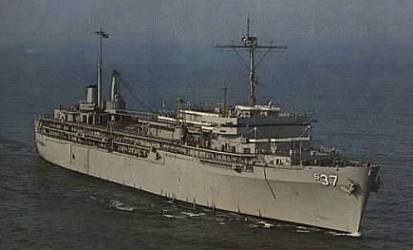
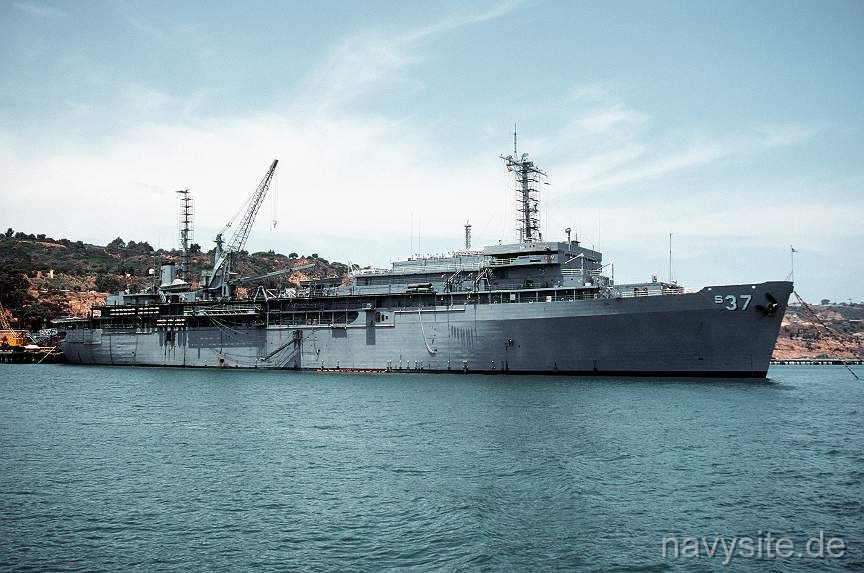
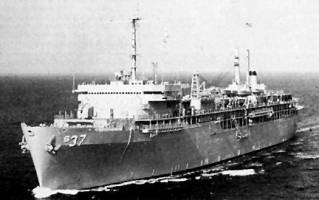
USS DIXON was a L. Y. SPEAR-class submarine tender built to sustain the United States Navy's expanding nuclear submarine force during the later Cold War. Named for Lieutenant George E. Dixon, the Confederate officer who commanded the Civil War submarine H. L. HUNLEY when it sank the Union sloop HOUSATONIC on February 17, 1864, the ship carried into the nuclear age the name of a figure associated with the very first combat submarine attack.
Her construction began at the General Dynamics Fore River Shipyard in Quincy, Massachusetts, where her keel was laid on September 7, 1967. Built as the second unit of the L. Y. SPEAR-class, she embodied the design philosophy of a large, mobile repair base: about 645 feet in length with a beam of 85 feet and a displacement reported in contemporary descriptions at over 23,000 tons when fully loaded. Within her twelve decks and more than 900 compartments were machine shops, electronics repair facilities, weapons magazines, medical and dental spaces, extensive supply storerooms and berthing for a complement well over a thousand officers and enlisted personnel. The class was designed so that up to four submarines could lie directly alongside to receive full tender services, while additional boats could be supported at nearby berths or anchorages.
DIXON was launched at Quincy on June 20, 1970, sponsored by Mrs. Dorothy (often recorded as "Mrs. Paul") Masterson, the wife of retired Vice Admiral Paul Masterson. After fitting-out, she was formally placed in commission on August 7, 1971, at Norfolk Naval Shipyard under the command of Captain David S. Boyd. Following the ceremony, the new tender steamed to the Pacific via the Panama Canal to take up her permanent role with the Pacific Fleet submarine force. By late 1971, she had arrived at her long-term homeport of San Diego, California, where she moored at the submarine base at Point Loma and began work as a key support platform for attack submarines of the Pacific Fleet.
Throughout the early 1970s, under Captain Boyd and his successor Captain B. M. Kauderer, who assumed command on August 17, 1973, USS DIXON settled into the pattern that would characterize most of her career: a large, essentially stationary industrial complex that allowed submarines to remain forward-based on the U.S. West Coast rather than return to major shipyards for routine maintenance. Official U.S. Navy imagery from 1971 and the early 1970s shows DIXON operating at sea and then at San Diego, already nested with submarines lying outboard as she conducted her first repair periods. As the Cold War intensified in the Pacific - with the Vietnam War still under way and the Soviet Pacific Fleet growing in reach - San Diego's submarine base became increasingly important, and DIXON's workshops, foundries and electronics technicians formed a shore-based extension afloat for the fast-attack submarines assigned there.
On November 22, 1975, DIXON appears in a well-known photograph moored at San Diego alongside the older tender USS SPERRY (AS 12), both ships servicing a cluster of submarines nested outboard. At that time, Captain J. P. Keane, who had taken command on May 23, 1975, was in charge. The image encapsulates DIXON's maturing role: the newer L. Y. SPEAR-class tender working together with a World War II-era predecessor to keep a mixed force of diesel-electric and nuclear boats ready for patrols and training along the Pacific coast and into the broader Pacific.
On November 10, 1977, Captain D. G. Harscheid relieved Captain Keane, and during his tenure DIXON took part in one of the most visible personnel changes in the modern U.S. Navy. In November 1978, two junior officers, Ensign Roberta McIntyre and Ensign Macushla McCormick, reported aboard DIXON. They were part of the first group of female officers assigned to serve at sea on U.S. Navy ships, and Ensign McIntyre would later become the first woman to qualify as a Surface Warfare Officer. Their arrival turned DIXON into an early test case for the integration of women into mixed-gender crews on large auxiliary ships - an important institutional change layered onto the ship's continuing technical mission.
By the end of the 1970s, the Pacific strategic environment was shifting. The Vietnam War had ended, but the Soviet Navy's presence in the Indian Ocean and western Pacific was increasing, and the United States maintained a forward posture with carrier battle groups and submarines operating from bases and anchorages extending from Hawaii and Guam to Diego Garcia. It was in this context that DIXON's activities broadened beyond routine San Diego operations. Under Captain R. L. Wolfe, who took command on August 2, 1979, the tender is documented at Diego Garcia in the British Indian Ocean Territory around 1981, berthed alongside the destroyer tender USS SAMUEL GOMPERS (AD 37). Official photographs show the two large auxiliaries together at the remote atoll, illustrating the U.S. Navy's use of forward repair hubs in the central Indian Ocean to sustain ships and submarines monitoring Soviet and regional maritime activity during the final phase of the Iran crisis and the early years of the Soviet-Afghan War.
Between these occasional deployments, DIXON remained closely tied to San Diego. When Captain N. A. Heuberger assumed command on April 3, 1982, she was again firmly anchored in her homeport role, even as the submarine force modernized around her. New LOS ANGELES-class nuclear attack submarines increasingly joined the older boats alongside her hull, taking advantage of her upgraded machine shops and weapons-handling arrangements.
By the mid-1980s, San Diego's submarine support complex had become unusually dense. A 1985 photograph shows DIXON at the base together with USS SPERRY and USS PROTEUS (AS 19), a World War II-era tender that had served extensively in the Pacific and at Guam. At this point, Captain T. H. Bond, who had taken command on January 26, 1985, was overseeing DIXON's contribution to a three-tender cluster that could simultaneously sustain a substantial number of submarines without sending them to distant shipyards.
The arrival of the newer tender USS McKEE (AS 41) in the mid-1980s began to change this balance. Navy records for McKEE note that after shakedown she joined DIXON at San Diego to support Pacific Fleet submarines, and a 1987 photograph shows both tenders moored together with multiple submarines at Point Loma. Under Captain R. N. Lee, who had taken command of DIXON on February 28, 1987, the older tender now worked in parallel with the new EMORY S. LAND-class ship, sharing upkeep and logistics duties for an increasingly modern submarine squadron based at San Diego.
Imagery from April 15, 1987, shows DIXON at San Diego with several submarines alongside, confirming that she remained heavily engaged in maintenance work even as McKEE took on a growing share of the load. Later that decade, she is seen in another official photograph sitting at the dock while a jet from the aircraft carrier USS CONSTELLATION (CV 64) passes low overhead during the large-scale Pacific Exercise PACEX '89. The exercise, conducted in 1989, was the largest allied naval exercise in the Pacific since World War II and involved substantial carrier, surface and submarine forces to demonstrate allied capabilities in the closing years of the Cold War. Though DIXON did not deploy to the open-ocean battle problems, her presence in the harbor during PACEX underlines the way submarine tenders underpinned such exercises by ensuring that participating submarines had reliable repair and logistics support before and after their at-sea phases.
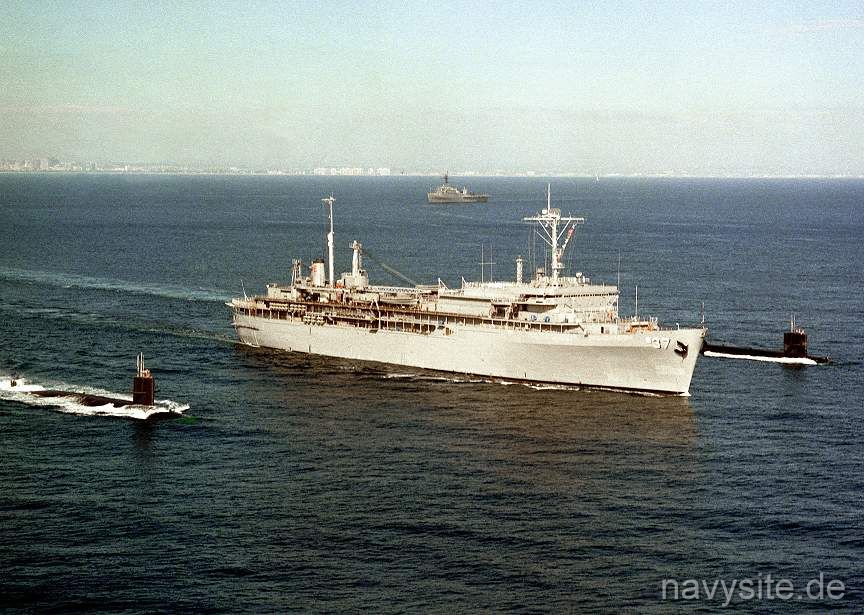
In 1989, Captain C. J. Beers Jr. relieved Captain Lee on April 29, just as the Cold War was entering its final phase with arms control talks and political upheavals in Eastern Europe. The following year provides one of the clearest single snapshots of DIXON's work with individual submarines: a photograph dated September 17, 1990, records the tender departing San Diego in company with the nuclear attack submarines USS GURNARD (SSN 662) and USS GUITARRO (SSN 665). The image demonstrates that DIXON occasionally got underway with the submarines she supported - for example to reposition for exercises or to participate as a mobile support ship during operations off the California coast - rather than serving exclusively as a pier-side platform.
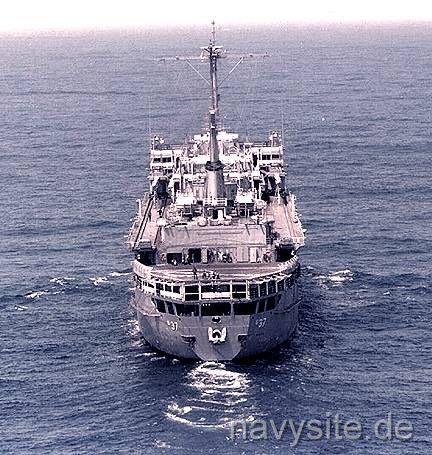
The early 1990s brought new operational demands as the Cold War ended and regional crises, particularly in the Middle East, began to shape U.S. naval deployments. Although detailed narrative accounts of all of DIXON's movements in this period are limited in publicly available sources, official photographic records show her in an aerial stern view moored at a pier near Manama, Bahrain, together with submarines and other vessels in what is described as the aftermath of Operation Desert Storm. This indicates that in the early 1990s she served at least temporarily as a forward repair and logistics base in the Persian Gulf, supporting submarines and surface units involved in enforcing post-war sanctions and monitoring regional security after the 1991 conflict.
Command passed to Captain R. A. McCurry on June 15, 1991, and to Captain D. W. Crisp on November 25, 1992. Around this time, a dedicated USS DIXON Cruise Book documents a 1992-93 Western Pacific deployment that extended into the Indian Ocean. While the cruise book itself is not fully available in open online archives, its existence confirms that DIXON undertook a major deployment in 1992–1993, consistent with the broader pattern of the post–Desert Storm Navy: rotating large auxiliaries through Western Pacific and Indian Ocean ports to sustain submarines participating in presence missions, exercises with allies and continued surveillance of strategic sea lanes in the western Pacific and northern Arabian Sea.
Alongside these deployments, DIXON continued to appear regularly at San Diego. Photographs from 1990 show her again at the submarine base with multiple boats alongside, and another undated image from the early 1990s records the LOS ANGELES-class submarine USS TOPEKA (SSN 754) being eased into position next to DIXON for maintenance shortly after TOPEKA's entry into service. These scenes highlight the tender's role in receiving new-construction submarines for their first significant maintenance availabilities after initial trials and deployments, providing a bridge between the building yards and long-term operational life in the fleet.
By the mid-1990s, however, the U.S. Navy was reducing its inventory of traditional submarine tenders. The end of the Cold War, the shrinking size of the submarine force and the growth of shore-based maintenance facilities all reduced the perceived need for multiple large repair ships at West Coast bases. Captain D. W. Hearding became DIXON's final commanding officer on August 10, 1994, taking her through her last active year. On December 15, 1995, after nearly a quarter-century of service, USS DIXON was decommissioned. She was struck from the Naval Vessel Register on March 18, 1996.
The decommissioning created an immediate shift in responsibilities at San Diego. Records for USS McKEE note that in 1995, after DIXON left service, McKEE assumed all submarine tender duties for San Diego-based submarines, confirming that DIXON's departure marked the end of an era with two large tenders sharing the workload at Point Loma. Ex-DIXON then entered the inactive fleet, awaiting a final disposition decision at a time when many decommissioned auxiliaries were being scrapped or sunk in weapons tests.
Ultimately, the Navy chose to employ DIXON in a live-fire sinking exercise. On July 21, 2003, she was sunk as a target in the Atlantic Ocean approximately 360 miles southeast of Charleston, South Carolina, in waters over 5,000 meters deep. Her destruction allowed fleet units to conduct realistic weapons training against a large, robust hull while simultaneously disposing of a ship that no longer fit the Navy’s support concept.
back to top
go to the end of the page
USS DIXON Image Gallery:
back to top
Back to Submarine Tenders list.
Back to Ships list.
Back to selection page.
Back to 1st page.