Search the Site with 
General Characteristics Crew List Memorabilia Cruise Books Accidents aboard the Ship Notes of interest About the name SEATTLE History Image Gallery to end of page

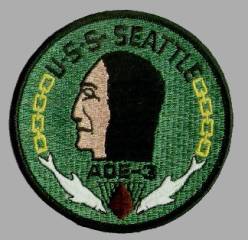
USS Seattle (AOE 3)

- decommissioned -


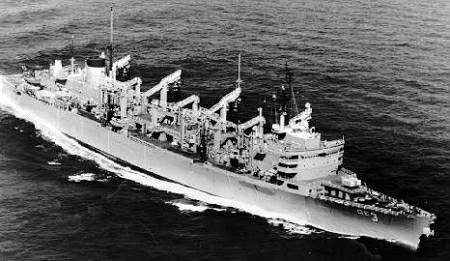
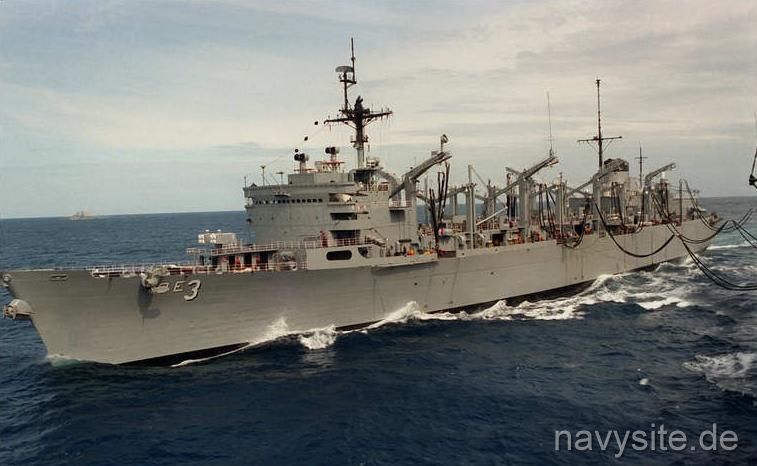
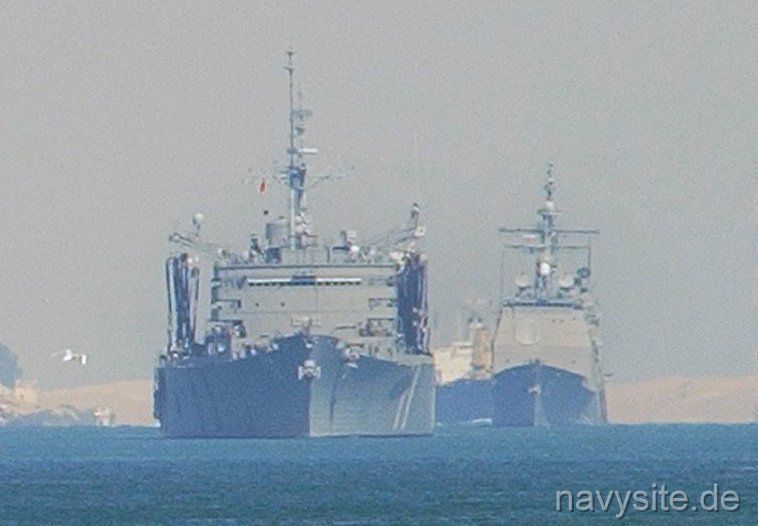
USS SEATTLE was the last but one SACRAMENTO - class Fast Combat Support Ship. Decommissioned on March 15, 2005, the SEATTLE was subsequently laid-up in Philadelphia, Penn. The SEATTLE was sold for scrapping in September 2005 to ESCO Marine Inc., Brownsville, Tx. The ship was towed to Brownsville arriving there on February 9, 2006 and scrapping was completed on January 26, 2007.

General Characteristics:Awarded: December 29, 1964
Keel laid: October 1, 1965
Launched: March 1, 1968
Commissioned: April 5, 1969
Decommissioned: March 15, 2005
Builder: Puget Sound Naval Shipyard, Bremerton, Washington
Propulsion System: four V2M 600 PSI Propulsion Boilers
Propellers: two
Length: 794 feet (242 meters)
Beam: 107 feet (32.6 meters)
Draft: 38 feet (11.6 meters)
Displacement: approx. 53,000 tons
Speed: 26 knots
Aircraft: two CH-46
Armament: one Sea Sparrow launcher, two Phalanx CIWS
Crew: 48 Officers, 678 Enlisted


Back to topback to top  go to endgo to the end of the page


Back to topback to top  go to endgo to the end of the page

Crew List:

This section contains the names of sailors who served aboard USS SEATTLE. It is no official listing but contains the names of sailors who submitted their information.


back to top  go to the end of the page


Back to topback to top  go to endgo to the end of the page

USS SEATTLE Cruise Books:


Back to topback to top  go to endgo to the end of the page

Accidents aboard USS SEATTLE:

DateWhereEvents
February 1982Craney Island, Norfolk, Va.In early February, USS SEATTLE is hit by a tugboat while getting underway from Norfolk, Va., causing extensive damage to equipment on the ship's aft end.
June 11, 1982AtlanticUSS SEATTLE and USS AYLWIN (FF 1081) collide when SEATTLE loses steering control while refueling the frigate during transit across the Atlantic to the Mediterranean.
July 12, 1982Porto Torres, Sardinia, ItalyUSS SEATTLE suffers a " freak explosion" in the after portion of the ship while moored alongside a fuel pier at Porto Torres. A chemical reaction between fuel vapors and a chemical stored in one of the blast-torn spaces causes the explosion which damages the after steering compartment and Enlisted Dining Facility. SEATTLE is able to get underway for Naples, Italy, less than 12 hours after the Genertal Quarters alarm was first sounded.
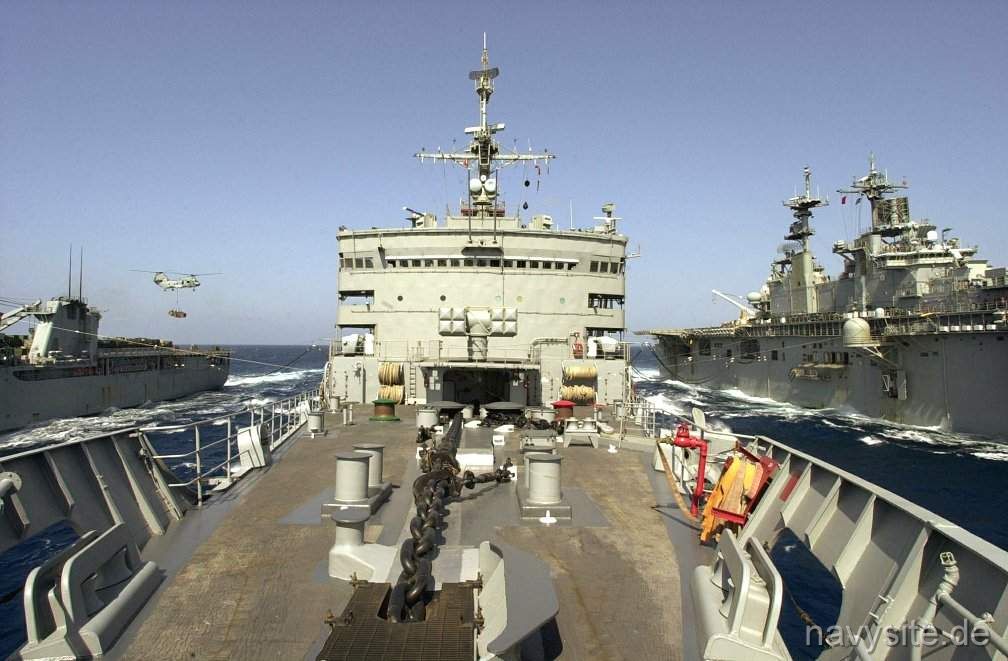
March 29, 1995 USS SEATTLE collides with the Amphibious Assault Ship USS WASP (LHD 1).
August 18, 1998Philadelphia, Penn.USS SEATTLE hit the decommissioned USS AMERICA (CV 66) while leaving a slip in Philadelphia, sustaining minor damage. A civilian harbor pilot, not the SEATTLE's regular pilot, was at the helm during the crash.
February 7, 2002100 miles east of the Virginia CapesDuring a vertical replenishment with USNS MOUNT BAKER (T-AE 34), one of SEATTLE's CH-46 helicopters went down in the Atlantic Ocean. All four crewmembers were recovered by a second helicopter also participating in the VERTREP and were returned to SEATTLE.

The four crewmembers of the Navy CH-46 "Sea Knight" have been identified as: Lt. Lance Collier, 31; Lt. j.g. Cyndee Brittingham, 28; Aviation Machinist's Mate 2nd Class Kevin Maul, 29; and Aviation Electronics Technician 3rd Class Clifton Lyons, 20.The helicopter's co-pilot and one crewmember suffered minor injuries. Co-pilot Lt. j.g. Brittingham received a minor injury to her nose and crewman Petty Officer Maul separated his shoulder. The other two crewmembers were unharmed.

Both helicopters belonged to Helicopter Combat Support Squadron 6, Detachment 4, embarked aboard SEATTLE.


Back to topback to top  go to endgo to the end of the page

Notes of Interest:


Back to topback to top  go to endgo to the end of the page

About the Ship's Name, about Chief Seattle, the Namesake of the City of Seattle:

Chief Seattle, considered the greatest of all the Puget Sound Indians, was born at the campsite of his ancestors on Blake Island in 1786. His father was Chief Schweabe of the Shuamish Indians.

Chief Seattle was seven years old when Captain Cooke, in the sailing vessel Vancouver, discovered and explored the Puget Sound. Pioneers first landed at Alki Point on 28 September 1851 near the site of the present City of Seattle. Because the native pronunciation of his name (Schweabe) was too difficult for English-speaking people to say, the name Sealth or Seattle was suggested by a local physician, a Dr. Maynard.

Relations between the Indians and the settlers were peaceful from the start of the colonization period. The settlers thought so much of Chief Seattle that they named their new community after him. The relations with the Indians remained peaceful until 1855, when a tribe of the White River District rebelled over an unfair treaty. An attack against the settlers of Seattle was repelled with the aid of the steam barque Decator.

Throughout this violent period, Chief Seattle remained a steadfast and loyal friend of the settlers, and encouraged the Indians to remain peaceful.

In his later years, Chief Seattle was baptized, and adopted the Christian name of Noah. The last years of his life were spent at the Fort Madison Reservation and Agate Point on Bainbridge Island. He died in 1866.


Back to topback to top  go to endgo to the end of the page


Back to topback to top  go to endgo to the end of the page

USS SEATTLE History:

The fast combat support ship USS SEATTLE was built to solve a very specific Cold War logistics problem: keeping high-tempo carrier and escort operations sustained at sea without relying on fixed bases. USS SEATTLE was laid down on 1 October 1965 at Puget Sound Naval Shipyard, Bremerton, Washington, as one of the very large, high-speed replenishment ships whose size and cargo/fuel capacity were intended to match the demands of carrier task forces. She was launched on 1 March 1968 and commissioned on 5 April 1969.

In the years after commissioning, USS SEATTLE's public record consistently reflects the same core pattern: repeated overseas deployments - especially to the Mediterranean and, later, into the Indian Ocean and Persian Gulf operating areas - interspersed with periods of upkeep, training, and major maintenance, all in support of fleet readiness during the late Cold War and the post-Cold-War era of sustained forward naval presence.

By July 1971, USS SEATTLE had earned the Battle Efficiency "E", and by the fiscal year ending June 1972 she was credited with multiple excellence awards (including engineering and communications distinctions) as her operational cycle matured into a rhythm of long, ship-and-air-wing-driven logistics support at sea. Deployment summaries place USS SEATTLE on an extended Mediterranean deployment from August 1970 to March 1971, then again from December 1971 to July 1972, and again from June 1973 to December 1973 - a sequence that fits the broader strategic reality of the period: Sixth Fleet carrier operations required frequent underway replenishment in a region where political tension could spike quickly, and where U.S. naval presence was an everyday instrument of policy and reassurance for allies.

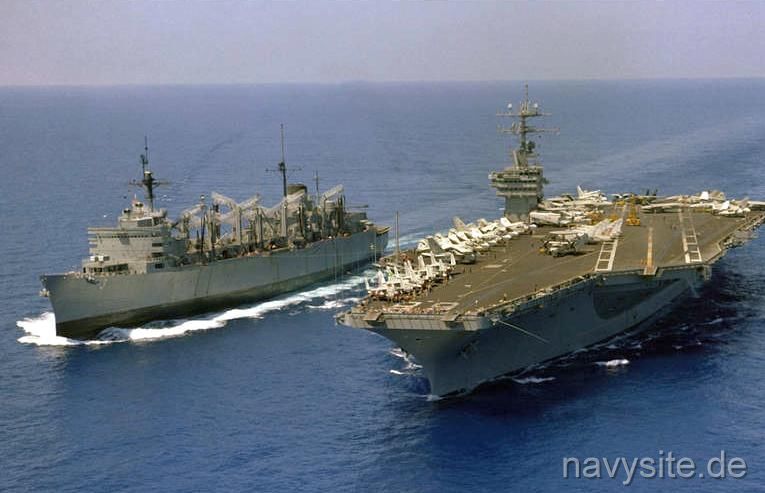
USS SEATTLE completed her first major overhaul in February 1975, and photographs place her at Mosquito Pier, Vieques, Puerto Rico, on 9 June 1975, consistent with the Caribbean training and weapons-range activity that commonly bracketed major deployments for Atlantic Fleet units. On 4 November 1974, she received the Arleigh Burke Fleet Trophy, and in April 1974 she was presented a "Top Runner" award by Commander, Second Fleet, tied to Atlantic Fleet readiness exercises - signals that, beyond simply carrying fuel and ordnance, the ship was expected to execute complex multi-station replenishment evolutions at speed while maintaining high engineering and communications performance. Summaries identify a Mediterranean deployment from January 1976 to August 1976; during that broader deployment period, a documented underway replenishment event occurred on 13 January 1976, when USS SEATTLE conducted replenishment at sea with USS AMERICA (CV 66) and USS JOHN F. KENNEDY (CV 67), illustrating her role as a logistics pivot for carrier operations even when multiple carriers were operating on overlapping schedules.

From the late 1970s through the 1980s, the same deployment cycle continued, with public cruise book and association records indicating repeated long overseas cruises. These years were defined by NATO and U.S. national policy focused on deterring Soviet pressure points while maintaining credible maritime response options from the Mediterranean to the approaches of the Middle East. For a ship like USS SEATTLE, that translated into sustained at-sea logistics for carrier and surface action groups, frequent rendezvous cycles for fuel and stores transfers, and the communications and navigation precision necessary to support safe multi-ship operations day after day - a cadence that aligns with the era's continuing forward presence and large-scale exercises, even as the Cold War began to shift toward its endgame.

That strategic shift was overtaken by the crisis of 1990-1991, when Iraq's invasion of Kuwait drove a major multinational build-up and then combat operations in the region. Deployment summaries place USS SEATTLE on deployments from March 1990 to July 1990 and then, crucially, August 1990 to April 1991, corresponding to the period of Operation Desert Shield and the transition into Operation Desert Storm. While detailed port-by-port itineraries are not consistently available, the broad timing and theater framing reflect the operational reality: fast combat support ships were essential to sustaining the high sortie generation rates and escort-screen endurance of carrier forces operating far from established infrastructure. After the war, USS SEATTLE's recorded overseas deployments continued: May 1993 to September 1993, then May 1995 to September 1995, when an incident underscored the crowded, high-tempo nature of Adriatic operations in the Balkans era - on 29 March 1995, USS SEATTLE collided with USS WASP (LHD 1) in the Adriatic Sea, a reminder that even non-combat events could carry operational consequences during sustained forward deployments.

By the late 1990s, the U.S. Navy's day-to-day posture increasingly centered on persistent presence, maritime security, and enforcing post-Gulf-War constraints, and the logistics demand remained constant. Summaries place USS SEATTLE on deployment from October 1997 to April 1998 and again from October 1999 to March 2000. During that latter deployment, command history material notes that Captain Barbaree assumed command while USS SEATTLE was deployed in March 2000, and that during his tour the ship completed its 5,000th underway replenishment - an operational milestone that fits the cumulative arithmetic of decades of frequent, multi-recipient replenishment events.

In the early 2000s, forward carrier operations were shaped by the post-9/11 wars and the requirement to keep strike and surveillance aircraft operating across wide geographic arcs. Summaries list a deployment from August 2002 to December 2002, and then the ship's final major overseas deployment from June 2004 to December 2004. During that 2004 deployment, publicly accessible carrier deployment documentation places USS SEATTLE with the USS JOHN F. KENNEDY strike group and ties the deployment context to Operation Enduring Freedom, Operation Iraqi Freedom, and the "Summer Pulse 2004" surge exercise. Port-visit listings associated with that deployment include Valletta, Malta; Bahrain; Jebel Ali, United Arab Emirates; and Tarragona, Spain - an itinerary consistent with the Mediterranean-to-Gulf operating circuit and the logistics and liberty rhythms that supported sustained carrier flight operations. The deployment also generated multiple dated public imagery references: for example, on 12 July 2004 and 23 July 2004, documented replenishment activity connected USS SEATTLE to USS JOHN F. KENNEDY operations in the Persian Gulf region, illustrating how the ship's aviation detachment and alongside replenishment capability were integrated into the strike group's day-to-day sustainment.

After returning from her final deployment in December 2004, USS SEATTLE moved rapidly into end-of-service milestones. She was decommissioned on 15 March 2005, closing a career defined by repeated long deployments and the steady, technically demanding work of keeping other ships fueled, fed, armed, and supplied while underway. Open sources further indicate that her disposal process concluded with scrapping in Brownsville, Texas, reported as completed on 26 January 2007.


Back to topback to top  go to endgo to the end of the page


The photos below were taken by Charles Waddell and show the decommissioning ceremony of the USS SEATTLE on March 15, 2005, at Norfolk, Va.


Navy Band

Ship's Bell

Vice Admiral

Casting-off

Colorguard

Going from board

Going from board

Leaving for Philly

Tour Jacket

Last Man

Manning the Rails

Speakers

Plankowners

Saluting the Vice Admiral

Decom Crew

Welcome alongside...


Back to topback to top


Back to Fast Combat Support Ships site. Back to ships list. Back to selection page. Back to 1st page.