Search the Site with 
General Characteristics Crew List Memorabilia Cruise Books Accidents aboard the Ship About the Ship's Name History Image Gallery to end of page

USS Du Pont (DD 941)

- decommissioned -

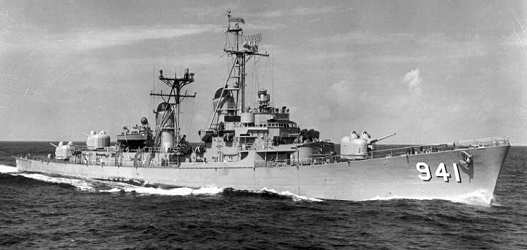
USS DU PONT was a FORREST SHERMAN - class destroyer and the third ship in the Navy to bear the name. In the mid-1960s, the USS DU PONT was one of the eight FORREST SHERMAN - class destroyers chosen to receive an anti-submarine warfare capability upgrade which included the replacement of one of the Mk-42 5-inch guns with a Mk-16 ASROC missile launcher. The ships that underwent the conversion then formed the BARRY - class.

Decommissioned after almost of 26 years of service on March 4, 1983, the DU PONT was stricken from the Navy list on June 1, 1990, and on December 11, 1992, the destroyer was finally sold for scrapping.

General Characteristics:Awarded: July 30, 1954
Keel laid: May 11, 1955
Launched: September 8, 1956
Commissioned: July 1, 1957
Decommissioned: March 4, 1983
Builder: Bath Iron Works, Bath, Maine
Propulsion system: four-1200 lb. boilers; two steam turbines; two shafts
Propellers: two
Length: 418.3 feet (127.5 meters)
Beam: 45,3 feet (13.8 meters)
Draft: 22 feet (6.7 meters)
Displacement: approx. 4,000 tons full load
Speed: 32+ knots
Aircraft: none
Armament: two Mk-42 5-inch/54 caliber guns, Mk-32 ASW torpedo tubes (two triple mounts), one Mk-16 ASROC missile launcher
Crew: 17 officers, 287 enlisted


Back to topback to top  go to endgo to the end of the page


Back to topback to top  go to endgo to the end of the page

Crew List:

This section contains the names of sailors who served aboard USS DU PONT. It is no official listing but contains the names of sailors who submitted their information.


back to top  go to the end of the page


Back to topback to top  go to endgo to the end of the page

USS DU PONT Cruise Books:


Back to topback to top  go to endgo to the end of the page

Accidents aboard USS DU PONT:

DateWhereEvents
April 25, 1974Yorktown, Va.USS DU PONT collides with the left swing span of a bridge at Yorktown, Va. The DU PONT suffers damage to the forward mast while the bridge is closed to traffic for approx. one hour.


Back to topback to top  go to endgo to the end of the page

About the Ship's Name:

Samuel Francis Du Pont, born 27 September 1803 in Bergen Point, N.J., became a midshipman 19 December 1815. He commanded the sloop CYANE during the Mexican War and gave distinguished service at San Diego, Mazatlan, San Jose, and other ports. In command of the South Atlantic Blockading Squadron from 18 September 1861 to 3 June 1863, he directed many operations along the coast including the victorious campaign which resulted in the fall of Port Royal, S.C., 7 November 1861. For this accomplishment he received the thanks of Congress. Rear Admiral Du Pont died 23 June 1865 in Philadelphia, Pa.


Back to topback to top  go to endgo to the end of the page

USS DU PONT History:

USS DU PONT was a FORREST SHERMAN-class destroyer built at Bath Iron Works, Bath, Maine. Her keel was laid on May 11, 1955; she was launched on September 8, 1956, and commissioned on July 1, 1957. In her first year the ship completed shakedown and joined the Atlantic Fleet. From July 6-31, 1958, she embarked midshipmen for training while conducting anti-submarine exercises in the western Atlantic, with a mid-cruise visit to New York that underscored her early role as an ASW destroyer amid escalating Cold War submarine activity. On September 2, 1958, she sailed for her first Sixth Fleet deployment in the Mediterranean, where she worked high-tempo air-defense and ASW problems before returning to Norfolk on March 12, 1959. That spring and summer, DU PONT was selected for Operation INLAND SEAS, the inaugural U.S. Navy task force transit of the newly opened Saint Lawrence Seaway into the Great Lakes. On June 26, 1959, she helped escort the Royal Yacht BRITANNIA during the dedication ceremonies attended by Queen Elizabeth II and President Dwight D. Eisenhower, then continued visits to Great Lakes ports as part of the historic cruise. In late summer 1959, the destroyer re-crossed the Atlantic, serving as plane-guard to cover President Eisenhower's transatlantic flight before a port call at Southampton, England, in August-September. On January 28, 1960 she again deployed to the Mediterranean, returning August 31 to enter overhaul at Norfolk Naval Shipyard through the end of the year.

In 1961-1962, DU PONT alternated East Coast operations and Caribbean exercises with rising strategic tensions. In October-November 1962, she helped enforce the naval "quarantine" of Cuba during the Cuban Missile Crisis, part of the Atlantic Fleet screen that executed the administration's blockade policy at sea. In April 1963, only months later, she shifted to emergency duty off New England when USS THRESHER (SSN 593) was lost during deep-dive trials. DU PONT served as a command ship in the multi-unit search effort out of Boston beginning April 10, coordinating with submarines, rescue ships, and other destroyers as the Navy organized what was then an unprecedented deep-ocean search. By year's end 1963, she had compiled exceptional machinery-space performance, finishing the year as the only Atlantic Fleet destroyer to earn four consecutive Engineering "E" awards. A further Mediterranean cruise followed from late 1963 into 1964, reflecting routine Sixth Fleet presence missions in the eastern Atlantic and Med.

In 1965, DU PONT continued Cold War tasks but also touched the early space age. During the GEMINI 5 mission (August 21-29, 1965) she was the first ship to reach the splashdown point, standing by while the astronauts and capsule were secured by the designated recovery force. She additionally recovered a booster section from a space launch and brought it to Norfolk secured on her fantail. That same year, when civil war and U.S. intervention gripped the Dominican Republic, DU PONT operated in and off Santo Domingo during the April-September 1965 crisis (OPERATION POWER PACK). NATO and Sixth Fleet exercises occupied the first half of 1966, followed by Caribbean operations and a seventh consecutive Engineering "E", at the time an unprecedented run for an Atlantic Fleet destroyer.

The destroyer's first WESTPAC/Vietnam combat tour began in August 1967. Assigned to the northern I Corps gunline in support of U.S. Marines near the Demilitarized Zone, DU PONT conducted day-and-night naval gunfire against North Vietnamese artillery sites, troop concentrations, and logistics positions while under frequent counter-battery threat. On August 28, 1967, enemy 130-mm coastal guns shifted fire from ROBISON (DDG 12) to DU PONT. One round struck MOUNT 52, sending shrapnel through the mount and after superstructure, killing FN Frank L. Bellant and wounding eight sailors. Despite the casualties, DU PONT remained on station two more weeks before repairs at Subic Bay and then returned to the gunline on October 10, again drawing fire but avoiding hits. On November 10 the eight wounded received Purple Hearts. Two days later the ship made a final late-tour gunline run. Over seventy-five combat days that deployment, DU PONT's 5-inch/54 batteries fired roughly 20,000 rounds. She returned to Norfolk in January 1968 for dry-dock repairs and briefly supported Apollo recovery contingencies and Caribbean training, adding further departmental excellence marks that summer.

DU PONT began a second combat period in theater on October 10, 1968, working twenty-six days of close support in the Mekong Delta as blue-water destroyers increasingly covered brown-water operations. She fired missions for SEAL reconnaissance teams and ARVN units, struck a Viet Cong-held island in the Gulf of Siam, supported a swift boat sweep up the Ong Doc River estuary, and returned north to provide gunfire near Da Nang and other I Corps targets. In mid-December, she covered an amphibious landing to the south. In January 1969, she again supported the 1st Marine Division around Da Nang and a subsequent four-day amphibious landing before more Mekong-Delta missions. When she cleared the combat zone in spring 1969, DU PONT's guns had fired approximately 30,000 rounds across her Vietnam service, credited with damaging or destroying hundreds of military structures and small craft. Back in the United States, she decommissioned on May 23, 1969 at Boston Naval Shipyard for an SCB-251 anti-submarine modernization that replaced her after 5-inch mount with an ASROC launcher, upgraded sonar and fire control, and improved sensors, aligning her with the ASW-enhanced subset of the class.

From the start of 1970, USS DU PONT was completing her anti-submarine warfare modernization. She was recommissioned at Boston Naval Shipyard on May 9, 1970, and returned to Norfolk to rejoin the Atlantic Fleet. Through the summer and autumn she ran trials, certifications, and type training in the Virginia Capes operating areas. Deck logs confirm her back at sea by mid-July, reflecting the normal post-overhaul work-up cycle. The ship entered 1971 focused on anti-submarine exercises, local operations along the U.S. East Coast, and periodic Caribbean evolutions as she rebuilt readiness for sustained deployments.

By 1972, DU PONT's engineering and combat teams were operating at a high tempo in the Western Atlantic and Mediterranean training lanes, and the ship's performance was recognized when she received the Marjorie Sterrett Battleship Fund Award for the Atlantic Fleet, an annual readiness and excellence honor conferred by the Chief of Naval Operations.

On December 1, 1972 DU PONT departed Norfolk for a seven-month Sixth Fleet deployment. Her cruise track and liberty calls were typical of Cold War Mediterranean rotations, balancing NATO exercises, presence missions, and logistics stops. The ship crossed the Atlantic on December 1-10, called at Rota, Spain (December 10-11), then Tunis, Tunisia (December 13-16). Over the Christmas and New Year period she lay at Toulon, France (December 20-27) and Naples, Italy (December 28-January 6, 1973). January brought St. Tropez, France (January 16-20) and Palma, Majorca (January 27-February 5). In February she visited Malaga, Spain (February 6-7); Carboneras, Spain (February 9-12); La Spezia, Italy (February 14-17); and Augusta Bay, Sicily (February 23-25). A longer operating and upkeep stretch followed at Athens, Greece (February 27-March 12). Mid-March she shifted to Valencia, Spain (March 15-19), then Pollensa Bay, Majorca (March 20-22). Through late March and April she divided time between Barcelona, Spain (March 25-April 10); Pollensa Bay (April 11-13); Port Mahon, Menorca (April 14-18); and Valencia (April 20-27). In early May she paused at San Raphael, France (May 3-4), then made Genoa, Italy (May 14-21) and San Remo, Italy (May 21-25). Late May and June were spent at Gaeta, Italy (May 27-31), Cannes, France (June 1-8), back to Gaeta (June 10-11), Palma (June 13-16), and Rota (June 17-21). DU PONT then recrossed the Atlantic (June 21-29) and returned to Norfolk, Virginia, on June 29, 1973.

Stateside in late 1973 and early 1974, DU PONT resumed the Atlantic Fleet training cycle. On April 25, 1974, while maneuvering near Yorktown, Virginia, she struck the left swing span of a bridge. The destroyer sustained damage to her forward mast and the bridge was closed to traffic for roughly an hour. Repairs followed and the ship returned to routine operations afterward.

In 1975, DU PONT underwent a regular overhaul that reset her material condition for the next series of deployments. After yard work she rejoined the Atlantic Fleet, resuming exercises and underway periods from Norfolk. Command leadership changed late that year, and the ship settled back into the standard pattern of Second Fleet training and periodic Caribbean evolutions across 1976-1977 as the Navy emphasized allied interoperability and open-ocean ASW against the expanding Soviet submarine force. Surviving administrative records also show scheduled port-call planning in late 1976 alongside other Atlantic Fleet escorts.

DU PONT's most visible tasking of the period came in 1978, when she deployed with Task Group 138 for UNITAS XIX, the inter-American exercise series conducted with Latin American partner navies. The ship sailed on July 10, 1978, and spent the summer and fall in the South Atlantic and Caribbean operating with U.S. and regional frigates, destroyers, and a U.S. attack submarine, practicing underway replenishment, convoy and air-defense drills, and combined anti-submarine tactics. Photographic records from the Naval History and Heritage Command show DU PONT maneuvering with the Venezuelan frigate ALMIRANTE CLEMENTE (F 11) and underway in formation with USS WILLIAM V. PRATT (DDG 44) and USS BOWEN (FF 1079) during the exercise. She completed the cruise on December 13, 1978, returning to Norfolk to conclude the deployment year. Strategically, UNITAS during the late 1970s reinforced hemispheric maritime cooperation and gave U.S. escorts like DU PONT sustained practice in multi-navy task-group operations.

In 1979, she entered Bethlehem Steel's Hoboken (New Jersey) yard for a major refit, and in 1980 conducted REFTRA at Guantanamo Bay, where the crew trained intensively in engineering casualties, combat systems drills, and damage control. That year the ship earned multiple "E" awards under CDR Harlan K. Ullman while attached to COMDESRON TWO.

With the Iranian hostage crisis and subsequent instability reframing U.S. naval posture, DU PONT deployed to the Middle East in 1981, transiting the Suez Canal into the Red Sea and Persian Gulf for extended patrols associated with the USS NIMITZ (CVN 68) battle group's presence missions in the region. She operated at elevated readiness in proximity to Iranian maritime patrol aircraft and surface combatants as U.S. carriers maintained deterrent coverage in the Arabian Sea and Gulf following the January 20, 1981, release of the hostages. In 1982, as the Multinational Force in Lebanon formed after the Israeli-PLO fighting, DU PONT took station off Beirut in August and remained nearly one hundred days. During that period, she provided carefully controlled naval gunfire support during the PLO evacuation and subsequent phases of the peacekeeping mission, at times serving longer on Beirut station than any other U.S. ship in that initial rotation. She departed the eastern Med in December 1982 and returned to the United States.

DU PONT was decommissioned at the end of her fleet career on March 4, 1983, after more than twenty-five years of service across the Cold War and Vietnam eras. She entered the Philadelphia reserve fleet, was stricken from the Naval Vessel Register on June 1, 1990, and was sold for scrapping on December 11, 1992.


Back to topback to top  go to endgo to the end of the page


Back to topback to top


Back to Destroyers list. Back to ships list. Back to selection page. Back to 1st page.