
Search the Site with

|
Search the Site with
|
 General Characteristics Crew List Memorabilia Cruise Books History About the Ship's Name Accidents aboard the Ship Image Gallery to end of page
 |  |
USS NEWMAN K. PERRY was one of the GEARING - class destroyers and the first ship in the Navy to bear the name. Both decommissioned and stricken from the Navy list on February 27, 1981, the NEWMAN K. PERRY was transferred to South Korea the same day and recommissioned as KYONG KI. Finally decommissioned in 1998, the destroyer was later scrapped.
| General Characteristics: | Awarded: 1943 |
| Keel laid: October 10, 1944 | |
| Launched: March 17, 1945 | |
| Commissioned: July 26, 1945 | |
| Decommissioned: February 27, 1981 | |
| Builder: Consolidated Steel Co., Orange, TX | |
| FRAM I Conversion Shipyard: Boston Naval Shipyard, Boston, Mass. | |
| FRAM I Conversion Period: 1964 - February 1965 | |
| Propulsion system: four boilers, General Electric geared turbines; 60,000 SHP | |
| Propellers: two | |
| Length: 391 feet (119.2 meters) | |
| Beam: 41 feet (12.5 meters) | |
| Draft: 18.7 feet (5.7 meters) | |
| Displacement: approx. 3,400 tons full load | |
| Speed: 34 knots | |
| Aircraft after FRAM I: two DASH drones | |
| Armament after FRAM I: one ASROC missile launcher, two 5-inch/38 caliber twin mounts, Mk-32 ASW torpedo tubes (two triple mounts) | |
| Crew after FRAM I: 14 officers, 260 enlisted |
 back to top go to the end of the pageback to top go to the end of the page
Crew List:
This section contains the names of sailors who served aboard USS NEWMAN K. PERRY. It is no official listing but contains the names of sailors who submitted their information.
back to top go to the end of the pageback to top go to the end of the pageUSS NEWMAN K. PERRY Cruise Books:
back to top go to the end of the pageUSS NEWMAN K. PERRY History:
USS NEWMAN K. PERRY was laid down at Consolidated Steel, Orange, Texas, on 10 October 1944, launched on 17 March 1945 with Mrs. Laura P. Gunter as sponsor, and commissioned on 26 July 1945 under Commander Norman E. Smith. Following shakedown she shifted from the Atlantic to the Pacific on 7 November 1945, reached Pearl Harbor, then proceeded to Japan for occupation duty. Returning to Pearl Harbor on 28 March 1946, she joined Joint Task Force 1 for atomic tests "Able" and "Baker" at Bikini in July, and in August 1946 steamed back to the United States. On 18 August 1946 she arrived at San Diego.
On 13 September 1947 she reached Yokosuka with Destroyer Division 132 and three days later shifted to Qingdao to begin patrol, escort, SAR, ASW and hydrographic work along the China coast and off Taiwan and Okinawa. Relieved on 5 May 1948, she returned to California, underwent overhaul at Mare Island from October 1948, and on 4 April 1949 departed San Diego for her new Atlantic home port of Newport, arriving 21 April 1949.
In March 1949 she was reclassified DDR 883, reflecting radar-picket duties, and began the pattern that would define her 1950s: Sixth Fleet Mediterranean deployments interspersed with Second Fleet training, midshipman cruises, and Atlantic/Caribbean exercises.
In 1952, she completed a Mediterranean tour - part of the steady post-Korea pattern of maintaining a visible U.S. naval presence in the eastern Atlantic and Middle Sea amid tension points from North Africa to the Balkans - before returning to the Second Fleet treadmill of gunnery, ASW, and replenishment drills. One tangible modernization milestone fell in 1953, when the destroyer received more advanced radar, a revamped CIC, and new anti-aircraft armament to keep her picket and escort capabilities current against faster jet aircraft and denser air pictures.
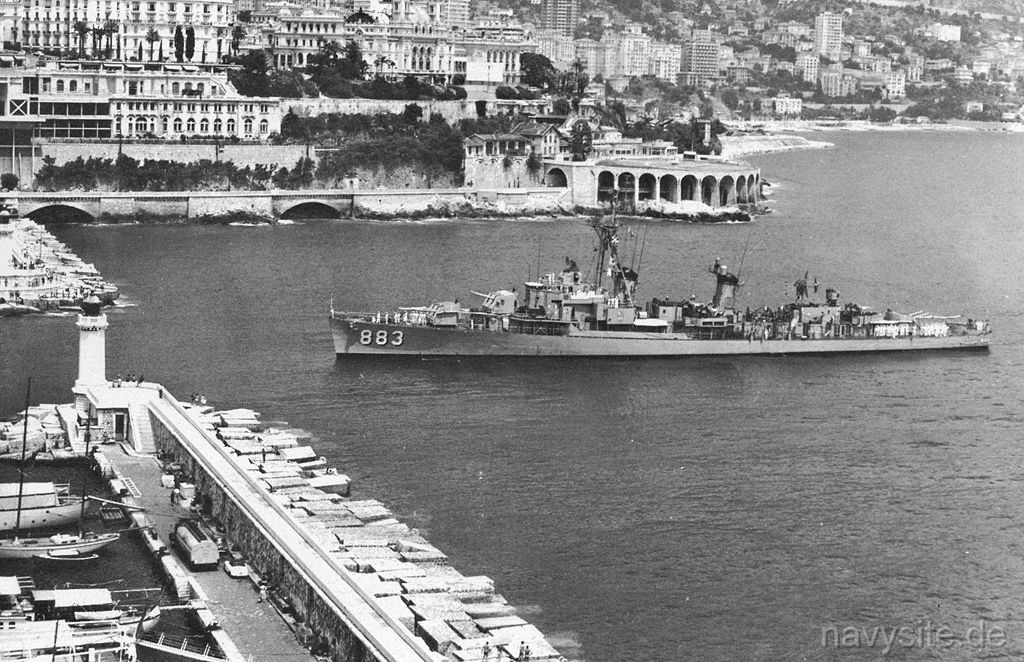
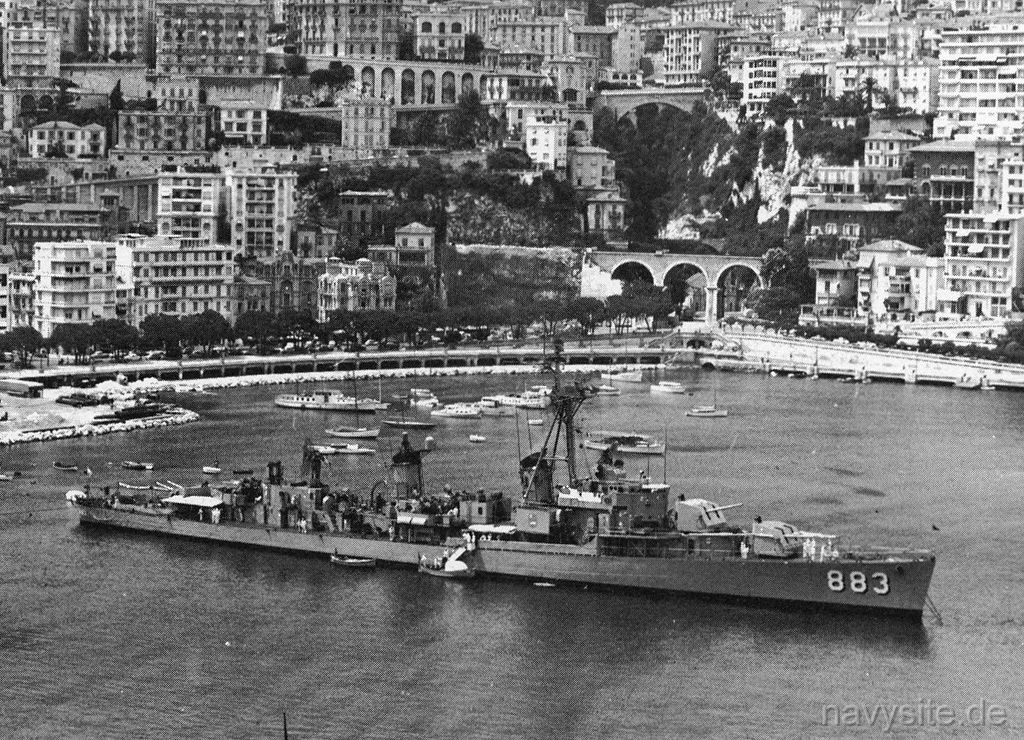
Her 1954 Mediterranean deployment is well documented in the ship's cruise book and period summaries: ports of call included Cannes, Salonika, Barcelona, Augusta Bay, Taranto, Gibraltar, Istanbul, Marseille, Leghorn, and Genoa. The itinerary mirrored Sixth Fleet operating patterns of the time - air defense problems and screen drills built around fast carriers, interleaved with liberty calls that also served presence and diplomacy - before she returned across the Atlantic for stateside training.
Through the latter 1950s, NEWMAN K. PERRY continued to alternate Atlantic training with Mediterranean duty and frequent work in carrier screens. Photographic evidence places her at sea escorting the newly introduced carrier USS SARATOGA (CVA 60) during 1957-1959, a period when the FORRESTAL-class ships drove higher-tempo air operations and demanded reliable radar pickets and close-in plane guards. In May 1959, the oiler USS CANISTEO (AO 99) is recorded refueling SARATOGA and NEWMAN K. PERRY off Florida - a typical snapshot of Second Fleet underway replenishment that also fixes the destroyer in the carrier's orbit late that spring. A broader change came that same year, when a shift in operating patterns brought her home port to Charleston, South Carolina, aligning her with the large cluster of Atlantic destroyers managed from that base.
Carrier support remained central as the new decade opened. On 25 March 1960, the oiler USS AUCILLA (AO 56) simultaneously refueled NEWMAN K. PERRY and USS FORRESTAL (CVA 59), a precisely dated evolution that again places the destroyer in the thick of fast-carrier task group work and underscores her dual duties as radar picket and escort in the age of jet aviation and nuclear strike doctrines. The remainder of 1960 saw the familiar alternation of screen assignments, ASW exercises, and port calls as the ship cycled between the Mediterranean and western Atlantic.
In early 1961, her tasking expanded beyond naval aviation support to the nation's emergent space program. In March 1961, NEWMAN K. PERRY was assigned to Project Mercury recovery operations as part of the Atlantic network of picket and secondary recovery ships that ringed planned splashdown zones for test shots preceding human spaceflight. She is additionally listed among the Secondary Recovery Ships for Mercury-Redstone 3 - the first U.S. crewed spaceflight - on 5 May 1961, when the prime recovery ship USS LAKE CHAMPLAIN (CVS 39) recovered astronaut Alan Shepard's FREEDOM 7 while destroyers like NEWMAN K. PERRY stood their ocean stations to extend range safety and retrieval coverage. Those Mercury details anchor her in a broader Cold War context: a Cold War destroyer performing precise station-keeping, communications relay, and contingency retrieval roles for national-priority missions.
During the Cuban Missile Crisis (22 October-late November 1962) she served with the quarantine force as an Atlantic destroyer, and in 1964-February 1965 received a FRAM I overhaul at Boston Naval Shipyard that replaced aging systems with ASROC amidships, DASH facilities aft, and updated sensors. She reverted to general-purpose designation DD 883. Two incidents framed 1965: on 12 August 1965 the embarked Commodore, CAPT Robert Carter, COMDESRON 20, was lost overboard north of Bermuda in heavy seas, and on 27 August 1965 she collided with the carrier SHANGRI-LA (CVA 38) off Sardinia; repairs followed at Naples.
Her Western Pacific/Vietnam cruise began from Newport on 4 October 1966. After transiting the Panama Canal and calling at Hawaii, Japan, Okinawa, and the Philippines, she entered the Mekong Delta combat zone on 23 November 1966 for naval gunfire support through 28 November, then shifted to Phu Quoc for five days in direct support of Vietnamese and Special Forces units. Through December she alternated delta fire support and coastal tasks northward toward the DMZ. She then took up Gulf of Tonkin plane-guard and search-and-rescue duties for the carrier force. On 8 March 1967 she cleared the combat zone for Hong Kong, returned to Subic Bay for upkeep, departed the Philippines on 27 March, and completed her circumnavigation by mooring at Newport on 8 May 1967. A Navy photograph dated 22 June 1967 records her crew firing a Mk 37 ASW torpedo during post-deployment exercises.
After an overhaul at Boston, NEWMAN K. PERRY opened 1968 with Caribbean training and on 4 April 1968 departed Newport for a Sixth Fleet deployment. She spent spring and early summer in the Mediterranean, rotating through carrier screen, ASW exercises, and presence port periods during a year of sustained Cold War tensions. She returned stateside later in 1968 to resume Atlantic workups.
From 1969 into 1970, she remained an Atlantic Fleet unit. A Navy image shows her underway in Narragansett Bay on 6 May 1969 during local operations. That period included the familiar cycle of type training, gunnery and ASW drills, and short Caribbean evolutions. During 1969, she also operated with the Sixth Fleet. Open reporting notes that in mid-1969 - early 1970 U.S. destroyers NEWMAN K. PERRY and NORRIS (DD 859) entered and later departed the Black Sea for routine operations before rejoining the Sixth Fleet - part of periodic freedom-of-navigation forays and intelligence collection amid growing Soviet naval activity.
By 1971, NEWMAN K. PERRY transitioned to Naval Reserve Force duty under Destroyer Squadron 28 at Newport, adopting a composite active/reserve crew. Her schedule shifted to shorter evolutions: weekend underways, annual training cruises to East Coast and Caribbean ports, and regular engineering and combat-systems certifications to keep the ship safe and effective as a reserve trainer.
A detailed sequence punctuates autumn 1974. In October, while moving in New York Harbor, she struck a buoy foundation, holing the scoop-injection to the forward engine room. After emergency measures she lay overnight at Hoboken, where a storm drove the ship hard against the pier and ruptured a steam line in the forward fireroom. She entered dry dock at Todd Shipyards, Brooklyn, for roughly a month of repairs, then proceeded to Norfolk for gun trials, where a forward 5-inch mount misfired and required further corrective work. The incidents were repaired within the normal maintenance framework and the destroyer returned to reserve training.
Through the late 1970s she continued reserve and local operations from Newport with periodic shipyard availabilities, remaining materially sound but employed on short-range training rather than extended overseas cruises. On 27 February 1981, NEWMAN K. PERRY was decommissioned and stricken and, the same day, transferred to the Republic of Korea as ROKS KYONG KI. She served under Korean colors into the late 1990s, decommissioning in 1997 and being scrapped after a 1999 fire.
back to top go to the end of the pageAbout the Ship's Name:
Newman Kershaw Perry, born in South Carolina 28 November 1880, was appointed Naval Cadet 9 September 1897 and commissioned Ensign 7 June 1903. Stationed in BENNINGTON, he was killed by an explosion of boilers in that ship at San Diego, 21 July 1905.
back to top go to the end of the pageAccidents aboard USS NEWMAN K. PERRY:
| Date | Where | Events |
|---|---|---|
| March 3, 1964 | Tampa Bay, Fla. | USS NEWMAN K. PERRY collides with a barge, sinking the barge and causing flooding in the destroyer's bow area. |
| August 12, 1965 | north of Bermuda | The embarked Commodore, CAPT Robert Carter, COMDESRON 20, is lost overboard north of Bermuda in heavy seas. |
| August 27, 1965 | off Sardinia, Italy | USS SHANGRI-LA (CV 38) and USS NEWMAN K. PERRY collide off Sardinia, killing one sailor and injuring another on the destroyer. The PERRY's bow is crushed and twisted to starboard. Both ships are repaired at Naples and return to duty with the Sixth Fleet. Below is a report about the collision from SHANGRI-LA's 1965 cruise book.   |
| October 1964 | New York City and Hoboken | While moving in New York Harbor, USS NEWMAN K. PERRY strikes a buoy foundation, holing the scoop-injection to the forward engine room. After emergency measures she lay overnight at Hoboken, where a storm drove the ship hard against the pier and ruptured a steam line in the forward fireroom. USS NEWMAN K. PERRY subsequently entered dry dock at Todd Shipyards, Brooklyn, for roughly a month of repairs. |
| January 20, 1975 | off New Jersey | USS NEWMAN K. PERRY experiences minor flooding in the engine room after hitting an unknown object off New Jersey. |
back to top go to the end of the page
USS NEWMAN K. PERRY Image Gallery:
 |  |  |  |  |
 |
 |  |  |  |
back to top
 Back to Destroyers list. Back to ships list. Back to selection page. Back to 1st page.