
Search the Site with

|
Search the Site with
|
 General Characteristics Crew List Memorabilia Cruise Books About the Ship's Name History Image Gallery to end of page
| Sorry, no coat of arms available. | 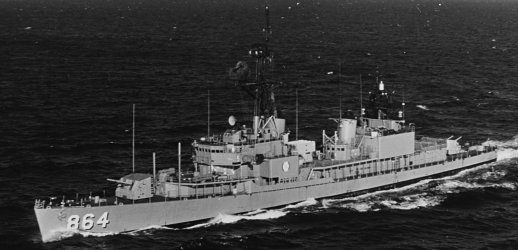 |
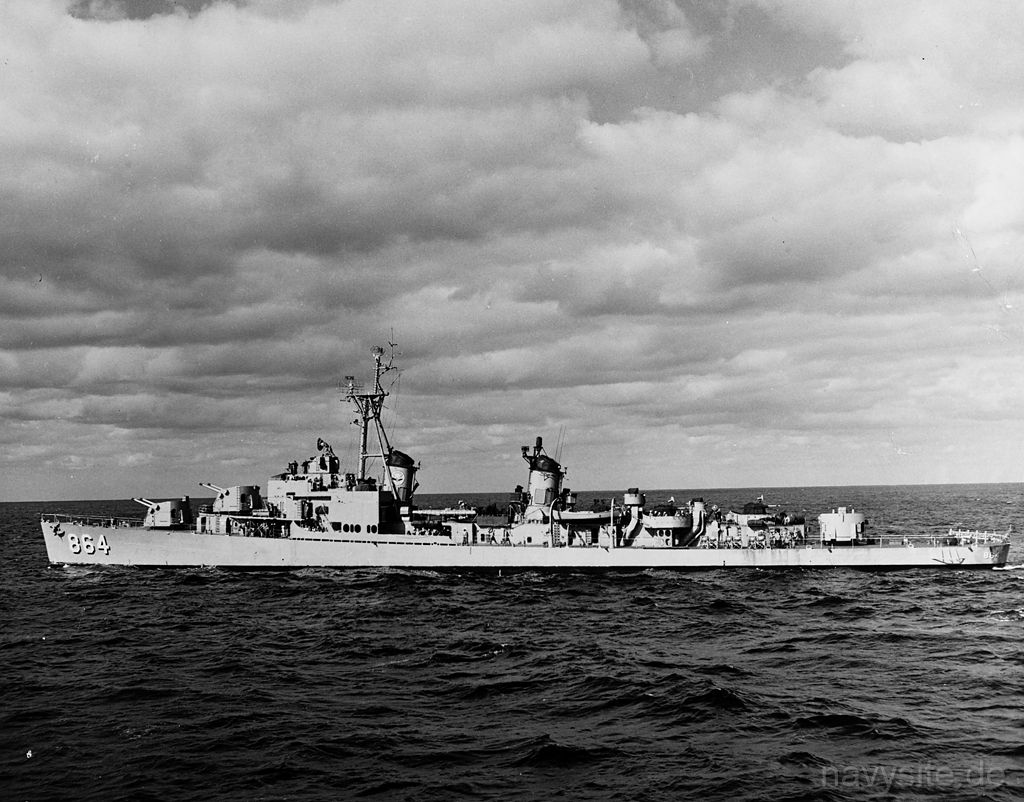
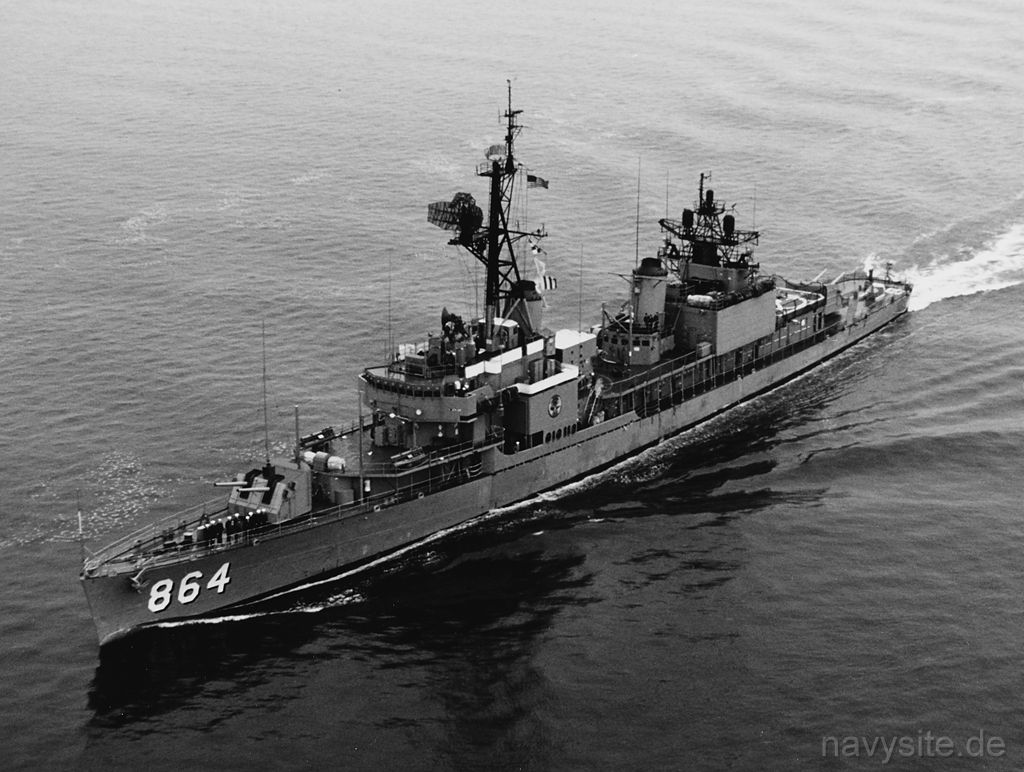
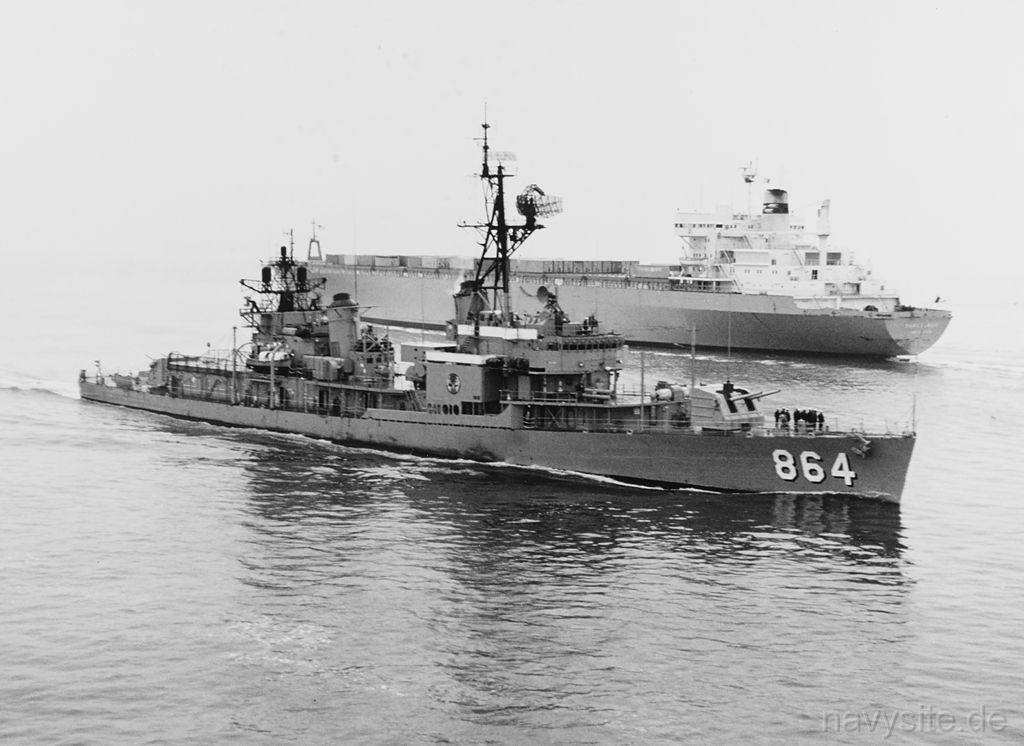
USS HAROLD J. ELLISON was one of the GEARING - class destroyers and the second ship in the Navy to bear the name. One previous ship, HAROLD J. ELLISON (DE 545), a JOHN C. BUTLER - class destroyer escort, was under construction at Boston Navy Yard, Boston, when it was cancelled on June 10, 1944. DD 864 was decommissioned and stricken from the Navy list on October 1, 1983, and transferred to Pakistan the same day. There she was recommissioning as SHAH JAHAN. Later stricken, she was sunk as a target in 1994.
| General Characteristics: | Awarded: 1943 |
| Keel laid: October 3, 1944 | |
| Launched: March 14, 1945 | |
| Commissioned: June 23, 1945 | |
| Decommissioned: October 1, 1983 | |
| Builder: Bethlehem Steel Co., Staten Island, N.Y. | |
| FRAM I Conversion Shipyard: New York Naval Shipyard, Brooklyn, NY. | |
| FRAM I Conversion Period: 1962 - January 1963 | |
| Propulsion system: four boilers, General Electric geared turbines; 60,000 SHP | |
| Propellers: two | |
| Length: 391 feet (119.2 meters) | |
| Beam: 41 feet (12.5 meters) | |
| Draft: 18.7 feet (5.7 meters) | |
| Displacement: approx. 3,400 tons full load | |
| Speed: 34 knots | |
| Aircraft after FRAM I: two DASH drones | |
| Armament after FRAM I: one ASROC missile launcher, two 5-inch/38 caliber twin mounts, Mk-32 ASW torpedo tubes (two triple mounts) | |
| Crew after FRAM I: 14 officers, 260 enlisted |
 back to top go to the end of the pageback to top go to the end of the page
Crew List:
This section contains the names of sailors who served aboard USS HAROLD J. ELLISON. It is no official listing but contains the names of sailors who submitted their information.
back to top go to the end of the pageback to top go to the end of the pageUSS HAROLD J. ELLISON Cruise Books:
back to top go to the end of the pageAbout the Ship's Name:
Harold John Ellison was born 17 January 1917 in Buffalo, N.Y., and was appointed Ensign 20 October 1941 after completing flight training. Soon afterwards he reported to Torpedo Squadron 8 on board famous carrier HORNET (CV 8). In the pivotal battle of Midway, 4 and 5 June 1942, Ellison and his comrades led a gallant torpedo attack on the Japanese ships, pressing home the attack without fighter cover and knowing they had insufficient fuel to return to HORNET. Though no hits were scored in this first attack, the torpedo bombers diverted the Japanese ships, decoyed their combat air patrols away from Navy dive bombers, and thus contributed importantly to the great victory. Ensign Ellison was presumed dead 5 June 1942 and received the Navy Cross posthumously for his gallantry.
back to top go to the end of the pageUSS HAROLD J. ELLISON History:
HAROLD J. ELLISON was launched by Bethlehem Steel Co., Staten Island, N.Y., 14 March 1945; sponsored by Mrs. Audrey Ellison, widow; and commissioned 23 June 1945, Comdr. J. C. South in command.
Although scheduled to join the Pacific Fleet for the final assault on Japan, HAROLD J. ELLISON was completing her shakedown cruise when the surrender came 15 August 1945. Homeported at Norfolk, she operated in the Atlantic and Caribbean for the next 2 years, taking part in Naval Reserve training cruises, and antisubmarine exercises.
Beginning in 1947, when she sailed from Norfolk 10 November, HAROLD J. ELLISON added periodic cruises to the Mediterranean with the 6th Fleet to her operations. She participated in the search for lost British submarine AFFRAY in April 1951, and added cruises to the Caribbean and northern Europe in 1953.
From 1954 to 1956 she continued tactical training along the East Coast and participated in European cruises. Following the explosive "Suez crises", HAROLD J. ELLISON, took part in vital peacekeeping operation during 1957 as the 6th Fleet helped stabilize the dangerous incident in the Eastern Mediterranean.
The following summer another crisis threatened the stability of the Mideast, as the government of Lebanon was in danger from communist oriented insurgents. The destroyer screened SARATOGA (CVA 60) and DES MOINES (CA 134) from July to September 1958 while the 6th Fleet landed Marines at the request of Lebanese President Chamoun. In September she operated with famed Task Group Alfa for the perfection of new tactics and equipment in antisubmarine warfare. HAROLD J. ELLISON remained on this duty until April 1959.
The ship returned to her pattern of cruises to the Mediterranean in 1959, departing 21 September. In 1960 her homeport became Charleston, and in 1961, during her tenth tour with the 6th Fleet, the ship cruised in the troubled Persian Gulf during the crisis in Kuwait. HAROLD J. ELLISON added a new function in January 1962, when she was assigned to Project Mercury as a part of the recovery unit on the Atlantic range. Later in 1962 she entered New York Naval Shipyard for a Fleet modernization and rehabilitation overhaul, an extensive repair job designed to extend her life and improve her readiness. The veteran destroyer rejoined the fleet in early 1963 and through 1964 continued to operate on training and readiness exercises off the Atlantic coast. Her high peacetime accomplishments are exemplified by the winning of five Battle Efficiency "E" awards during her years of service.
On 29 September 1965, HAROLD J. ELLISON departed Norfolk in DesRon 24 and headed via the Panama Canal for the Pacific to augment the Pacific Fleet during the Vietnam War. During her months in the combat zone, she served as a rescue destroyer, screened carriers, patrolled, and fired over 1,000 rounds of ammunition on various Viet Cong targets to support friendly troops. Leaving Southeast Asia by steaming eastward through the Suez Canal, she completed her round-the-world cruise upon returning to Norfolk in April 1966. In July she entered the Norfolk Naval Shipyard for an overhaul which lasted for the rest of the year.
After sea trials and refresher training early in 1967 HAROLD J. ELLISON rejoined the Atlantic Fleet. On 2 November 1967, the destroyer got underway for a Middle East deployment. Heading south to Brazil, HAROLD J. ELLISON continued around South Africa into the Indian Ocean and arrived in the Persian Gulf in mid-January. During the cruise, she visited Puerto Rico, Brazil, Angola, Mozambique, Madagascar, Ethiopia, Bahrain, Pakistan, Djibuti, India, Mauritius and Kenya and again returned home via Brazil, arriving at Norfolk on 14 May 1968.
In July-September 1968 she shifted to a South American cruise, a presence and training itinerary typical of the late-1960s Second Fleet pattern that mixed antisubmarine warfare drills with port visits and goodwill calls in the South Atlantic. By the end of September 1968 she was back on the U.S. East Coast to prepare for the next major commitment.
She sailed for the Mediterranean in January 1969 for a Sixth Fleet tour that ran into May 1969. In that four-month period she rotated through carrier screen, convoy escort practices, and allied exercises across the western and central Mediterranean while the U.S. Navy maintained heightened readiness during a volatile regional year. Returning stateside in late spring, she entered a Guantanamo Bay work-up and refresher phase in March-September 1969, the standard post-deployment cycle that re-certified gunnery, engineering, and damage-control teams and included short operational periods in the Caribbean operating areas.
A shipyard period followed. From November 1969 to February 1970 HAROLD J. ELLISON was in dry dock for maintenance and overhaul, emerging to complete a further round of refresher training from April to June 1970 in the Guantanamo Bay operating areas. That spring she also marked two equator crossings recorded by the crew - 24 May 1970 and 25 September 1970 - bookending the run-up to her next long deployment. These alternating cycles of yard work and Gitmo training reflected the Navy's emphasis on keeping FRAM-modernized GEARING-class destroyers materially sound and fully certified for sustained operations.
With the Suez Canal still shut and U.S. interests in the Persian Gulf growing, HAROLD J. ELLISON departed in September 1970 for a Middle East Force deployment routed via the South Atlantic and around the Cape of Good Hope, reaching the Red Sea and Persian Gulf for presence patrols, exercises with regional and allied navies, and logistics turns through Indian Ocean anchorages. She remained on that circuit into March 1971. The pattern included port calls and patrols typical of MIDEASTFOR: staging and upkeep at Bahrain, visits along the East African littoral and Indian Ocean islands, and routine operations in the southern Red Sea and the Gulf that balanced visibility with steady seamanship and frequent underway replenishment. She returned to the Atlantic in spring 1971.
Later that year she was noted operating at high latitudes. Crew records preserve "Blue Nose" certificates for Arctic Circle crossings in September-October 1971, an unusual but documented punctuation to her otherwise temperate-waters routine. In these months, the destroyer continued Atlantic training and short deployments while the Navy adjusted homeporting and squadron assignments in the wake of Vietnam drawdowns and Indian Ocean commitments.
In the first half of 1972, the ship remained a Mayport-based Atlantic Fleet unit. By 1 July 1972 she was aligned under a Navy Reserve destroyer squadron for training support, a role that still demanded full technical readiness but focused on shorter evolutions and periodic exercises rather than long overseas cruises. During 1973, she entered a stateside overhaul at Portsmouth, Virginia, and, following yard trials and inspections, conducted a post-availability Caribbean swing that included calls at Port-au-Prince, San Juan, and Bermuda - short, well-sequenced port visits used to exercise navigation, engineering, and deck departments after major work.
She continued to serve through the mid-1970s with alternating patterns of training, brief deployments, and reserve embarkations. On 19 July 1974, HAROLD J. ELLISON departed Norfolk with the carrier USS INDEPENDENCE (CVA 62) for a Mediterranean deployment, again taking up familiar Sixth Fleet screening and exercise duties before shifting later that year to a new administrative alignment and moving her homeport to Philadelphia for sustained reserve-training service. Through the late 1970s and into the early 1980s she operated primarily along the U.S. East Coast and into the Caribbean, embarked reservists for at-sea drills, and completed scheduled maintenance periods to keep the aging destroyer safely employable.
On 1 October 1983, HAROLD J. ELLISON was decommissioned and stricken from the Naval Vessel Register, ending thirty-eight years of U.S. service. The same day she transferred to Pakistan and entered service as SHAH JAHAN (D 164). In foreign service she remained active into the 1990s. She was finally cannibalized for parts and sunk as a target in 1994.
back to top go to the end of the page
USS HAROLD J. ELLISON Image Gallery:
 |
 |  | 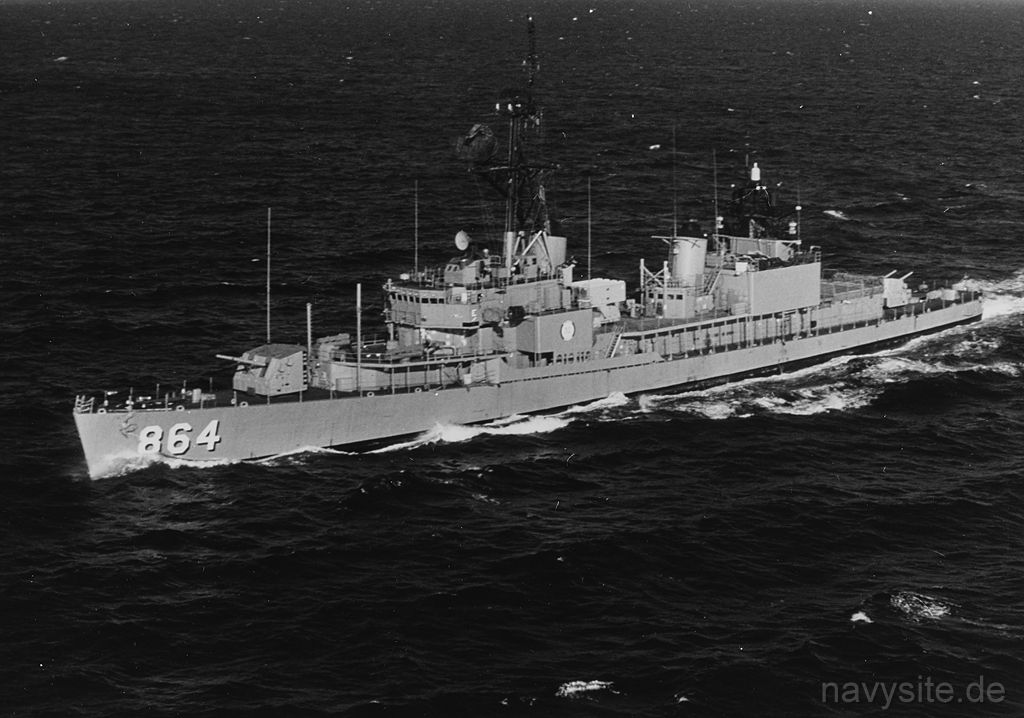 |
back to top
 Back to Destroyers list. Back to ships list. Back to selection page. Back to 1st page.