![]() |
Search the Site with
|
![]() | ![]() |
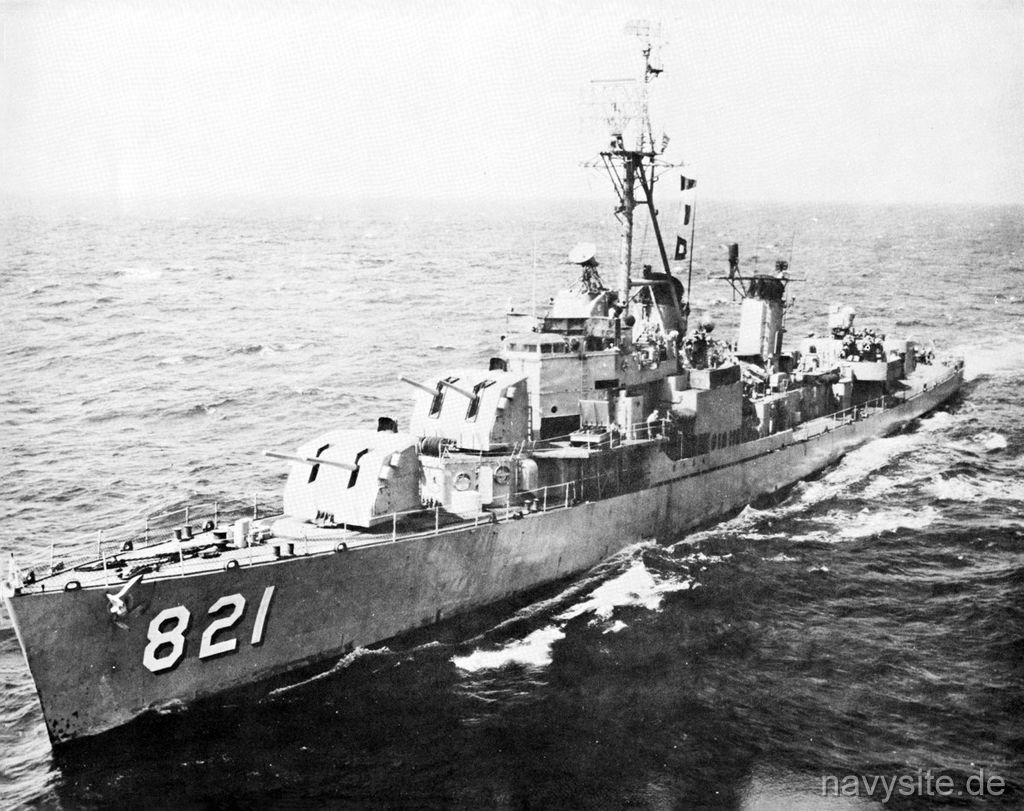
USS JOHNSTON was one of the GEARING - class destroyers and the second ship in the Navy to bear the name. Both decommissioned and stricken from the Navy list, the JOHNSTON was transfered to Taiwan in April 1981 and recommissioned as CHEN YANG. She was finally sunk as a target on July 20, 2006.
| General Characteristics: | Awarded: 1943 |
| Keel laid: March 26, 1945 | |
| Launched: October 10, 1945 | |
| Commissioned: August 23, 1946 | |
| Decommissioned: October 1, 1980 | |
| Builder: Consolidated Steel Corp., Orange, TX | |
| FRAM I Conversion Shipyard: Boston Naval Shipyard, Boston, Mass. | |
| FRAM I Conversion Period: January 1962 - October 1962 | |
| Propulsion system: four boilers, General Electric geared turbines; 60,000 SHP | |
| Propellers: two | |
| Length: 391 feet (119.2 meters) | |
| Beam: 41 feet (12.5 meters) | |
| Draft: 18.7 feet (5.7 meters) | |
| Displacement: approx. 3,400 tons full load | |
| Speed: 34 knots | |
| Aircraft after FRAM I: two DASH drones | |
| Armament after FRAM I: one ASROC missile launcher, two 5-inch/38 caliber twin mounts, Mk-32 ASW torpedo tubes (two triple mounts) | |
| Crew after FRAM I: 14 officers, 260 enlisted |
Crew List:
This section contains the names of sailors who served aboard USS JOHNSTON. It is no official listing but contains the names of sailors who submitted their information.
USS JOHNSTON Cruise Books:
About the Ship's Name:
John Vincent Johnston of Cincinnati, Ohio, entered the Navy in September 1861 as First Master in gunboat ST. LOUIS. He assisted in the Union gunboat attacks that captured strategic Fort Henry on the Tennessee River 6 February 1862. The night of 1 April 1862 he was the Navy commander of a combined Army-Navy boat expedition from ST. LOUIS which landed and spiked the guns of Fort No. 1 above the Confederate stronghold, Island No. 10. He was promoted to Acting Volunteer Lieutenant for gallantry in this expedition. After joining in the bombardments of Vicksburg, he took command of FORREST ROSE to patrol the Mississippi and its tributaries. On 15 February 1864 his gunboat repelled the attack of confederate raiders, saving the town of Waterproof, La., and its federal garrison. Lt. Johnston resigned from the naval service 23 June 1864 and died 23 April 1912 at St. Louis, Mo.
Accidents aboard USS JOHNSTON:
| Date | Where | Events |
|---|---|---|
| May 27, 1947 | off New London, Ct. | USS JOHNSTON collides with the USS TORSK (SS 423) while both vessels are operating of Connecticut. |
| January 14, 1961 | 200 nautical miles off North Carolina | USS JOHNSTON and USS KEPPLER (DD 765) are involved in a minor collision while underway off North Carolina. |
USS JOHNSTON History:
USS JOHNSTON was laid down 26 March 1945 by Consolidated Steel Corp., Orange, Tex.; launched 10 October 1945; sponsored by Mrs. Marie S. Klinger; grandniece of Lt. J. V. Johnston; and commissioned 23 August 1946, Cmdr. E. C. Long in command.
After shakedown in the Caribbean, JOHNSTON reported to Newport, R.I., 16 May 1947 for duty with the Atlantic Fleet. Operating out of Newport, her home port, she sailed 9 February 1948 for Northern Europe where she visited ports in Great Britain, France, and Scandinavia before returning to Newport 26 June. For 14 months she operated along the Atlantic coast, then sailed 23 August 1949 for the Mediterranean. From then until 4 October 1961 she deployed with the mighty 6th Fleet on eight occasions and supported peace-keeping efforts in the Middle East.
While on her first Mediterranean deployment, she helped to stabilize the Adriatic Sea during the Trieste crisis and she patrolled the coast of Greece to bolster national security against threatened Communist domination. JOHNSTON returned to Newport 26 January 1950. She operated out of Newport from Canada to the Caribbean until 4 June 1951 when she departed with Midshipmen at sea training off Northern Europe. Following her return to Newport 28 July, she cleared the East Coast for the Mediterranean 3 September and joined the 6th Fleet in operations that carried her from French Morocco to Turkey. She then returned to home port 4 February 1952.
JOHNSTON departed Newport 7 January 1953 for NATO operations in the North Atlantic. Before sailing for duty in the Mediterranean 16 March JOHNSTON aided the Dutch after storms in the North Sea had caused extensive flooding in the Netherlands. Her crew donated bundles of warm clothing and more than $1,200 for the storm victims. She operated in the Mediterranean until 8 May when she steamed for Newport, arriving 18 May.
After a 4-month deployment in the Mediterranean during early 1954, JOHNSTON operated for more than 17 months along the Atlantic coast from New England to Cuba. On 5 November 1955, she steamed for maneuvers off Northern Europe, followed by another tour of duty in the Mediterranean. While operating in the eastern Mediterranean during February 1956, she patrolled off Israel and Egypt as the Middle East rumbled over the developing Suez Canal crisis. Returning to Newport 5 March, she embarked midshipmen 5 June for 2 months of at-sea training off Northern Europe, after which she resumed operations out of Newport.
JOHNSTON sailed once again 6 May 1957 for peace-keeping operations with the 6th Fleet. Before returning to the United States 1 August she ranged the Mediterranean from Spain to Sicily on ASW barrier patrols. While at Marseille, France, 3 July, she helped fight a destructive blaze on board LAKE CHAMPLAIN (CVS 39). Steaming from Newport 3 September, she joined the mighty Atlantic Fleet for the NATO Exercise "Strike Back" in the North Atlantic. She returned to Newport 22 October, then resumed operations that sent her into the Caribbean and the Gulf of Mexico.
Returning to the North Atlantic 6 June 1959 for further NATO maneuvers, JOHNSTON steamed to Charleston, S.C., 25 July and joined DesRon 4 for deployment to the Mediterranean. Departing Charleston 21 September, she conducted Fleet operations in the western Mediterranean. On 18 December she joined naval units from France, Italy and Spain along the French coast for a review in honor of President Eisenhower. Following patrols along the Greek coast, she departed Athens for the United States 24 March 1960, arriving Charleston 10 April.
Before deploying again to the Mediterranean, JOHNSTON joined in NATO Exercise "Sword Thrust" during the fall of 1960. Then she departed Charleston 8 March 1961 to bolster the 6th Fleet's continuing efforts to maintain peace in the Middle East. After returning to the United States 4 October, she steamed 19 November for patrol duty off the Dominican Republic. During this brief but important duty her presence did much to stabilize a situation "which had threatened to plunge the country into bitter fighting and a return of the Trujillo dictatorship".
JOHNSTON returned to Charleston 26 November and following coastal operations, she steamed to Boston where she underwent FRAM I overhaul from 4 January to 31 October 1962. During this time she received the latest equipment, including ASROC system and DASH facilities, to prepare her for new assignment in the modern Navy. Departing Boston 2 November, she arrived Guantanamo Bay, Cuba, via Charleston 10 December for Caribbean operations. While steaming near Mona Island 1 February 1963, she rescued crewmen from the sinking Honduran freighter KIRCO and towed her to Mayaguez, P.R. Continuing her Atlantic operations, she supported Polaris missile firing tests. As THOMAS JEFFERSON (SSBN 618) fired two underwater missiles off the Florida coast 14 March, JOHNSTON became the first destroyer to serve as "primary support ship for an underwater firing of a Polaris missile".
After more than 4 months of ASW tactical operations, JOHNSTON departed Charleston 6 August for her ninth deployment to the Mediterranean. While operating with the 6th Fleet, she steamed the length and breadth of the Mediterranean and entered the Black Sea 27 September and visited Turkish Black Sea ports. Following 2 months of ASW operations, JOHNSTON departed Cannes, France, for the United States 7 December and arrived Charleston 23 December for coastal operations through 1964.
The veteran destroyer departed Charleston 6 January 1965 for the Mediterranean to resume peace-keeping operations with forces of other NATO countries. She returned to Charleston 7 June, and devoted the rest of the year to operations with Polaris submarines, amphibious exercises, and overhaul to prepare for future service.
JOHNSTON began New Year 1966 as sonar school training ship at Key West, Fla. During this period of training she visited Guantanamo Bay, Cuba, for refresher training; and in February while JOHNSTON's crew was spending weekend liberty at Kingston, Jamaica, her sailors swiftly answered a call for help on the 27th. The famous Myrtle Bank Hotel had caught fire and threatened the whole water front. JOHNSTON sailors rushed to the fire and averted disaster.
JOHNSTON operated off the East Coast until departing Charleston 29 September for Mediterranean and Middle East deployment. After operating on the far side of the Suez Canal, she again transited the Suez Canal to rejoin the 6th Fleet in the Mediterranean. She returned to Charleston 9 February 1967 and operated on the East Coast through mid-year. From mid-1967 onward, USS JOHNSTON moved through the closing years of her active Atlantic destroyer career in a steadily shifting strategic environment. On 6 May 1967 she sailed again for peace-keeping duty with the 6th Fleet, a short deployment that coincided with mounting regional tension culminating in the Six-Day War of 5-10 June 1967. She ranged the Mediterranean on routine screens and exercises and returned to the United States on 1 August 1967 to resume preparations for heavier tasking.
Late that year JOHNSTON shifted to a Western Pacific cycle. Departing Charleston in November 1967, she transited via the Panama Canal and the central Pacific, passing Hawaii - where she was photographed underway off Oahu on 13 December 1967 - and continued westward. Heavy weather on the crossing slowed her progress, and Christmas 1967 was spent at sea en route to Subic Bay, the Seventh Fleet's principal logistics hub. She reached the Gulf of Tonkin line period in early January. On 7 January 1968 she entered the Vietnam combat zone and promptly rotated between plane-guard duties for the attack carrier USS RANGER (CVA 61) on "Yankee Station" and gunline assignments along the I Corps coast, including sustained naval gunfire support around the approaches to Hue as Marine operations there intensified. These tasks unfolded as the Tet Offensive erupted on 30-31 Januar 1968, a sudden, theater-wide escalation that drove high sortie rates from the carriers and heavy call-for-fire schedules along the northern littoral.
Through the first months of 1968, JOHNSTON alternated carrier screening, coastal interdiction, and shore bombardment with brief logistics stops at Subic Bay and underway replenishments at sea. Records from the oiler PASSUMPSIC (AO 107) and other command histories place JOHNSTON alongside units such as USS PREBLE (DLG 15) during underway movements in the Philippines in early May, reflecting the normal choreography of Seventh Fleet turnover at the end of a line period. She began her final departure from the combat zone on 6 May 1968 and shaped course east for post-deployment upkeep, closing a WestPac marked by a mix of plane-guard, gunfire support near the Demilitarized Zone, and routine surveillance sweeps in the northern South China Sea.
After stateside refit and training, JOHNSTON pivoted back to her long-standing Atlantic/6th Fleet rhythm. In September 1969, she sailed for another Mediterranean deployment, remaining with the 6th Fleet through March 1970. Cruise book and photographic evidence place her across the western and central Mediterranean in that period, reflecting the standard mix of anti-submarine exercises, carrier screening, and presence port calls. She returned to the United States in the spring of 1970.
By April 1971, JOHNSTON had entered the Philadelphia Naval Shipyard, photographed that month heading up Delaware Bay toward the yard for a stateside phase that would transition her to Naval Reserve Force duty. Over the next two years she completed inactivation and maintenance work at Philadelphia, culminating in trials after yard work. On 15 November 1973 she put out on the Delaware River for engineering runs tied to a Navy experiment with coal-derived synthetic liquid fuel - a response to growing energy-security concerns - an unusual post-FRAM chapter captured in contemporary images and later analysis. The broader context of these tests was the autumn 1973 oil shock and Arab oil embargo, which sharpened U.S. attention to alternative fuels across the fleet.
After the trials, JOHNSTON settled into reserve training service from Philadelphia. Contemporary rosters and veteran accounts describe frequent short evolutions - weekend and annual-training cruises - to East Coast and Caribbean ports, including Boston, Norfolk, Fort Lauderdale, and refresher periods at Guantanamo Bay, interspersed with routine shipyard availabilities. A major yard period ran from January 1975 to April 1976, after which she continued reserve support and limited local operations as a trainer.
Her U.S. service closed the following year. On 27 February 1981 JOHNSTON was stricken and transferred to the Republic of China Navy, where she commissioned as CHEN YANG (DD 928). Under Taiwanese colors she later underwent a comprehensive WU-CHIN III modernization, served into the early 2000s, decommissioned on 16 Dezember 2003, and was expended as a target off Hualien on 20 July 2006.
USS JOHNSTON Image Gallery:
![]() |
Back to Destroyers list.
Back to ships list.
Back to selection page.
Back to 1st page.