
Search the Site with

|
Search the Site with
|
 General Characteristics Crew List Memorabilia Namesake History Image Gallery to end of page
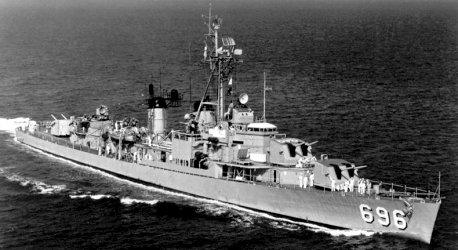 |  |
USS ENGLISH was one of the ALLEN M. SUMNER - class destroyers and the first ship in the Navy named after Rear Admiral Robert Henry English. Unlike many other ships in her class ENGLISH did not receive a FRAM (Fleet Rehabilitation and Modernization) overhaul. Both decommissioned and stricken from the Navy list on May 15, 1970, ENGLISH was transferred to Taiwan on August 11, 1970, and recommissioned as HUEI YANG. She remained in service until August 1999 and was sunk as a target on October 14, 2003.
| General Characteristics: | Awarded: 1942 |
| Keel laid: October 19, 1943 | |
| Launched: February 27, 1944 | |
| Commissioned: May 4, 1944 | |
| Decommissioned: May 15, 1970 | |
| Builder: Federal Shipbuilding & Drydock Co., Kearny, NJ. | |
| Propulsion system: four boilers, General Electric geared turbines; 60,000 SHP | |
| Propellers: two | |
| Length: 376.3 feet (114.7 meters) | |
| Beam: 41 feet (12.5 meters) | |
| Draft: 18.7 feet (5.7 meters) | |
| Displacement: approx. 3,300 tons full load | |
| Speed: 34 knots | |
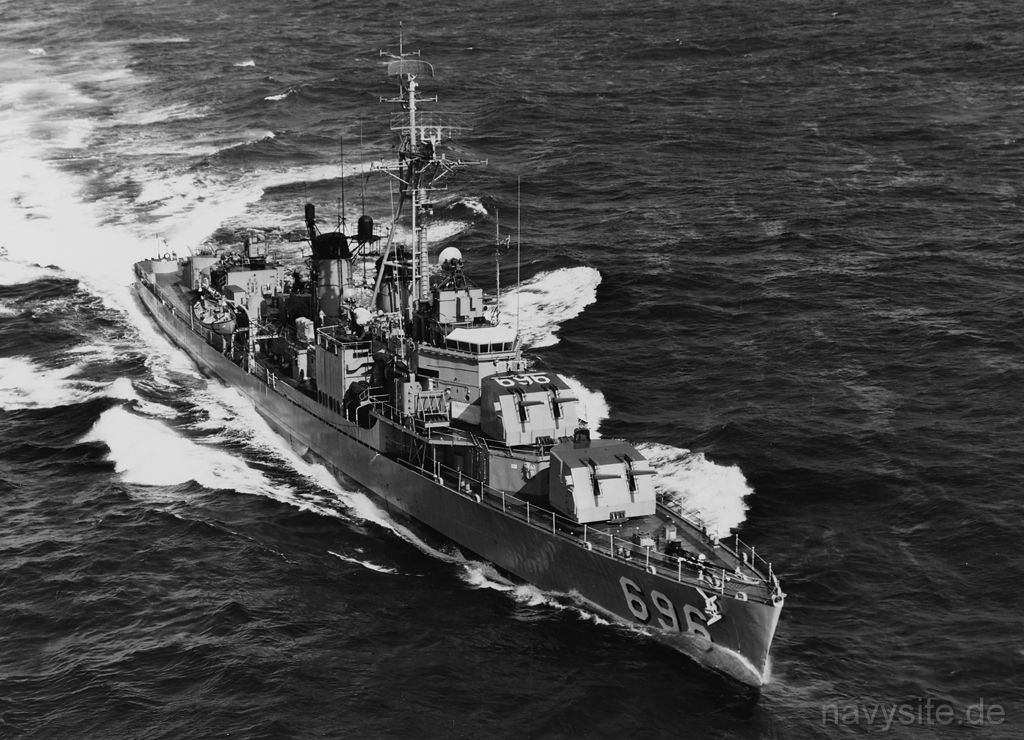
| Armament: three 5-inch/38 caliber twin mounts, two 3-inch/50 caliber twin guns, two Mk-10 Hedgehogs, Mk-32 ASW torpedo tubes (two triple mounts) | |
| Crew: 336 |
 back to top go to the end of the pageback to top go to the end of the page
Crew List:
This section contains the names of sailors who served aboard USS ENGLISH. It is no official listing but contains the names of sailors who submitted their information.
back to top go to the end of the pageback to top go to the end of the pageAbout the Ship's Name:
Robert Henry English, born 16 January 1888 in Warrenton, Ga., was a member of the Naval Academy class of 1911, and early in his naval career became a submariner. In 1917, while commanding O-U (SS 65), he won the Navy Cross for his great heroism in rescuing an officer trapped in O-5 (SS 66) after an explosion. After a series of important assignments, he became commanding officer of HELENA (CL 50) and during the Japanese attack on Pearl Harbor 7 December 1941 was one of the first to bring his ship into action. On 14 May 1942, he became Commander, Submarines, U.S. Pacific Fleet, and was so serving when killed in an airplane accident in California 21 January 1943. For his exceptionally meritorious service in his last assignment, Rear Admiral English was posthumously awarded the Distinguished Service Medal.
back to top go to the end of the pageUSS ENGLISH History:
ENGLISH was launched 27 February 1944 by Federal Shipbuilding and Drydock Co., Kearny, N.J.; sponsored by Ensign Eloise W. English, USNR(W), daughter of Rear Admiral English; and commissioned 4 May 1944, Commander J. T. Smith in command.
ENGLISH arrived in the Hawaiian Islands 3 September 1944 for final training, and service as plane guard during the qualification of aviators in carrier operations. On 17 December, she sailed from Pearl Harbor for Ulithi, where on 28 December she joined the screen for mighty carrier TF 38. She put to sea 2 days later for air strikes to neutralize Japanese bases on Formosa, Luzon, Okinawa, and the Indo-China coast in coordination with the invasion of Lingayen Gulf. ENGLISH returned to Ulithi to replenish between 26 January 1945 and 8 February, then sailed to Saipan to meet INDIANAPOLIS (CA 35) and escort her to a rendezvous with newly designated TF 58. She screened the carriers as they launched the series of strikes accompanying the Iwo Jima operation, hitting Tokyo both before and after the assault, Iwo Jima itself, and Okinawa.
After taking on fuel and stores at Ulithi from 4 March 1945 to 14 March, ENGLISH sortied with TF 58 for strikes on Kyushu heralding the Okinawa operation. When FRANKLIN (CV 13) was heavily damaged by bombing on 19 March off Kyushu, ENGLISH screened the carrier's retirement from the action area, then rejoined the screen for strikes on Okinawa and nearby islands in the days preceeding the assault. On 1 April, she closed Okinawa to provide fire support for the invading troops, returning to the carrier screen for continued strikes on shore targets and Japanese shipping. She left the task force to bombard Minami Daito Shima on the night of 10 May. Next day ENGLISH went close alongside BUNKER HILL (CV 17), damaged by a suicide plane, to help in fighting fires, and to take off Vice Admiral M. A. Mitscher and his staff, whom she transferred to another carrier.
ENGLISH put in to San Pedro Bay, P.I., from 1 June 1945 to 1 July for repairs and exercises, then sailed again with TF 38 for the final pounding series of air strikes on the Japanese homeland. She closed the coast of Honshu on 18 July to hunt Japanese snipping in Sagami Wan and to bombard targets on Nojima Saki. In Tokyo Bay from 10 to 19 September, ENGLISH voyaged to escort occupation shipping from the Marianas, then after two months of occupation duty cleared Sasebo for the long passage to Boston, where she arrived 26 April 1946.
ENGLISH operated out of Boston, and later Charleston and New Orleans, for exercises and to train members of the Naval Reserve, cruising along the east coast and in the Caribbean. From 23 April 1949 she was home ported at Norfolk, from which she sailed 6 September for her first tour of duty with the 6th Fleet in the Mediterranean. She returned to Norfolk 26 January 1950 for exercises off the Virginia Capes and in the Caribbean.
Alerted for distant deployment upon the outbreak of the Korean war, ENGLISH departed Norfolk 6 September 1950 for the Panama Canal, San Diego, Pearl Harbor, Midway, and Yokosuka, where she arrived 5 October. She supported the withdrawal from Hungnam, then proceeded with two corvettes of the Royal Thai navy to shell Communist positions at Choderi and Chonjin. On 7 January 1951, one of these, HMTS PRASE, grounded in a heavy snowstorm, and after arduous attempts to salvage her, ENGLISH destroyed the corvette with gunfire.
On 20 January 1951 ENGLISH began duty as direct fire-support ship for a division of the Korean army, blasting positions at Kanson, Kosong, and Kangnung to support the Korean advance ashore. She served on blockade at Chongjin and Wonsan, where in 20 consecutive days on the firing line she silenced 20 attacks by Communist shore batteries. After a final period of service screening carriers on both coasts of Korea, she sailed from Yokosuka 11 May eastbound for Norfolk.
From her return to Norfolk 9 June 1951, ENGLISH resumed local training operations, and in the winter of 1952 joined in cold-weather exercises off Newfoundland and Nova Scotia. On 26 August 1952 she departed for NATO operations in which she visited British ports, sailing on to a tour of duty in the Mediterranean from which she returned to Norfolk 5 February 1953. In the fall of 1954 she visited Lisbon, Portugal. On 31 October, while at sea for a major fleet exercise, she was in collision with WALLACE L. LIND (DD 703), but though ENGLISH lost 50 feet of her bow, she suffered no casualties. Skillful seamanship brought her into port under her own power, and she was repaired in time to join in large-scale exercises in the Caribbean early in 1955.
From May to August 1955, ENGLISH made a good will cruise to ports of northern Europe, and between 28 July 1956 and 4 December served again in the Mediterranean, visiting Bahrain in the Persian Gulf. With the eruption of the Suez Crisis, she aided in evacuating American citizens from the troubled area, and patrolled the eastern Mediterranean to serve with the 6th Fleet. Returning to Norfolk in April she spent the remainder of 1959 and almost all of 1960 in conducting an intensive program of antisubmarine warfare exercises.
After completing a late-1960 overhaul at Norfolk Naval Shipyard, ENGLISH left the yard in April 1961 and conducted two months of refresher training at Guantanamo Bay before returning to Norfolk on 26 June 1961. On 4 July 1961 she visited Baltimore for Independence Day events tied to the public opening of the restored sailing frigate USS CONSTELLATION. The crew contributed volunteer work to the exhibit as final preparations were made. Through the remainder of the summer, she prepared for Sixth Fleet duty, then sailed from Norfolk on 8 September 1961 with units of DESRON TWO, making Pollensa Bay, Mallorca on 21 September 1961 to begin a Mediterranean tour. Over the following months, she executed the standard Sixth Fleet regimen - plane-guard duties for carriers, anti-submarine exercises, and a multinational NATO phase alongside British, Italian, and Greek ships - before returning to her homeport on 1 April 1962.
Back on the U.S. East Coast, ENGLISH took part in a large Presidential Review off North Carolina on 13 April 1962, then supported Project Mercury recovery operations in May 1962 as NASA's manned-spaceflight program advanced from orbital flights to the long-duration missions that would follow. In June-July 1962 she ran type training as part of a midshipmen cruise highlighted by a 4 July liberty visit to Camden, Maine, and a call at New York City during the return transit to Norfolk. The destroyer spent August-September 1962 in tender and interim shipyard availabilities at Norfolk Naval Shipyard, emerging in early October for contingency tasking.
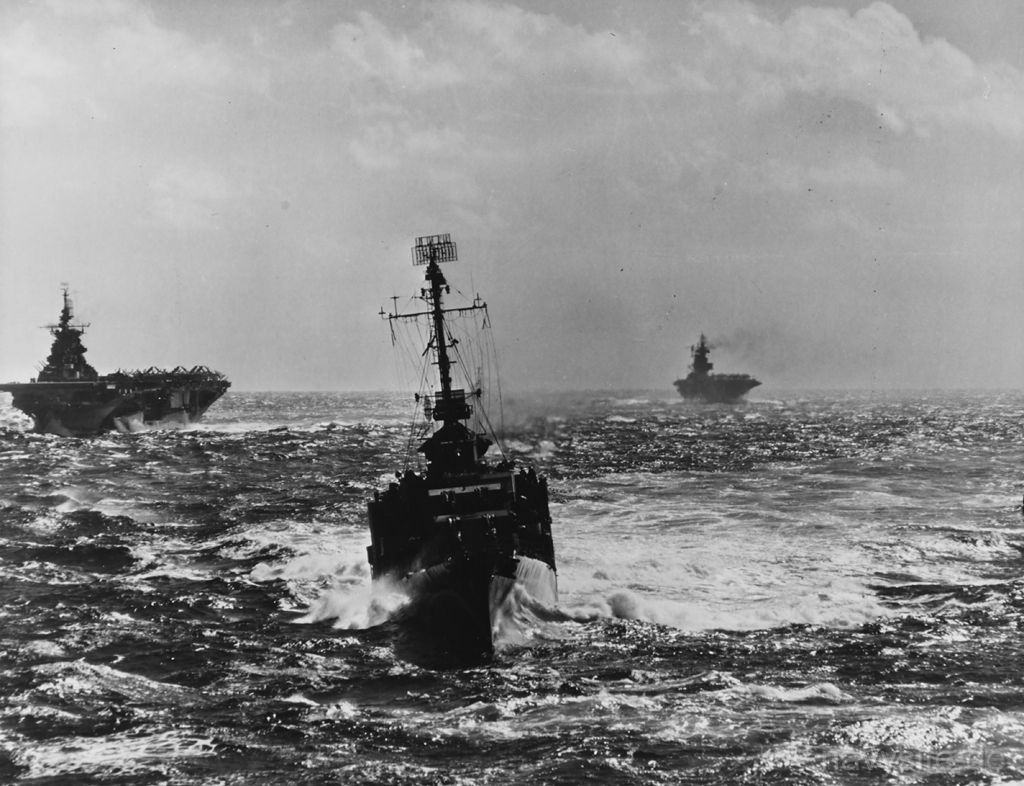
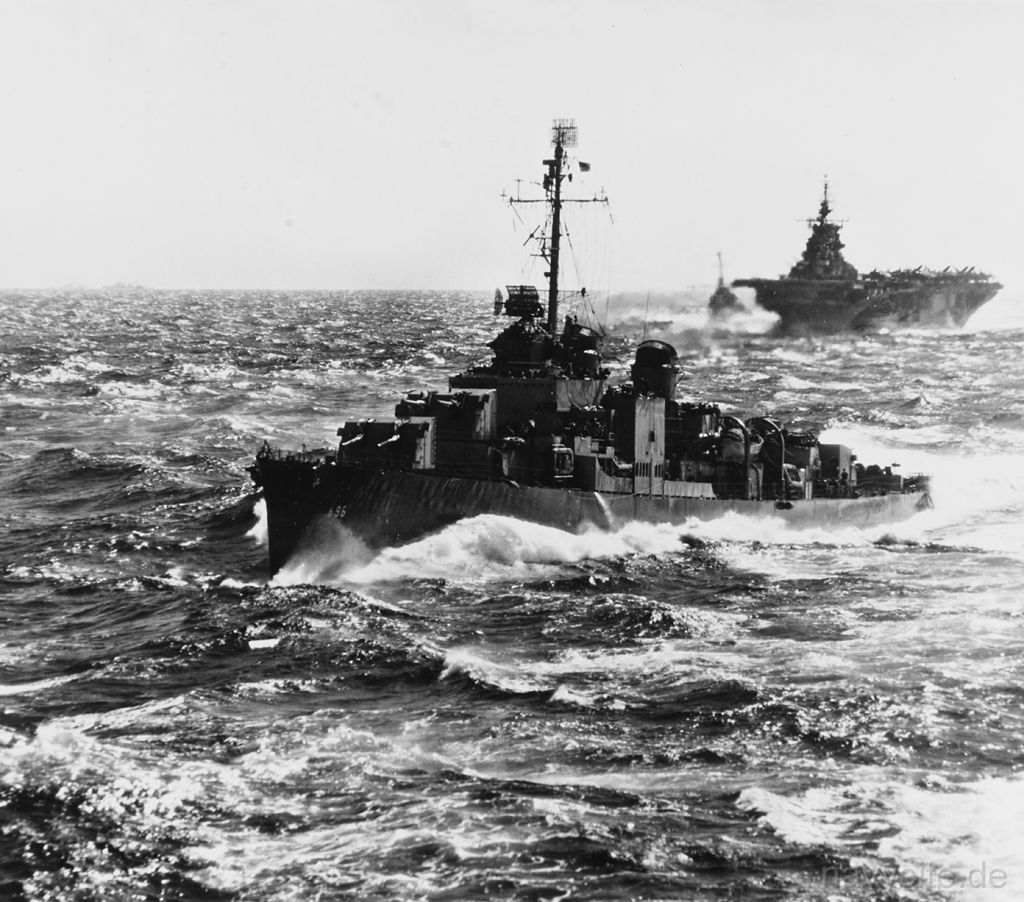
On 11 October 1962, with tensions rising over Soviet missiles in Cuba, ENGLISH sailed south to join USS INDEPENDENCE (CVA 62) as plane guard and screening destroyer. She was at sea when President Kennedy announced the naval "quarantine" on 22 October and remained on continuous operations for roughly a month. Contemporary imagery and official histories place ENGLISH refueling alongside INDEPENDENCE en route to the Caribbean and show her underway on 20 October 1962, emblematic of the rapid sortie and high-tempo patrols of the period. Her recognized Armed Forces Expeditionary Medal eligibility dates for the crisis run 24 October-24 November 1962. After a brief tender availability at Kingston, Jamaica, beginning 12 November 1962, she returned to Norfolk on 25 November 1962 for holiday stand-down.
ENGLISH deployed again to the Mediterranean in March 1963, pausing at Rota, Spain to refuel, then crossing the Strait of Gibraltar to join the SIXTH FLEET for five months of exercises and port visits. Her liberty calls on this cruise included Barcelona and Palma (Majorca) in Spain; Marseille and Cannes in France; Rapallo, Naples, and Palermo in Italy; Valletta (Malta); and Piraeus (Athens) in Greece. During the deployment, Vice Admiral William E. Gentner, Commander SIXTH FLEET, visited ENGLISH for a full tour. The ship also organized a People-to-People goodwill effort, delivering books, clothing, and supplies to schools, hospitals, and charities in several of the ports above. She returned to Norfolk in August 1963.
Upon return, ENGLISH shifted to a new role as a Naval Reserve training ship based at Mayport, Florida. Following a brief overhaul split between Charleston and Jacksonville, she commenced the demanding rhythm of weekend drills and two-week embarkations that trained thousands of reservists between January 1964 and May 1970. In this period she remained Atlantic-based, operating primarily in the VACAPES and Caribbean operating areas and making routine short cruises without the deep modernization many of her SUMNER-class sisters received - notably, ENGLISH did not undergo a FRAM conversion, a choice consistent with her Reserve training assignment in the later 1960s.
ENGLISH's U.S. Navy service concluded in 1970. She was decommissioned and stricken on 15 May 1970 and, under the U.S. security-assistance program, transferred to the Republic of China (Taiwan) on 11 August 1970, where she entered service as HUEI YANG. These actions closed a quarter-century of active and reserve duty.
ENGLISH received four battle stars for World War II service, and four for Korean war service.
back to top go to the end of the page
USS ENGLISH Image Gallery:
 |  |  |
back to top
 Back to Destroyers list. Back to ships list. Back to selection page. Back to 1st page.