
Search the Site with

|
Search the Site with
|
 General Characteristics Crew List Memorabilia Cruise Books History About the Ship's Name Image Gallery to end of page
 | Sorry, no coat of arms available. |
USS MOALE was the second ship in the ALLEN M. SUMNER - class of destroyers and the first ship in the Navy to bear the name. Both decommissioned and stricken from the Navy list on July 2, 1973, MOALE was sold for scrapping on November 13, 1974, and was subsequently broken at at Brownsville, Tx.
| General Characteristics: | Awarded: 1942 |
| Keel laid: August 5, 1943 | |
| Launched: January 16, 1943 | |
| Commissioned: February 28, 1944 | |
| Decommissioned: July 2, 1973 | |
| Builder: Federal Shipbuilding & Drydock Co., Kearny, NJ. | |
| FRAM II Conversion Shipyard: Charleston Naval Shipyard, Charleston, SC. | |
| FRAM II Conversion Period: 1961 - December 1961 | |
| Propulsion system: four boilers, General Electric geared turbines; 60,000 SHP | |
| Propellers: two | |
| Length: 376.3 feet (114.7 meters) | |
| Beam: 41 feet (12.5 meters) | |
| Draft: 18.7 feet (5.7 meters) | |
| Displacement: approx. 3,180 tons full load | |
| Speed: 34 knots | |
| Aircraft after FRAM II: two DASH drones | |
| Armament after FRAM II: three 5-inch/38 caliber twin mounts, two Mk-10 Hedgehogs, Mk-32 ASW torpedo tubes (two triple mounts), two Mk-25 ASW torpedo tubes (removed prior to decommissioning) | |
| Crew before FRAM II: 336 |
 back to top go to the end of the pageback to top go to the end of the page
Crew List:
This section contains the names of sailors who served aboard USS MOALE. It is no official listing but contains the names of sailors who submitted their information.
back to top go to the end of the pageback to top go to the end of the pageUSS MOALE Cruise Books:
back to top go to the end of the pageUSS MOALE History:
MOALE was laid down on 5 August 1943 at Kearny, N.J., by the Federal Shipbuilding & Dry Dock Co.; launched on 16 January 1944; sponsored by Mrs. Edward S. Moale, daughter-in-law of the late Lt. Edward Moale, Jr.; and commissioned on 28 February 1944, Cmdr. Walter M. Foster in command.
Following a Bermuda shakedown, MOALE remained on the Atlantic coast conducting experimental tests and training precommissioning destroyer crews. On 21 August, she got underway with Destroyer Division 120 for the British West Indies, whence she continued to the Panama Canal Zone, and, thence into the Pacific. Reporting to Commander Destroyers Pacific at Pearl Harbor, on 15 September, she underwent carrier screening, night firing, and shore bombardment exercises until 23 October. She then departed for the Western Carolines as a unit of Destroyer Squadron (DesRon) 60. Arriving at Ulithi on 5 November, she joined Task Force 38, the fast carrier force, and got underway the same day to screen the carriers as their planes conducted strikes against Japanese targets on Luzon and Mindoro. Returning to Ulithi on 22 November, she was underway again on the 27th to report for duty with the Seventh Fleet.
Joining Task Group (TG) 77.2 on 29 November 1944, in San Pedro Bay, she patrolled Leyte Gulf and participated in strikes against enemy forces in Ormoc Bay. On 12 December, she shifted to TG 77.3 and took up a screening position with the Mindoro assault force. On the 15th, she provided fire support for the troops and antiaircraft protection for the ships in the transport area.
MOALE departed for Leyte on 17 December 1944. Arriving on the 18th, she completed a high speed cargo run to Ulithi and back by the end of the year. On 3 January 1945, she was once again en route to an assault area. Steaming with TG 77.2, she arrived off Luzon on the 6th and commenced screening the heavy ships to seaward as they bombarded San Fernando and other enemy concentrations in the proposed beachhead area. On the 9th, she took up gunfire support duties, alternating such duties with antisubmarine and antiaircraft operations. The destroyer operated with the Luzon covering group until the 22nd. She then returned to Leyte, whence she steamed back to Ulithi to resume operations with the fast carrier forces, now designated TF 58.
On 10 February 1945, the force sortied from Ulithi and on the 16th and 17th strikes were conducted against the enemy's capital to prevent aid from being sent to the Japanese defenders on Iwo Jima. Two ships of DesRon 60, BARTON (DD 722) and INGRAHAM (DD 694), were damaged when they collided on the 16th while screening the carriers, and on the 17th MOALE was detached to escort them back to Saipan. While enroute, in waters roughly northwest of Chichi Jima, she assisted in the sinking of the Japanese guardboats No. 35 NANSHIN MARU, No. 3 KYOWA MARU, and No. 5 FUKUICHI MARU. Ordered back on the 18th, she rendezvoused with TG 58.4 on the 19th and, on the 21st, screened the carriers as they provided air cover for the marines on Iwo Jima.
Having sustained extensive damage to her deck and her forward twin 5-inch mount, in heavy seas with 40-foot swells, MOALE departed the Volcanos on 25 February 1945, and sailed eastward for repairs at Pearl Harbor. On 3 June, she returned to Ulithi, getting underway for the combat area the next day. Arriving at Hagushi Anchorage, Okinawa, on 7 June, she reported to commander TG 31.5 and immediately became part of the antiaircraft defenses of the area. Through the 27th she served on radar picket stations, where danger remained present and alerts still frequent, even though the pressure was not as great as in April and May. On the 28th, MOALE departed for Leyte, where she joined TG 32.12 and returned to Okinawa to act as part of the covering force for minesweepers in Operation Juneau.
At the end of the month, MOALE once again anchored in San Pedro Bay, Leyte. There, on 15 August 1945, she received word of the Japanese surrender. On the 20th, she sailed to rendezvous with TG 38.4 off the coast of Japan, and for the next month she steamed off that coast, serving as a weather ship and air route radio beacon. On 27 September she departed Tokyo Bay, proceeding, via Guam, to the west coast and peacetime duty.
MOALE remained in operation off the west coast until 21 May 1946, when she sailed for Bikini to join TF 1 for Operation Crossroads, returning to the west coast for overhaul at Bremerton on 22 August. Overhaul completed in January 1947, she conducted operations along the California coast until March. She then deployed to the western Pacific for six months prior to reporting to the Fleet Sonar School at San Diego for duty as a training ship.
In the spring of 1949, MOALE, with DesDiv 72, was transfered to the Atlantic Fleet. Arriving at Norfolk at the end of April 1949, she participated in training exercises in the western Atlantic until November, 1950, when she sailed eastward for her first Sixth Fleet deployment. Similar operational schedules, alternate east coast and Mediterranean duties, were followed until 24 April 1953, when MOALE departed on an around-the-world voyage. During that cruise, which ended at Norfolk, 27 October, the destroyer spent four months with the U.N. forces off the coast of Korea. During June and July, she operated with TF 77 and TF 95, remaining after the truce as a unit of the security patrol.
After completing the around-the-world cruise, MOALE entered the regular Atlantic Fleet pattern that would define her next decade and a half: East Coast and Caribbean training, periodic Sixth Fleet deployments, and participation in NATO phases that underpinned U.S. commitments in Europe during the early Cold War. Through 1954 she operated from Norfolk into the VACAPES and Caribbean operating areas, cycling gunnery, anti-submarine warfare, and carrier-screen drills with tender and shipyard availabilities typical of an ALLEN M. SUMNER-class destroyer of her age. These stateside periods framed her readiness for Mediterranean duty as tensions in the Eastern Mediterranean and Middle East ebbed and flowed with the politics of decolonization and Arab-Israeli rivalry.
During 1955, MOALE continued Atlantic and Caribbean exercises with destroyer squadron mates, executed short goodwill or logistics calls in the Greater Antilles when embarked, and completed inspection and upkeep cycles at Norfolk Naval Shipyard to sustain high readiness for forward operations. The Atlantic Fleet's destroyer force at mid-decade emphasized anti-submarine proficiency and coordinated air defense with carrier groups - core missions MOALE repeatedly trained to on the Virginia capes ranges and in the spring and late-summer Caribbean phases before she again prepared to deploy with the Sixth Fleet.
In 1956, crises in the Middle East overtook routine scheduling. As nationalization of the Suez Canal culminated in armed confrontation, MOALE took up patrol duty in the Eastern Mediterranean during the Suez Crisis, aligning with a Sixth Fleet posture designed to stabilize sea lines, protect U.S. citizens, and deter escalation while British, French, Egyptian, and Israeli forces fought ashore and at sea. Her Eastern Med watch fell in late October-early November 1956, the period bracketed by the Israeli move into Sinai on 29 October 1956 and the Anglo-French intervention from 31 October 1956, with a cease-fire in place by 6 November 1956. MOALE continued routine fleet evolutions and logistics calls afterward before returning to the Atlantic.
Through 1957 and 1958, she alternated Atlantic training with Sixth Fleet deployments, exercising with allied navies in the Western and Central Mediterranean and conducting presence visits to the usual liberty ports - Naples, Palermo, Cannes/Marseille, Barcelona, Valletta, and Piraeus - as schedules permitted. In the background loomed NATO's maturing maritime exercise architecture and, in July 1958, U.S. intervention in Lebanon. MOALE's documented pattern places her in the Med rotation during these years as part of the broader deterrent calculus, with standard destroyer tasks: plane-guarding carriers, anti-submarine screens, radar picket work, and gunnery shoots.
Across 1959-1961, MOALE remained an East Coast-to-Mediterranean workhorse: upkeep in Tidewater yards, refresher and type training off the Virginia capes and Guantanamo Bay, and periodic deployment east of Gibraltar for allied phases and patrols. This was the era in which the Navy accelerated destroyer anti-submarine modernization and tactical development. MOALE trained accordingly while retaining her multi-mission gun and torpedo profiles alongside the big-deck carriers that anchored Sixth Fleet operations.
In May 1962, the ship's schedule intersected with the early U.S. space program. MOALE stood as a recovery ship for the Mercury-Atlas 7 flight of astronaut Scott Carpenter on 24 May 1962, one of the destroyers arrayed across the Atlantic landing zones to retrieve the astronaut and capsule if required, a visible example of Cold War naval support to national space efforts. After the Mercury evolution and subsequent summer training, she resumed Atlantic Fleet tasks with a standard tender availability to prepare for fall operations.
That autumn, MOALE joined the Navy's quarantine of Cuba during the Cuban Missile Crisis. Already at high readiness when President Kennedy addressed the nation on the evening of 22 October 1962, the destroyer executed blockade patrols and screening duty through the critical window 24 October-24 November 1962, inspecting and tracking merchant traffic, maneuvering with carrier groups, and sustaining the sea-control cordon that pressured the Soviet Union to withdraw offensive missiles. Following the stand-down she returned north for holiday upkeep, having completed a compact but intense month of Cold War confrontation at sea.
In 1963, MOALE's Mediterranean employment and Atlantic training resumed. The year mixed NATO amphibious cover, carrier screen, and anti-submarine phases with the usual liberty and logistics ports and a measured stateside yard period to keep hull, machinery, and combat systems on schedule. The tempo reflected a fleet balancing routine presence with the need to recover from the extraordinary surge of the previous autumn's crisis.
Amid intercommunal violence on Cyprus in 1964, MOALE stood on standby for the evacuation of American nationals, part of a Sixth Fleet contingency architecture that positioned destroyers, amphibious ships, and carrier air in the Eastern Mediterranean to extract citizens if conditions deteriorated. While large-scale evacuation was not ultimately required in that early phase, the deployment underlined the ship's utility for embassy support and maritime security as diplomacy worked to contain the crisis.
Through 1965 and 1966, she continued the established East Coast-Mediterranean cycle, honing anti-submarine tactics with U.S. and allied submarines, maintaining proficiency in radar picket and gunfire support tasks, and conducting routine port periods between at-sea phases. In 1967, MOALE's performance in the Atlantic Fleet's hard-fought anti-submarine competition was singled out when she won the Atlantic Fleet ASW Trophy. That same competitive year she also earned the Battle Efficiency "E" for DESTROYER SQUADRON 10, a shorthand signal of superior material condition, training, and combat systems readiness.
By 1968-1969, MOALE was one of the older SUMNERs still on full active Atlantic duty, her schedule indicating continued operations in the Atlantic, North Sea, and Caribbean with regular Sixth Fleet rotations. These were the destroyer fleet's high-tempo years supporting Vietnam-era global commitments while sustaining the day-to-day deterrent presence in Europe. MOALE's operational profile remained the familiar mix of plane-guard, screen, ASW prosecution, gunnery exercises, and port visits framed by periodic yard time.
In 1970, MOALE shifted to conclude her U.S. service as part of RESERVE DESTROYER SQUADRON 302 at the Brooklyn Navy Yard, embarking Naval Reservists for weekend drills and annual training cruises while maintaining enough sea time to keep crews proficient and the ship safe and serviceable. She continued in this role into the early 1970s as the Navy drew down its World War II-era gun destroyers in favor of newer escorts and guided-missile designs. On 2 July 1973, MOALE was decommissioned and stricken from the Naval Vessel Register, closing nearly three decades of service that had seen her pivot smoothly among crises, presence missions, high-end fleet exercises, and reserve training without a FRAM conversion, a testament to careful upkeep and steady employment. Ex-MOALE was disposed of, by Navy sale, on 1 December 1974.
MOALE received five battle stars for service in World War II; one for Korea.
back to top go to the end of the pageAbout the Ship's Name:
Lt. Edward Moale, Jr., born at Little Rock, Ark., 10 September 1866, was appointed a naval cadet in 1882 and commissioned an ensign, 1 July 1889. As an officer on board gunboat HELENA in 1898, he took part in operations against Spanish land and naval forces at Santiago de Cuba, including the naval battle of 3 July. HELENA subsequently sailed east, around the Cape of Good Hope, and across the Indian Ocean to the Philippines. There, Lieutenant Moale participated in operations, off northern Luzon, to assist the U.S. Army during the Philippine Insurrection, 1890-1900. Lieutenant Moale later served in SCINDIA, SAN FRANCISCO, CHICAGO, and BROOKLYN. He died 23 October 1903, at Baltimore, Md., from illness contracted during land operations in the Cagayan Valley swamps in 1899.
back to top go to the end of the page
USS MOALE Image Gallery:
 | 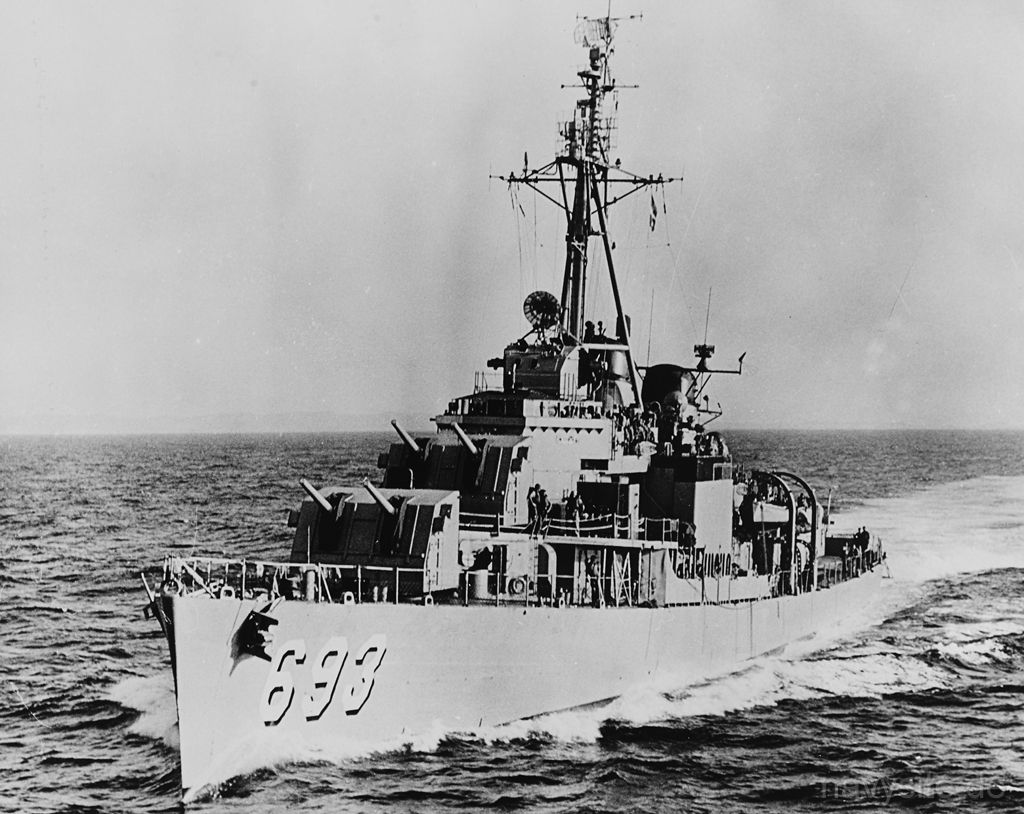 |
 |
back to top
 Back to Destroyers list. Back to ships list. Back to selection page. Back to 1st page.