
Search the Site with

|
Search the Site with
|
 General Characteristics Crew List History Image Gallery to end of page
 | Sorry, no coat of arms available. | 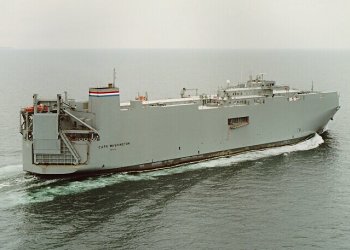 |
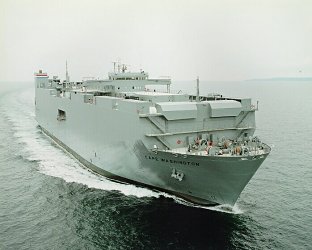
Built in 1982, the ship was delivered to Grace Marine Co., Panama, as MV HUAL TRANSPORTER. She was purchased by the Maritime Administration on April 7, 1993. Renamed MV CAPE WASHINGTON (T-AKR 9961) on January 1, 1994, she was assigned to the Ready Reserve Force on April 5, 1994. The ship was initially equipped with seven vehicle decks, however, those decks were too weak for heavy military vehicles. Therefore, CAPE WASHINGTON's original vehicle decks were replaced by three stronger cargo decks starting in October 1999. These new decks added an additional 156,000 square feet of cargo capacity. Since then, she is maintained in reduced operating status in a layberth at Baltimore, Md. If required, she can be fully activated within 5 days.
| General Characteristics: | Built: 1982 |
| Builder: Stocznia im Komuny Partyskiej, Gdynia, Poland | |
| Purchased by MARAD: April 7, 1993 | |
| Propulsion system: one Cegielski-Sulzer 6RND 90/155 Diesel engine | |
| Propellers: one | |
| Length: 697 feet (212.6 meters) | |
| Beam: 106 feet (32.3 meters) | |
| Draft: 38 feet (11.6 meters) | |
| Displacement: approx. 53,500 tons full load | |
| Speed: 14.9 knots | |
| Aircraft: none | |
| Armament: none | |
| Crew: 27 civilian mariners when activated | |
| Homeport: Baltimore, Md. |
 back to top go to the end of the pageback to top go to the end of the page
Crew List:
This section contains the names of sailors who served aboard MV CAPE WASHINGTON. It is no official listing but contains the names of sailors who submitted their information.
back to top go to the end of the pageMV CAPE WASHINGTON History:
MV CAPE WASHINGTON originated as the roll-on/roll-off cargo ship HUAL TRANSPORTER, built in 1982 at Stocznia im. Komuny Paryskiej in Gdynia, Poland, for Grace Marine Co. of New York, New York. As built, she was a large vehicle-capable ro/ro merchant ship, a type that became increasingly important to U.S. defense planners during the late Cold War and especially after the 1990-1991 Gulf War highlighted how quickly heavy equipment and sustainment cargo had to be moved across oceans to support expeditionary operations.
On April 7, 1993, the U.S. Maritime Administration acquired HUAL TRANSPORTER and placed her into the National Defense Reserve Fleet, with administrative actions tied to the James River Reserve Fleet. During this period, the Maritime Administration and the Department of Defense were managing a broader sealift modernization and surge-readiness effort: the aim was not simply to possess hulls on paper, but to maintain a pool of ships that could be brought to operating status quickly with civilian mariners, then deliver armored vehicles, engineering equipment, ammunition, fuel, and sustainment stocks to distant theaters. On November 2, 1993, the ship was withdrawn from reserve-fleet status for reflagging and conversion-related work, reflecting the government's intent to shift her from a commercially configured ro/ro into a ship optimized for defense requirements and surge employment.
Effective January 1, 1994, the vessel's name was changed to MV CAPE WASHINGTON. From that point, she was associated with the government surge sealift structure that sits behind day-to-day deployed naval forces: ships held at readiness to move large Army and Marine Corps formations and their equipment when crises expand, when deterrence surges are ordered, or when a major contingency requires rapid reinforcement overseas. In the post-Cold War environment of the 1990s - marked by repeated regional crises, NATO operations in the Balkans, and ongoing U.S. commitments in the Middle East - the U.S. increasingly relied on a combination of prepositioned stocks and surge sealift to avoid keeping massive ground formations permanently forward-based while still retaining the ability to flow heavy forces quickly.
By fiscal year 1997, MV CAPE WASHINGTON was specifically identified in the context of Ready Reserve Force operations supporting the Army's afloat prepositioning construct, alongside her close counterpart MV CAPE WRATH (T-AKR 9962). In that reporting, the pair were discussed as part of a Ready Reserve Force contingent aligned to afloat prepositioning support, with the broader ro/ro force described as operating at very high material readiness. This reflected the defense logic of the era: afloat prepositioning reduced deployment timelines by keeping equipment closer to likely theaters, while surge ships like MV CAPE WASHINGTON provided the lift capacity to reposition stocks, reinforce forces, or sustain operations as requirements grew beyond what was already forward.
As the U.S. military's deployment model evolved, so did the government ro/ro fleet. In fiscal year 2000, the Maritime Administration reported a continuing program to increase usable ro/ro capacity across multiple ship classes to address sealift shortfalls. Within that effort, MV CAPE WASHINGTON was specifically noted as receiving an award in September 2000 for a capacity upgrade, with completion expected in November 2001. The same reporting framed this as part of a deliberate, programmatic approach to expanding effective military cargo capacity (not merely owning tonnage), consistent with the late-1990s and early-2000s emphasis on moving mechanized forces, sustainment loads, and outsized equipment efficiently.
In the mid-2000s, MV CAPE WASHINGTON also appeared in Maritime Administration documentation connected to environmental and engineering compliance initiatives. In fiscal year 2006, the Maritime Administration described modifications and preparations associated with ballast-water-related technology testing and shipboard changes - an example of how reserve-force ships, even when held at readiness, still required periodic technical work to meet regulatory realities and to support government-directed programs beyond pure surge sealift.
By the mid-2010s, the Ready Reserve Force concept increasingly emphasized measurable activation performance - how quickly a ship could be crewed, brought to operating condition, and made ready for sea - because strategic warning time in many scenarios was expected to be short. In that context, MV CAPE WASHINGTON appeared in published fleet-change/force-status reporting connected to readiness exercises, reflecting that she remained part of the government's surge sealift enterprise and was being tested for activation responsiveness and operational reliability.
In the late 2010s and early 2020s, the strategic environment again pushed sealift into view: renewed great-power competition in Europe and the Indo-Pacific, combined with persistent global commitments, increased the importance of being able to move heavy forces quickly and repeatedly. MV CAPE WASHINGTON's role became publicly visible in direct support of European reinforcement efforts during the Russia-Ukraine war era. In March 2022, U.S. sealift authorities activated MV CAPE WASHINGTON to load U.S. Army cargo at the Port of Beaumont, Texas, and sent her on a transatlantic movement in support of Operation Atlantic Resolve. Reporting from that activation described a substantial loadout - more than a dozen helicopters and roughly 1,350 pieces of cargo including tracked and wheeled vehicles and supporting equipment - consistent with the mission of flowing heavy combat capability and sustainment into Europe at speed. The ship's arrival and offload in Vlissingen, Netherlands, was documented with a March 27, 2022 arrival date for the equipment movement, directly tied to Atlantic Resolve activities supporting NATO assurance and deterrence measures after Russia's full-scale invasion of Ukraine on February 24, 2022. In the same operational context, additional ships (including ARC ENDURANCE) were described arriving soon after, illustrating how the sealift enterprise typically functions in practice: not a single ship movement, but a sequence of coordinated arrivals through multiple European ports to distribute equipment onward by rail and road.
As of late 2025, publicly posted National Defense Reserve Fleet inventories still list MV CAPE WASHINGTON as part of the Ready Reserve Force at Baltimore, Maryland.
back to top go to the end of the pageMV CAPE WASHINGTON Image Gallery:
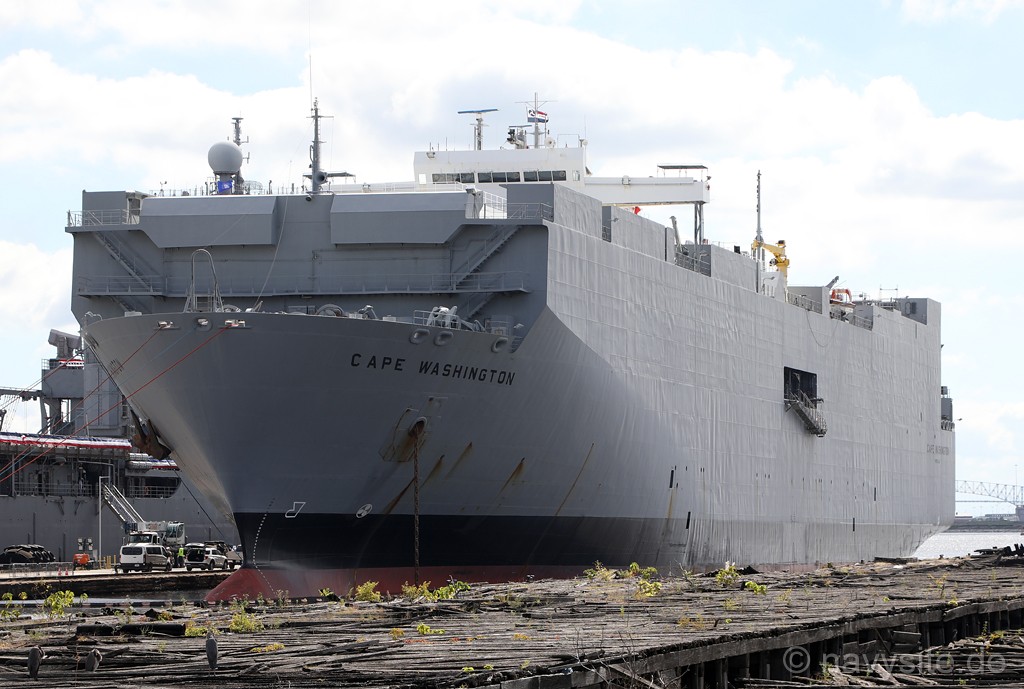
The photo below was taken by Michael Jenning and shows the CAPE WASHINGTON at her layberth at Baltimore, Md., on September 8, 2022.
 |
back to top Back to Vehicle Cargo Ships. Back to ships list. Back to selection page. Back to 1st page.