
Search the Site with

|
Search the Site with
|
 General Characteristics Crew List History Image Gallery to end of page
 | Sorry, no coat of arms available. |
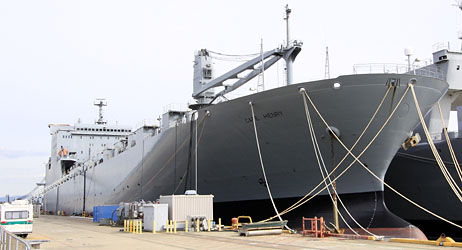
Built in 1979, the ship was delivered to Barber Steamship Co. as MV BARBER PRIAM. On May 15, 1986, she was purchased by the Maritime Administration and was subsequently converted for military use. Renamed MV CAPE HENRY (T-AKR 5067) on September 30, 1986, she was assigned to the Ready Reserve Force on November 18, 1986. Since then, she is maintained in reduced operating status in a layberth at the former Naval Air Station Alameda, Calif. If required, she can be fully activated within 5 days.
| General Characteristics: | Built: 1979 |
| Builder: Mitsubishi Heavy Industries, Nagasaki, Japan | |
| Purchased by MARAD: May 15, 1986 | |
| Propulsion system: one slow speed Diesel engine | |
| Propellers: one | |
| Length: 749 feet (228.3 meters) | |
| Beam: 106 feet (32.3 meters) | |
| Draft: 36 feet (11 meters) | |
| Displacement: 51,836 tons full load | |
| Speed: 18.5 knots | |
| Armament: none | |
| Crew: 9 civilian mariners in ROS; 27 civilian mariners when activated | |
| Homeport: Alameda, Calif. |
 back to top go to the end of the pageback to top go to the end of the page
Crew List:
This section contains the names of sailors who served aboard MV CAPE HENRY. It is no official listing but contains the names of sailors who submitted their information.
back to top go to the end of the pageMV CAPE HENRY History:
Built in 1979 at Mitsubishi Heavy Industries' Nagasaki shipyard in Japan, BARBER PRIAM entered service as a commercial roll-on/roll-off cargo ship. On May 15, 1986, the U.S. Maritime Administration acquired the vessel for strategic sealift purposes, reflecting the mid-Cold War U.S. effort to expand and modernize government-controlled surge sealift capacity for rapid reinforcement and sustainment of forces overseas. On September 30, 1986, the ship was renamed MV CAPE HENRY and entered the Ready Reserve Force (RRF) as T-AKR 5067, becoming one of the RRF's roll-on/roll-off ships positioned to activate quickly in a crisis.
During the 1990s, CAPE HENRY was repeatedly documented as part of the Department of Defense's practice of using selected RRF ships as an extension of afloat prepositioning and contingency logistics, keeping high readiness and logistics support standards so ships could transition from reserve status to operational employment on short notice. In fiscal year 1996, CAPE HENRY was listed among the roll-on/roll-off vessels used as an integral part of the prepositioning fleet supporting the U.S. Army's Interim Brigade Afloat Force (AWR-3), operating at a reported "over 99.5 percent" fully mission capable level - an indicator of how intensely the government focused on readiness metrics for these surge assets.
In fiscal year 1997, CAPE HENRY was again identified as part of the assigned RRF contingent supporting the Army's afloat prepositioning program (APS-3). That year, CAPE HENRY was recorded conducting at least two distinct, mission-tied overseas cargo movements after participating in APS-3: first, transporting military equipment to Bremerhaven, Germany, in support of Operation Joint Guard (the NATO-led stabilization mission in the Balkans), and afterward sailing to Santa Marta, Colombia, to participate in Operation Presidential Determination. These voyages illustrate how RRF ships could shift from reserve layberth status to operational employment aligned with evolving post-Cold War security requirements - ranging from European stabilization commitments to missions in the Western Hemisphere - while still remaining part of the United States' strategic surge sealift structure.
By the end of the decade, CAPE HENRY was also documented in a specifically described readiness activation and cargo movement. In fiscal year 1999, CAPE HENRY took part in a Sea Deployment Readiness Exercise (SEDRE). The ship was activated in San Francisco, California, then loaded in Jacksonville, Florida, sailed to Port Hueneme, California to discharge cargo, and returned to its San Francisco outport. Even though this was framed as a readiness exercise, the described coast-to-coast movement and cargo handling underscores what these drills were designed to validate: real-world activation timelines, long-range transits, and efficient onload/offload of military cargo through U.S. ports that could be used in contingency deployments.
Across the 2000s and 2010s, publicly released government documentation about CAPE HENRY is more episodic than day-by-day - typical for RRF vessels that spend long periods in reserve layberths with intermittent activations, maintenance, and readiness testing. What is clearly documented, however, is that the ship remained in the RRF inventory and continued to be managed as a militarily useful roll-on/roll-off asset. By March 1, 2016, an official MARAD vessel-characteristics publication described CAPE HENRY as a roll-on/roll-off ship in the RRF and noted a specific cargo-handling capability relevant to modern air-mobility support: internal stowage suitability for V-22 Osprey aircraft (reflecting how some RRF ro/ro vessels were evaluated and configured to carry outsized or specialized military equipment beyond standard wheeled vehicles). Documentation tied to RRF layberth management and port coordination later placed the ship at West Coast reserve berths associated with RRF operations.
In the 2020s, CAPE HENRY began appearing frequently in publicly released material connected to Indo-Pacific exercises, reflecting the renewed emphasis on distributed logistics and theater-level sustainment in a "free and open Indo-Pacific" framework. In an offload event documented during Balikatan 23, CAPE HENRY was shown discharging military vehicles at Subic Bay, Philippines, on April 3, 2023, during the long-running U.S.-Philippines exercise series focused on alliance interoperability and regional deterrence. That same pattern continued into 2025. During Cobra Gold 2025, CAPE HENRY was documented offloading a UH-60 Black Hawk helicopter at the pier in Sattahip, Thailand, on February 18, 2025, as part of the logistics flow supporting the annual U.S.-Thai-led multinational exercise. Later that year, on July 15, 2025, Military Sealift Command highlighted CAPE HENRY in connection with Talisman Sabre 25, stating that the ship's crew worked with soldiers from the 8th Theater Sustainment Command and the 599th Transportation Brigade to offload military vehicles and equipment in support of that major U.S.-Australia bilateral exercise with multinational participation - an illustration of how reserve-force shipping, when chartered and activated under MSC control, plugs directly into theater sustainment organizations during large-scale rehearsals.
back to top go to the end of the pageMV CAPE HENRY Image Gallery:
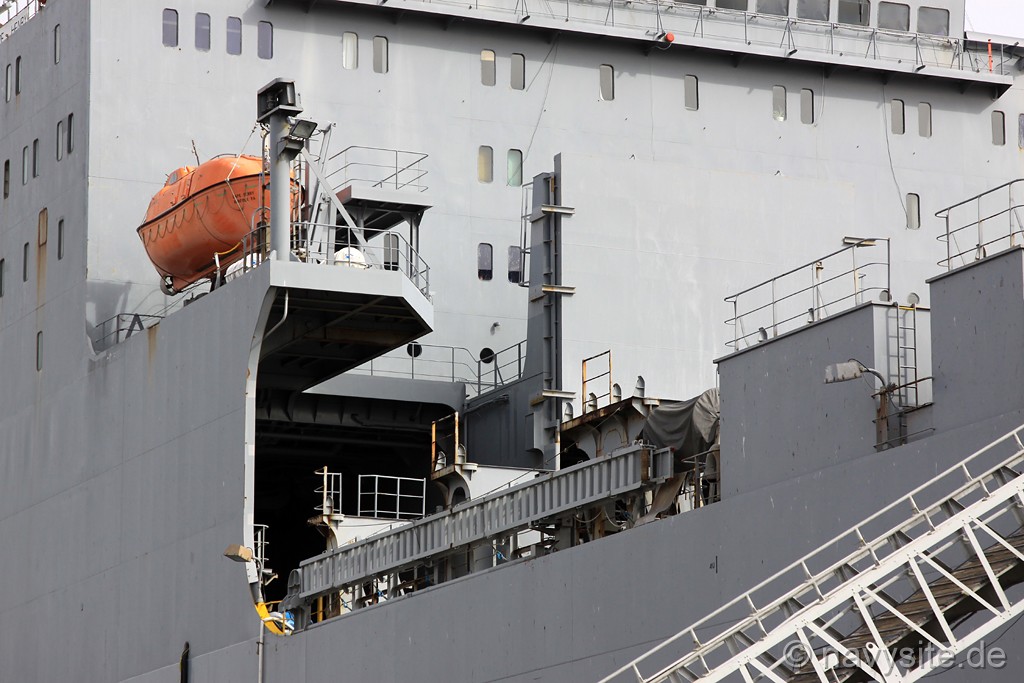
The photos below were taken by me and show the CAPE HENRY at Alameda, Calif., on March 19, 2012.
 |  |  |  |  |
 |
back to top Back to Vehicle Cargo Ships. Back to ships list. Back to selection page. Back to 1st page.