Search the Site with 
General Characteristics Crew List History Image Gallery to end of page

SS Cape May (T-AKR 5063)

- formerly ALMERIA LYKES -
- stricken -


Sorry,
no coat of arms
available.

Delivered as SS ALMERIA LYKES to Lykes Bros Steamship Company in 1972, the ship was purchased by the Maritime Administration (MARAD) in July 1986, and renamed SS CAPE MAY (T-AKR 5063). Assigned to Military Sealift Command's Ready Reserve Force, the CAPE MAY could be fully activated within 5 days if required.

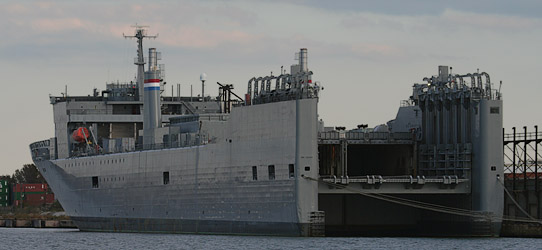
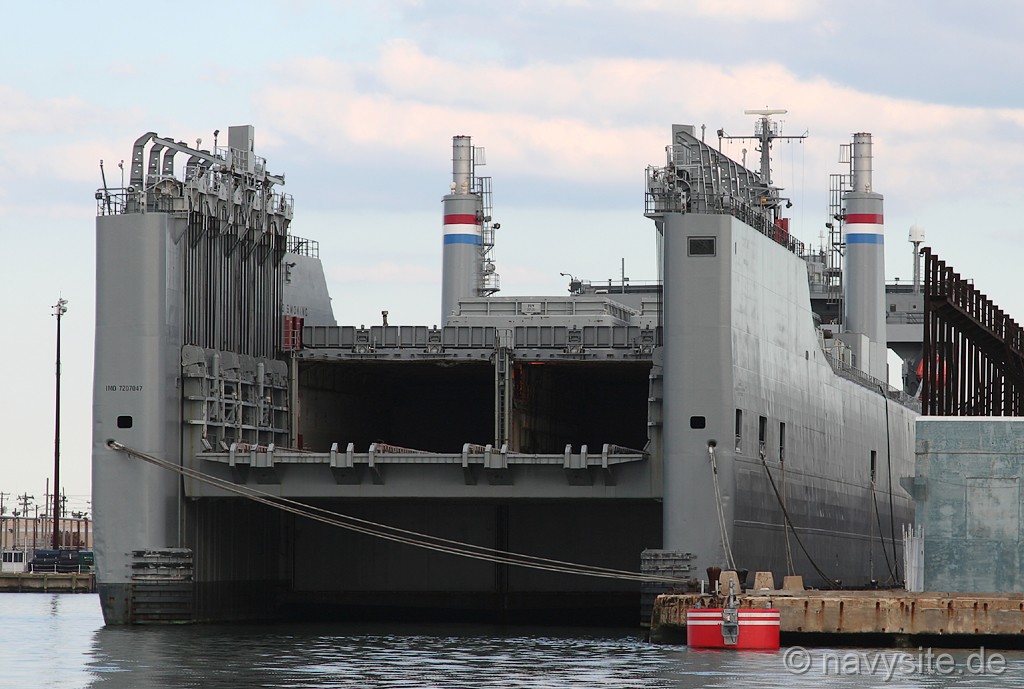
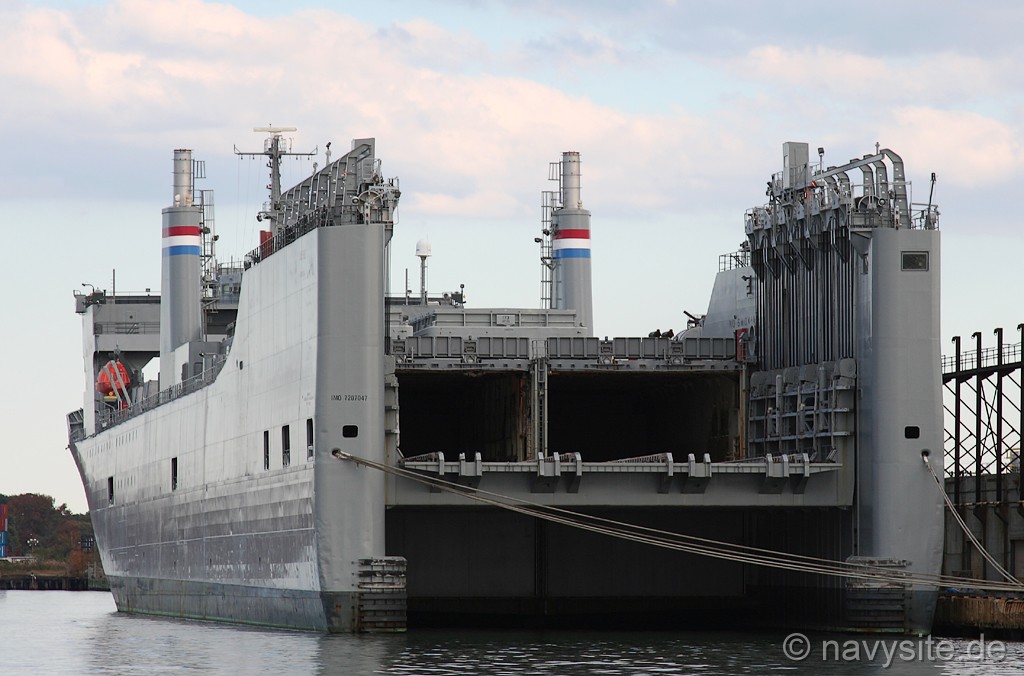
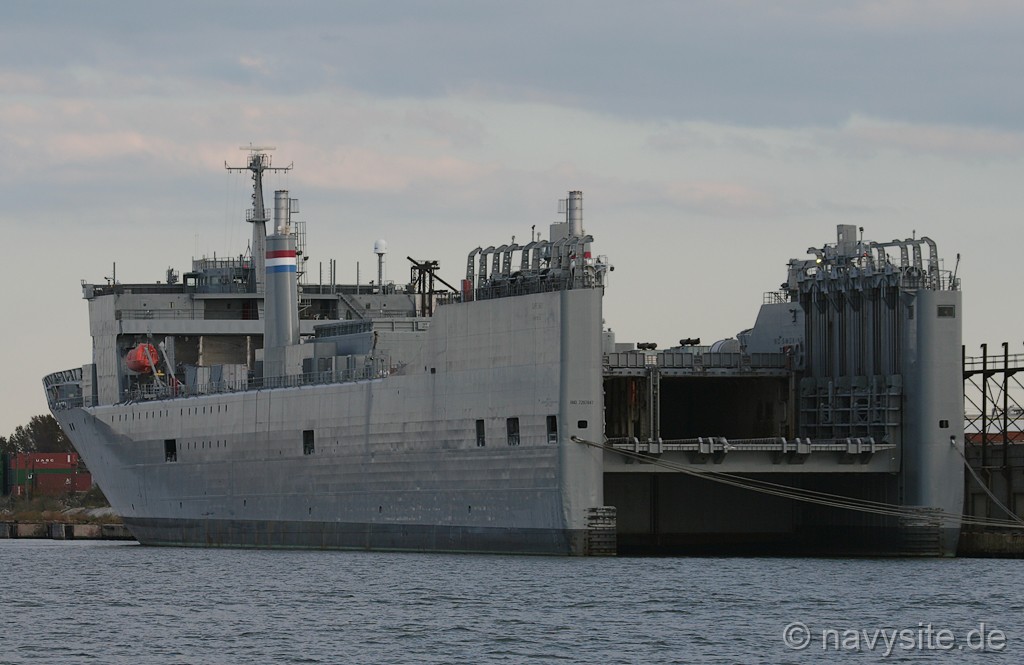
The CAPE MAY was a SEABEE (Sea Barge) ship. These ships were designed to carry loaded barges instead of only the cargo itself. The idea behind it was to reduce loading times since the carrier ship only had to load or unload its barges. Loading was done using the ship's 2000-ton-capacity stern elevator. Under ideal conditions this process took only 13 hours. A similar design were the LASH (lighter aboard ships) ships [see Cape F - class LASH ships]. However, the LASH ships used smaller barges but carried more of them. Loading aboard the LASH ships was done using the ship's 405-ton-capacity gantry crane.

On September 4, 2021, CAPE MAY arrived under tow from Norfolk, Va., at Beaumont, Tx., for lay-up. On June 5, 2025, she was downgraded from "Retention" to "Non-retention, disposal." She is presently laid up at Beaumont, Tx., awaiting final disposal.

General Characteristics:Awarded: October 31, 1968
Keel laid: March 3, 1971
Launched: February 27, 1972
Delivered: September 26, 1972
Purchased by MARAD: September 13, 1986
Stricken: June 5, 2025
Builder: General Dynamics Shipyard, Quincy, Mass.
Propulsion system: boilers and two steam turbines
Propellers: one
Length: 873 feet (266 meters)
Beam: 105 feet (32 meters)
Draft: 39 feet (11.9 meters)
Displacement: approx. 57,290 long tons full load
Speed: 16+ knots
Aircraft: none but area between deckhouse and smokestacks may be used as landing platform
Armament: none
Capacity: 38 barges
Crew: 36 (when activated)


Back to topback to top  go to endgo to the end of the page


Back to topback to top  go to endgo to the end of the page

Crew List:

This section contains the names of sailors who served aboard SS CAPE MAY. It is no official listing but contains the names of sailors who submitted their information.


Back to topback to top  go to endgo to the end of the page

SS CAPE MAY History:

SS CAPE MAY began life as SS ALMERIA LYKES, a Seabee heavy-lift barge carrier built for Lykes Brothers Steamship Company to move cargo in large ocean-going barges that could be raised and lowered by the ship's stern elevator, allowing discharge even where port infrastructure was limited. Construction was contract-awarded on October 31, 1968, the keel was laid on March 3, 1971, and the ship was launched on February 27, 1972. SS ALMERIA LYKES was delivered on September 26, 1972, from the General Dynamics shipyard at Quincy, Massachusetts. In commercial service through the 1970s and early 1980s, she operated as a U.S.-flagged barge carrier in international liner trades under Lykes Lines, using the Seabee barge system as a distinctive alternative to conventional breakbulk and early container operations. On March 20, 1986, the United States Maritime Administration acquired the ship. On July 25, 1986, she was renamed SS CAPE MAY and entered government reserve-fleet service as a Ready Reserve Force asset, maintained to be brought to full operating condition on short notice.

The first major contingency activation recorded for SS CAPE MAY occurred in direct response to Iraq's invasion of Kuwait and the ensuing United States-led buildup for Operations Desert Shield and Desert Storm. She was activated beginning on August 14, 1990, completed activation on August 22, 1990, and was tendered for operational tasking under the Military Sealift Command framework that supported the coalition logistics pipeline into the theater. Maritime Administration records associate her Desert Shield/Desert Storm/Sortie employment with a mission end date of November 2, 1991. After that wartime surge, the ship's record shows a shift toward readiness demonstrations and logistics-over-the-shore training designed to prove her utility as a barge carrier for austere offload. She was activated for the exercise recorded as Fuertas Defensas 95 beginning on February 14, 1995, and completed that activation on February 19, 1995. Another major exercise activation followed in 1997: SS CAPE MAY began Joint Task Force Exercise 97-3 on September 9, 1997, completed that phase on September 22, 1997, then conducted an anchorage period at Fort Story, Virginia, on October 4, 1997, and moved to CSX Pier 15 at Newport News, Virginia, on October 5, 1997. A rapid-readiness demonstration followed: on March 1, 1998, she commenced a no-notice "turbo activation" sea trial and completed it on March 3, 1998, reflecting the Ready Reserve Force emphasis on proving activation timelines and propulsion reliability under compressed schedules.

In 2000-2004, recorded events show SS CAPE MAY cycling through sea trials, maintenance movements, and additional logistics-over-the-shore work. A sea trial to a new homeport began on January 22, 2000, and was completed on February 5, 2000. Another sea trial, listed as TA-01-03B, ran from February 5, 2001, through February 9, 2001. On October 16, 2001, she was towed to Baltimore Marine Industries for drydocking, and on October 17, 2001, she was towed into that shipyard's Drydock 3. After completion of that availability period, she performed a post-availability sea trial from April 3, 2002, through April 5, 2002. She was then towed back into the Norfolk area from July 30, 2002, through August 1, 2002, arriving at Norfolk Pier 3 (NIT). With the post-9/11 operational environment increasing the emphasis on expeditionary logistics, SS CAPE MAY supported additional sealift readiness evolutions: she conducted a sea trial under the operational control of the Military Sealift Command from January 21, 2004, through January 24, 2004, then commenced a Joint Logistics Over-the-Shore activation associated with the New Horizons series on February 4, 2004, completing that mission on March 17, 2004.

From 2009 onward, the ship's documented activations align closely with Joint Logistics Over-the-Shore testing and real-world humanitarian response. SS CAPE MAY began the Joint Logistics Over-the-Shore 2009 mission on April 27, 2009, and completed it on July 31, 2009. Accounts of that exercise period describe SS CAPE MAY delivering a large share of the equipment required to build floating and fixed causeway platforms, operating in tandem with other specialized government sealift vessels including SS CORNHUSKER STATE (T-ACS 6) and USNS SEAY (T-AKR 302) to practice port-opening and sustainment concepts relevant to contingency operations. Following the catastrophic Haiti earthquake of January 12, 2010, she was ordered into a no-notice activation on January 17, 2010, in support of the relief operation that the United States designated Operation Unified Response. Maritime Administration records list January 21, 2010, as the completion date for that initial activation phase. During the Haiti response, SS CAPE MAY's Seabee configuration was employed for expeditionary offload: she delivered Joint Logistics Over-the-Shore gear including 90-foot causeway sections to enable shallow-water cargo operations, and her 2,000-ton stern elevator was also used in an improvised repair role to support damaged or overworked watercraft during the surge of relief shipping into the area. The ship returned to a training and readiness pattern afterward, conducting a Joint Logistics Over-the-Shore activation described as an "ACOE barge list exercise" beginning on July 29, 2012, and completing that exercise on September 5, 2012. Another rapid-readiness demonstration followed two years later: SS CAPE MAY commenced a turbo activation sea trial on May 31, 2014, and completed it on June 3, 2014.

Her last documented changes were administrative and status-related rather than operational deployments. Over time, the Maritime Administration's public reserve-fleet inventories show SS CAPE MAY transitioning away from the Ready Reserve Force posture and into the broader National Defense Reserve Fleet accounting and disposal pipeline. Public inventory reporting records her as assigned to the Beaumont Reserve Fleet in Texas, and by the month ending December 31, 2025, she is listed in the National Defense Reserve Fleet as a non-retention barge ship at Beaumont with status "Disposal", indicating she is no longer maintained as a Ready Reserve Force activation asset but instead carried as a reserve-fleet hull awaiting final disposition.


Back to topback to top  go to endgo to the end of the page


Back to topback to top


Back to Vehicle Cargo Ships. Back to ships list. Back to selection page. Back to 1st page.