
Search the Site with

|
Search the Site with
|
 General Characteristics Crew List About the Ship's Name History Image Gallery to end of page
 | Sorry, no coat of arms available. |
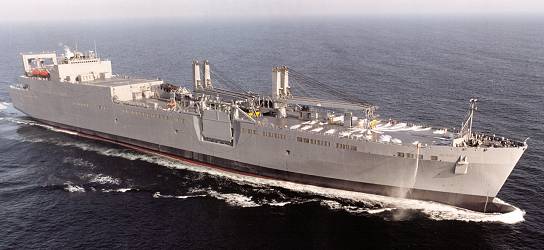
USNS RED CLOUD is the fourth WATSON - class large, medium-speed, roll-on/roll-off ship (LMSR) and homeported in Diego Garcia. One previous ship (YT 268) (1943- 1986) was named RED CLOUD in honor of an American Indian chief (1822-1909).
| General Characteristics: | Awarded: January 30, 1996 |
| Keel laid: June 29, 1998 | |
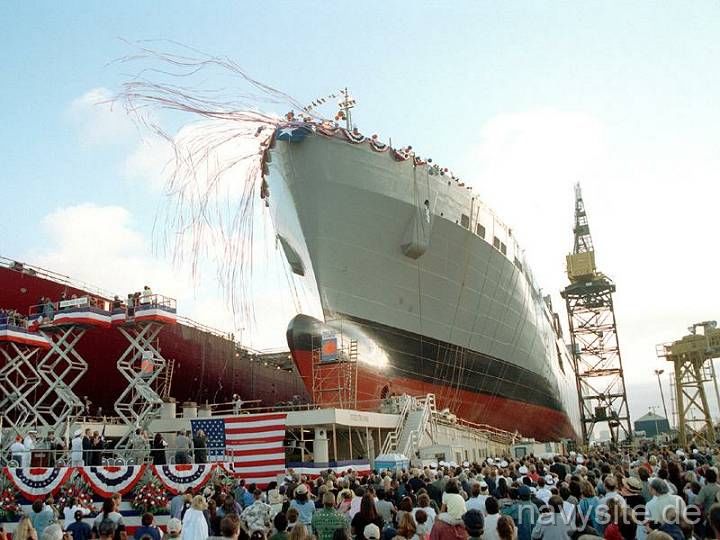
| Launched: August 7, 1999 | |
| Delivered: January 18, 2000 | |
| Builder: National Steel and Shipbuilding, San Diego, CA | |
| Propulsion system: two GE Marine LM gas turbines | |
| Propellers: two | |
| Length: 951.4 feet (290 meters) | |
| Beam: 106 feet (32.3 meters) | |
| Draft: 34.1 feet (10.4 meters) | |
| Displacement: approx. 62,970 tons full load | |
| Speed: 24 knots | |
| Aircraft: helicopter landing area only | |
| Armament: none | |
| Capacity: 393,000 sq. ft. (more than 900 vehicles including tanks and trucks) | |
| Crew: 26 civilian crew (up to 45); up to 50 active duty | |
| Homeport: not assigned |
 back to top go to the end of the pageback to top go to the end of the page
Crew List:
This section contains the names of sailors who served aboard USNS RED CLOUD. It is no official listing but contains the names of sailors who submitted their information.
back to top go to the end of the pageAbout the Ship's Name:
The ship is named RED CLOUD in honor of Army Cpl. Mitchell Red Cloud Jr. (1925-1950), a native of Hatfield, Wis. Cpl. Mitchell Red Cloud, Jr. enlisted in the U.S. Marine Corps in 1941 and was honorably discharged in 1945. He enlisted in the U.S. Army in 1948 and was sent to Korea in 1950. He was posthumously awarded the Medal of Honor for actions during the defense of a ridge in front of his company command post in Korea, Nov. 5, 1950. As the first to detect the approach of enemy forces, Red Cloud gave the alarm and initiated action as the enemy charged from an area less than a hundred feet away. This action allowed his company to organize a defense. He maintained his position despite being severely wounded. He wrapped his arm around a tree to allow him to continue firing upon the enemy until mortally wounded. His heroic actions prevented his company from being overrun.
Citation:
Cpl. Red Cloud, Company E, distinguished himself by conspicuous gallantry and intrepidity above and beyond the call of duty in action against the enemy. From his position on the point of a ridge immediately in front of the company command post he was the first to detect the approach of the Chinese Communist forces and give the alarm as the enemy charged from a brush-covered area less than 100 feet from him. Springing up he delivered devastating pointblank automatic rifle fire into the advancing enemy. His accurate and intense fire checked this assault and gained time for the company to consolidate its defense. With utter fearlessness he maintained his firing position until severely wounded by enemy fire. Refusing assistance he pulled himself to his feet and wrapping his arm around a tree continued his deadly fire again, until he was fatally wounded. This heroic act stopped the enemy from overrunning his company's position and gained time for reorganization and evacuation of the wounded. Cpl. Red Cloud's dauntless courage and gallant self-sacrifice reflects the highest credit upon himself and upholds the esteemed traditions of the U.S. Army. for conspicuous gallantry and intrepidity in action at the risk of his life above and beyond the call of duty in Chonghyon, Korea, 5 November 1950.
back to top go to the end of the pageUSNS RED CLOUD History:
USNS RED CLOUD entered service as a WATSON - class large, medium-speed roll-on/roll-off (LMSR) and began her career squarely in the U.S. Army Prepositioned Stocks afloat enterprise (APS-3). The Navy awarded the ship on January 30, 1996; she was laid down at General Dynamics NASSCO, San Diego, on June 29, 1998, launched on August 7, 1999, and placed in service with Military Sealift Command on January 18, 2000. RED CLOUD was built for speed to theater and very high vehicle throughput - nearly a thousand feet in length, twin screw, and a cargo capacity measured in hundreds of thousands of square feet with internal ramps and heavy-lift gear for pier-independent operations.
Acceptance, trials, and the first load cycle in 2000-2001 were followed by assignment to APS-3. In practical terms, that meant repeating "upload–station–download–refit" loops: loading Army combat power at Joint Base Charleston, South Carolina, and Military Ocean Terminal Sunny Point, North Carolina; steaming to prepositioning hubs - Diego Garcia in the Indian Ocean or Guam/Saipan in the Western Pacific - for extended on-station readiness; then returning on a 30-36-month rhythm for cargo refurbishment, regulatory dry dock, and class maintenance. This model matured across the early 2000s as APS-3 standardized the brigade-set equipment afloat and refined turnaround timelines between Charleston uploads and forward stationing.
The ship's first major contingency move came with Operation Iraqi Freedom. In the surge to the U.S. Central Command theater, RED CLOUD carried U.S. Army vehicles and associated rolling stock toward Kuwaiti ports in early 2003, contributing to the initial ground buildup that preceded the air campaign opening on March 20, 2003. As with all APS-3 evolutions, this was a logistics event more than a tactical one: the measure of performance was square footage loaded, discharge rate at the pier, and how quickly unit equipment could form at assembly areas ashore. After offload and backhaul, RED CLOUD returned to the APS-3 cycle.
Through the mid- and late-2000s, the ship alternated between on-station periods at Diego Garcia (supporting Gulf contingencies and Indian Ocean presence) and Western Pacific positioning (covering Northeast and Southeast Asia response options), punctuated by periodic regulatory and class maintenance in U.S. yards. The pattern of port calls reflected that cadence: Charleston/Sunny Point for uploads; Pearl Harbor as a mid-ocean logistics hinge when routing to the Pacific; Guam and Saipan for staging and crew services; and Diego Garcia for extended readiness. While these deployments ran largely without incident, the class's operating concept - large deck, flight-quarters capable - also enabled joint training evolutions with Army and Special Operations aviation.
One such evolution produced a widely reported mishap on August 12, 2015, when a U.S. Army UH-60 Black Hawk made a hard deck landing on RED CLOUD while the ship was underway roughly 20 miles east of Okinawa, near Ukibaru Island; seven personnel were injured and the helicopter was damaged. The ship remained seaworthy, and the episode underscored how frequently APS-3 hulls operate in the same air and maritime envelopes as combatants during joint training. After inspections and recovery, RED CLOUD resumed tasking.
On April 19, 2016, after a full upload by Army Strategic Logistics Activity-Charleston and the 841st Transportation Battalion - about 1,300 pieces of equipment - RED CLOUD departed Joint Base Charleston bound for the Western Pacific. The itinerary was classic APS-3: transit via the Pacific with routine logistics pauses as needed, take up station near Guam/Saipan for contingency coverage and exercises, and integrate with allied ports as opportunities arose. In 2017-2018, as APS-3 redistributed brigade-set inventory among hulls, RED CLOUD operated in company with fellow LMSRs in the Western Pacific, supporting a mix of joint exercises and readiness posture for U.S. Army and joint forces.
The ship returned to the United States in October 2019 to discharge "port-opening" equipment for refurbishment, then entered a scheduled regulatory overhaul from March-July 2020. That yard work was conducted at Bayonne Dry Dock, New Jersey, during the first wave of the COVID-19 pandemic and included significant propulsion shaft-seal repair and class surveys. An OSHA record and related court filings document RED CLOUD's presence in dry dock in April 2020, and an industrial contractor's case study details the in-place machining carried out on the ship's shaft-seal liner in May 2020. With the regulatory period complete, the ship postured for her next APS-3 deployment.
In 2021-2022 the broader APS-3 flotilla executed distributed downloads and tests across the Indo-Pacific, validating access and throughput at regional ports. RED CLOUD continued to cycle within that framework while maintaining the Charleston-forward station-Charleston rhythm that APS-3 demands. The operational backdrop was shifting toward great-power deterrence in the Western Pacific, and prepositioned afloat sets - delivered by ships like RED CLOUD - remained a key hedge for rapid reinforcement.
A notable logistics milestone came in mid-2023, when RED CLOUD completed a mission and returned stateside for equipment refurbishment and reassignment within the LMSR pool. Military Sealift Command's 2023 report notes RED CLOUD's mission exchange with USNS WATKINS (T-AKR 315) - the kind of fleet-level swap that keeps prepositioned sets fresh and aligned to theater needs. In parallel, Army logisticians recorded the Charleston refit cycle that turns a returning APS-3 hull around to meet the next upload window on a tight clock.
By 2024-2025, RED CLOUD's operating picture again reflected flexible sealift: periods on the U.S. East Coast for maintenance and crew turnover; trans-Atlantic and European port work, including roll-on/roll-off evolutions at Bremerhaven, Germany, and Gdynia, Poland, as NATO infrastructure expanded heavy-lift reception options; and renewed staging for afloat prepositioned equipment. These moves are incremental on paper - berth assignments, cranes, ramps, cargo counts - but cumulative in strategic effect, broadening the set of ports where an LMSR can quickly put brigade-scale combat power ashore.
back to top go to the end of the pageUSNS RED CLOUD Image Gallery:
 | 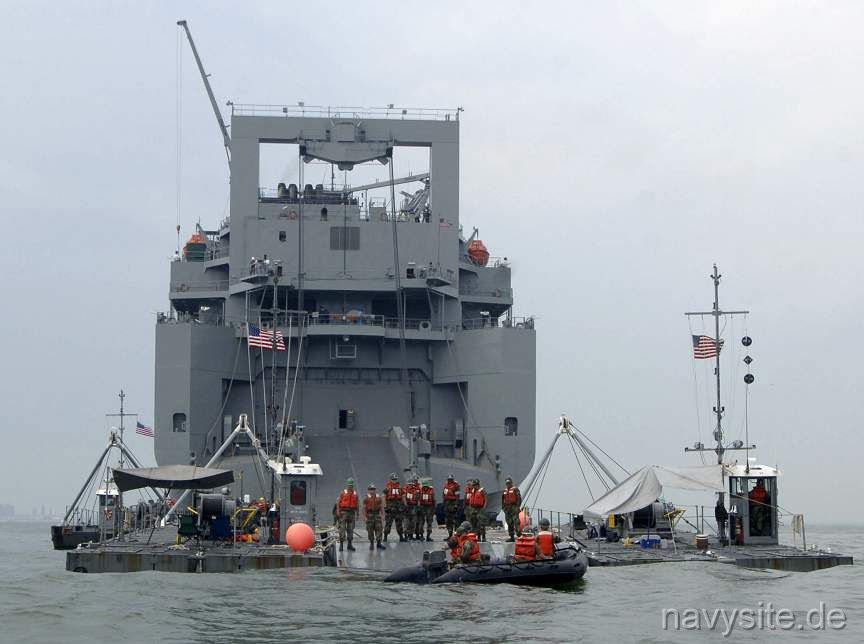 |
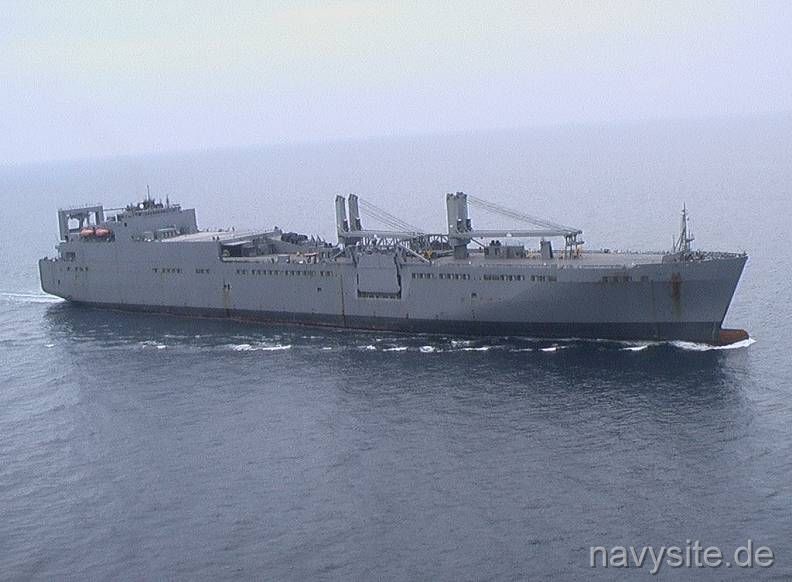
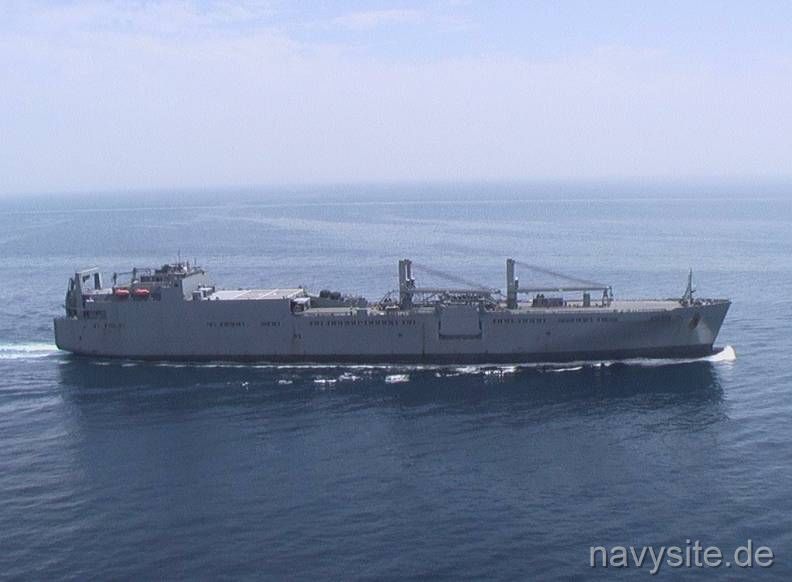
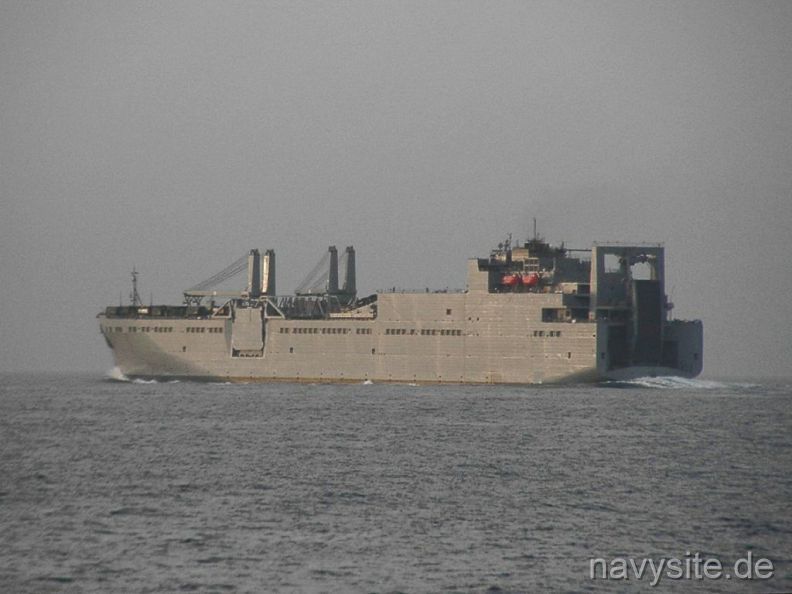
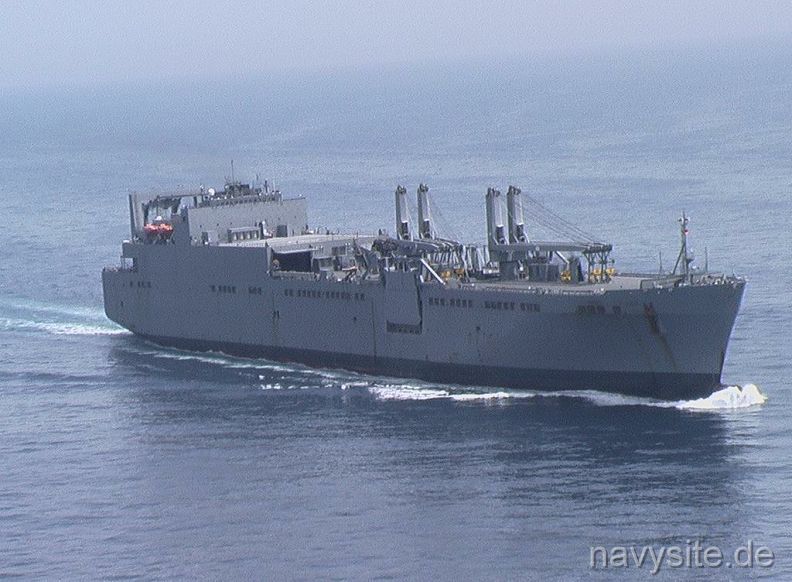
The photos below were contributed by Stefan Karpinski and were taken by him and the helo detachment of the German frigate MECKLENBURG-VORPOMMERN (F 218). They show the RED CLOUD being escorted through Bab El Mandeb by the MECKLENBURG-VORPOMMERN during Operation Enduring Freedom in 2003.
 |  |  |  |
The photos below were taken by Michael Jenning and show the RED CLOUD at Norfolk, Va., on October 4, 2024.
 |  |  |
The photos below were taken by me and show USNS RED CLOUD arriving at Bremerhaven, Germany, on January 13, 2025.
 |  |  |  |  |
 |  |  |  |  |
 |  |  |  |  |
 |  |  |  |  |
 |  |  |  |  |
 |  |  |  |  |
 |  |  |
The photos below were taken by Michael Jenning and show USNS RED CLOUD at Norfolk, Va., on May 31, 2025.
 |  |  |
back to top Back to Vehicle Cargo Ships. Back to ships list. Back to selection page. Back to 1st page.