
Search the Site with

|
Search the Site with
|
 General Characteristics Crew List History Image Gallery to end of page
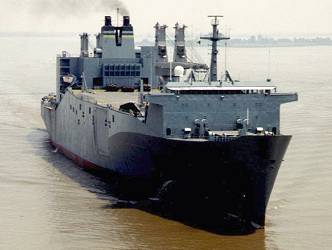 | Sorry, no coat of arms available. |
Named after the star in the constellation Auriga, the SS CAPELLA was the seventh ALGOL - class fast sealift ship and the second ship in the Navy to bear the name. Ships in that class are the world's fastest cargo ships. Originally built in the Netherlands in 1973 as SS SEA-LAND McLEAN for Sea-Land Services, Inc., Port Elizabeth, N.J., the ship was purchased by the Navy in 1982 and converted. The cargo hold was redesigned into a series of decks connected by ramps so that vehicles could now be driven in and out of storage areas for rapid loading and unloading. Four cranes were installed - twin cranes amidships capable of lifting 35 long tons and twin cranes aft capable of lifting 50 long tons. The CAPELLA was delivered to the Military Sealift Command in 1984.
Since then, the CAPELLA was involved in several operations including Desert Shield/Desert Storm (1990/91), Restore Hope (1992) and Operation Enduring Freedom (2001 - ). On October 1, 2007, CAPELLA was transferred to the MARAD. On October 1, 2008, the ship was transferred to the Ready Reserve Force and lost her USNS designation. Since fall 2025, she's laid up at Beaumont, Tx., awaiting disposal.
| General Characteristics: | Launched: September 1, 1972 |
| Delivered to Sea-Land Services, Inc., Port Elizabeth, N.J.: October 1,1973 | |
| Purchased by the Navy: April 16, 1982 | |
| Conversion started: October 23, 1982 | |
| Delivered: July 1, 1984 | |
| Stricken: October 1, 2008 | |
| Builder: Rotterdamsche D.D.Mij N.V., Rotterdam, The Netherlands | |
| Conversion yard: Pennsylvania Shipbuilding, Chester, PA | |
| Propulsion system: two Foster-Wheeler boilers, 875 psi (61.6kg/cm2); 9500F (5100C) and two GE MST-19 steam turbines; 120,000 hp (89.5 MW) | |
| Propellers: two | |
| Length: 946.2 feet (288.4 meters) | |
| Beam: 105.6 feet (32.2 meters) | |
| Draft: 36.4 feet (11.1 meters) | |
| Displacement: approx. 55,355 tons full load | |
| Speed: 33 knots | |
| Aircraft: helicopter landing area only | |
| Armament: none | |
| Capacity: more than 700 Army vehicles (including tanks, trucks, and helicopters) | |
| Crew: 43 civilians, 12 military technicians (fully operational); 18 civilians (reduced operating status) |
 back to top go to the end of the pageback to top go to the end of the page
Crew List:
This section contains the names of sailors who served aboard SS CAPELLA. It is no official listing but contains the names of sailors who submitted their information.
back to top go to the end of the pageSS CAPELLA History:
Built in 1972 as the high-speed containership SEA-LAND MCLEAN for Sea-Land Service, CAPELLA was acquired by the U.S. Navy on April 16, 1982, and selected for conversion into a Fast Sealift Ship - part of the United States' surge-sealift capability intended to move heavy Army and Marine Corps equipment rapidly across oceans during crises. Conversion work began on October 23, 1982, remaking the ship from a container carrier into a roll-on/roll-off vehicle carrier with internal decks and ramps and shipboard cargo cranes for self-sustained loading and discharge in ports with limited infrastructure. CAPELLA was delivered to Military Sealift Command as USNS CAPELLA (T-AKR 293) on July 1, 1984. On August 1, 1984, she was documented in Los Angeles, California, discharging U.S. Army M60A1 main battle tanks for Exercise GALLANT EAGLE '84, illustrating the ship's intended role: rapidly delivering outsized ground equipment in a form ready to move onward by road or rail.
When not activated for major movements, CAPELLA's broader mission set was shaped by readiness: maintaining a condition that allowed sailing on short notice, and periodically proving that readiness through activations, trials, and maintenance availabilities. That surge function was tested almost immediately at the end of the Cold War when Iraq invaded Kuwait on August 2, 1990, and the United States began the rapid buildup for OPERATION DESERT SHIELD. CAPELLA was among the fast sealift ships brought forward early in the mobilization. She arrived at Savannah, Georgia, around 11:00 p.m. on August 10, 1990, to load outsized Army cargo, and she departed Savannah on August 17, 1990, carrying equipment associated with the 24th Infantry Division as the sealift pipeline opened to Saudi Arabia - one element of the wider logistics effort that underpinned the coalition's subsequent transition from deterrence to combat operations in early 1991. In the next major contingency of the decade, CAPELLA's ability to discharge military vehicles into austere conditions was again put to use during the Somalia intervention: on January 20, 1993, she was photographed offloading military vehicles and supplies in the port of Mogadishu in direct support of OPERATION RESTORE HOPE, a mission conducted amid state collapse and famine where seaborne delivery into a damaged port system was central to sustaining forces ashore and humanitarian distribution.
In the post-9/11 era, CAPELLA continued to appear in publicly documented surge movements tied to expeditionary operations. On February 4, 2003, she arrived at the North Charleston terminal in South Carolina to load military equipment for OPERATION ENDURING FREEDOM, and on February 25, 2003, she discharged cargo at Iskenderun, Turkey, including trucks, communications gear, and supplies during a period when U.S. and NATO logistics activity in and around Turkey was closely linked to regional defense measures and the rapidly developing Iraq crisis. On March 20, 2003, CAPELLA was recorded as being "in area operations", reflecting an operational status aligned with the opening phase of the 2003 Iraq War period.
From the late 2000s onward, CAPELLA's documented history is dominated by reserve-force custody and readiness cycles rather than continuous deployed steaming. A key transition occurred on October 1, 2007, when she was recorded entering the National Defense Reserve Fleet system, followed by shipyard and trial activity that established her as a maintained surge asset under the U.S. Maritime Administration. She was towed to Boston Ship Repair on May 7, 2008, entered drydock on May 20, 2008, and then conducted a sea trial to Lamberts Point, Virginia, on July 9, 2008, completing that trial on July 12, 2008. A 120-hour activation period was recorded on July 18, 2008, and title transfer from Military Sealift Command to the Maritime Administration was recorded on October 1, 2008.
A further "turbo activation" was recorded on October 8, 2008, after which CAPELLA arrived at Alameda Point, California, on November 17, 2008. Additional readiness events recorded for the ship included a turbo activation on March 30, 2010, a sea trial on July 16, 2015, and another turbo activation on April 22, 2016. These cycles fit the Ready Reserve Force model in which ships are maintained at defined readiness levels - structured to support activation within set day-counts - so they can be crewed, brought online, and sailed when a contingency demands rapid sealift.
By the mid-2020s, public fleet inventory reporting showed CAPELLA's status shifting away from active retention. In the month ending September 30, 2025, she appeared in the Maritime Administration's public NDRF inventory at BRF Beaumont, Texas, listed in "Disposal" status, indicating that her role as a maintained surge asset had ended and that she had moved into the disposition phase rather than continued readiness preservation.
back to top go to the end of the pageSS CAPELLA Image Gallery:
 |  |  |
The photo below was taken by me and shows the CAPELLA berthed at Alameda, Calif., on March 28, 2010.
 |
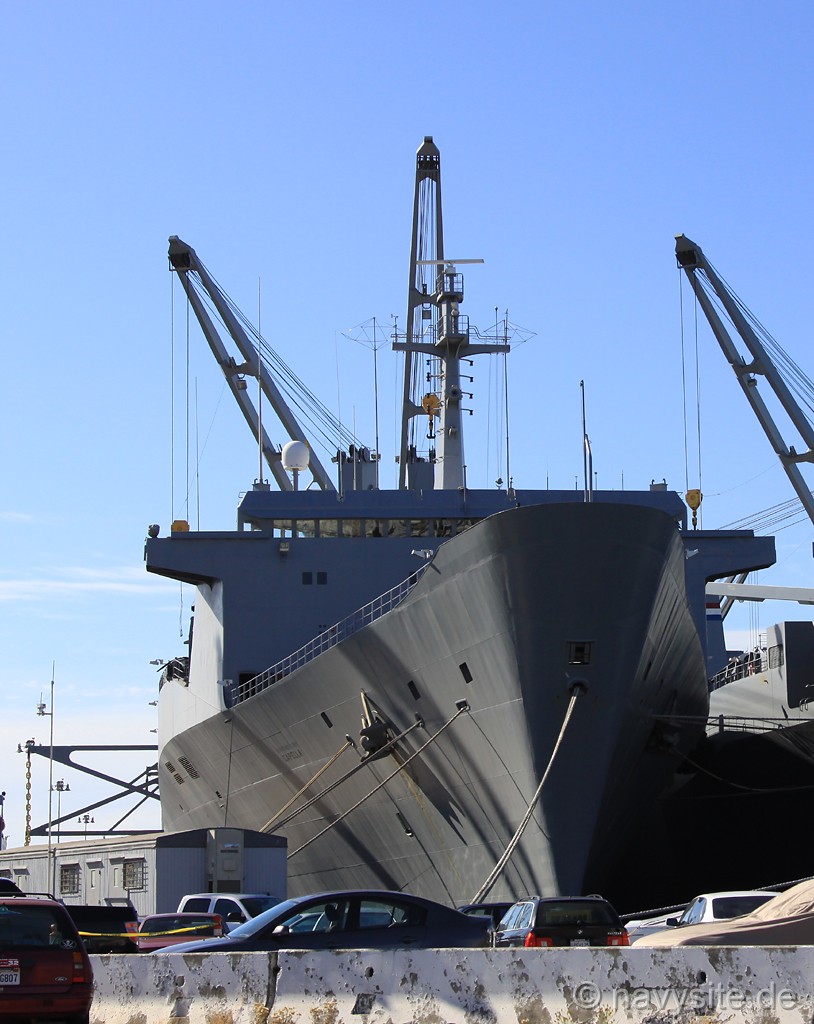
The photo below was taken by me and shows the CAPELLA berthed alongside her sistership ALGOL (T-AKR 287) at their layberth at Alameda, Calif., on October 10, 2012.
 |
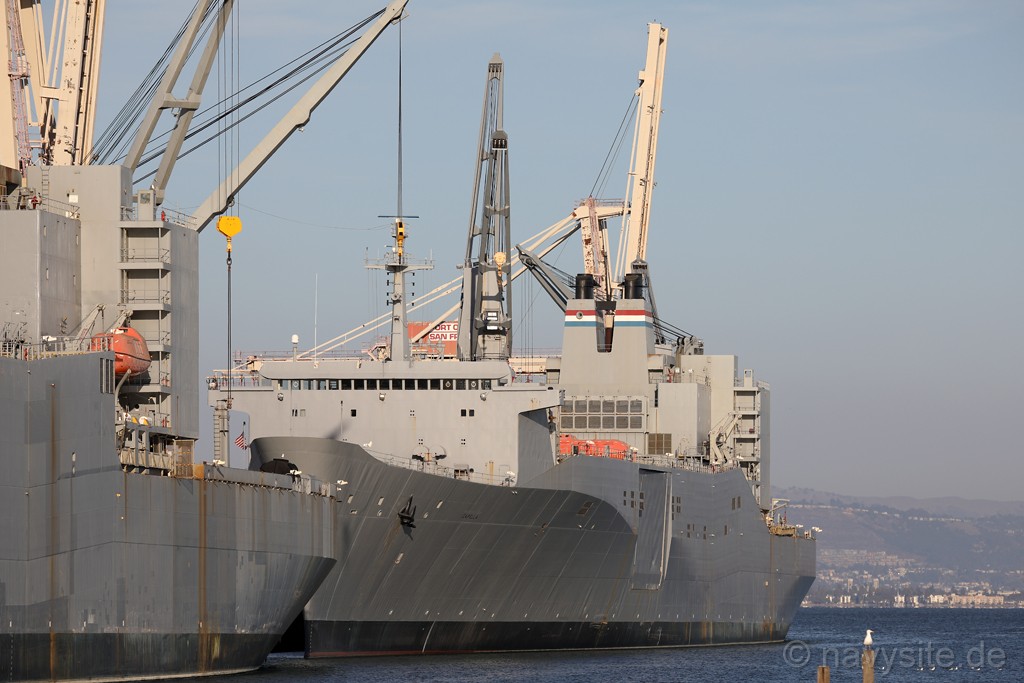
The photos below were taken by Michael Jenning and show the CAPELLA at San Francisco, Calif., on October 6, 2022.
 |  |
back to top Back to Vehicle Cargo Ships. Back to ships list. Back to selection page. Back to 1st page.