
Search the Site with

|
Search the Site with
|
 General Characteristics Crew List Memorabilia History Image Gallery to end of page


USS PORTSMOUTH was the 20th LOS ANGELES class attack submarine and the 15th ship in that class built by Electric Boat in Groton, CT. On June 6, 2002, USS PORTSMOUTH sunk the former USS OKINAWA (LPH 3) during a COMSUBPAC SINKEX off the US west coast. The PORTSMOUTH was last homeported in San Diego, Calif.
| General Characteristics: | Awarded: December 10, 1973 |
| Keel Laid: May 8, 1980 | |
| Launched: September 18, 1982 | |
| Commissioned: October 1, 1983 | |
| Decommissioned: September 10, 2004 | |
| Builder: Electric Boat Division of General Dynamics Corporation, Groton, CT | |
| Propulsion system: one nuclear reactor | |
| Propellers: one | |
| Length: 360 feet (109.73 meters) | |
| Beam: 33 feet (10 meters) | |
| Draft: 32,15 feet (9.8 meters) | |
| Displacement: Surfaced: approx. 6,000 tons | |
| Submerged: approx. 6,900 tons | |
| Speed: Surfaced: approx. 15 knots | |
| Submerged: approx. 32 knots | |
| Armament: four 533 mm torpedo tubes for | |
| Cost: approx. $900 million | |
| Crew: 12 Officers, 115 Enlisted |
 back to top go to the end of the pageback to top go to the end of the page
Crew List:
This section contains the names of sailors who served aboard USS PORTSMOUTH. It is no official listing but contains the names of sailors who submitted their information.
back to top go to the end of the pageback to top go to the end of the pageUSS PORTSMOUTH History:
USS PORTSMOUTH's contract was awarded on December 10, 1973, to the Electric Boat Division of General Dynamics in Groton, after which her keel was laid on May 8, 1980, and she was launched on September 18, 1982, sponsored by Helen Poe Goodrich. Delivered on August 27, 1983, she was commissioned on October 1, 1983, at Portsmouth Naval Shipyard with Commander Donald M. Olson in command. Three weeks later, in late October 1983, she was tasked to support the U.S. operation in Grenada. For this early commitment, the submarine received the Armed Forces Expeditionary Medal.
In early 1984, PORTSMOUTH completed a 14-week post-shakedown availability and shifted from the initial homeport area on the east coast through the Panama Canal to her permanent Pacific assignment at Ballast Point, San Diego, reaching her new home on October 22, 1984. In March 1985, she transferred to Commander, Submarine Squadron Eleven, and that year commenced her first Western Pacific operating period, which included port calls in Japan and Australia. On January 5, 1986, while operating in the South Pacific, she entered Suva and became the first nuclear-powered U.S. warship to visit Fiji after that country reversed its earlier non-nuclear policy - a politically sensitive milestone that underscored Washington's regional security diplomacy in the mid-1980s.
Through the later 1980s, PORTSMOUTH's Pacific routine combined local operations out of San Diego with forward activity in the Western Pacific. In February 1991, she entered Mare Island Naval Shipyard at Vallejo for a Depot Modernization Period, receiving extensive engineering and combat-systems upgrades before returning to San Diego and commencing operations under Commander, Submarine Squadron Three. These early-1990s changes framed her subsequent deployments as the post-Cold War order shifted and the U.S. Navy emphasized presence and sanctions enforcement in the Middle East while maintaining deterrence and alliance cooperation in Northeast and Southeast Asia.
In 1993, PORTSMOUTH deployed to the Western Pacific with the USS ABRAHAM LINCOLN (CVN 72) battle group. During this deployment, she was used in special warfare training, to include a night insertion of Army Rangers during a joint exercise - illustrating the growing integration of attack submarines into joint littoral and special operations scenarios of the post-Cold War era.
From late 1995 into the spring of 1996, the submarine operated with the USS NIMITZ (CVN 68) battle group during a deployment that began in Fifth Fleet waters and then surged at high speed toward East Asia in response to rising tension across the Taiwan Strait. In March 1996, as part of the U.S. show of resolve accompanying Taiwan's presidential election, the NIMITZ force - including PORTSMOUTH - shifted from the Persian Gulf/Indian Ocean to the South China Sea. The battle group's operations during this period earned a Meritorious Unit Commendation and epitomized the flexible global employment that characterized U.S. carrier-submarine teams in the 1990s.
In 1997, PORTSMOUTH again deployed to Seventh Fleet. Command histories record the boat assigned to Task Force 74 from July 1 to September 21, operating in Western Pacific patrol areas typical for the theater's undersea forces. The deployment contributed to the submarine's subsequent recognition for battle efficiency within her San Diego squadron.
As the Navy entered the 2000s, PORTSMOUTH continued a steady cycle of local operations, exercises and Western Pacific deployments. During the 2001-2002 period, she was photographed arriving at Guam in mid-September 2001 at the outset of a WestPac that unfolded in the immediate aftermath of the September 11 attacks, a reminder of the heightened operational tempo and tasking that followed for forward-deployed submarines.
On June 6, 2002, during a COMSUBPAC sinking exercise off southern California, PORTSMOUTH fired the finishing Mk-48 torpedo that sent the decommissioned amphibious assault ship ex-OKINAWA (LPH 3) to the bottom in deep water - part of routine live-fire training and weapons evaluation conducted under carefully controlled range conditions.
Her final extended deployment began in the second half of 2003 and ran roughly six months into early 2004. PORTSMOUTH returned to San Diego on February 11, 2004, after operations throughout the Western Pacific that totaled nearly 36,000 nautical miles. For her 2003 performance, she received several squadron readiness awards (Tactical White "T", Communications Green "C", and Damage Control Red "DC"), and the deployment included port calls in Guam; Sasebo and Yokosuka in Japan; Chinhae in South Korea; Singapore; and Oahu, reflecting the submarine's mix of exercises with allies and independent tasking across Seventh Fleet waters.
After post-deployment upkeep in San Diego, PORTSMOUTH began her final transit from the Pacific to the Atlantic in August 2004 for inactivation and retirement processing on the U.S. east coast. Imagery from that month shows the crew conducting a traditional swim call at sea on August 15, and the boat transiting the Panama Canal on August 21 en route to Norfolk. PORTSMOUTH entered inactivation at Norfolk and, upon completion of the process, was decommissioned, stricken from the Naval Vessel Register, and inactivated on August 18, 2005. She subsequently entered the Ship-Submarine Recycling Program at Puget Sound Naval Shipyard, Bremerton, for defueling and final disposition - standard end-of-life steps for nuclear-powered US Navy combatants.
back to top go to the end of the pageUSS PORTSMOUTH Image Gallery:
 |  |  |
The photo below was taken by me and shows the PORTSMOUTH laid up at the Puget Sound Naval Shipyard, Bremerton, Wash., on May 12, 2012.
 |
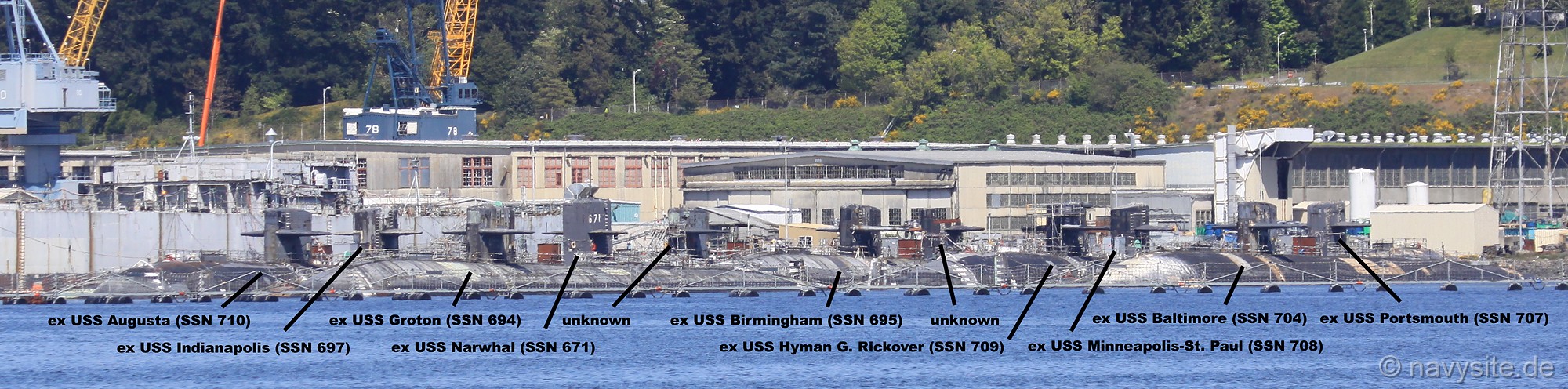
The photo below was taken by me and shows a number of decommissioned nuclear-powered attack submarines laid up at the Puget Sound Naval Shipyard, Bremerton, Wash. The photo was taken from Port Orchard, Wash., on May 12, 2012. The submarines' names are on the photo.
The photo below was taken by Michael Jenning and shows the PORTSMOUTH laid up at the Puget Sound Naval Shipyard, Bremerton, Wash., on October 13, 2017.
 |
back to top Back to Submarines list. Back to ships list. Back to selection page. Back to 1st page.