![]() |
Search the Site with
|
![]() | ![]() |
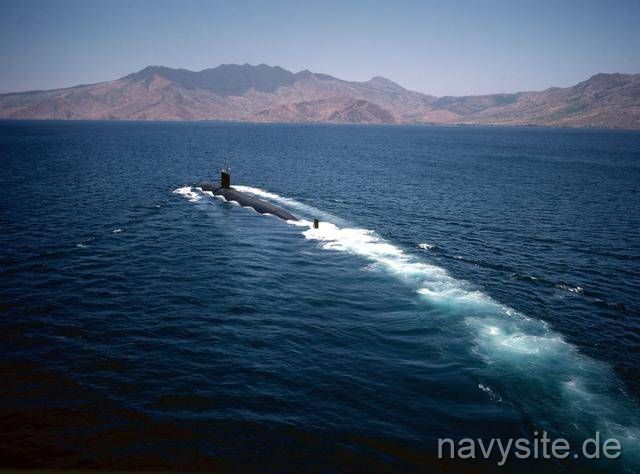
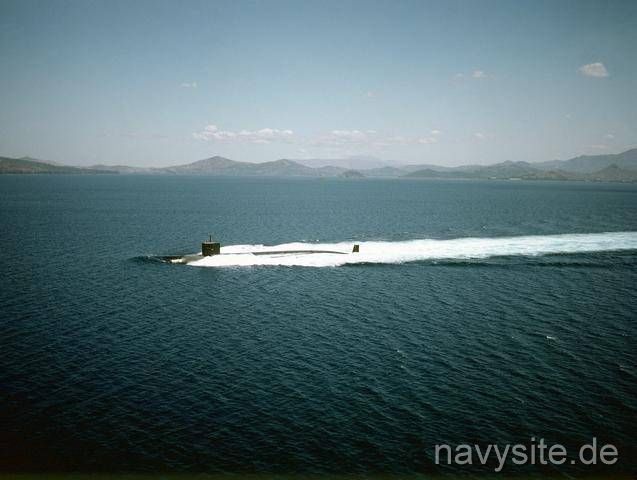
USS OMAHA was the fifth LOS ANGELES-class attack submarine. Decommissioned and stricken from the Navy list on October 5, 1995, the submarine was subsequently laid up at the Puget Sound Naval Shipyard in Bremerton, Wash., awaiting scrapping. OMAHA formally entered the Navy's submarine recycling program on September 30, 2010, and recycling was completed on November 30, 2012. As part of the disposal process, the sail and rudder were preserved. Local authorities and veterans are working to establish a memorial using these pieces at Levi Carter Park near Eppley Airfield in Omaha, Nebraska, creating a replica-footprint display to commemorate the submarine's Cold War service and to provide a venue for community and remembrance events.
| General Characteristics: | Awarded: January 31, 1971 |
| Keel Laid: January 27, 1973 | |
| Launched: February 21, 1976 | |
| Commissioned: March 11, 1978 | |
| Decommissioned: October 5, 1995 | |
| Builder: Electric Boat Division of General Dynamics Corporation, Groton, CT. | |
| Propulsion system: one nuclear reactor | |
| Propellers: one | |
| Length: 360 feet (109.73 meters) | |
| Beam: 33 feet (10 meters) | |
| Draft: 32,15 feet (9.8 meters) | |
| Displacement: Surfaced: approx. 6,000 tons | |
| Submerged: approx. 6,900 tons | |
| Speed: Surfaced: approx. 15 knots | |
| Submerged: approx. 32 knots | |
| Armament: four 533 mm torpedo tubes for | |
| Cost: approx. $900 million | |
| Crew: 12 Officers, 115 Enlisted |
Crew List:
This section contains the names of sailors who served aboard USS OMAHA. It is no official listing but contains the names of sailors who submitted their information.
USS OMAHA History:
The LOS ANGELES-class nuclear-powered attack submarine USS OMAHA began as part of the U.S. Navy's early 1970s program to introduce a faster, quieter generation of attack submarines for blue-water operations. The contract to build the boat was awarded on January 31, 1971, to the Electric Boat Division of General Dynamics at Groton, Connecticut, and her keel was laid there on January 27, 1973. Construction progressed over the next three years, and OMAHA was launched at Groton on February 21, 1976, sponsored by Victoria Kuncl Hruska, wife of senator Roman L. Hruska of Nebraska. After fitting-out and sea trials, the Navy placed the submarine in commission on March 11, 1978, with her first homeport administratively assigned as Groton.
Shortly after commissioning, the Navy decided to base OMAHA in the Pacific. In late April 1978, she was reassigned to Pearl Harbor, effective May 1. She sailed from Naval Submarine Base New London on August 11 and reached Naval Submarine Base Pearl Harbor on September 15, joining Submarine Squadron Seven.
During this first year in service, she completed post-commissioning sea trials, initial shakedown, acoustic measurements for Naval Sea Systems Command, certification firings with the Mk 48 torpedo, and a submarine-versus-submarine warfare exercise to qualify her combat systems and crew. On November 15, 1978, OMAHA entered Pearl Harbor Naval Shipyard for an extended post-shakedown availability combined with a selected restricted availability. This yard period, used to correct construction-phase deficiencies and fine-tune systems, lasted until June 1979.
After post-availability sea trials in mid-1979, OMAHA moved quickly into weapons and operational testing. In July she successfully conducted three SUBROC quality-assurance test firings and twelve additional Mk 48 torpedo firings to certify her weapons accuracy. On July 22, 1979, she departed Pearl Harbor for a deployment in eastern Pacific waters. During this EASTPAC cruise she visited Seattle, Washington, where her port call coincided with the city's Seafair Festival, and Esquimalt, British Columbia, using both ports for liberty and logistics. Over the remainder of the year she also completed further acoustic trials, two major anti-submarine warfare exercises, two special operations, and additional local operations from Pearl Harbor, establishing a pattern of alternating regional deployments with training and evaluation periods close to home.
In the first half of 1980, OMAHA prepared for her first major deployment, undergoing training, examinations, certifications and upkeep in Hawaiian waters. She departed Pearl Harbor in May and reached her western Pacific station on June 6. For roughly a month, she carried out special operations directed by Commander, Submarine Force U.S. Pacific Fleet, before entering Subic Bay in the Philippines for a week of upkeep in early July. Later that month, she visited Hong Kong, but the stop was cut short when the ship had to leave port to avoid Typhoon Joe. On July 28, she paused at Guam for a three-week maintenance period. On August 16, OMAHA conducted a surveillance operation in the Philippine Sea and then proceeded south and west into the Indian Ocean, where she operated for about two months during a period of heightened U.S. naval presence related to regional tensions after the Soviet invasion of Afghanistan and the continuing Iran crisis.
She entered Diego Garcia on October 28 for a week of upkeep and then made a week-long port visit at Perth, Australia, from November 10-16, before returning across the Pacific to Pearl Harbor in December, in time for the year-end holidays. For her service in the Indian Ocean between August 23 and November 21, 1980, OMAHA received the Navy Expeditionary Medal, and in the same year, she was awarded a Meritorious Unit Commendation.
OMAHA sailed again for the western Pacific in early June 1981, beginning a shorter WESTPAC deployment. She came under Seventh Fleet control on June 8 and once again conducted special operations for Commander, Submarine Force U.S. Pacific Fleet. At the end of July the submarine entered Subic Bay for upkeep from July 28 to August 1 and then returned across the Pacific to Pearl Harbor. In September, she hosted about one hundred guests for a dependents' cruise, providing family members and other guests with a brief look at submarine operations. After off-loading her weapons, OMAHA entered dry dock at Pearl Harbor Naval Shipyard on September 25, 1981, for another selected restricted availability, during which a retractable towed-array sonar system was installed to improve her long-range detection capability. This work concluded with sea trials in February 1982.
With the upgraded sonar suite complete, OMAHA spent the first half of 1982 in inspections and certifications for a new deployment. In September, she departed Pearl Harbor for another WESTPAC, this time joining the Battle Group built around aircraft carrier ENTERPRISE (CVN 65) and inchopping to Seventh Fleet as one of its submarines. In early October, she carried out operations in the northern Pacific and the Sea of Japan under Commander Task Group 70.6, reflecting the continued American emphasis on monitoring Soviet naval activity in northeast Asian waters. After this phase, she put into Subic Bay for upkeep from October 13-21, then sailed to Singapore for a port visit from October 25-29. From there, she transited the Strait of Malacca in company with escort ship HEPBURN (FF 1055) en route back to the Indian Ocean to resume operations with CTG 70.6, including participation in anti-submarine warfare exercise ASWEX 83-2U from November 15-17. A series of port calls rounded out the deployment: Mombasa, Kenya, from November 23-26; Diego Garcia from December 21-23; and Perth again from December 30, 1982, to January 5, 1983, where the crew spent the New Year in port.
Following the turn of the year, OMAHA returned to the western Pacific. She briefly called at Subic Bay on her way north to participate in anti-surface warfare exercise ASUWEX 83-1 in the Philippine Sea on January 17-18, 1983. From January 22 to February 8 she underwent maintenance at Guam. Afterward, she paid a short visit to Yokosuka, Japan, between February 15-18, then resumed special operations for Commander, Submarine Force U.S. Pacific Fleet through early March. On March 11, 1983, she left her operating areas and set course back to Pearl Harbor, closing this extended WESTPAC-Indian Ocean deployment.
In May 1983, OMAHA was assigned a special project for the Chief of Naval Operations, working off San Clemente Island, California, a task that again showed her usefulness as a test and evaluation platform as well as an operational submarine. The same summer, she underwent a series of major inspections and, in June, entered the floating dry dock COMPETENT (AFDM 6) at Pearl Harbor for a two-month selected restricted availability. That work, focused on upkeep and incremental improvements, ended in October after sea trials confirmed that the ship's systems performed satisfactorily.
Early in January 1984, OMAHA took part in exercises with frigate BADGER (FF 1071) and in March completed a tactical readiness evaluation in preparation for another deployment. She put to sea for yet another WESTPAC later in March and was on station by April 1. Between that date and May 15, she carried out further special operations for Commander, Submarine Force U.S. Pacific Fleet. She entered Yokosuka for upkeep from May 16-21, then, after a week of operations, put into Subic Bay for additional maintenance between May 30 and June 10. The following week, OMAHA conducted an independent ship exercise in the South China Sea and returned to Subic Bay on June 21. A port visit to Hong Kong followed from August 1-4, supported by destroyer LEFTWICH (DD 984), after which she again used Subic Bay for upkeep from August 7-11. On passage toward Singapore, she provided services for CTG 70.6 and then made a five-day port visit there from August 18-22, hosting, among others, the president of Singapore, Devan Nair, for dinner on board. Another maintenance period at Subic Bay from August 28 to September 8 included a short sortie from September 1-3 to evade Typhoon Ike. Later in September, she arrived back at Pearl Harbor, ending the deployment.
In mid-November, OMAHA was again underway, this time to join Fleet Exercise 1-85 in the Philippine Sea from November 17 to December 1, operating alongside fellow Submarine Squadron Seven boats SWORDISH (SSN 579), SARGO (SSN 583), SAN FRANCISCO (SSN 711) and BREMERTON (SSN 698) in a large multi-ship exercise.
On January 7, 1985, OMAHA entered Pearl Harbor Naval Shipyard for a scheduled major overhaul that would occupy the remainder of 1985 and all of 1986. The refit upgraded her sonar and fire-control systems and overhauled essentially all major ship systems, extending her useful life and ensuring compatibility with evolving weapons and sensors. She emerged from this overhaul on April 13, 1987, and began the usual cycle of post-overhaul inspections, certifications and refresher training to restore full operational readiness. From late July to early September 1987, she deployed on a six-week EASTPAC cruise that included acoustic trials and anti-submarine warfare operations. During this deployment, OMAHA visited Seattle, Washington, Alameda, California, and San Diego, California, giving the crew several liberty ports as the boat demonstrated her upgraded capabilities. In November 1987, she successfully certified to employ the Tomahawk cruise missile system, and in December she completed her pre-overseas movement certification for future deployments.
OMAHA began 1988 with an eight-week deployment to the northern Pacific in January, conducting operations in colder waters and contributing to the Pacific Fleet's surveillance and training tasks. After a short upkeep period back in Pearl Harbor, she left again in April for a six-month WESTPAC deployment, entering Seventh Fleet control on April 21. In the Philippine Sea, she took part in exercise KiloEx from May 12-14 and anti-submarine warfare exercise ASWEX 88-2JA from May 18-20, followed by a Harpoon missile exercise in the South China Sea on May 27-28. Later in the deployment, she visited Hong Kong from August 21-27 and carried out further independent and combined evolutions. Additional stops on this cruise included Okinawa and Yokosuka in Japan, Subic Bay, Guam, and Chinhae in the Republic of Korea. OMAHA returned to Pearl Harbor in October 1988, conducted local operations in November, and wrapped up the year by successfully completing a tactical readiness examination in December.
During the opening months of 1989, OMAHA continued local operations from Pearl Harbor and completed scheduled maintenance. In March, she departed for another eight-week NORPAC deployment, returning in April to resume training in Hawaiian operating areas and to pass a technical proficiency inspection. A dependents' cruise in June, with a port call at Lahaina on the island of Maui, provided an opportunity to familiarize families with submarine life. A selected restricted availability followed in July and August, again at Pearl Harbor Naval Shipyard. In September and October 1989, OMAHA participated in PacEx 89, a major Pacific exercise, and made a visit to Cold Bay, Alaska, during the evolution. She finished the year back in Hawaii, conducting local operations, undergoing a tactical readiness evaluation, and preparing for another overseas deployment.
In January 1990, OMAHA deployed once more to the western Pacific. Over the course of this WESTPAC cruise, she visited Yokosuka, Guam, Chinhae, Subic Bay and Hong Kong, in between periods of operations at sea under Seventh Fleet and Commander, Submarine Force U.S. Pacific Fleet tasking. She returned to Pearl Harbor in July 1990 and operated locally through the rest of the summer. In October, the submarine sailed again, this time for a seven-week NORPAC deployment that included a port visit to Seattle before she returned to Pearl Harbor in November and resumed local employment into early 1991.
OMAHA began 1991 with an intermediate maintenance availability in January. That month, she also achieved what the command history described as a "Solid Gold" wardroom: with the qualification of Lieutenant Jean-Paul Tennant, every officer on board held submarine warfare qualification, making OMAHA the only Pacific Fleet submarine with all officers qualified at that time. In February, she served as the at-sea training platform for prospective commanding officers and ran two dependents' cruises, again visiting Lahaina. After further upkeep the submarine conducted local operations in the spring, including torpedo-proficiency firings and another tactical readiness evaluation.
In May 1991, OMAHA departed on a seven-week NORPAC deployment carrying out operations for Commander, Submarine Force U.S. Pacific Fleet. On May 31, she was involved in a humanitarian evacuation: a crew member whose child had been born prematurely was transferred off the boat near Kodiak Island by a Coast Guard helicopter so he could return home, an episode that the command history notes because the child later fully recovered. OMAHA visited Adak, Alaska, in June and returned to Pearl Harbor in July. Shortly afterward, she put to sea again for an eastern Pacific deployment. From August 2-6, she visited Esquimalt, British Columbia, followed by Bangor, Washington, on August 10-11, where she embarked guests for a "Tiger Cruise" to Alameda, California. While in Alameda from August 14-19, the submarine conducted two distinguished-visitor cruises on August 14 and 15. Guests included the mayor of Alameda and the mayor of Omaha, Nebraska, linking the current crew with their ship's namesake city. After a brief visit to San Diego on August 24-25, OMAHA returned to Pearl Harbor. For her operational performance between January 1, 1990, and August 1, 1991, the submarine received a second Meritorious Unit Commendation.
Following this EASTPAC deployment, OMAHA remained in Hawaiian waters until November 4, 1991, when she again entered the dry dock COMPETENT for a selected restricted availability. Sea trials after completion of the work in late February 1992 confirmed the ship's readiness, and she resumed local operations. In March 1992, the submarine exercised with PINTADO (SSN 672) and BIRMINGHAM (SSN 695), and in April she conducted another dependents' cruise with a stop at Lahaina. As preparations for a new deployment advanced she completed another tactical readiness evaluation and deperming evolution. In June 1992, OMAHA participated in the large multinational Rim of the Pacific (RIMPAC 92) exercise, and in July she achieved pre-overseas movement certification.
OMAHA left Pearl Harbor in August 1992 for a six-month WESTPAC deployment. During the transit west, she supported battle group exercises, then later in the month took part in a search-and-rescue exercise and made a port call at Sasebo, Japan. In November, she called at Yokosuka and then proceeded south to participate in Exercise Lungfish 92 off Australia, operating with Australian submarines HMAS OTWAY (S 59) and HMAS OVENS (S 70) in shallow-water and anti-submarine training. After these evolutions, OMAHA visited Melbourne from December 2-5 and Brisbane from December 14-17. She then sailed to Guam for a maintenance period alongside submarine tender HOLLAND (AS 32). Departing Guam on January 10, 1993, she returned to Pearl Harbor on January 26, closing another extended western Pacific cruise.
Post-deployment stand-down followed, after which OMAHA underwent an intermediate maintenance activity in March 1993 and then resumed local training. On April 23-24, an inspection and survey board conducted an underway material inspection. At the end of that month, she made another dependents' cruise and port call at Kailua-Kona on the island of Hawaii from April 30 to May 3. After returning to Pearl Harbor, she continued local operations through the spring and spent most of July in upkeep. During the summer, she completed major assessments and conducted additional prospective commanding officer operations in August. On September 13, 1993, OMAHA departed on an EASTPAC deployment, calling first at San Diego from September 18-26. While there, members of the veterans' association for the earlier cruiser OMAHA (CL 4) visited the submarine on September 21 during their reunion, an event recorded by the ship's historian as strengthening ties between crews of ships that had carried the same name. Later in the cruise, she visited Alameda from September 28-30 and the Canadian ports of Nanoose and Esquimalt from October 6-12, before returning to Pearl Harbor on November 4 and spending the remainder of 1993 in stand-down and upkeep.
The first months of 1994 were devoted to preparations for what would be OMAHA's final WESTPAC deployment. She carried out additional training and assessments, entered another intermediate maintenance period in February, and completed pre-overseas movement certification in March. On April 4, she sailed from Pearl Harbor for the western Pacific, later visiting Sasebo, Japan, that same month. In May, she made a brief stop at Chinhae in the Republic of Korea, where two South Korean naval personnel embarked for a short submarine indoctrination cruise. June 1994 brought another iteration of the RIMPAC exercise series. During RIMPAC 94 OMAHA participated in large battle-group operations involving ships from the United States, Canada, Australia, Japan and South Korea and carried out a humanitarian evacuation of a senior chief petty officer who was transferred by helicopter to aircraft carrier INDEPENDENCE (CV 62) for medical care. June also saw the submarine in Guam for an availability alongside tender HOLLAND and engaged in special forces training with a U.S. Marine reconnaissance company off Okinawa. After another Guam maintenance period in August, she sailed south, calling at Brisbane from August 20-25 and at American Samoa from August 29 to September 1. OMAHA returned to Pearl Harbor on September 6, 1994, and the crew then enjoyed a stand-down period after a deployment in which the ship was reportedly underway 81 percent of the time.
OMAHA resumed local operations in October 1994, supporting other Submarine Squadron Seven units. She entered another intermediate maintenance availability in November. While still deployed earlier in the year, the crew had received notice that the submarine's homeport would be administratively shifted to Kittery, Maine, effective December 1, in order to conduct inactivation at Portsmouth Naval Shipyard. Before leaving Hawaii, OMAHA ran a final dependents' cruise to Kailua-Kona from December 12-15. On the following day at Naval Submarine Base Pearl Harbor the boat held an inactivation ceremony attended by three former commanding officers, formally marking the beginning of the stripping and inactivation process prior to decommissioning.
Placed in commission in reserve status on February 7, 1995, OMAHA completed her transit to the East Coast and was decommissioned at Portsmouth Naval Shipyard on October 5, 1995. She was stricken from the Naval Vessel Register the same day. The hull was later transferred to Puget Sound Naval Shipyard in Bremerton, Washington, for dismantlement through the Navy's Ship and Submarine Recycling Program. She formally entered the program on September 30, 2010, and recycling was completed on November 30, 2012. As part of the disposal process, the sail and rudder were preserved. Local authorities and veterans are working to establish a memorial using these pieces at Levi Carter Park near Eppley Airfield in Omaha, Nebraska, creating a replica-footprint display to commemorate the submarine's Cold War service and to provide a venue for community and remembrance events.
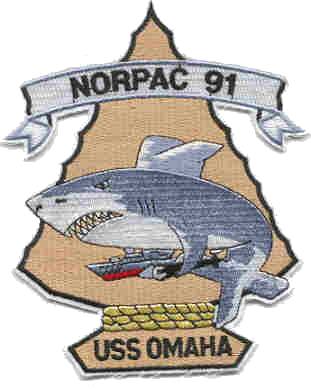
USS OMAHA Patch Gallery:
![]() |
USS OMAHA Image Gallery:
![]() | ![]() | ![]() |
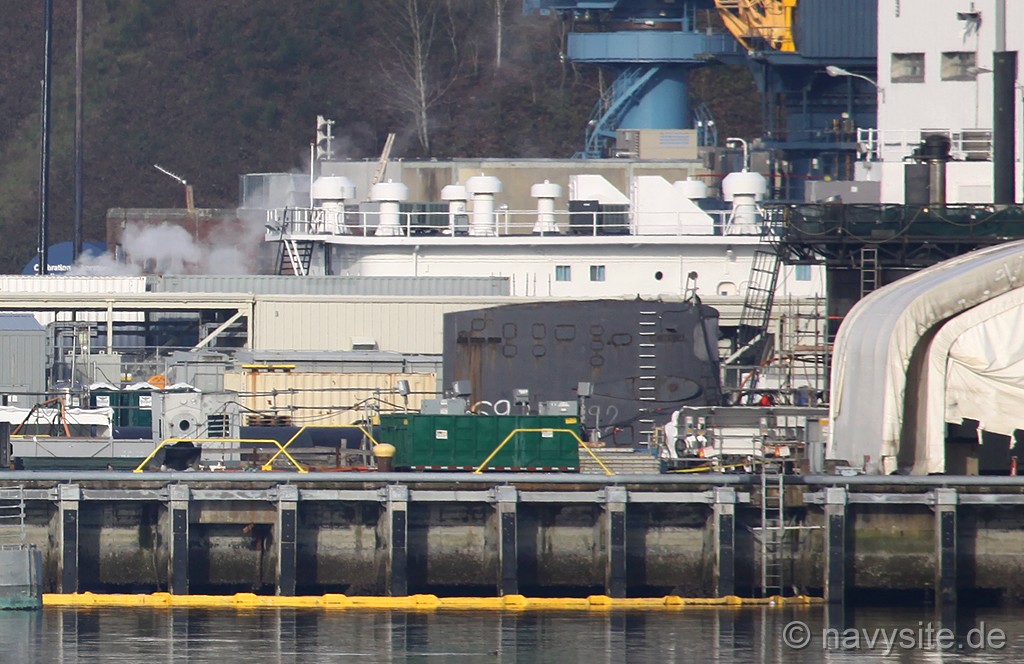
The photo below was taken by me and shows the OMAHA laid-up at the Puget Sound Naval Shipyard, Bremerton, Wash. on March 14, 2010.
![]() |
Back to Submarines list.
Back to ships list.
Back to selection page.
Back to 1st page.