
Search the Site with

|
Search the Site with
|
 General Characteristics Crew List Memorabilia History to end of page
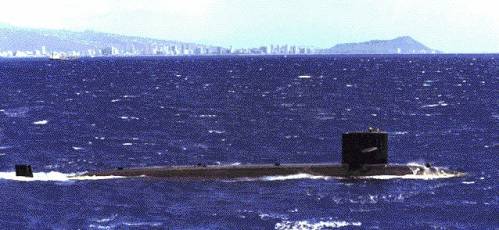 | 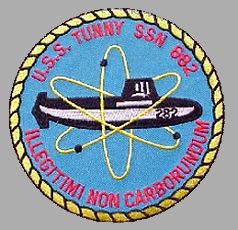 |
USS TUNNY was the 34th STURGEON-class attack submarine and the second ship in the Navy named after any of several oceanic fishes resembling the mackerel. Deactivated while still in commission on October 1, 1997, the TUNNY entered the Navy's Nuclear Powered Ship and Submarine Recycling Program at the Puget Sound Naval Shipyard the same day. Both decommissioned and stricken from the Navy list on March 13, 1998, recycling of the TUNNY was completed on October 27, 1998.
| General Characteristics: | Awarded: June 25, 1968 |
| Keel Laid: May 22, 1970 | |
| Launched: June 10, 1972 | |
| Commissioned: January 26, 1974 | |
| Decommissioned: March 13, 1998 | |
| Builder: Ingalls Shipbuilding, Pascagoula, Miss. | |
| Propulsion system: one S5W2 nuclear reactor | |
| Propellers: one | |
| Length: 302 feet (91.5 meters) | |
| Beam: 31.7 feet (9.65 meters) | |
| Draft: 29.2 feet (8.9 meters) | |
| Displacement: Surfaced: approx. 4,460 tons | |
| Submerged: approx. 4,960 tons | |
| Speed: Surfaced: approx. 15 knots | |
| Submerged: approx. 30 knots | |
| Armament: four 533 mm torpedo tubes for | |
| Crew: 12 Officers, 95 Enlisted |
 back to top go to the end of the pageback to top go to the end of the page
Crew List:
This section contains the names of sailors who served aboard USS TUNNY. It is no official listing but contains the names of sailors who submitted their information.
back to top go to the end of the pageback to top go to the end of the pageUSS TUNNY History:
USS TUNNY was the second United States Navy submarine to bear the name Tunny. The earlier USS TUNNY (SS 282) had served in World War II and later as a Regulus guided-missile submarine, but the second USS TUNNY belonged to a different technological and strategic era. She was a long-hull STURGEON-class nuclear-powered attack submarine, built for submerged endurance, anti-submarine warfare, reconnaissance and surveillance-related work, fleet support, mining capability, support capabilities for underwater-demolition or raiding-party operations, and independent operations in the Atlantic, Mediterranean, Pacific, and Indian Ocean operating areas. Her construction contract was awarded to the Ingalls Shipbuilding Division of Litton Industries at Pascagoula, Mississippi, on June 25, 1968. Her keel was laid down at Pascagoula on May 22, 1970. She was launched on June 10, 1972, sponsored by Mrs. Lola Aiken, wife of Senator George D. Aiken of Vermont. She completed initial sea trials on November 11, 1973. USS TUNNY was commissioned on January 26, 1974, with Commander Dennis Y. Sloan in command. Her first home port was Charleston, South Carolina, and she was initially assigned to the Atlantic Fleet.
After commissioning, USS TUNNY remained at Charleston until March 1974, when she moved to Groton, Connecticut, for two weeks of in-port training at the submarine base. This was part of the normal transition from new construction into fleet service: the crew had to become fully familiar with the ship, complete training, refine procedures, and prepare for operational evaluation. Between March and June 1974, USS TUNNY conducted shakedown training in the West Indies and along the United States East Coast. The shakedown period allowed the crew and ship to test machinery, weapons, sonar, navigation systems, reactor-plant procedures, damage-control readiness, and ordinary submarine routines under operational conditions. From June to August 1974, she operated out of Charleston. On August 12, 1974, she entered Portsmouth Naval Shipyard at Kittery, Maine, for post-shakedown overhaul. That yard period corrected deficiencies discovered during trials and shakedown and incorporated the repairs and adjustments needed before she could enter the regular deployment cycle. The post-shakedown work was completed on October 5, 1974, and USS TUNNY returned to Charleston, where she resumed training operations.
In February 1975, USS TUNNY began preparations for her first Mediterranean deployment. She departed Charleston on March 6, 1975, crossed the Atlantic, and came under operational control of the United States Sixth Fleet on March 16, 1975. During the first part of the deployment, she operated with Task Force 60 and conducted anti-submarine-warfare exercises with other units of that force. This work placed her in the central operating pattern of the Cold War Mediterranean. The Sixth Fleet maintained a continuous presence in a theater where NATO's southern flank, Soviet naval activity, Middle Eastern instability after the 1973 Arab-Israeli War, and North African political tension all overlapped. In June and early July 1975, USS TUNNY underwent refit and upkeep alongside a submarine tender at Santo Stefano, Sardinia. After that period, she rejoined the Sixth Fleet as a unit of Task Force 69 and resumed anti-submarine-warfare training. Late in July and early in August 1975, she participated in a major Sixth Fleet exercise. She then departed the Mediterranean, shifted operational control from the Sixth Fleet to the Atlantic Fleet Submarine Force on August 17, 1975, and returned to Charleston on August 29, 1975, completing her first deployment. The deployment earned USS TUNNY a Meritorious Unit Commendation. After a routine post-deployment standdown in September and repairs and alterations at Charleston Naval Shipyard during October and November, she resumed operations, mostly attack-submarine training, out of Charleston on November 20, 1975.
In January 1976, USS TUNNY conducted attack-submarine training along the coasts of South Carolina and Florida. February 1976 brought inspections and examinations. On February 26, 1976, Commander Peter W. Thomas relieved Commander Sloan as commanding officer. In March 1976, USS TUNNY participated in two special operations designed to help develop and evaluate submarine tactics. In May 1976, USS TUNNY began preparations for her second deployment with the Sixth Fleet, but the deployment itself did not begin until July. In June 1976, she conducted a naval mine-warfare exercise, reflecting one of the broader capabilities assigned to nuclear-powered attack submarines in addition to anti-submarine warfare and surveillance.
On July 26, 1976, USS TUNNY departed Charleston for her second Mediterranean deployment. She visited Lisbon, Portugal, while en route and joined the Sixth Fleet on August 11, 1976. After about a month of anti-submarine-warfare training, highlighted by Exercise National Week XXI, she entered Santo Stefano for a month of upkeep alongside USS HOWARD W. GILMORE (AS 16). Exercise National Week was one of the recurring Sixth Fleet training events used to maintain proficiency in coordinated air, surface, and undersea operations in the Mediterranean. In October 1976, USS TUNNY returned to sea for further anti-submarine-warfare training, punctuated by periodic visits to Naples, Italy, or additional upkeep at Santo Stefano. This pattern continued until December 11, 1976, when she departed Santo Stefano to return to the United States. She arrived at Charleston on December 22, 1976, and began a combined Christmas holiday leave period, upkeep, and routine post-deployment standdown. During this second Mediterranean deployment, USS TUNNY was credited with winning the Sixth Fleet "Hook 'Em" award for anti-submarine-warfare performance.
January 1977 found USS TUNNY in extensive upkeep following her Mediterranean deployment. She then resumed operations off the United States East Coast through the spring and summer. These operations were part of the ordinary but essential submarine cycle of local training, inspections, maintenance, tactical proficiency, and preparation for future deployment. In mid-September 1977, she began a two-month period of repairs and alterations at Norfolk Naval Shipyard in Portsmouth, Virginia. That selected availability concluded in late November and was followed by a short sea-trial period. After refresher training at the Submarine School at Naval Submarine Base New London, USS TUNNY returned to Charleston for the end of the year.
During January and part of February 1978, USS TUNNY prepared for a North Atlantic deployment. The deployment began in late February and concluded in late April. During it, she made stops at Dunoon, Scotland, and Portland, England. This deployment took place in one of the most important maritime theaters of the Cold War. The North Atlantic was central to NATO reinforcement planning, sea-lane protection, and anti-submarine warfare because it connected North America with Europe and lay between Soviet Northern Fleet operating areas and the Atlantic approaches. USS TUNNY's North Atlantic operations therefore fit the wider Atlantic Fleet submarine mission of maintaining readiness against Soviet submarines and supporting alliance control of transatlantic sea routes.
In July 1978, USS TUNNY's home port was changed from Charleston to Pearl Harbor, Hawaii. She transited the Panama Canal and briefly crossed the equator during her voyage to the Pacific. She arrived at Pearl Harbor on August 19, 1978, and was assigned to Submarine Squadron One. The home port change shifted USS TUNNY from the Atlantic and Mediterranean operating cycle into the Pacific Fleet pattern of Hawaii-based operations, Western Pacific deployments, Indian Ocean activity, and Seventh Fleet support. On October 26, 1978, Commander Karl L. Kaup relieved Commander Thomas as commanding officer. USS TUNNY spent the remainder of 1978 operating in the Hawaiian Islands and preparing for her first Western Pacific deployment.
In February 1979, USS TUNNY began a Western Pacific deployment from Pearl Harbor. During the deployment, she visited several ports, including Sattahip, Thailand, and Orote Point, Guam. She also entered the Indian Ocean and visited Diego Garcia in the British Indian Ocean Territory, which had become an important American support base for operations in the Indian Ocean. USS TUNNY also visited HMAS Stirling at Garden Island near Perth, Western Australia, where she was a guest of the Royal Australian Navy, and her crew participated in the Anzac Day parade in April 1979. The deployment occurred at a time when the United States Navy was paying increasing attention to the Indian Ocean because of Soviet activity, Persian Gulf oil routes, the Iranian Revolution, and the broader strategic consequences of instability across Southwest Asia. USS TUNNY completed the deployment when she returned to Pearl Harbor in June 1979.
From August 1979 to December 1980, USS TUNNY underwent a regular overhaul at Pearl Harbor Naval Shipyard. During this overhaul, she received advanced sonar, electronic support measures, and fire-control systems. The overhaul came at a time of heightened international tension. The Iranian hostage crisis began in November 1979, Soviet forces entered Afghanistan in December 1979, and the Indian Ocean and Persian Gulf became more prominent in American naval planning. USS TUNNY was in the shipyard during this period, but the modernization work helped prepare her for further Pacific and Indian Ocean service. After the overhaul, she conducted an eastern Pacific deployment and standard post-overhaul tests and inspections before returning fully to the Western Pacific deployment cycle.
From December 1981 to June 1982, USS TUNNY conducted the first of five Western Pacific deployments after the Pearl Harbor overhaul. For this deployment she received a Meritorious Unit Commendation. On August 2, 1982, Captain George R. Fister relieved Commander Kaup as commanding officer. From January to April 1983, USS TUNNY conducted her next Western Pacific deployment and participated in FleetEx '83. Fleet exercises of this kind tested the coordination of carrier, surface, submarine, and air forces, and a nuclear-powered attack submarine could serve either as a friendly undersea unit or as an opposing-force submarine for anti-submarine-warfare training.
From January 1984 to July 1984, USS TUNNY conducted another six-month Western Pacific deployment. The deployment included a show of the flag in Western Australia. On May 29, 1984, Commander Douglas H. Siemon relieved Captain Fister as commanding officer. During this period, Pacific Fleet attack submarines operated in an environment shaped by Soviet Pacific Fleet activity, the continued importance of Japan, Guam, the Philippines, and Australia as support and allied locations, and American interest in maintaining the ability to move between the Pacific and Indian Ocean.
From April to August 1985, USS TUNNY conducted her fourth Western Pacific deployment in the post-overhaul sequence. For this deployment she received the Navy Unit Commendation. In May 1986, USS TUNNY began another Western Pacific deployment, which lasted until November 1986. This fifth post-overhaul deployment included port calls at Sasebo, Japan, and White Beach, Okinawa. Sasebo was a major United States and Japanese naval support location in western Japan, while White Beach on Okinawa was important for amphibious, logistics, and forward naval support. The deployment took place during the final decade of the Cold War, when the western Pacific remained central to American deterrence, allied support, and monitoring of Soviet Far Eastern naval activity.
On May 7, 1987, Commander Robert G. Speer relieved Commander Siemon as commanding officer. In May 1987, USS TUNNY deployed to the northern Pacific. This deployment included the first submarine upkeep at Adak, Alaska, since World War II. Adak had strategic significance because of its location in the Aleutian Islands, close to northern Pacific and Soviet Far Eastern operating areas. Submarine upkeep there supported operations in a region important for monitoring Soviet Pacific Fleet movements and maintaining American undersea readiness in cold northern waters. In December 1987, USS TUNNY again deployed to the northern Pacific. Her performance in this period earned the Antisubmarine Warfare "A" for excellence in submarine operations. These northern Pacific deployments were part of the late-Cold-War forward-operating posture in which American attack submarines worked in areas close to Soviet submarine routes and naval bases while also preserving the ability to support broader Pacific Fleet operations.
In March 1988, USS TUNNY changed home port to Bremerton, Washington, and began a roughly two-year refueling overhaul at Puget Sound Naval Shipyard. The overhaul was completed in April 1990. During this major shipyard period, USS TUNNY received advanced combat systems, including updated sonar, electronic support measures, and fire-control systems. Refueling overhaul was one of the most important technical events in the life of a nuclear-powered submarine. It renewed the propulsion plant, modernized major ship systems, and prepared the submarine for continued service beyond the first phase of her career. The work took place as the Cold War was nearing its end and as the Navy was beginning to prepare older submarines for a strategic environment that would soon shift from global confrontation with the Soviet Union to regional crisis response, coalition operations, and reduced force structure.
In June 1990, USS TUNNY returned to her home port at Pearl Harbor. On October 26, 1990, Commander Martin McDonough relieved Commander Speer as commanding officer. In August 1990, USS TUNNY had begun her sixth Western Pacific deployment, which lasted until February 1991. The deployment included port calls at Hong Kong, Guam, Japan, Korea, and the Philippine Islands. This cruise overlapped the period of Operation Desert Shield and the beginning of Operation Desert Storm, but the deployment did not establish a direct combat or Persian Gulf role for USS TUNNY.
USS TUNNY returned from another six-month Western Pacific cruise on April 7, 1992. USS TUNNY received the Commander Submarine Squadron One Battle Efficiency "E" award for 1992, recognizing overall readiness and performance within the squadron. On April 23, 1993, Commander Scott A. Spencer relieved Commander McDonough as commanding officer. In October 1993, USS TUNNY deployed for her eighth Western Pacific deployment.
USS TUNNY received the Commander Submarine Squadron One Battle Efficiency "E" again for 1994. TUNNY also conducted a ninth Western Pacific deployment in 1995, during which she received a Meritorious Unit Commendation. In the mid-1990s, USS TUNNY remained one of the older STURGEON-class submarines still active in a Navy that was reducing Cold War force structure while continuing to rely on nuclear-powered attack submarines for regional presence, surveillance, exercises, and support to joint operations. She received the Commander Submarine Squadron One Battle Efficiency "E" again for 1995. On March 8, 1996, Commander Eric K. Nelson relieved Commander Spencer as commanding officer.
USS TUNNY's final Western Pacific deployment was completed in March 1997. USS TUNNY's final deployment closed a Pacific Fleet operating career that had included repeated WestPac service, Indian Ocean operations, northern Pacific work, and major support from Pearl Harbor, Guam, Japan, Okinawa, Western Australia, and other regional naval locations.
On September 2, 1997, USS TUNNY's inactivation ceremony was held at Naval Submarine Base Pearl Harbor, Hawaii. On October 1, 1997, USS TUNNY was deactivated while still in commission and entered the Nuclear-Powered Ship and Submarine Recycling Program at Puget Sound Naval Shipyard, Bremerton, Washington; and on March 13, 1998, she was formally decommissioned and struck from the Naval Vessel Register. Recycling was completed on October 27, 1998.
back to top Back to Submarines list. Back to ships list. Back to selection page. Back to 1st page.