
Search the Site with

|
Search the Site with
|
 General Characteristics Crew List Memorabilia History to end of page
 | 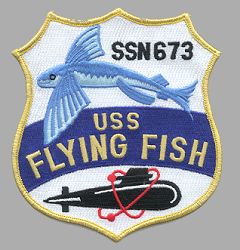 |
USS FLYING FISH was one of the STURGEON - class attack submarines and the third ship in the Navy to bear the name. Both decommissioned and stricken from the Navy list on May 16, 1996, the FLYING FISH subsequently entered the Navy's Nuclear Powered Ship and Submarine Recycling Program Recycling at the Puget Sound Naval Shipyard at Bremerton, Wash. Recycling was finished on October 15, 1996.
| General Characteristics: | Awarded: July 15, 1966 |
| Keel Laid: June 30, 1967 | |
| Launched: May 17, 1969 | |
| Commissioned: April 29, 1970 | |
| Decommissioned: May 16, 1996 | |
| Builder: Electric Boat Division of General Dynamics Corporation, Groton, CT. | |
| Propulsion system: one S5W2 nuclear reactor | |
| Propellers: one | |
| Length: 292 feet (89 meters) | |
| Beam: 31.7 feet (9.65 meters) | |
| Draft: 29.2 feet (8.9 meters) | |
| Displacement: Surfaced: approx. 4,250 tons | |
| Submerged: approx. 4,700 tons | |
| Speed: Surfaced: approx. 15 knots | |
| Submerged: approx. 30 knots | |
| Armament: four 533 mm torpedo tubes for | |
| Crew: 12 Officers, 95 Enlisted |
 back to top go to the end of the pageback to top go to the end of the page
Crew List:
This section contains the names of sailors who served aboard USS FLYING FISH. It is no official listing but contains the names of sailors who submitted their information.
back to top go to the end of the pageback to top go to the end of the pageUSS FLYING FISH History:
USS FLYING FISH was the third United States Navy ship to bear the name Flying Fish and the second submarine of that name. The contract for USS FLYING FISH was awarded to the Electric Boat Division of General Dynamics Corporation at Groton, Connecticut, on July 15, 1966. Her keel was laid down at Electric Boat on June 30, 1967. She was launched on May 17, 1969, sponsored by Mrs. John W. Harvey, widow of Commander John W. Harvey, the commanding officer of USS THRESHER (SSN 593), which had been lost during deep-diving trials on April 10, 1963. That sponsorship linked the new submarine directly to one of the most consequential tragedies in the history of the United States nuclear submarine force. USS FLYING FISH was delivered to the Navy on April 1, 1970, and commissioned at Groton on April 29, 1970, with Commander Donald C. Shelton in command. She was assigned to Submarine Squadron Six at Norfolk, Virginia.
After commissioning, USS FLYING FISH entered the normal post-delivery cycle of nuclear-submarine work: crew training, material correction, tests, local operations, tactical training, weapons certification, and integration into the Atlantic Fleet. Award records in her inactivation material show that she earned a Meritorious Unit Commendation in 1971 and Navy Unit Commendations for 1972 and 1973. In 1972 and 1973 she also earned Battle Efficiency "E" awards, and in 1971, 1972, and 1973 she earned Fire Control "E" awards. These awards indicate a high level of recognized operational and combat-system performance during her early Atlantic Fleet service, even though the specific missions behind some of the awards remain classified or unpublished. In the Cold War context, those years were dominated by the continuing expansion of the Soviet submarine force, the importance of the North Atlantic and Mediterranean, and the United States Navy's need for quiet attack submarines able to track, train against, and, if required, engage Soviet submarines and surface units.
On February 13, 1973, Commander James D. Williams relieved Commander Shelton as commanding officer. Later that year, on November 14, 1973, USS FLYING FISH entered Portsmouth Naval Shipyard for an extensive overhaul that lasted approximately one year. This major availability interrupted her early operational rhythm and was part of the maintenance and modernization cycle required for a nuclear-powered attack submarine operating at high tempo.
After the Portsmouth overhaul, USS FLYING FISH returned to Atlantic Fleet service. During 1975 and 1976 she earned the Anti-Submarine Warfare and Operations "A" award, and in 1976 she won the Marjorie Sterrett Battleship Fund Award for the United States Atlantic Fleet, a major readiness and performance award.
On May 22, 1976, Commander Thomas A. Meinicke relieved Commander Williams as commanding officer. In October 1976, USS FLYING FISH visited Bremerhaven, West Germany, from October 4, 1976, to October 8, 1976. Bremerhaven was a significant port in a NATO country directly connected to Cold War reinforcement planning and North Atlantic operations. A visit by an American nuclear-powered attack submarine there placed USS FLYING FISH within the broader pattern of United States naval presence in northern Europe.
In 1977, USS FLYING FISH undertook one of the defining public events of her career: her Arctic deployment and North Pole surfacing during Subicex 1-77. On April 29, 1977, exactly seven years after commissioning, she surfaced at the North Pole at midnight and remained there for about twelve hours. She was the eleventh submarine to visit the North Pole and the tenth to surface there. Dr. Waldo K. Lyon, one of the central figures in United States Navy under-ice research and Arctic submarine operations, was embarked. Arctic records list USS FLYING FISH, under Commander Meinicke, as operating in the Arctic Ocean in 1977 with Dr. Lyon and Richard Boyle. Arctic operations required specialized navigation, sonar interpretation, ship control, communications planning, ice analysis, and surfacing procedures. Strategically, the Arctic mattered because it lay close to Soviet northern approaches and because submarines could use under-ice routes and polar operating areas for concealment, surveillance, and strategic mobility. USS FLYING FISH returned to Norfolk from the polar cruise on June 6, 1977. Later in 1977, she entered Portsmouth Naval Shipyard for another overhaul. Her awards for this period included the Navy Unit Commendation for 1977 and the Engineering "E" award for 1977.
USS FLYING FISH completed the overhaul in December 1978 and conducted sea trials. After sea trials and post-overhaul work, she rejoined Submarine Squadron Six at the destroyer-submarine piers at Norfolk. From April 1979 through June 1979, she completed torpedo range certification in the Bahamas and made a port visit to Roosevelt Roads, Puerto Rico. The Bahamas torpedo ranges and Roosevelt Roads were recurring locations for Atlantic Fleet training, weapons certification, and Caribbean operating-area work. From October 1979 through December 1979, USS FLYING FISH deployed to the northern Atlantic for a special operation. Public award material associates this period with a Navy Expeditionary Medal. In 1979, she also received another Battle Efficiency "E", an Engineering "E", a Damage Control "DC" award, and a Communications "C" award, showing that she returned from overhaul into a strong operational and material-readiness period.
On July 8, 1980, Commander Steven J. Loucks relieved Commander Meinicke as commanding officer. In July 1980, USS FLYING FISH deployed to the Mediterranean. She returned to Norfolk on December 10, 1980, after a five-month Mediterranean deployment. Reported port visits during that deployment included Athens, Greece; Naples, Italy; La Spezia, Italy; and Ashdod, Israel. This deployment took place during a tense period in Cold War and regional history. The Soviet invasion of Afghanistan had begun in December 1979, the Iranian Revolution and hostage crisis had changed the Middle Eastern strategic environment, and the United States Sixth Fleet remained a central instrument of American presence in the Mediterranean. USS FLYING FISH's Mediterranean deployment therefore formed part of the Navy's wider posture of anti-submarine surveillance, regional presence, fleet support, and allied reassurance. For 1980, she received a Meritorious Unit Commendation and a Battle Efficiency "E".
On April 12, 1981, USS FLYING FISH provided Atlantic Ocean security for the first Space Shuttle launch, the STS-1 mission of Space Shuttle COLUMBIA. From October 1981 through December 1981, she deployed again to the northern Atlantic for a special operation. That deployment was associated with a Navy Expeditionary Medal and a Meritorious Unit Commendation. In 1981, she also earned an Engineering "E". The North Atlantic remained central to Cold War naval strategy because of Soviet submarine routes, NATO reinforcement planning, and the need to maintain proficiency in northern waters.
On April 1, 1983, Commander Joseph T. Lario relieved Commander Loucks as commanding officer. On June 30, 1983, USS FLYING FISH was in port at Port Everglades, Florida. Her operations during the early 1980s continued the alternating pattern of deployments, training, port calls, special operations, and maintenance. In 1983, she earned a Communications "C" award. By this point, the Cold War was in one of its most intense late phases, with the United States Navy emphasizing forward maritime strategy, Nato exercises, and persistent undersea surveillance.
In early 1984, USS FLYING FISH deployed again to the Mediterranean. She returned to Norfolk on July 23, 1984, after a five-month deployment that included port visits to La Spezia, Italy, and Ashdod, Israel. The Mediterranean remained a complex operating theater with Soviet naval presence, continuing tensions in the Middle East, and American concern for freedom of navigation and regional crisis response. USS FLYING FISH's 1984 deployment continued her role as a Sixth Fleet attack-submarine asset. In 1984, she earned another Engineering "E" award. On June 10, 1985, she arrived at New London for refresher training, a normal part of the cycle of maintaining submarine crew readiness and tactical proficiency.
On February 6, 1986, Commander Robert L. Hendricks relieved Commander Lario as commanding officer. On July 15, 1986, USS FLYING FISH began an overhaul at Puget Sound Naval Shipyard in Bremerton, Washington. This was a major shipyard period far from her Norfolk operating base and took her through a substantial modernization and repair cycle. She completed the overhaul on January 15, 1988. On November 5, 1988, after an extended absence connected with the Puget Sound overhaul and return-to-service process, she rejoined Submarine Squadron Six at Naval Base Norfolk. By then, she had been away from normal Norfolk squadron operations for roughly two and a half years. The shipyard work restored her for further late-Cold-War and post-Cold-War service.
On April 3, 1989, Commander Stanley J. Mack assumed command. Later in 1989, USS FLYING FISH deployed to the Mediterranean. She returned to Norfolk on March 5, 1990, from a six-month Mediterranean cruise. This deployment took place during the dramatic political transition at the end of the Cold War. The Berlin Wall fell on November 9, 1989, while United States naval forces were still operating under Cold War-era patterns of surveillance, alliance support, and Mediterranean presence. The Soviet Union still existed, and the United States attack-submarine force continued to conduct its established missions, even as the strategic background was beginning to change. In 1990, USS FLYING FISH earned another Battle Efficiency "E".
On October 11, 1991, Commander Louis T. Roumaya relieved Commander Mack at Naval Station Norfolk. The year 1991 was a major transition year. Operation Desert Storm began on January 17, 1991, the Soviet Union dissolved on December 26, 1991, and the United States Navy moved rapidly from Cold War structure toward post-Cold-War regional crisis response and presence operations. USS FLYING FISH's award record for 1991 includes a Meritorious Unit Commendation, an Arctic Service Ribbon, an Anti-Submarine Warfare and Operations "A", and recognition as Commander, Submarine Force Atlantic Top Torpedo Performer.
In 1992, USS FLYING FISH earned the Deck Seamanship "D" award and the Engineering "E" award. In 1993, she received another Arctic Service Ribbon and another Battle Efficiency "E". On November 24, 1993, Commander Wiley Robert Deal Jr. assumed command of USS FLYING FISH. He became the final commanding officer to take USS FLYING FISH through her last full operational phase and into inactivation.
In 1994, USS FLYING FISH conducted a four-month Mediterranean and South Atlantic cruise. She returned to Norfolk on November 14, 1994. Reported port visits during that cruise included Toulon, France; La Maddalena, Italy; Gibraltar; Roosevelt Roads, Puerto Rico; Curacao; and Bridgetown, Barbados. The deployment reflects the post-Cold-War broadening of submarine operations. The Mediterranean remained important for NATO and United States naval presence, while the South Atlantic and Caribbean portions of the cruise linked the submarine to regional training, access routes, and allied or partner-port engagement.
In May 1995, USS FLYING FISH conducted mine-laying exercises, joint-service special warfare operations, and an operational test launch of a Tomahawk cruise missile. These activities show the breadth of late-career attack-submarine employment. Mine-laying exercises preserved a traditional but specialized submarine mission. Joint-service special warfare operations reflected the submarine force's ability to support special operations forces and covert insertion or support tasks. The Tomahawk test launch demonstrated the post-Cold-War importance of precision land-attack capability in the submarine force. During the 1990s, Tomahawk-capable submarines became increasingly important not only as anti-submarine and anti-surface platforms but also as strike assets for regional contingencies.
USS FLYING FISH entered her inactivation phase at Norfolk on July 10, 1995. On October 20, 1995, she was placed in reserve, in commission, from the active fleet for decommissioning. USS FLYING FISH was decommissioned at Puget Sound Naval Shipyard on May 16, 1996, and stricken from the Naval Vessel Register the same day. Over her service life, she had nine commanding officers and steamed about 600,000 miles during her commissioned service. Her disposal was carried out through the Nuclear Powered Ship and Submarine Recycling Program at Puget Sound Naval Shipyard, Bremerton, Washington. Recycling was completed on October 15, 1996.
back to top Back to Submarines list. Back to ships list. Back to selection page. Back to 1st page.