![]() |
Search the Site with
|
![]() | ![]() |
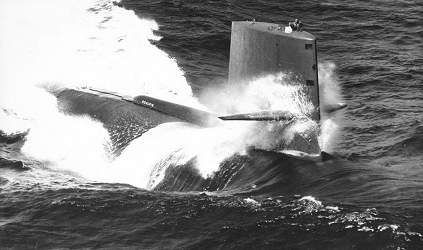
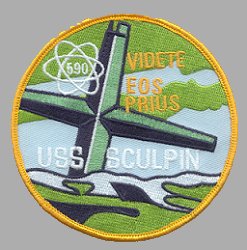
USS SCULPIN was the fourth SKIPJACK - class nuclear-powered attack submarine and the second ship in the Navy to be named after the fish. Decommissioned on August 3, 1990, and stricken from the Navy list on August 30, 1990, the SCULPIN spent the following years at the Puget Sound Naval Shipyard, Bremerton, Wash., awaiting to enter the Navy’s Nuclear Powered Ship and Submarine Recycling Program. Recycling of SCULPIN started on October 1, 2000, and was completed on October 30, 2001.
| General Characteristics: | Awarded: January 18, 1957 |
| Keel laid: February 3, 1959 | |
| Launched: March 31, 1960 | |
| Commissioned: June 1, 1961 | |
| Decommissioned: August 3, 1990 | |
| Builder: Ingalls Shipbuilding, Pascagoula, Miss. | |
| Propulsion system: one S5W nuclear reactor | |
| Propellers: one | |
| Length: 251.64 feet (76.7 meters) | |
| Beam: 31.5 feet (9.6 meters) | |
| Draft: 27.9 feet (8.5 meters) | |
| Displacement: Surfaced: approx. 2,880 tons Submerged: approx. 3,500 tons | |
| Speed: Surfaced: approx. 15 knots Submerged: approx. 30 knots | |
| Armament: six 533 mm torpedo tubes | |
| Crew: 8 Officers, 85 Enlisted |
Crew List:
This section contains the names of sailors who served aboard USS SCULPIN. It is no official listing but contains the names of sailors who submitted their information.
USS SCULPIN History:
USS SCULPIN was ordered on January 18, 1957, and laid down on February 3, 1958, at Ingalls Shipbuilding Corporation in Pascagoula, Mississippi. She was a SKIPJACK-class nuclear-powered attack submarine and the second completed and commissioned United States Navy ship to bear the name Sculpin. The name connected her with USS SCULPIN (SS 191), the World War II submarine that had been scuttled after severe battle damage north of Truk on November 19, 1943. The new nuclear-powered USS SCULPIN belonged to the generation of submarines that joined the streamlined submerged hull form pioneered by USS ALBACORE (AGSS 569) with the endurance of the S5W nuclear reactor plant. The SKIPJACK-class emphasized submerged speed, maneuverability, a single shaft, sail-mounted diving planes, and a compact hull form optimized for underwater performance rather than surface cruising. In Cold War terms, USS SCULPIN was built for a Navy that increasingly expected attack submarines to conduct long submerged operations, train against surface and air antisubmarine forces, support fleet exercises, and maintain forward presence in the Atlantic and Pacific without the endurance limits of diesel-electric submarines.
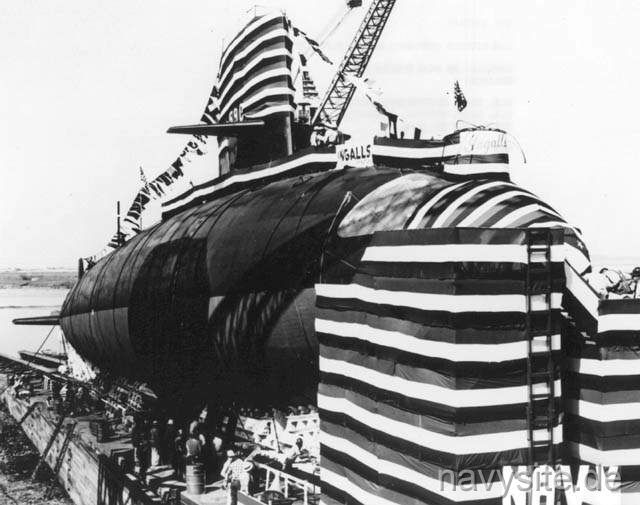
USS SCULPIN was launched on March 31, 1960. Her sponsor was Mrs. Fred Connaway, widow of Commander Fred Connaway, who had been commanding officer of the wartime USS SCULPIN when that submarine was lost. After fitting out and trials in the Gulf of Mexico and at Pascagoula, the submarine was commissioned on June 1, 1961, with Commander C. N. Mitchell in command. One week later, on June 8, 1961, USS SCULPIN departed Pascagoula for her assigned home port of San Diego, California. The movement from the Gulf Coast to the Pacific Fleet marked the beginning of nearly two decades in which she was primarily a Pacific-based attack submarine.
After reaching San Diego, USS SCULPIN began shakedown training. In July 1961, she conducted special trials and tests in the Puget Sound area, then returned to San Diego for type training. In August, she made a two-week cruise to Pearl Harbor and then returned to San Diego. These early operations tested the submarine's machinery, reactor plant, sonar, weapons systems, diving characteristics, maneuverability, and crew proficiency under realistic operating conditions. They also introduced the crew to the wide operating geography that would become normal for the boat: West Coast waters, Puget Sound, Hawaii, and the western Pacific approaches. During the remaining months of 1961, USS SCULPIN operated off the West Coast before entering Mare Island Naval Shipyard in Vallejo, California, in October for post-shakedown availability. That yard period corrected deficiencies found during trials and prepared the submarine for regular fleet service. The post-shakedown availability was completed in late March 1962, after which USS SCULPIN returned to San Diego.
Following further training operations, USS SCULPIN departed in May 1962 for her first western Pacific deployment. She proceeded by way of Pearl Harbor and then continued into the Seventh Fleet operating area. She operated in the western Pacific and returned to San Diego in August 1962. The deployment took place during a period when the Pacific Fleet was increasing its reliance on nuclear-powered attack submarines for fleet training, forward presence, and antisubmarine warfare development. The western Pacific was a central Cold War theater, shaped by Soviet naval growth, the presence of Communist China, the continuing division of Korea, and growing instability in Southeast Asia. USS SCULPIN's first deployment placed her within that strategic environment while the Navy was still refining the employment of fast nuclear submarines in long-range Pacific operations.
After returning from the western Pacific, USS SCULPIN participated in local training operations, ordnance evaluation projects, and fleet exercises from San Diego. In early January 1963, she entered Mare Island Naval Shipyard for a hull survey. She returned to San Diego at the end of the month, conducted type training for two months, and on March 29, 1963, got underway for a dependents' cruise. In April, she returned to Mare Island for a restricted availability that lasted until August. When that work was complete, she returned to San Diego and resumed local operations. These activities were typical of the operating rhythm of an early nuclear attack submarine: forward deployments followed by upkeep, evaluations, type training, and fleet exercises designed to measure both the submarine's performance and the ability of other naval forces to detect and counter her.
In early December 1963, USS SCULPIN was at Pearl Harbor while en route to the western Pacific when defective piping forced her to return to Mare Island for repairs. She remained out of the planned deployment cycle until repairs were complete and returned to San Diego on February 25, 1964. She operated from San Diego until early April. On April 8, 1964, USS SCULPIN sailed for duty with the Seventh Fleet. Before formally reporting for operations, she made port calls at Pearl Harbor, Sydney, and Subic Bay. Her Sydney visit placed her in Australia during a period when American naval links with Australia remained closely tied to the memory of World War II cooperation and to Cold War alliance structures in the Pacific. After Subic Bay, she operated for the remainder of the deployment in and out of Subic Bay and Naha, Okinawa, with the Seventh Fleet. Subic Bay and Okinawa were central support locations for American naval forces operating across East Asian waters. USS SCULPIN returned to San Diego on October 20, 1964.
From late 1964 through most of 1966, USS SCULPIN conducted operations and exercises along the West Coast between San Diego and Bangor, Washington. This long period of Pacific Coast activity included training, readiness work, and exercises in areas used by the Pacific submarine force for sonar, weapons, and tactical development. During this period, the wider strategic context changed sharply. The Gulf of Tonkin incident in August 1964 led to a major expansion of American involvement in Vietnam, and the Seventh Fleet became increasingly central to American operations in Southeast Asia. Although USS SCULPIN remained in West Coast operating areas for much of this interval, her training supported the broader Pacific Fleet requirement to maintain nuclear attack submarines ready for forward deployment in a theater increasingly dominated by the Vietnam War and Cold War maritime competition.
On November 27, 1966, USS SCULPIN stood out of San Diego for Naha and another tour with the Seventh Fleet. This deployment returned her to the western Pacific during the period of major American escalation in Vietnam. USS SCULPIN returned to San Diego on May 11, 1967, and resumed local operations. From July 27 to October 26, 1967, she conducted an extended training cruise. On November 11, 1967, she gave a demonstration dive for President Lyndon B. Johnson. The presidential demonstration was a public-facing episode within a career otherwise dominated by classified or routine submarine operations, and it reflected senior national interest in the capabilities of the nuclear submarine force.
On December 31, 1967, USS SCULPIN was notified that she was due for drydocking and overhaul at Puget Sound Naval Shipyard. She departed San Diego for that destination on January 2, 1968. This was her first major overhaul and reactor refueling since commissioning. She was in drydock from January 30, 1968, to January 22, 1969. The long shipyard period removed her from the operating schedule for a year and addressed the engineering, hull, propulsion, reactor, and combat-system requirements of a nuclear submarine that had been in intensive service since 1961. Sea trials and training followed and lasted until July 26, 1969, when USS SCULPIN sailed to Pearl Harbor on a shakedown training cruise. She returned to the West Coast on August 22 and began an upkeep period at San Diego that lasted until September 8. After that, she operated along the California coast until February 6, 1970.
On February 6, 1970, USS SCULPIN got underway from San Diego for Pearl Harbor and a western Pacific deployment. She departed Pearl Harbor on February 21 and entered Buckner Bay, Okinawa, on March 6. During the deployment, she also visited Subic Bay, Hong Kong, and Yokosuka before returning to San Diego on August 21, 1970. These port calls placed her within the normal Seventh Fleet support network of the era. Subic Bay was the major American naval base in the Philippines; Yokosuka was the central American naval facility in Japan; Hong Kong remained a frequent liberty and logistics port for western Pacific units; and Okinawa served as a key forward operating area near the East China Sea, Taiwan Strait approaches, and the wider western Pacific. USS SCULPIN's 1970 deployment came during a period when the Vietnam War remained active, while the Soviet Pacific Fleet was increasing in importance and the United States continued to maintain a broad naval posture across East Asian waters.
After returning from the 1970 deployment, USS SCULPIN conducted local operations until January 4, 1971, when she began a three-month restricted availability at Mare Island Naval Shipyard. The yard work was completed on April 16, and the submarine returned to San Diego. In October 1971, she sailed to Puget Sound to have her bottom sandblasted and painted. She returned to San Diego on November 13 and began preparing for another deployment. During this pre-deployment period, USS SCULPIN also exercised with surface forces. On December 14, 1971, USS STERETT (DLG 31) got underway for at-sea preparation for overseas movement and conducted a number of antisubmarine warfare exercises with USS SCULPIN. Those exercises included antisubmarine rocket firing and Mark 46 torpedo drops from a helicopter, showing the way a nuclear-powered submarine could be used as a demanding target for surface combatants and embarked helicopters preparing for deployment.
USS SCULPIN's next deployment began on January 5, 1972, and lasted until July 24, 1972. It became the most publicly documented operational episode of her career because one portion was later cleared for public discussion by participants. After leaving the West Coast in January, USS SCULPIN first conducted a classified operation that lasted about two months. That initial assignment remains described only in general terms, but the released account identifies it as an intelligence-gathering operation directed against the Soviet Union. After that mission, USS SCULPIN entered Yokosuka, Japan, for liberty before beginning her next operation.
In March 1972, while patrolling in the South China Sea, USS SCULPIN was diverted to a mission connected with North Vietnamese seaborne infiltration. American and South Vietnamese forces believed that trawlers were carrying arms, ammunition, and supplies from the region around Hainan Island to the Vietcong in the southern part of South Vietnam. Previous incidents had shown that such trawlers could bring large quantities of war materiel to remote coastal landing points. The plan that emerged was to use a submarine to covertly trail a suspect trawler from its departure area and guide friendly forces to it before it could land its cargo.
On April 10, 1972, USS SCULPIN took up a patrol station south of Hainan. On April 12, she picked up a suspect trawler and began trailing it. The target had a distinctive shaft and propeller sound that allowed USS SCULPIN's sonar team to maintain contact. The submarine relied primarily on passive sonar to avoid detection. The chase required difficult submerged handling in shallow and poorly charted waters, including the area marked on charts as dangerous ground in the South China Sea. USS SCULPIN at times operated at high submerged speed with limited water beneath her keel and with oil platforms, shoals, wrecks, and dense shipping traffic complicating the pursuit. A P-3 Orion patrol aircraft assisted at critical moments, especially when the trawler entered areas where the submarine could not safely follow and when contact was temporarily lost.
USS SCULPIN trailed the target for more than 2,300 miles and ultimately followed it roughly 2,500 miles to the final interception area as it moved southward and then toward the Gulf of Thailand and the southern coast of South Vietnam. During the final phase, she coordinated with American command authorities and South Vietnamese naval forces. On April 24, 1972, a South Vietnamese destroyer escort challenged the trawler. USS SCULPIN used underwater communications to confirm the identification of the target. The trawler refused to stop, came under fire, burned, and then exploded as its cargo detonated. Survivors later confirmed that the ship had been carrying war supplies. The operation showed an unusual use of a nuclear-powered attack submarine in a shallow-water Vietnam War mission, far removed from the deep-ocean Cold War submarine operations more commonly associated with American SSNs. For this operation, USS SCULPIN received the Vietnamese Cross of Gallantry. After the deployment concluded on July 24, she returned to San Diego. She remained berthed there for the rest of 1972, spending only a small number of days at sea during the remainder of the year.
On February 2, 1973, USS SCULPIN entered Mare Island Naval Shipyard for a three-month restricted availability. After leaving the yard in May, she operated along the Pacific coast until November 12, when she arrived at San Diego and began preparing for another deployment. The year 1973 was one of transition in Southeast Asia. The Paris Peace Accords had been signed in January, and American direct combat involvement in Vietnam was winding down, but U.S. naval forces remained active across the western Pacific. USS SCULPIN's work during the year was therefore split between maintenance, coastal operations, and preparation for continued forward service.
On January 7, 1974, USS SCULPIN sailed from San Diego for Pearl Harbor and the western Pacific on an extended cruise that continued at least into June 1974. The deployment continued her established pattern of Pacific Fleet service: departure from San Diego, movement through Pearl Harbor, operations with the Seventh Fleet, and eventual return to the West Coast for upkeep and training.
Later summaries place USS SCULPIN in a refueling overhaul at Puget Sound Naval Shipyard beginning in 1975, with return to San Diego operations in the early part of 1977. This second major refueling period removed her from regular operations and extended her useful service life. Refueling overhauls were essential to early nuclear attack submarines, renewing the reactor core while also giving the Navy an opportunity to inspect and repair hull, mechanical, electrical, sonar, weapons, and habitability systems. Following completion of the overhaul, USS SCULPIN returned to San Diego and resumed operations.
Most of 1977 was spent conducting weekly operations out of San Diego and recovering from the long overhaul. Later crew-based summaries describe a post-overhaul incident in which USS SCULPIN had returned to port and tied up alongside a submarine tender when USS SNOOK (SSN 592) struck her while attempting to moor nearby. USS SNOOK suffered damage to her bow torpedo tube outer doors and reportedly required several weeks in drydock for repairs. USS SCULPIN was then required to return to sea and assume part of the operating schedule that USS SNOOK could not carry out. The incident illustrated the practical consequences of damage and scheduling disruptions in a submarine force that depended on a limited number of operational nuclear attack submarines to meet training and deployment commitments.
In April and May 1978, USS SCULPIN participated in the Rim of the Pacific 1978 exercise, the multinational exercise conducted in and around Hawaiian waters. The exercise involved allied maritime forces and emphasized coordination in antisubmarine warfare, communications, surveillance, and combined naval operations. USS SCULPIN's participation placed her again in the role for which fast nuclear submarines were especially valuable in exercises: as both a participating submarine and a challenging target for surface ships, aircraft, and other submarines practicing detection and tracking. The exercise included a port call at Pearl Harbor.
In June 1978, USS SCULPIN left San Diego and headed south. On July 2, she transited the Panama Canal. After the canal transit, she made a port call at Willemstad, Curacao, and then continued north to her new home port of Groton, Connecticut. This transfer marked a major change in her career. After seventeen years centered on the Pacific Fleet, San Diego, Pearl Harbor, and Seventh Fleet operations, USS SCULPIN shifted to the Atlantic submarine force and became part of the Groton-based submarine community. During the fall of 1978, she participated in Exercise Northern Wedding, a major North Atlantic Treaty Organization exercise designed to test reinforcement, sea control, and antisubmarine warfare procedures in the North Atlantic and Norwegian Sea region. During that exercise period, she stopped at Holy Loch, Scotland, for repairs. She returned to Groton for the holiday season, introducing the crew to the colder winter conditions of New England after years of Pacific and West Coast service.
In February 1979, USS SCULPIN departed Groton for operations in the Mediterranean. This deployment moved her into Sixth Fleet waters during a period of active Cold War competition, Soviet naval presence in the Mediterranean, continuing tensions in the Middle East, and allied efforts to maintain undersea and surface readiness across the region. The deployment marked USS SCULPIN's return to forward operations after her transfer to the Atlantic Fleet. The Mediterranean was a demanding operating area for nuclear submarines because of confined waters, heavy merchant traffic, complex acoustic conditions, and the proximity of Soviet, allied, and regional naval forces.
In the early 1980s, USS SCULPIN underwent a non-refueling overhaul at Mare Island Naval Shipyard. Public summaries place completion of the overhaul in 1982. During post-overhaul sea trials, USS SCULPIN reportedly experienced severe angles while completing a crashback maneuver while submerged. The submarine recovered and continued her return to service. After the overhaul and trials, she proceeded to San Diego and then moved back to Groton by way of the Panama Canal. Her return to Groton restored her to the Atlantic operating cycle after the West Coast shipyard period.
After shakedown and shorter cruises in 1983, USS SCULPIN deployed to the Mediterranean in 1984. Later summaries associate this Mediterranean service with operations connected to the Lebanon crisis and the presence of USS NEW JERSEY (BB 62) off Lebanon, but the precise patrol details are not publicly documented in official ship histories. The Mediterranean during that period was a politically sensitive operating area, shaped by the aftermath of the October 23, 1983, Beirut barracks bombing, continuing instability in Lebanon, Soviet naval presence, and the deployment of American naval forces in support of regional policy.
For the period from 1985 through 1990, the submarine remained in active service with the Atlantic Fleet and continued local operations, training, inspections, upkeep, and exercises appropriate to an older nuclear-powered attack submarine approaching the end of her service life. By the second half of the 1980s, the Navy was increasingly retiring or preparing to retire the first generation of nuclear attack submarines. The SKIPJACK-class had been highly significant in design history, but by this period its members were maintenance-intensive and technologically behind the later LOS ANGELES-class boats that formed the backbone of the attack-submarine force.
USS SCULPIN was decommissioned on August 3, 1990. Her final commanding officer was Commander J. B. Allen. The decommissioning ceremonies took place at Norfolk Naval Base before the submarine entered the decommissioning process at Newport News Naval Shipyard. She was stricken from the Naval Vessel Register on August 30, 1990. Her decommissioning came only months before the final collapse of the Cold War order in Europe and during the same year in which Iraq's invasion of Kuwait shifted American naval attention toward the Persian Gulf. USS SCULPIN's active life had therefore almost exactly spanned the mature Cold War submarine era, from the early 1960s expansion of nuclear attack submarines through the end of the 1980s.
After decommissioning, ex-SCULPIN remained in inactive status for a decade. She entered the Nuclear-Powered Ship and Submarine Recycling Program at Puget Sound Naval Shipyard in Bremerton, Washington, on October 1, 2000. Recycling was completed on October 30, 2001. Her disposal ended the material existence of a submarine.
USS SCULPIN Image Gallery:
![]() |
Back to Submarines list.
Back to ships list.
Back to selection page.
Back to 1st page.