![]() |
Search the Site with
|


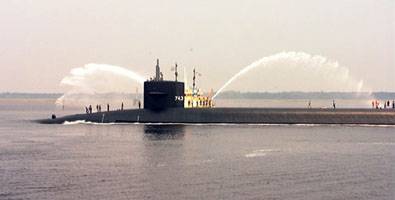
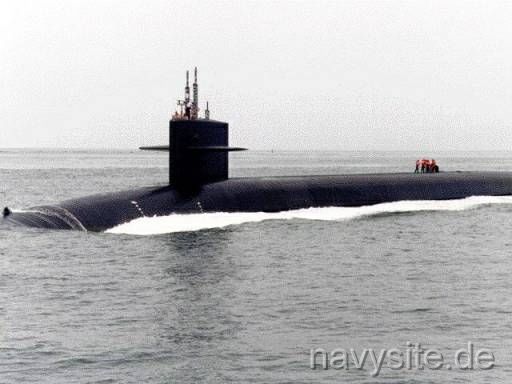
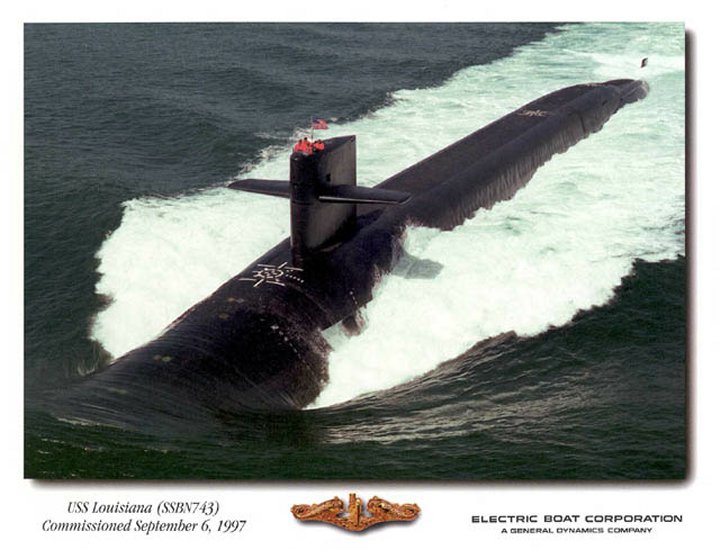
USS LOUISIANA is the fourth U.S. Naval vessel to be named in honor of the eighteenth state admitted into the union, and eighteenth and last Trident Submarine to be commissioned.
| General Characteristics: | Keel Laid: December 19, 1990 |
| Launched: July 27, 1996 | |
| Commissioned: September 6, 1997 | |
| Builder: General Dynamics Electric Boat Division, Groton, Conn. | |
| Propulsion system: one nuclear reactor | |
| Propellers: one | |
| Length: 560 feet (171 meters) | |
| Beam: 42 feet (12.8 meters) | |
| Draft: 36,5 feet (11.1 meters) | |
| Displacement: Surfaced: approx. 16,765 tons Submerged: approx. 18,750 tons | |
| Speed: 20+ knots | |
| Armament: 24 tubes for Trident | |
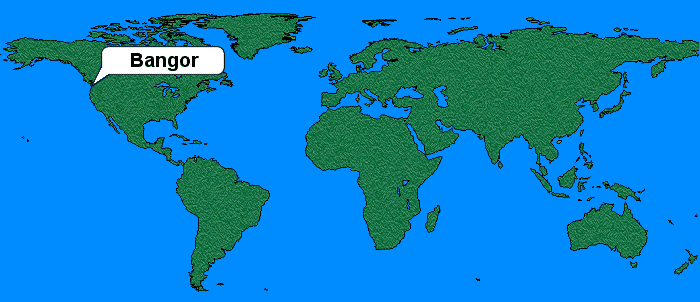
| Homeport: Bangor, WA | |
| Crew: 17 Officers, 15 Chief Petty Officers and 122 Enlisted (2 crews) |
Crew List:
This section contains the names of sailors who served aboard USS LOUISIANA. It is no official listing but contains the names of sailors who submitted their information.
Accidents aboard USS LOUISIANA:
| Date | Where | Events |
|---|---|---|
| August 18, 2016 | Strait of Juan de Fuca | USS LOUISIANA and the offshore support vessel USNS EAGLEVIEW (T-AGSE 3) collide while both vessels are underway in the Strait of Juan de Fuca off the coast of Washington state. EAGLEVIEW suffers damage to its aft port hull while LOUISIANA damages her starboard forward hull. Both vessels safely return to Bangor, Wash., for damage assessment. |

USS LOUISIANA History:
USS LOUISIANA was ordered near the end of the Cold War as part of the final increment of the OHIO-class ballistic missile submarine program that underpinned the United States' sea-based nuclear deterrent. The construction contract was awarded to General Dynamics Electric Boat on December 19, 1990, as the last hull in the Trident submarine line. Her keel was laid at Electric Boat in Groton, Connecticut, on October 23, 1992, marking the formal start of construction of what would become the 18th and final OHIO-class SSBN. On July 27, 1996, the submarine was launched and christened LOUISIANA, sponsored by Patricia O'Keefe, in keeping with the tradition of linking each ship symbolically to a prominent civilian sponsor.
After fitting out and initial pierside testing in Groton, LOUISIANA completed her builder's and acceptance trials at sea, proving propulsion, navigation, combat systems and missile compartment performance to the satisfaction of the Navy's Board of Inspection and Survey. These trials took place against the background of a rapidly changing strategic environment: the Soviet Union had already dissolved, but the United States retained its ballistic missile submarine force as the most survivable leg of the strategic nuclear triad. With trials complete, the submarine was formally placed in commission on September 6, 1997, at Naval Submarine Base Kings Bay, Georgia. At commissioning she became the 18th and last OHIO-class SSBN and the fourth U.S. Navy ship to bear the name LOUISIANA.
Her assignment to Kings Bay brought that base up to its planned full complement of 10 ballistic missile submarines, solidifying it as the principal Atlantic homeport for the Trident force. In her early post-commissioning period at Kings Bay, LOUISIANA carried out the typical sequence of post-delivery shakedown operations, tactical training and certification events required before an SSBN can conduct operational deterrent patrols. This phase included crew work-ups, weapons system tests and preparation for the first loading of Trident II D5 missiles at the Strategic Weapons Facility Atlantic (SWFLANT). According to an open chronology of Trident operations, she completed her first full strategic weapons loadout at Kings Bay on October 15, 1998, and on October 22, 1998, departed on her first strategic deterrent patrol. That milestone marked the point at which LOUISIANA joined the continuous at-sea deterrent posture maintained by the U.S. ballistic missile submarine force.
From the end of 1998 into the early 2000s, LOUISIANA settled into the standard two-crew operating rhythm that characterizes OHIO-class SSBN employment. With distinct Blue and Gold crews alternating at sea and ashore, the submarine conducted extended deterrent patrols of roughly two to three months duration, interspersed with refit periods at Kings Bay for maintenance, resupply and crew turnover. Publicly available fragments of her Kings Bay-era chronology, compiled from Navy releases, indicate multiple such strategic deterrent patrols by both crews, each on the order of two and a half months, though detailed dates and patrol areas remain classified.
In this period the broader strategic context was shifting: post-Cold War arms control talks, renewed focus on regional crises, and eventually the post-September 11 security environment all reinforced the importance of a survivable, continuously deployed SSBN force, and LOUISIANA's patrols formed part of that enduring mission. As U.S. strategic planners began to rebalance part of the ballistic missile submarine force toward the Pacific, a group of Trident boats was selected to shift from the Atlantic to the Pacific fleet. Open-source overviews of the OHIO class note that PENNSYLVANIA (SSBN 735), KENTUCKY (SSBN 737), NEBRASKA (SSBN 739), MAINE (SSBN 741) and LOUISIANA were among the submarines realigned from Kings Bay to the Pacific Northwest in the early 2000s. LOUISIANA's own official "About" page records that she was "originally assigned to Kings Bay" and that her homeport was shifted to Naval Submarine Base Bangor, Washington, in October 2005.
This homeport change reflected a wider strategic emphasis on the Pacific theater, with Pacific Fleet SSBNs providing continuous coverage of potential targets in Asia while Atlantic-based boats continued to focus on other regions.
After her arrival in the Pacific Northwest, LOUISIANA was assigned to Submarine Squadron 17 under Submarine Group 9 and became part of the Bangor-based SSBN force. From Bangor, she continued the established Blue-and-Gold crew cycle of strategic deterrent patrols, now in the Pacific. Public imagery from the Navy's maintenance community shows LOUISIANA being guided by tugs back to her berth at Naval Base Kitsap-Bangor after completing a patrol in 2012, illustrating her routine pattern of returning to Bangor for post-patrol maintenance and crew turnover after extended periods at sea. During these years, she contributed to the Pacific deterrent posture alongside other Bangor-based SSBNs, operating quietly and largely out of public view, while the strategic environment in the Pacific became increasingly focused on the emergence of China as a major maritime power and on North Korea's nuclear and missile programs.
LOUISIANA's performance during her first decade in the Pacific was recognized with several significant awards. On May 31, 2007, United States Strategic Command announced the winners of the 2006 Omaha Trophy, which recognizes excellence in strategic deterrence across several categories. In the Submarine Ballistic Missile category, the award went to USS LOUISIANA, then homeported at Naval Base Kitsap. The Omaha Trophy citation, as summarized in later references, emphasized that both Blue and Gold crews had achieved across-the-board excellence in formal inspections, weapons handling, tactical evaluations, safety, retention and broader measures such as community involvement. A formal presentation followed at Bangor, where General Kevin P. Chilton, commander of U.S. Strategic Command, presented the 2006 Omaha Trophy Submarine Ballistic Missile Award to the combined crews of LOUISIANA.
The following year, the submarine's sustained high performance was further recognized in the Navy's internal competition for operational readiness. On January 1, 2008, Commander, Submarine Force U.S. Pacific Fleet announced the 2007 Battle Efficiency ("Battle E") awards for the Pacific submarine force. Among the winners were both Blue and Gold crews of LOUISIANA, which received the 2007 Battle "E" as one of the top-performing Pacific Fleet submarines. Contemporary local reporting from the Kitsap region highlighted LOUISIANA, the Bangor-based SSBN MAINE and the special-mission attack submarine JIMMY CARTER (SSN 23) as the three Bangor boats recognized with the Battle "E", underscoring the high readiness levels expected of the Pacific Northwest submarine force.
On February 17, 2009, Chief of Naval Operations Admiral Gary Roughead visited Naval Base Kitsap and, during an all-hands event, presented LOUISIANA's Blue and Gold crews with a Meritorious Unit Commendation. Photographs from the event show the CNO handing a Meritorious Unit Commendation flag to Blue Team commanding officer Commander Blake Converse and Gold Team commanding officer Captain Shannon Kawane. The citation recognized the crews for "demonstrating sustained superior performance while setting fleet standards of excellence in administration, engineering, supply, personnel programs and community support", and open summaries note that LOUISIANA was the first ballistic missile submarine to receive the Meritorious Unit Commendation since 2001. This award reflected the boat's consistently strong record across the full spectrum of SSBN duties: maintaining a high tempo of deterrent patrols, meeting or exceeding inspection standards and supporting the wider base and community.
Through the early 2010s, LOUISIANA continued her cycle of Pacific deterrent patrols from Bangor. The period coincided with the U.S. Navy's "rebalance to the Pacific" and increasing attention to great-power competition in the maritime domain. Strategic messaging from U.S. Pacific Fleet and U.S. Strategic Command regularly emphasized the importance of the at-sea deterrent provided by Bangor-based SSBNs, including LOUISIANA, even though specific patrol areas and timings remained classified. The 2012 photograph of tugs guiding LOUISIANA back to her berth after a patrol underscores that she remained actively engaged in the deterrent mission into the second decade of her service life.
On August 18, 2016, LOUISIANA became the subject of rare public attention when she was involved in a collision while conducting operations on the surface. At about 6 p.m. local time, the submarine and the Military Sealift Command offshore support vessel USNS EAGLEVIEW (T-AGSE 3) collided in the Strait of Juan de Fuca off the coast of Washington state during routine operations. Contemporary reports from the Navy and multiple news outlets noted that LOUISIANA and EAGLEVIEW were conducting routine submarine support operations in the strait when the incident occurred, and that there were no injuries to personnel on either vessel. Damage assessments later described impact damage to the aft port hull of EAGLEVIEW and to the forward starboard hull of LOUISIANA. Both ships returned to port under their own power: EAGLEVIEW to Port Angeles, Washington, and LOUISIANA to her homeport at Naval Base Kitsap-Bangor, where further inspection and repairs were arranged. The collision occurred during a period when a series of surface ship accidents led to wide-ranging reviews of seamanship, risk management and training across the Navy, and the LOUISIANA-EAGLEVIEW incident was often cited in broader discussions of navigational safety and escort operations for high-value units.
In the latter half of the 2010s, as the earlier OHIO-class SSBNs approached the midpoint of their planned service lives, the Navy began scheduling engineered refueling overhauls (EROs) to extend those lives into the 2030s and beyond. LOUISIANA was selected for such a mid-life overhaul at Puget Sound Naval Shipyard & Intermediate Maintenance Facility (PSNS & IMF) in Bremerton, Washington. She arrived at PSNS & IMF on August 13, 2019, and entered dry dock on September 11, 2019, commencing a multi-year ERO. A Naval Sea Systems Command article described the availability as focusing on refueling the submarine's S8G reactor, preserving the hull, superstructure and internal tanks, modernizing the reverse osmosis system and incorporating the alterations necessary to support enlisted women serving aboard ballistic missile submarines. At the time, the project was expected to take roughly two and a half to almost three years, involve on the order of 700,000 man-days of work and cost about $400 million.
During the ERO, LOUISIANA's Blue and Gold crews were combined into a single "Green" crew under a unified chain of command to work closely with the shipyard team. In addition to reactor refueling and major preservation work, the availability included modernization of tactical and support systems in line with fleet-wide upgrades to the Ohio class. A 2020 overview of dry-dock utilization at PSNS noted that LOUISIANA, occupying Dry Dock 4, was in the midst of a 31-month ERO scheduled to complete in 2022, and that the overhaul would extend the submarine's service life by about 19 years. Throughout this period, public statements by senior officers emphasized the importance of maintaining schedule and quality standards despite the additional constraints imposed by COVID-19 mitigation measures. The commanding officer later remarked that the combined efforts of PSNS & IMF and the ship's crew had allowed the availability to meet or exceed key milestones even under those conditions.
By 2021, the ERO had progressed sufficiently that undocking and final phases of work could begin, and by 2022 the project was approaching completion. In parallel with the wind-down of the overhaul, personnel changes reflected the transition back to normal two-crew operations. On March 6, 2020, during the yard period, the crew held a change of command ceremony at the chapel on Naval Base Kitsap-Bangor, at which Commander Lester "J.R." Patterson Jr. relieved Commander Martin Sprague II as commanding officer of LOUISIANA. Patterson would later preside over much of the ERO period, working closely with PSNS & IMF personnel and higher headquarters as the ship moved through the major milestones of the overhaul.
On March 25, 2022, while LOUISIANA remained in the final stages of her yard work, a further change of command took place at the U.S. Naval Undersea Museum in Keyport, Washington. At that ceremony, Commander Michael Kessler relieved Commander Lester Patterson as commanding officer of LOUISIANA, marking the transition toward post-overhaul operations.
Later that year, on August 5, 2022, a formal crew-split ceremony was held at PSNS & IMF. During this event, LOUISIANA reconstituted her traditional Blue and Gold crews: Commander Kessler assumed command of LOUISIANA (Blue), while Commander Josh Veney assumed command of LOUISIANA (Gold). The ceremony marked the end of the "Green" crew arrangement used during the overhaul and signaled that the submarine was preparing to leave the shipyard and return to the normal SSBN operating model. Officials at the event noted that in the months following the ceremony, LOUISIANA would relocate from PSNS & IMF back to her permanent operational homeport at Naval Base Kitsap-Bangor.
By early 2023, the refueled and modernized LOUISIANA had completed her extended maintenance period and was returning to active operations. Public imagery and commentary describe her transiting Puget Sound past the Seattle skyline after finishing a roughly 41-month engineered refueling overhaul, highlighting her renewed readiness to resume long-range deterrent patrols as part of the Pacific Fleet. With a refueled reactor and updated systems, her life was effectively extended into the 2040s, aligning with broader Navy plans to keep the last OHIO-class SSBNs in service until sufficient numbers of the COLUMBIA-class replacements are available.
A clear example of LOUISIANA's post-overhaul operational activity came on May 29, 2024, when the Gold crew brought the submarine into Apra Harbor for a scheduled port visit to Naval Base Guam. A Defense Visual Information Distribution Service release recorded USS LOUISIANA (Gold Crew) arrive at Naval Base Guam on that date to conduct the visit, describing the stop as a reflection of Guam's strategic importance and of the United States' commitment to a free and open Indo-Pacific region. The same release emphasized that the presence of an SSBN in Guam demonstrated the flexibility, survivability, readiness and capability of U.S. submarine forces, and that such deployments complemented exercises, training and other cooperative activities undertaken by strategic forces in the region.
USS LOUISIANA Image Gallery:
![]() | ![]() | ![]() | ![]() | ![]() |
![]() |
The photos below were taken by me and show USS LOUISIANA during a short stop off Point Loma, Calif., on July 24, 2024. LOUISIANA was met by three C-TRACTOR tugs and two security boats. The submarine conducted a personnel transfer (most likely midshipmen during their summer training period at San Diego) and took on supplies. The tugs turned the LOUISIANA around off the submarine base and she went out to sea again. The entire evolution took less than an hour.
![]() | ![]() | ![]() | ![]() | ![]() |
![]() | ![]() |
Back to Ballistic Submarines list.
Back to ships list.
Back to selection page.
Back to 1st page.