Search the Site with 
General Characteristics Crew List Memorabilia History Image Gallery to end of page

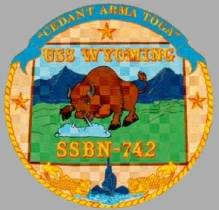
USS Wyoming (SSBN 742)


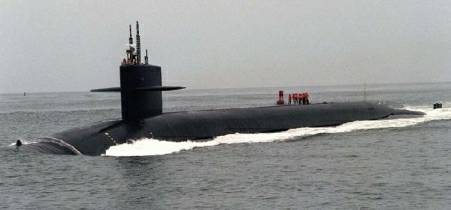
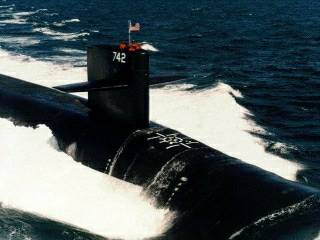
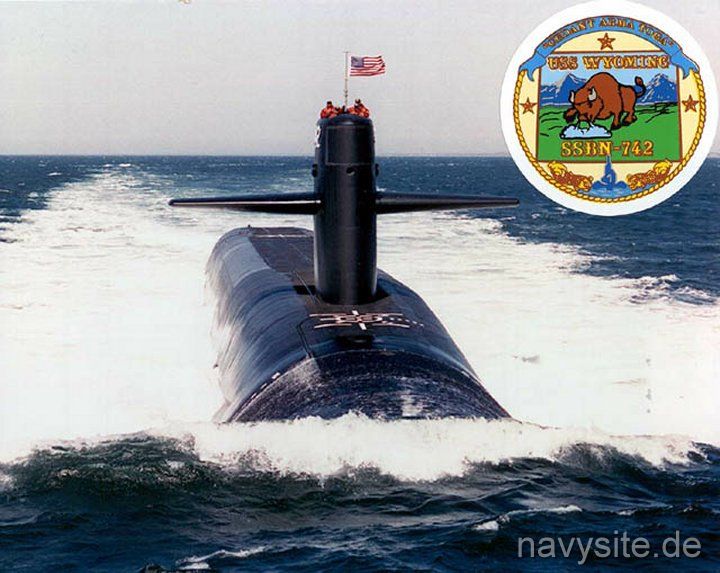
USS WYOMING is the 17th submarine in the OHIO class and the fourth U.S. Naval ship to be named after the 44th state of the Union.

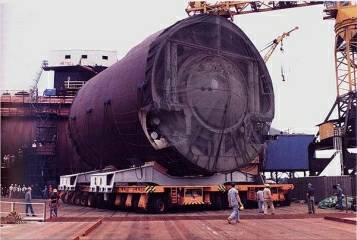
General Characteristics:Keel Laid: January 27, 1990
Launched: July 15, 1995
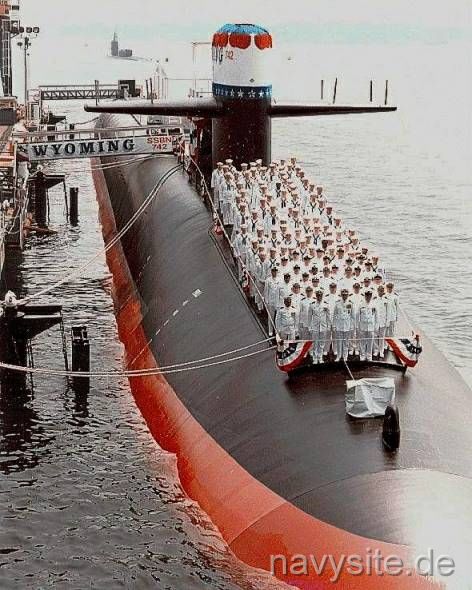
Commissioned: July 13, 1996
Builder: General Dynamics Electric Boat Division, Groton, Conn.
Propulsion system: one nuclear reactor
Propellers: one
Length: 560 feet (171 meters)
Beam: 42 feet (12.8 meters)
Draft: 36,5 feet (11.1 meters)
Displacement: Surfaced: approx. 16,765 tons   Submerged: approx. 18,750 tons
Speed: 20+ knots
Armament: 24 tubes for Trident I and II, Mk-48 torpedoes, four torpedo tubes
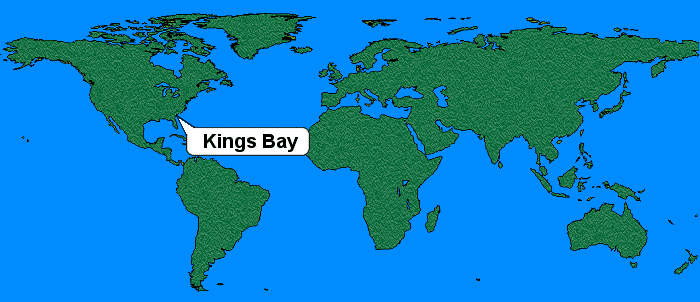
Homeport: Kings Bay, Georgia
Crew: 17 Officers, 15 Chief Petty Officers and 122 Enlisted (2 crews)


Back to topback to top  go to endgo to the end of the page


Back to topback to top  go to endgo to the end of the page

Crew List:

This section contains the names of sailors who served aboard USS WYOMING. It is no official listing but contains the names of sailors who submitted their information.


back to top  go to the end of the page


Back to topback to top  go to endgo to the end of the page


Back to topback to top  go to endgo to the end of the page

USS WYOMING History:

USS WYOMING is an OHIO-class ballistic-missile submarine and part of the United States' sea-based nuclear deterrent. The construction contract was awarded to the Electric Boat division of General Dynamics in Groton, Connecticut, on October 18, 1989, as the Cold War was ending but long-term nuclear deterrence remained a central element of U.S. strategy. Her keel was laid at Electric Boat on August 8, 1991, and she was launched there on July 15, 1995, sponsored by Monika B. Owens. WYOMING was commissioned on July 13, 1996, with separate Blue and Gold crews, and only a few days later, on July 26, 1996, she arrived at Naval Submarine Base Kings Bay, Georgia, becoming the ninth submarine homeported there and joining Submarine Group Ten as part of the Atlantic-based Trident force.

Following commissioning and initial trials, WYOMING began working up for routine strategic deterrent patrols in the Atlantic, the core mission of OHIO-class ballistic-missile submarines. These patrols are conducted largely in secrecy, but the Navy has stated that a typical deterrent patrol consists of about 77 days at sea followed by roughly 35 days alongside for maintenance and crew turnover, with Blue and Gold crews alternating to keep each submarine on station for much of the year.

WYOMING's first deterrent patrol began in August 1997, marking her transition from a new construction unit into a fully operational part of the U.S. nuclear triad. Through the late 1990s, she settled into this pattern of repeated Atlantic patrols out of Kings Bay, providing continuous at-sea nuclear deterrence while arms-control measures such as START II and later New START reshaped U.S. and Russian strategic arsenals in the background.

By the end of the 1990s and into the early 2000s, WYOMING had become representative of the "quiet" but persistent presence of Trident submarines at sea. Public glimpses of her operations remained rare because patrol routes and schedules are classified, but one exception came when C-SPAN was allowed to film on board. On November 27, 2000, and November 28, 2000, C-SPAN aired "Aboard a Boomer: USS WYOMING, Day 1" and "Day 2", programs built from footage shot during a training period at sea, giving the public an unusual look at daily life and routines on board an operational Trident submarine. The broadcasts underlined how tightly controlled information about ballistic-missile submarine operations normally is, even as WYOMING continued a steady sequence of patrols through the early 2000s in the post-Cold-War, post-September-11 security environment.

Over the next decade she cycled repeatedly between Kings Bay and patrol areas in the Atlantic Ocean. By early 2009, this steady operational tempo had produced a significant milestone. WYOMING completed her 38th strategic deterrent patrol on February 11, 2009; at the same time this patrol was recognized as the 1,000th Trident strategic deterrent patrol carried out by the U.S. ballistic-missile submarine force since the first Trident patrol in the 1980s. A ceremony at Kings Bay later in February 2009, attended by senior Navy and Defense Department officials, highlighted how continuous patrols by boats such as WYOMING underpinned U.S. extended deterrence commitments to NATO and other allies in the post-Cold-War era.

The early 2010s saw WYOMING continue this pattern, but with some notable developments. Navy imagery shows the boat getting underway from Kings Bay in January 2011 to begin another period of operations at sea, reflecting the routine rhythm of departures and returns that define SSBN life. In December 2011, after more than three months away, WYOMING's Gold crew returned to Kings Bay on December 6, 2011. According to a compiled operational chronology, this marked completion of the submarine's 45th strategic deterrent patrol, which on that occasion lasted about 100 days.

At the same time, WYOMING became part of a major personnel policy change within the submarine force. In 2011, she was selected as one of the first four U.S. submarines to embark female officers after the Navy opened the submarine community to women. By late 2012, women serving on board WYOMING were qualifying in submarine warfare, earning their "dolphins" and integrating into the crew in engineering, supply, and other wardroom billets. This integration occurred while WYOMING continued her routine deterrent patrols from Kings Bay, reflecting both operational continuity and gradual social change inside the submarine force.

On June 6, 2012, WYOMING also took part in a high-profile operational experiment linking special operations aviation and the SSBN force. During this event a CV-22 Osprey tilt-rotor aircraft flew approximately 12,000 nautical miles, including multiple aerial refuellings, to rendezvous with WYOMING at sea and conduct hoist operations from the submarine's deck. The proof-of-concept mission demonstrated that the Osprey could support long-range personnel recovery or medical evacuation from an SSBN, expanding options for rescuing injured sailors or moving key personnel without bringing a ballistic-missile submarine into port.

The integration of women on board WYOMING was marred by a serious misconduct case during subsequent patrols. Between August and November 2013 and again between March and June 2014, a group of male petty officers secretly recorded several female officers and midshipmen while they were in a shower and changing area on board. The case came to light in 2014; Navy investigations indicated that up to twelve sailors were implicated in making and distributing the recordings, though only one appears to have originally filmed them. Ten sailors were ultimately prosecuted and convicted, receiving punishments that ranged from confinement to reductions in rank and pay.

During this period, WYOMING continued deterrent patrols. For example, imagery shows her returning to Kings Bay on June 28, 2014, following routine operations, reflecting how regular patrol commitments continued even as the Navy addressed the disciplinary and cultural issues raised by the incident.

In the mid-2010s, WYOMING acquired a prominent role in signaling allied solidarity and deterrence in Europe. On September 16, 2015, the Gold crew brought WYOMING into Her Majesty's Naval Base Clyde at Faslane, Scotland, for a port visit of about five days. This was the first publicly announced foreign port call by a U.S. ballistic-missile submarine since 2003, breaking a long-standing practice of keeping SSBN port movements unpublicized. Analyses by independent experts and the International Committee of the Red Cross noted that the visit formed part of a broader pattern of more visible U.S. nuclear operations in Europe following Russia's actions in Ukraine and increased Russian nuclear signaling. A contemporaneous report, citing U.S. Strategic Command, described the WYOMING visit as demonstrating the closeness of the U.S.-U.K. defense relationship and the U.S. commitment to the collective security of NATO member states, and noted that the port call followed an earlier unannounced visit by a British ballistic-missile submarine to Kings Bay.

After returning from deployments like the Faslane patrol, WYOMING continued her steady deterrent cycle while the Navy planned mid-life refuelling for Atlantic-based OHIO-class submarines. On January 9, 2018, she arrived at Norfolk Naval Shipyard in Portsmouth, Virginia, to begin a 27-month Engineered Refueling Overhaul (ERO). A Navy press release on January 29, 2018, emphasized that the ERO would refuel the submarine's nuclear reactor and carry out extensive modernization, including "Enlisted Women at Sea" alterations that reconfigured berthing to support mixed-gender crews. The ERO followed earlier overhauls for other Trident boats, allowing Norfolk Naval Shipyard to apply lessons learned and aim for improved efficiency in refuelling timelines and undocking.

During the ERO, which kept WYOMING in the yard through 2018 and 2019, the shipyard and crew worked through reactor refuelling, modernization of the strategic weapon system, and ship-wide maintenance. Norfolk Naval Shipyard completed refuelling in a period deliberately targeted to beat previous Trident records, applying planning methods proven on earlier overhauls. On November 6, 2019, WYOMING undocked as part of the final phase of the overhaul, shifting to further systems testing and certification alongside.

On October 9, 2020, she formally completed the ERO and "returned to the fleet" after more than two years in major maintenance, closing out a series of eight East Coast Trident refuellings at Norfolk that had begun in 2003. The yard highlighted that missile test teams on WYOMING set a new record for completing Missile Operational Sequence Testing during an ERO, reflecting both the maturity of the Trident program and the ship's importance within it.

Soon after returning to operational status, WYOMING underwent a key post-overhaul certification of her strategic weapon system. On September 17, 2021, operating in the Atlantic Ocean off Cape Canaveral, Florida, she conducted Demonstration and Shakedown Operation (DASO) 31, launching two unarmed Trident II D5 Life Extended (D5LE) missiles that landed within the Eastern Test Range. The DASO evaluated the readiness of the ship's strategic weapons system and crew for a return to deterrent patrols after refuelling. The U.S. Navy reported that the test contributed to the long series of successful Trident II test flights - over 180 at that point - supporting confidence in the reliability of the sea-based leg of the nuclear triad.

In early 2022, WYOMING's operations illustrated both the traditional patterns and evolving practices of the SSBN force. On January 24, 2022, the Blue crew conducted an exchange of command and crews at sea in the Atlantic Ocean, supported by the expeditionary sea-base-type ship USNS BLACK POWDER (T-AGSE 1). Navy photographs show WYOMING surfaced with BLACK POWDER alongside while Blue and Gold crews executed the crew swap, underscoring how at-sea crew exchanges can shorten transit time, increase deployed availability, and allow sailors to return home more quickly after patrols. The operation was described by U.S. Fleet Forces Command as a regularly scheduled exchange demonstrating the continuity and flexibility of sea-based nuclear deterrent operations.

Two months later, WYOMING was at the center of another first in submarine history. On March 24, 2022, U.S. Fleet Forces Command reported that the Blue crew of WYOMING had recently completed a deterrent patrol with fifteen enlisted women on board, making her the first ballistic-missile submarine in U.S. Navy history to complete a strategic deterrent patrol with enlisted female sailors as part of the crew. The article, based at Kings Bay, used photographs taken on February 24, 2022, in front of the static display of USS GEORGE BANCROFT (SSBN 643) at the base's gate, showing the command triad with the group of enlisted women. It placed WYOMING's patrol in the broader context of a gradual expansion of women's roles in the submarine force since their initial authorization more than a decade earlier, noting that enlisted women were already serving on four guided-missile submarines and that WYOMING was the first SSBN to join them.

Through 2023 and into 2024 and 2025, publicly available information indicates that WYOMING has continued to operate from Kings Bay as part of the Atlantic-based OHIO-class force, conducting strategic deterrent patrols under Submarine Group Ten while the Navy plans for eventual transition to the COLUMBIA-class SSBNs in the 2030s. Social-media posts marking the anniversaries of her commissioning have highlighted her role in the sea-based deterrent, her milestone participation in the 1,000th Trident patrol, and her status as the first ballistic-missile submarine to complete a patrol with enlisted women aboard, reflecting how operational achievements and personnel integration are now both part of her identity.


Back to topback to top  go to endgo to the end of the page


Back to topback to top


Back to Ballistic Submarines list. Back to ships list. Back to selection page. Back to 1st page.