![]() |
Search the Site with
|


USS MAINE is the third ship of the fleet to bear the name of the state. The first MAINE was the first battleship in the US Navy.
| General Characteristics: | Keel Laid: April 4, 1989 |
| Launched: July 16, 1994 | |
| Commissioned: July 29, 1995 | |
| Builder: General Dynamics Electric Boat Division, Groton, Conn. | |
| Propulsion system: one nuclear reactor | |
| Propellers: one | |
| Length: 560 feet (171 meters) | |
| Beam: 42 feet (12.8 meters) | |
| Draft: 36,5 feet (11.1 meters) | |
| Displacement: Surfaced: approx. 16,765 tons Submerged: approx. 18,750 tons | |
| Speed: 20+ knots | |
| Armament: 24 tubes for Trident | |
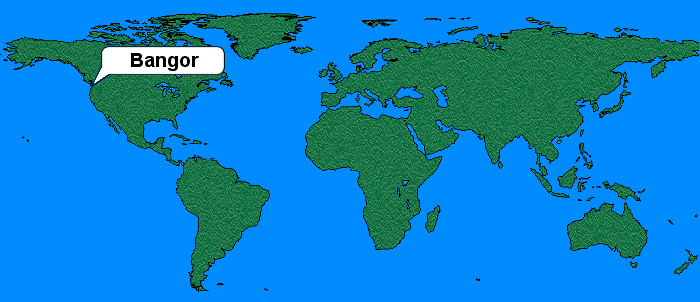
| Homeport: Bangor, WA | |
| Crew: 17 Officers, 15 Chief Petty Officers and 122 Enlisted (2 crews) |
Crew List:
This section contains the names of sailors who served aboard USS MAINE. It is no official listing but contains the names of sailors who submitted their information.


USS MAINE History:
USS MAINE was ordered as part of the last generation of U.S. Cold War ballistic-missile submarines, conceived to carry the Trident II (D5) missile and provide a survivable nuclear deterrent into the 21st century. The contract to build the boat went to the Electric Boat Division of General Dynamics at Groton, Connecticut, on October 5, 1988, as the OHIO-class program was nearing completion and the Soviet Union itself was already beginning to unravel.
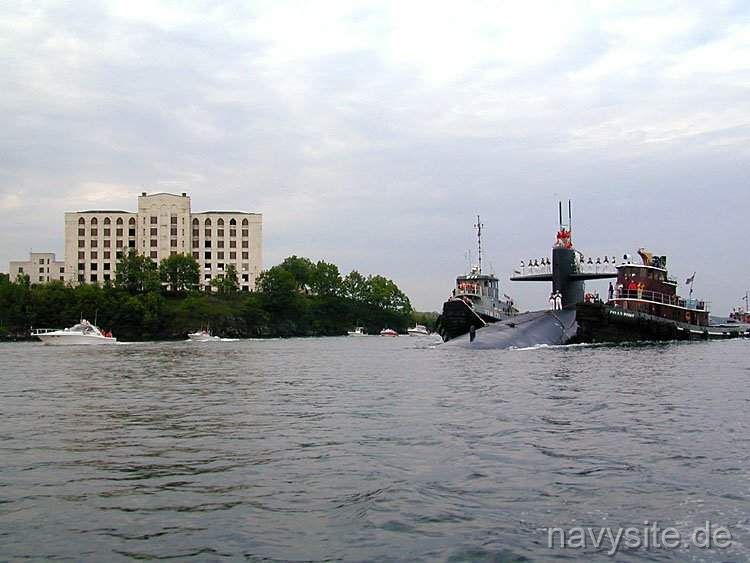
Her keel was laid at Groton on July 3, 1990, just months after the fall of the Berlin Wall, symbolizing that the United States intended to maintain a powerful sea-based deterrent even as the immediate Cold War crisis abated. Construction proceeded through the early 1990s, with MAINE launched on July 16, 1994. The boat was delivered to the U.S. Navy on June 23, 1995, and formally commissioned on July 29, 1995, at Portsmouth Naval Shipyard in Kittery, Maine, the state whose name she carried.
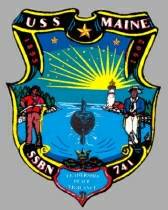
From the outset, MAINE embodied both the technical and symbolic aspects of the OHIO-class. Her crest, as later described in submarine community literature, carried 23 stars for Maine's status as the 23rd state, and 16 beams of light from a lighthouse representing both Maine's 16 counties and MAINE's place as the 16th Trident submarine. Her sponsor was Donna McLarty, wife of former White House chief of staff Thomas "Mack" McLarty, linking the new boat to the political leadership that oversaw the post-Cold War nuclear posture. The boat entered service as a dual-crew SSBN with Blue and Gold crews, following the standard pattern that allowed each hull to remain at sea for a large portion of the year while preserving crew training and family stability.
Shortly after commissioning, MAINE shifted to her first operational homeport at Naval Submarine Base Kings Bay, Georgia, in August 1995, joining the Atlantic-based Trident fleet. Throughout the late 1990s, she followed the classic "boomers' rhythm" that had been established since the 1960s: periods of refit and maintenance at Kings Bay, followed by months-long strategic deterrent patrols in the Atlantic and adjacent seas, always submerged and always on call but rarely discussed in public due to classification. Open sources give almost no patrol-by-patrol detail for these early years, but MAINE was part of the quietly stabilizing nuclear backdrop of the immediate post-Cold War era, as the United States and Russia implemented arms-control agreements while still maintaining substantial strategic arsenals.
One of the few publicly documented glimpses of MAINE at sea in this first decade comes from November 1999. A U.S. Navy photograph, later archived in public image collections, shows the boat on the surface in the Caribbean Sea, about 50 nautical miles south of Naval Station Roosevelt Roads, Puerto Rico, on November 14, 1999. The image captures the submarine operating in warm-water training areas where many Trident boats conducted post-refit shakedown workups, weapons-system checks, and crew training in relatively unconstrained waters compared to the more crowded approaches to the U.S. East Coast.
In the early 2000s, MAINE's routine of deterrent patrols and periodic training deployments intersected more visibly with the strategic missile test program. On April 23, 2003, MAINE launched two unarmed Trident II (D5) missiles during a Follow-on Commander's Evaluation Test (often referred to as FCET or CINC Evaluation Test). These tests, conducted from an operational SSBN rather than a dedicated test barge, are designed to validate the performance of the deployed missile system, its guidance, and the integration of submarine, fire-control, and missile systems under realistic conditions. Conducted in the early years of the post-9/11 era, when the United States was engaged in Afghanistan and preparing for war in Iraq, the test underscored that the strategic nuclear leg of U.S. power continued to be exercised and carefully evaluated even as conventional forces bore the brunt of expeditionary campaigns.
During these same years, MAINE also demonstrated the global reach that defines the SSBN force. In a retrospective article in the Naval Submarine League's Submarine Review, the boat was noted as having deployed south of the Antarctic Circle in 2002 - literally operating at the opposite end of the planet from the Arctic patrols that had characterized earlier Cold War deterrent patterns. Operating below the Antarctic Circle is a navigational and environmental challenge, with extreme weather, cold seas, and limited surface support. For MAINE, the deployment illustrated that even in a post-Cold War world the United States intended to maintain the ability to send its SSBNs into virtually any ocean region that offered safe, deep water.
Through the early 2000s, MAINE remained in the Atlantic fleet, based at Kings Bay, while Navy strategic planners began to rebalance the Trident force between the Atlantic and Pacific in response to evolving concerns about states such as China and North Korea. In December 2005, the submarine's homeport shifted to Naval Base Kitsap-Bangor, Washington, placing MAINE under the U.S. Pacific Fleet and aligning her patrol patterns more closely with the Pacific and Arctic regions. The move was part of a broader redistribution that saw several OHIO-class boats moving west, while others were later converted into guided-missile submarines (SSGNs).
Once settled at Bangor, MAINE joined a small group of Pacific Trident boats that would eventually provide the majority of the U.S. deployed strategic warheads. Much of her detailed operational history from 2005 onward remains, as expected, classified, but occasional public references show both the tempo and character of her work. Internal Navy reporting and later submarine community commentary note that MAINE became known for unusually long deterrent patrols. By 2008, her Blue Crew had conducted a 96-day strategic deterrent patrol - remarkable given that the practical limit on submerged patrol length is usually food storage rather than technical endurance.
The demand for persistent SSBN presence in the Pacific remained high. In 2010, MAINE's Blue Crew again pushed the envelope. A Navy public-affairs release later that year recorded that the crew completed a 105-day strategic deterrent patrol, described at the time as one of the longest patrols for a Bangor-based SSBN in recent years. The patrol began on August 22, 2010 and concluded with MAINE's return to Bangor on December 4, 2010, where the crew was recognized by the commander of Submarine Group 9.
Sailors who had remained deployed away from home for more than 90 days received the Sea Service Deployment Ribbon, and the patrol also saw a significant number of junior sailors complete their qualifications for submarine "dolphins", reflecting the way long, steady patrols provide time for training and watchstanding experience.
By the end of that decade, MAINE's operational record included both the long deterrent patrols of 2008 and 2010 and the earlier 2003 missile test, marking her as a well-worked and technically proven element of the Pacific SSBN squadron. In 2011, as noted in the Naval Submarine League's "States Put to Sea" article, MAINE transited the Arctic Circle, entering what submariners mark as the "domain of the polar bear". During that voyage, the crew participated in the traditional "Order of the Blue Nose" ceremony, formally recognizing their crossing of the Arctic Circle. The combination of her 2002 deployment below the Antarctic Circle and the later Arctic transit meant that MAINE had literally operated from pole to pole, a rare distinction even within the globe-circling U.S. submarine force.
In the same period, MAINE also became part of a major personnel and cultural change within the submarine community: the integration of women officers into SSBN crews. In 2011-2012 the Navy began assigning the first group of female submarine officers to selected OHIO-class boats. A Navy League article in December 2012 described how 13 women - four supply officers and nine line officers under instruction - were then assigned to USS OHIO (SSGN 726) and MAINE at Naval Base Kitsap-Bangor. These officers had completed the Submarine Officer Basic Course in Groton and nuclear-power training before joining their boats. While the article focused on Lt. Britta Christianson of OHIO, it made clear that MAINE was one of the initial SSBN platforms involved in integrating women into both operational and support roles at sea, a significant milestone in the boat's service life.
By the mid-2010s, MAINE was approaching the point in an OHIO-class submarine's life when a comprehensive mid-life overhaul and reactor refueling would be required to extend service into the late 2030s. Preparations for that overhaul dominated her operational narrative from 2015 onward. On August 3, 2016, after a two-month underway period totaling about 60 days at sea, the Blue and Gold crews were formally combined into a single "Green" crew during a ceremony at Naval Base Kitsap. Under Cmdr. Kelly Laing, the new "Green" crew prepared to take the boat into an Engineered Refueling Overhaul (ERO) at Puget Sound Naval Shipyard and Intermediate Maintenance Facility in nearby Bremerton.
The Navy's own account of the preceding years summarized what MAINE (Gold) had accomplished leading up to the ERO decision: four strategic deterrent patrols totaling 285 days at sea, approximately 540 days in refit, 67 days in dry dock, and 12 days spent in Hawaii. Those figures provide a rare quantitative glimpse into the operating cycle of a Pacific SSBN, showing how time in port for refit, nuclear-weapons handling, and maintenance roughly balances with time underway. The same article noted that MAINE (Gold) had hosted 239 midshipmen on embarked training rides throughout the Pacific and granted liberty in San Diego, California, and later in Ketchikan, Alaska, after sound trials. These port calls, while brief and tightly controlled, offered future officers and the crew itself rare opportunities for contact with the outside world between long submerged patrols.
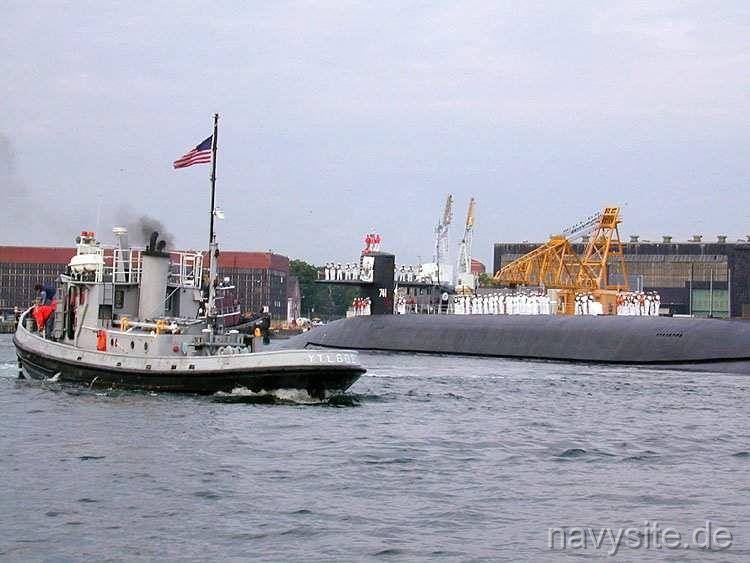
MAINE's formal entry into the ERO phase came a few weeks later. On September 13, 2016, the submarine transited the Hood Canal from Naval Base Kitsap-Bangor toward Bremerton with family members embarked for a dependents' cruise. Publicly released photographs and captions from the Department of Defense describe the boat moving through Puget Sound en route to Puget Sound Naval Shipyard and Intermediate Maintenance Facility "to commence an engineered refueling overhaul".
The ERO, planned for roughly 30 months, would involve cutting into the hull to refuel the reactor, extensive modernization of the strategic weapon system and ship's electronics, structural and hull repairs, and habitability upgrades - work that would effectively reset MAINE's material condition for another two decades of service. Defense Department reporting and a Department of Defense Inspector General document on SSBN maintenance later noted that MAINE's ERO was one of the priority projects in an adjusted SSBN refueling schedule, with the boat scheduled for an approximately 30-month overhaul that was also expected to realize efficiency gains compared to earlier EROs. The overhaul proved complex enough that Navy accounts later described it as a 32-month effort, but the essential point was that, once completed, MAINE would be equipped to operate safely and effectively until about 2037.
During the latter part of the overhaul, command of MAINE's crews passed through several hands. By April 2018, Cmdr. Mike Tomon had assumed command of the Blue Crew during what a later article described as "the final stretch" of the ERO, overseeing the reconstitution of a crew that included sailors who had never taken the submarine to sea. Maintenance teams at Puget Sound Naval Shipyard and the ship's force worked together to bring systems back online, conduct dock trials and sea trials, and prepare for the demanding Demonstration and Shakedown Operation (DASO) required before MAINE could re-enter the nuclear deterrent rotation.
That DASO came in early 2020 and marked one of the most visible events in MAINE's career. On February 12, 2020, the U.S. Navy conducted a scheduled test flight of an unarmed life-extended Trident II (D5LE) missile from MAINE on the Western Test Range off the coast of San Diego, California. The launch, designated DASO-30, was part of the Strategic Systems Programs' certification process, verifying that the submarine, her crew, and the modernized D5LE weapon system functioned together as intended after the lengthy overhaul. Photographs and video released by the Navy show the familiar bright plume of a Trident emerging from the Pacific as MAINE remained submerged. Four days later, the Navy announced that MAINE had successfully tested a second unarmed Trident II D5LE missile, again on the Western Test Range.
Together, these launches demonstrated not only the reliability of the life-extended Trident system but also MAINE's readiness to resume strategic patrols. Senior Navy and Department of the Navy officials, including the assistant secretary for research, development and acquisition, embarked the boat during the test sequence, underlining the institutional importance placed on this milestone.
Following DASO-30 and its follow-on launch, MAINE officially returned to strategic service. A Navy video piece titled "Launching into a New Era" and associated releases from Commander, Submarine Group 9 highlighted that in February 2020, MAINE and her crew had successfully completed the DASO and then rejoined the operational SSBN fleet.
On May 13, 2020, the Gold Crew was formally recognized for returning the boat to strategic service when they deployed on MAINE's first deterrent patrol in more than three years, an event the Navy timed close to the 25th anniversary of her commissioning and later highlighted in a "birthday" article celebrating the submarine's return to operational status.
The remainder of 2020 saw MAINE continue to regain and then sustain her place in the Pacific SSBN rotation. On December 11, 2020, the Blue Crew held a change-of-command ceremony at Deterrent Park in Silverdale, Washington. Cmdr. Darren Gerhardt relieved Cmdr. Mike Tomon as commanding officer of MAINE (Blue), with Rear Adm. Doug Perry, Commander, Submarine Group 9, emphasizing in his remarks how Tomon and his crew had taken a boat emerging from overhaul, trained a largely inexperienced crew, recertified the strategic weapons system, and safely returned MAINE to deterrent duty. The ceremony took place against the backdrop of the COVID-19 pandemic, which imposed severe constraints on port visits, crew liberty, and family contact, making the sustained deployment of SSBNs more challenging even as the strategic demand for them remained steady.
In the early 2020s, MAINE resumed regular strategic deterrent patrols from Bangor. Strategic Systems Programs and Navy public-affairs releases on subsequent missile tests repeatedly referred back to MAINE's February 2020 DASO as "the Navy's last DASO", marking it as the most recent example of a full post-overhaul demonstration before the shift to new classes of SSBNs later in the decade. At the same time, broader strategic commentary on the nuclear triad and the undersea leg highlighted MAINE and her sister ships as principal carriers of U.S. deployed strategic warheads, particularly as arms-control treaties with Russia came under strain and China expanded its own ballistic-missile submarine fleet.
The boat's renewed operations occasionally surfaced in public imagery and news when she appeared in unusual locations or in support of new concepts. In April 2023, MAINE conducted a rare logistics stop at Naval Base Guam, arriving at Apra Harbor on April 18 for what U.S. Indo-Pacific Command described as a scheduled port visit and a visible demonstration of U.S. commitment to regional allies and partners. SSBN visits to Guam are infrequent and are often highlighted precisely because they show the boats' ability to operate forward in the western Pacific while still preserving their core mission of remaining undetected for most of their patrols.
Around the same period, Marine Corps and Navy experimentation with new logistics concepts led to vertical replenishment trials in which CH-53E Sea Stallion helicopters conducted at-sea resupply of a ballistic-missile submarine identified in reporting as MAINE. Although details of the precise location and date are limited in public sources, the demonstration, discussed in U.S. naval media in May 2023, was part of a broader effort to explore ways to sustain SSBNs without requiring them to enter a port, thus enhancing both survivability and flexibility in a potential high-end conflict.
Strategic-policy commentary in 2024 and 2025 also mentioned MAINE in the context of increased allied cooperation, noting that in 2023 the United States hosted South Korean partners aboard the submarine as part of efforts to increase understanding of, and confidence in, the American nuclear deterrent among key Indo-Pacific allies. This outreach, while tightly controlled and conducted within strict security rules, reflected the growing role of the SSBN fleet not only as a military asset but also as a visible reassurance tool in alliance politics.
Even in more routine moments MAINE has occasionally appeared in public photographs. In March 2025, social-media imagery and associated captions showed the submarine transiting Puget Sound during routine operations, emphasizing that, three decades after commissioning, she remains an active, regularly deployed element of the Bangor SSBN squadron.
USS MAINE Image Gallery:
![]() | ![]() | ![]() |
Back to Ballistic Submarines list.
Back to ships list.
Back to selection page.
Back to 1st page.