Search the Site with 
General Characteristics Crew List Memorabilia History Image Gallery to end of page

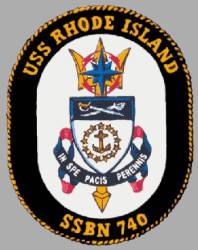
USS Rhode Island (SSBN 740)


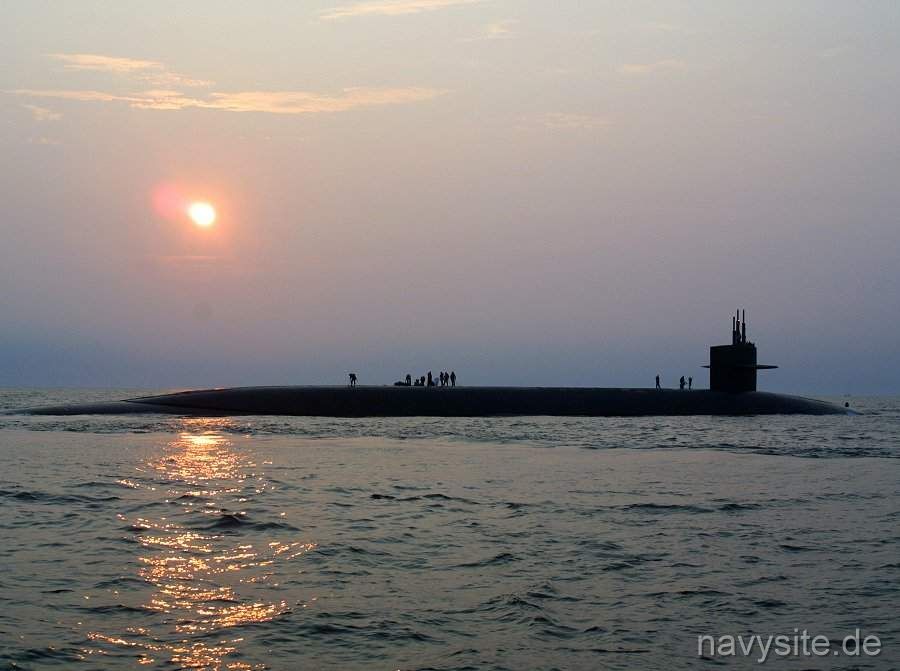
USS RHODE ISLAND is the 15th TRIDENT class Fleet Ballistic Submarine and the third U.S. Naval ship to be named in honor of the 13th state of the Union.

General Characteristics:Keel Laid: December 1, 1990
Launched: July 17, 1993
Commissioned: July 9, 1994
Builder: General Dynamics Electric Boat Division, Groton, Conn.
Propulsion system: one nuclear reactor
Propellers: one
Length: 560 feet (171 meters)
Beam: 42 feet (12.8 meters)
Draft: 36,5 feet (11.1 meters)
Displacement: Surfaced: approx. 16,765 tons   Submerged: approx. 18,750 tons
Speed: 20+ knots
Armament: 24 tubes for Trident I and II, Mk-48 torpedoes, four torpedo tubes
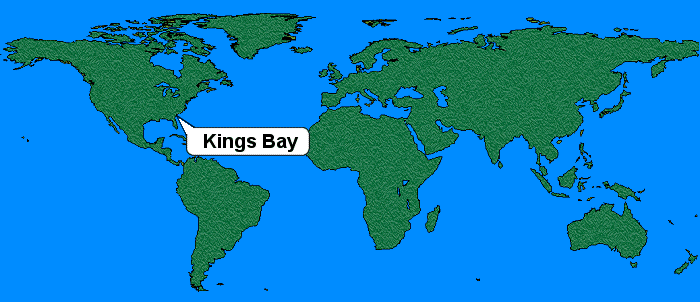
Homeport: Kings Bay, Georgia
Crew: 17 Officers, 15 Chief Petty Officers and 122 Enlisted (2 crews)


Back to topback to top  go to endgo to the end of the page


Back to topback to top  go to endgo to the end of the page

Crew List:

This section contains the names of sailors who served aboard USS RHODE ISLAND. It is no official listing but contains the names of sailors who submitted their information.


back to top  go to the end of the page


Back to topback to top  go to endgo to the end of the page


Back to topback to top  go to endgo to the end of the page

USS RHODE ISLAND History:

USS RHODE ISLAND is an OHIO-class ballistic missile submarine assigned to the United States Atlantic Fleet and homeported at Naval Submarine Base Kings Bay, Georgia. From her commissioning on July 9, 1994, she has formed part of the sea-based leg of the American nuclear triad, conducting strategic deterrent patrols in the Atlantic and, more rarely and publicly, making port visits that underline the political signalling power of this otherwise very discreet class of warship.

The origins of USS RHODE ISLAND go back to decisions taken in the late 1970s and 1980s as the United States expanded its Trident submarine fleet. The name "RHODE ISLAND" was initially assigned to hull number SSBN 730, but after the sudden death of senator Henry M. Jackson on September 1, 1983, the partly-built submarine was renamed USS HENRY M. JACKSON (SSBN 730), and the state name was freed for a later hull. The construction contract for the new RHODE ISLAND, hull number SSBN 740, was awarded to the Electric Boat Division of General Dynamics in Groton, Connecticut, on January 5, 1988. Her keel was laid at Groton on September 15, 1988, marking the formal start of construction. Over the next five years, Electric Boat completed the hull and outfitted the ship with the S8G nuclear propulsion plant, missile tubes for Trident ballistic missiles and the typical sonar, navigation and combat systems of an OHIO-class SSBN. She was launched on July 17, 1993, with Kati Machtley serving as sponsor during the ceremony, and entered the phase of final fitting out and sea trials.

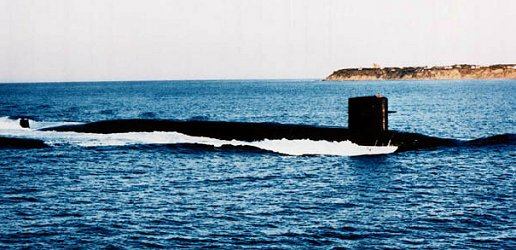
During the first half of 1994, RHODE ISLAND conducted builder's and acceptance trials off the U.S. east coast. A photograph from May 11, 1994, shows her underway off the coast of Rhode Island following one of these trials, demonstrating the characteristic silhouette of the class just weeks before she joined the fleet. RHODE ISLAND was commissioned on July 9, 1994. At commissioning she adopted the dual-crew system typical of OHIO-class SSBNs, with Captain John K. Eldridge commanding the Blue Crew and Commander Michael Maxfield the Gold Crew.

From the outset she was assigned to the Atlantic Fleet and based at Kings Bay, Georgia, where Submarine Group 10 manages the U.S. East Coast Trident submarine force and its strategic weapons facility. Her early years followed the standard pattern for the class: alternating 70- to 90-day deterrent patrols by Blue and Gold crews, interspersed with refit and training periods at Kings Bay, at a time when the United States was redefining its nuclear posture after the end of the Cold War but still maintained continuous at-sea deterrence.

Through the late 1990s and early 2000s, RHODE ISLAND quietly executed these strategic patrols in the Atlantic, operating largely unseen while her crews practised the routines of nuclear command and control, navigation and engineering that underpin the submarine leg of the triad. During these years, the strategic environment evolved from the immediate post-Soviet period to an era marked by concerns over nuclear proliferation and regional crises, but the basic mission of the Kings Bay SSBNs remained unchanged: to provide a survivable second-strike capability.

A more unusual and light-hearted public moment in this otherwise very discreet career came in the mid-2000s. On May 8, 2007, RHODE ISLAND was named the "official ballistic missile submarine" of the satirical television program The Colbert Report, after members of the crew had sent in photographs of a "Colbert Nation" poster displayed at various locations on board. The connection reportedly ran through a sailor engaged to a cousin of host Stephen Colbert. The designation had no operational consequences but reflected the way submariners occasionally engage with popular culture while remaining within the strict security framework that surrounds their work.

On August 11, 2009, RHODE ISLAND attracted attention for a very different reason when she rescued five Bahamian fishermen after their boat had capsized on August 7. According to later summaries, the submarine came across the four men and one boy in distress in waters near the Bahamas. Her medical staff brought them on board, provided initial treatment and stabilisation, and then transferred them to another vessel for transport ashore for further care. The episode illustrated how, even while deployed on a strategic deterrent patrol, an SSBN can still be called upon to perform conventional humanitarian tasks when circumstances demand.

By 2010, RHODE ISLAND was a seasoned deterrent platform within Submarine Squadron 20 at Kings Bay. On August 16, 2010, she was photographed transiting the Atlantic Ocean during her 49th strategic deterrent patrol, an indication of how intensively she had been employed in the first sixteen years of her service. Around the same period, the U.S. Navy allowed a small group of journalists and photographers aboard during a portion of a patrol, providing a rare public glimpse into life on a Trident submarine and highlighting the routines and responsibilities of the crew while emphasising that many operational details remained classified. For her performance during this period, RHODE ISLAND received important recognitions. In 2010, she was awarded the Battle "E" efficiency award for Squadron 20, reflecting top performance in readiness and tactical excellence among her peers at Kings Bay. The award documentation identifies both Blue and Gold crews and notes the continuity of command between commanders Robert Clark, Douglas Adams and Kevin Mooney during the competition cycle.

In 2011, RHODE ISLAND received the Omaha Trophy in the submarine ballistic missile category from U.S. Strategic Command, recognising her as the top Trident submarine in the force for sustained excellence in strategic deterrence operations.

Throughout the early 2010s, RHODE ISLAND continued strategic patrols from Kings Bay while the broader OHIO-class fleet approached the midpoint of its planned service life. With each OHIO-class submarine designed to operate for about 42 years, the Navy scheduled a single mid-life Engineered Refueling Overhaul (ERO) for each hull to refuel the reactor and modernize key systems. As RHODE ISLAND neared this point, the Navy began preparations for her own mid-life overhaul.

RHODE ISLAND's ERO formally began in December 2015 and was carried out at Norfolk Naval Shipyard (NNSY) in Portsmouth, Virginia. The submarine arrived at NNSY at the beginning of 2016 to start the physical work. Over the course of the overhaul, the Navy consolidated the usual Blue and Gold crews into a single "Green Crew" to focus on yard work, testing and training, with Commander Nirav Patel, who had assumed command in July 2015, leading the crew through what is one of the most demanding phases in a submarine's life cycle. The ERO was both technically complex and schedule-driven. NNSY and the crew established records during the refueling and testing phases. An article on related work for another submarine later noted that RHODE ISLAND's refueling had been completed in 217 days, beating the previous East Coast SSBN refueling record set on USS ALASKA (SSBN 732)'s overhaul. On July 17, 2017 NNSY undocked RHODE ISLAND two days ahead of schedule, with about 90 percent of production work already completed and certified while she was still in dock. This early undocking set a new record for East Coast EROs and allowed the remaining work to be finished pierside.

The overhaul extended beyond refueling the reactor. As official descriptions emphasize, an ERO replaces nuclear fuel and modernizes numerous ship systems, from propulsion and combat systems to habitability and safety equipment, preparing the submarine for at least two further decades of strategic service. In RHODE ISLAND's case the total ERO duration was approximately 33 months, from December 2015 to August 2018.

Following completion of the modernization work, RHODE ISLAND went to sea for an intensive 15-day sea trial period to validate the performance of the hull, propulsion plant, navigation systems and strategic weapons interfaces after the extended yard stay. A U.S. Strategic Command release notes that these sea trials thoroughly tested the boat's integrity and confirmed the success of the overhaul, which was expected to extend her service life by more than 20 years. On September 12, 2018, RHODE ISLAND returned to her homeport at Kings Bay, appearing there for the first time in nearly two and a half years.

A few days later, on September 17, 2018, the submarine marked another milestone with a change of command and crew split ceremony at Kings Bay. Commander Patel, who had commanded the boat during the ERO, was relieved, and the single Green Crew was divided back into the traditional Blue and Gold crews under new commanding officers Commander Jeremy Miller and Commander Jason Anderson. Rear Admiral Jeff Jablon, commander of Submarine Group 10, used the occasion to underline the strategic importance of RHODE ISLAND's mission, noting that ballistic missile submarines, though they represent a small fraction of the overall Navy, carry a large portion of the nation's accountable nuclear weapons and support its highest-priority mission of strategic deterrence.

After the yard period and sea trials the submarine entered a work-up phase to regain full operational certification. A key requirement for any Trident SSBN returning to service after overhaul is a Demonstration and Shakedown Operation (DASO), including a test launch of an unarmed Trident II D5 missile to certify the strategic weapons system. RHODE ISLAND conducted this event as DASO-29. On May 9, 2019, she launched an unarmed Trident II D5 ballistic missile from the Atlantic Ocean off Cape Canaveral, Florida. The test involved her Blue Crew and demonstrated the readiness of the crew and the upgraded systems to resume deterrent patrols. The launch formed part of a long-running series of operational flight tests used by the Navy and U.S. Strategic Command to verify the reliability of the sea-based deterrent. Following DASO-29, RHODE ISLAND resumed regular deterrent patrols from Kings Bay, re-entering the rotation of Kings Bay SSBNs that deploy on a roughly monthly rhythm to maintain continuous at-sea coverage.

The exact timing and routes of these patrols remain classified, but like her sister ships she would have spent much of each year submerged in the Atlantic, with periodic returns to Kings Bay for refit and crew turnover. Work done during her ERO also contributed to process improvements at NNSY. In 2020, the yard noted that it had broken its own record for missile systems testing on another SSBN, explicitly referencing the earlier benchmark set during RHODE ISLAND's overhaul.

In the early 2020s, RHODE ISLAND's operations became more visible than is usual for an SSBN, against a backdrop of renewed great-power competition. The strategic environment was characterized by Russian nuclear modernization, Chinese naval expansion and, from 2022 onward, the Russian full-scale invasion of Ukraine, which sharpened public awareness of nuclear deterrence issues. A long-form feature on the U.S. submarine force later reported that in February 2022, while in command of RHODE ISLAND, Commander David Burke received an urgent message informing him that Russia had begun its attack on Ukraine, a moment he described as a reminder of the gravity of the SSBN mission.

That same year, RHODE ISLAND carried out two unusually public port visits in Europe. On July 1, 2022. she arrived at His Majesty's Naval Base Clyde at Faslane, Scotland, for a scheduled port visit. The U.S. Navy noted that this port call by an OHIO-class SSBN was a visible demonstration of U.S. commitment to allies and partners and complemented exercises, training and other cooperation activities undertaken by strategic forces. It was also the first visit of a U.S. SSBN to Faslane since USS ALASKA had called there in July 2019. Photographs from July 4, 2022, show RHODE ISLAND moored at the base, framed by the hills around the Scottish loch, while maintaining strict security measures typical for a visiting nuclear-armed submarine.

On November 1, 2022, RHODE ISLAND made an even more remarked port visit when she arrived in Gibraltar, a British territory at the entrance to the Mediterranean Sea. The U.S. Navy's Sixth Fleet confirmed that the port call was scheduled and again emphasized the themes of alliance solidarity and operational flexibility. Commentators pointed out that public announcements of SSBN port visits are rare and that Gibraltar, with its strategically significant position at the Strait and facilities capable of supporting nuclear-powered submarines, offered a useful stage for visible reassurance and deterrence messaging in the context of the ongoing war in Ukraine. The same feature that described Commander Burke's receipt of the 2022 invasion message linked his later surfacing of RHODE ISLAND in Gibraltar to this broader signalling role of the Trident force.

In recognition of her continued performance, RHODE ISLAND again received top-level acknowledgment from U.S. Strategic Command. For the 2010 operating year she had been awarded the Omaha Trophy as the leading ballistic missile submarine; in the updated listing of Omaha Trophy recipients she appears once more as the submarine ballistic missile trophy winner for 2022, representing excellence in strategic deterrence during a period of heightened international tension. This second recognition, more than a decade after the first, reflects sustained standards of training, maintenance and operational execution across her crews.

By the mid-2020s, RHODE ISLAND remained in commission at Kings Bay as one of the six Trident SSBNs assigned to the Atlantic base. Her ERO-extended service life and the class-wide importance of the Trident force mean she is expected to continue operating into the 2030s and beyond, overlapping with the introduction of the new COLUMBIA-class ballistic missile submarines that will eventually replace the OHIO-class. Throughout this period she continues to execute the essentially unchanged core mission: alternating Blue and Gold crews, each taking the submarine to sea for prolonged deterrent patrols that are mostly invisible to the public but central to U.S. nuclear strategy.


Back to topback to top  go to endgo to the end of the page


The photos below were taken by Michael Jenning and show the RHODE ISLAND at the Norfolk Naval Shipyard, Portsmouth, Va., on October 4, 2017. The RHODE ISLAND is presently undergoing a 33-month Engineered Refueling Overhaul (EROH) at the Norfolk Naval Shipyard.


Back to topback to top


Back to Ballistic Submarines list. Back to ships list. Back to selection page. Back to 1st page.