![]() |
Search the Site with
|
![]() | ![]() | ![]() |
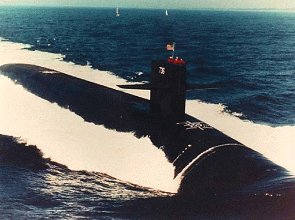
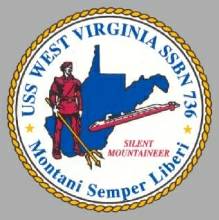
USS WEST VIRGINIA is the eleventh ship in the OHIO class and the first submarine and the third U.S. Naval ship to bear the name of this state.
| General Characteristics: | Keel Laid: October 24, 1987 |
| Launched: October 14, 1989 | |
| Commissioned: October 20, 1990 | |
| Builder: General Dynamics Electric Boat Division, Groton, Conn. | |
| Propulsion system: one nuclear reactor | |
| Propellers: one | |
| Length: 560 feet (171 meters) | |
| Beam: 42 feet (12.8 meters) | |
| Draft: 36,5 feet (11.1 meters) | |
| Displacement: Surfaced: approx. 16,765 tons Submerged: approx. 18,750 tons | |
| Speed: 20+ knots | |
| Armament: 24 tubes for Trident | |
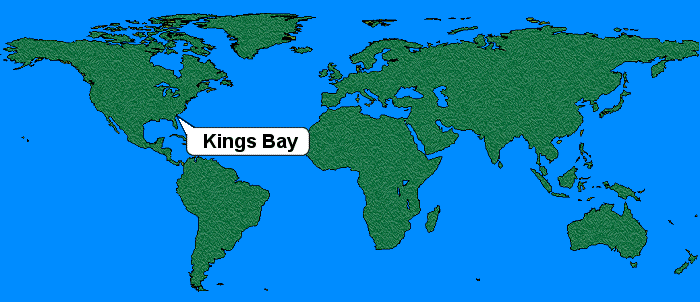
| Homeport: Kings Bay, Georgia | |
| Crew: 17 Officers, 15 Chief Petty Officers and 122 Enlisted (2 crews) |
Crew List:
This section contains the names of sailors who served aboard USS WEST VIRGINIA. It is no official listing but contains the names of sailors who submitted their information.
USS WEST VIRGINIA History:
USS WEST VIRGINIA entered the Navy's plans at the very end of the Cold War, when the United States was completing the fleet of TRIDENT II-capable ballistic missile submarines that would carry most of the nation's deployed strategic warheads. The contract to build the boat was awarded on November 21, 1983, to the Electric Boat division of General Dynamics in Groton, Connecticut, as the eleventh unit of the OHIO-class and the third built from the keel up for the TRIDENT II (D5) missile.
Her keel was laid at Groton on December 24, 1987, and she took shape during a period in which U.S.-Soviet tensions were easing but strategic planners still assumed a long-term requirement for survivable sea-based deterrence. The submarine was launched at Electric Boat on October 14, 1989, sponsored by Erma Byrd, the wife of senator Robert C. Byrd of West Virginia. After fitting out and trials, new-construction work was declared complete on September 22, 1990, marking her formal delivery as the third TRIDENT II submarine accepted by the Navy. She was commissioned on October 20, 1990, with a dual-crew arrangement typical for ballistic missile submarines: Captain J. R. Harvey took command of the Blue crew and Captain Donald McDermott took command of the Gold crew. From the outset she was assigned to the Atlantic deterrent force, with Naval Submarine Base Kings Bay, Georgia, as her permanent homeport.
In the months immediately following commissioning, USS WEST VIRGINIA completed an intensive period of testing, trials, and work-ups for operational service with the TRIDENT II D5 strategic weapon system. On November 28, 1990, the Blue crew carried out a Demonstration and Shakedown Operation (DASO), a combined sea trial and missile-firing sequence used to certify a new TRIDENT submarine and its crew. This DASO took place on the Eastern Test Range off Cape Canaveral, Florida, and confirmed that the ship, her fire control system, and her crew could safely execute a D5 launch profile under operationally realistic conditions. The Gold crew followed on April 15, 1991, with a separate DASO launch, designated a TRIDENT II DASO missile on the Eastern Test Range. This shot was recorded as the 37th TRIDENT II test missile flown and the 18th launched from a TRIDENT submarine. These back-to-back DASOs were conducted against the backdrop of the 1991 Gulf War and the final collapse of the Soviet Union, but their immediate purpose was technical: demonstrating the reliability of the new Atlantic-based D5 fleet.
With DASO firings complete, USS WEST VIRGINIA transitioned from trials into operational deployment. On September 29, 1991, she completed her first strategic loadout at Strategic Weapons Facility Atlantic, Kings Bay, loading a full complement of TRIDENT II missiles. Her first operational deterrent patrol began on December 3, 1991, when she deployed from Kings Bay as part of the Atlantic ballistic-missile submarine force that provided continuous at-sea deterrence during the post-Cold War drawdown and the implementation of START I.
Early in 1992, the boat played a visible role in the continuing test program for the D5 system. On February 21, 1992, the Blue crew launched four TRIDENT II missiles during a CINC Evaluation Test (CET), a multi-missile event designed to demonstrate to U.S. Strategic Command (and, indirectly, to foreign intelligence services) that the new weapon system and its crews could deliver a reliable, simultaneous salvo under controlled conditions. After that intensive test series, USS WEST VIRGINIA settled into the routine but demanding pattern of dual-crew strategic deterrent patrols, alternating Blue and Gold crews on roughly three-month cycles from Kings Bay and conducting classified patrols primarily in the Atlantic Ocean. Open sources do not list the details of those individual patrols in the mid-1990s, but they confirm that the submarine remained in commission, based at Kings Bay, and assigned to the Atlantic TRIDENT force throughout the decade.
One of the few publicly documented early port appearances occurred on May 4, 1994, when USS WEST VIRGINIA was photographed alongside a pier at Port Everglades, Florida. Such visits were used for community outreach and logistics but were infrequent for ballistic-missile submarines, whose primary mission demanded long, covert patrols away from public view. Technically, this period also saw the boat contribute repeatedly to the continuing qualification of the D5 system. On March 17, 1997, she launched two TRIDENT II missiles in a Follow-on CINC Evaluation Test on the Eastern Test Range, demonstrating continued reliability of the weapon system several years into operational service. On March 10, 1998, she again took part in a Follow-on CINC Evaluation Test, this time successfully launching four TRIDENT II missiles - two configured with Mk 4 reentry vehicles and two with Mk 5 - providing data on different payload configurations and reinforcing confidence in the strategic weapon system.
Through the late 1990s and into the 2000s, USS WEST VIRGINIA continued to operate as one of the core Atlantic-based ballistic-missile submarines. She cycled through routine refits and maintenance availabilities at Kings Bay and associated facilities while Blue and Gold crews alternated deterrent patrols consistent with U.S. nuclear posture after the end of the Cold War, the entry into force of START I, and later the Moscow Treaty and New START framework. These arms-control agreements reduced the total numbers of deployed warheads but retained the OHIO-class submarines as the survivable backbone of the sea-based leg of the nuclear triad.
A rare personnel event brought the submarine into public view at the end of 2008. On December 29, 2008, the commander of Submarine Squadron 16/20 relieved USS WEST VIRGINIA's commanding officer, Commander Charles "Tony" Hill, citing a loss of confidence in his ability to command. Captain Stephen Gillespie was assigned as temporary commanding officer.
By 2010, the submarine was approaching the midpoint of her planned service life, and preparations began for the major mid-life maintenance and refueling that would extend her operational career into the 2030s and beyond. On September 17, 2010, USS WEST VIRGINIA held a crew-combination ceremony at Naval Submarine Base Kings Bay, formally merging the separate Blue and Gold crews into a single combined crew of roughly 110 sailors in preparation for an Engineered Refueling Overhaul (ERO) at Norfolk Naval Shipyard in Portsmouth, Virginia. This consolidation simplified manning for the extended yard period while the boat was out of operational service.
On January 11, 2011, photographs and subsequent historical compilations record USS WEST VIRGINIA getting underway from her homeport to begin the transit to Norfolk Naval Shipyard for ERO. Once pier-side in Portsmouth, she entered an extended availability that involved refueling the reactor, modernizing propulsion and ship-control systems, upgrading combat and navigation systems, and overhauling hull, mechanical, and electrical equipment. A 2012 article on the yard's infrastructure notes that Norfolk Naval Shipyard dedicated a new Job Readiness Cell on May 17, 2012, specifically in support of the USS WEST VIRGINIA ERO, indicating the scale and complexity of the work. On September 9, 2011, while the boat remained in overhaul, Commander Adam D. Palmer relieved Commander Steven K. Hall as commanding officer during a change-of-command ceremony at Naval Medical Center Portsmouth. Public reporting on the event emphasized that USS WEST VIRGINIA was undergoing her engineered refueling overhaul at Norfolk Naval Shipyard while remaining permanently homeported at Kings Bay.
The ERO lasted just over two and a half years. On October 24, 2013, USS WEST VIRGINIA departed Norfolk Naval Shipyard at the conclusion of the overhaul, returning to sea with a refueled reactor and modernized systems.
On November 3, 2013, she arrived back at Naval Submarine Base Kings Bay, where local coverage described her return following a roughly 30-month refueling and overhaul period. The completion of ERO effectively reset the clock on the submarine's reactor life, enabling her to remain in strategic service in line with the extended 42-year OHIO-class life cycle adopted by the Navy.
With overhaul complete, USS WEST VIRGINIA resumed operational preparations. Historical summaries based on Navy sources record that on November 8, 2013, the dual-crew arrangement was re-established when Commander Benjamin A. Shupp assumed command of the Gold crew and Commander Adam D. Palmer took command of the reconstituted Blue crew during a ceremony at a refit wharf at Kings Bay. On February 7, 2014, the submarine returned to Kings Bay after an underway period devoted to routine training, work-ups, and certification following the long shipyard period.
The culminating proof of post-overhaul readiness came a few months later. On June 2, 2014, USS WEST VIRGINIA conducted a high-visibility Demonstration and Shakedown Operation, widely referred to as DASO-25. Operating on the Atlantic Missile Range off the Florida coast, she launched two unarmed TRIDENT II D5 missiles in a demonstration used by Strategic Systems Programs to certify a submarine and crew for operational deployment after a major overhaul. Navy photo releases and subsequent summaries emphasize that the missiles were fitted with test packages including range-safety devices and telemetry instrumentation rather than live warheads. The event verified the performance of both the submarine and the life-extended D5 hardware following the ERO.
From late 2014 onward, the boat resumed a full pattern of deterrent patrols out of Kings Bay. Chronological summaries drawn from navy change-of-command notices and base reporting show a consistent rhythm of patrols, refits, and crew rotations. On November 20, 2014, SSBN 736 (Blue) returned to Kings Bay following a strategic deterrent patrol, and on November 25, 2014, Commander Joseph W. Coleman relieved Commander Adam D. Palmer as Blue-crew commanding officer during a ceremony at the base chapel.
On December 18, 2014, USS WEST VIRGINIA (Gold) returned to her homeport after routine operations, closing out a year in which she had moved from post-refueling trials back into the operational rotation. The pattern continued into the second half of the decade. On December 7, 2015, USS WEST VIRGINIA (Gold) moored at Refit Wharf 3 at Kings Bay after completing another strategic deterrent patrol, and on December 18, 2015, Commander Timothy M. Clark relieved Commander Benjamin A. Shupp as Gold-crew commanding officer in a ceremony at the base chapel.
On March 11, 2017, the Gold crew again brought the submarine back to Kings Bay following a deterrent patrol, and later that year, on September 18, 2017, Commander Jared W. Wyrick relieved Commander Joseph W. Coleman as Blue-crew commanding officer, again at the Kings Bay chapel. On June 29, 2018, Commander Jay D. Bijeau relieved Commander Timothy M. Clark as commanding officer of the Gold crew, while on August 24, 2018, USS WEST VIRGINIA (Blue) moored once more at Refit Wharf 3 after a strategic deterrent patrol. These sequences reflect the stable, repetitive nature of OHIO-class operations: patrol, refit, and crew rotation, performed with little public attention.
In the early 2020s, the boat also figured in the Navy's gradual transition to the TRIDENT II D5 Life Extension (D5LE) missile. On June 5, 2020, Commander Joseph J. Pisoni relieved Commander Jared W. Wyrick as Blue-crew commanding officer during a ceremony on board at Kings Bay, and on October 16, 2020, Commander Erek A. Kasse relieved Commander Jay D. Bijeau as Gold-crew commanding officer at Kings Bay's World War II memorial.
On February 9, 2021, an unarmed TRIDENT II D5LE missile was launched from USS WEST VIRGINIA off the coast of Florida during a Commander Evaluation Test (CET), with official captions noting that the primary objective of the CET was to validate performance expectations for the D5LE strategic weapon system on an operationally deployed submarine, and that this event concluded the D5LE CET population flights for the OHIO-class. At the same time, USS WEST VIRGINIA continued her core deterrent mission from Kings Bay. On May 10, 2022, the Blue crew returned the submarine to Kings Bay at the end of another strategic deterrent patrol.
Later that year, the boat undertook one of the rare publicly documented extended-deterrence patrols in more forward waters. On October 19, 2022, U.S. Central Command and U.S. Naval Forces Central Command released information and imagery showing General Michael "Erik" Kurilla, the CENTCOM commander, embarking USS WEST VIRGINIA at an undisclosed location in international waters in the Arabian Sea. The visit, accompanied by the commander of U.S. Fifth Fleet, highlighted that an OHIO-class ballistic-missile submarine was operating in the CENTCOM area of responsibility, signaling U.S. strategic reach and integration of sea-based deterrence with regional commands. Shortly after that high-profile embark, the submarine conducted a notable foreign port visit. From October 25 to October 31, 2022, USS WEST VIRGINIA made a scheduled port call at U.S. Navy Support Facility Diego Garcia in the British Indian Ocean Territory during an extended deterrent patrol spanning both U.S. Central Command and Indo-Pacific Command areas.
A DVIDS news release on the visit emphasizes that the stop at Diego Garcia provided an opportunity for a complete Blue-Gold crew swap and rest period and that base personnel, Fleet Anti-terrorism Security Team Pacific, and other security elements created a layered defense around the submarine. It also notes that U.S. Navy divers from the submarine tender USS EMORY S. LAND (AS 39) supported the visit, underlining how a deployed SSBN's logistic and force-protection requirements are met through a wider network of Navy units.
Following the Diego Garcia visit, USS WEST VIRGINIA returned to the U.S. east coast for further operations and refits. Open-source chronologies based on navy announcements indicate that in late 2022, she again returned to Kings Bay after another deterrent patrol, though specific dates are not fully documented in accessible official releases. On January 27, 2023, Commander James H. Kepper IV relieved Commander Joseph J. Pisoni as Blue-crew commanding officer during a ceremony at the Kings Bay chapel, and on March 14, 2023, Commander Brian Ross relieved Commander Erek A. Kasse as commanding officer of the Gold crew, reflecting the continued rotation of leadership on board an in-service SSBN.
In June 2023, USS WEST VIRGINIA again figured in the publicly acknowledged missile-test program. Navy and U.S. Strategic Command releases, as summarized in later reporting, identify the boat as the launch platform for a Follow-on Commander's Evaluation Test in June 2023, during which she conducted a series of two unarmed TRIDENT II D5LE launches off the coast of Cape Canaveral, Florida. This FCET followed the earlier D5LE CET series and served to confirm long-term reliability of the life-extended missile as the OHIO-class approached its later years and preparations accelerated for the replacement COLUMBIA-class submarines.
By early 2024, according to compiled timelines based on Navy maintenance reporting and regional media summaries, USS WEST VIRGINIA had completed another significant maintenance period at Kings Bay's Trident Refit Facility and undocked to moor at one of the base's explosive handling wharves, ready for further strategic loadouts and patrols.
On August 14, 2025, additional publicly available summaries record that Commander Joseph W. Sammur relieved Commander James H. Kepper IV as Blue-crew commanding officer at Kings Bay, marking another rotation in the leadership of the boat's crews as she continued her patrol cycles.
Back to Ballistic Submarines list.
Back to ships list.
Back to selection page.
Back to 1st page.