Search the Site with

|
Search the Site with
|
 General Characteristics Crew List Memorabilia History About the Ship's Name Image Gallery to end of page
 |  |  |
USS ALASKA is the seventh TRIDENT-Class Nuclear Powered Fleet Ballistic Missile Submarine and the fourth U.S. Navy ship to bear the name of the Territory or State of Alaska.
| General Characteristics: | Keel Laid: March 9, 1983 |
| Launched: January 12, 1985 | |
| Commissioned: January 25, 1986 | |
| Builder: General Dynamics Electric Boat Division, Groton, Conn. | |
| Propulsion system: one nuclear reactor | |
| Propellers: one | |
| Length: 560 feet (171 meters) | |
| Beam: 42 feet (12.8 meters) | |
| Draft: 36,5 feet (11.1 meters) | |
| Displacement: Surfaced: approx. 16,765 tons Submerged: approx. 18,750 tons | |
| Speed: 20+ knots | |
| Armament: 24 Trident missile tubes (4 permanently deactivated under the New START Treaty), 4 torpedo tubes | |
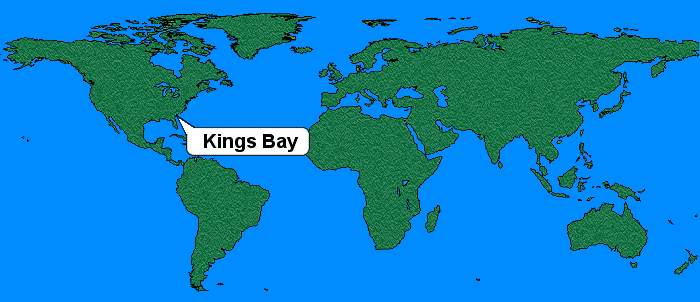
| Homeport: Kings Bay, Georgia | |
| Crew: 17 Officers, 15 Chief Petty Officers and 122 Enlisted (2 crews) |
 back to top go to the end of the pageback to top go to the end of the page
Crew List:
This section contains the names of sailors who served aboard USS ALASKA. It is no official listing but contains the names of sailors who submitted their information.
back to top go to the end of the pageback to top go to the end of the pageHistory of USS ALASKA:
USS ALASKA is the seventh OHIO-class nuclear-powered ballistic missile submarine. The construction contract was awarded to the Electric Boat Division of General Dynamics at Groton, Connecticut, on February 27, 1978. Her keel was laid on March 9, 1983, and in April 1984, the first members of the precommissioning crew began assembling under Captain Paul L. Callahan. The submarine was launched and christened on January 12, 1985, sponsored by Catherine Stevens, wife of Senator Ted Stevens of Alaska.
Following the completion of construction and fitting-out, ALASKA began builder's sea trials in September 1985. The trials included evaluations of her nuclear propulsion plant, navigation equipment, combat systems and strategic missile installations. After completing acceptance testing, the submarine was delivered to the U.S. Navy in late November 1985. Additional training and preparations continued at Groton before her commissioning.
USS ALASKA (SSBN 732) was commissioned on January 25, 1986, at Naval Submarine Base New London, Connecticut, with Captain Paul L. Callahan commanding the Blue Crew and Captain Charles J. Chotvacs commanding the Gold Crew. Originally equipped with 24 Trident I (C4) submarine-launched ballistic missiles and four torpedo tubes, ALASKA was designed to conduct extended submerged strategic deterrent patrols. Her Blue and Gold Crews would alternate responsibility for the submarine, allowing extended operations at sea while providing time for training, maintenance and leave between patrols.
During the first months of 1986, ALASKA operated from New London and Port Canaveral, Florida, conducting shakedown training and operational evaluations. Both crews completed extensive engineering, navigation, tactical and strategic weapons training in preparation for the submarine's assignment to the Pacific Fleet. Her activities included testing of the strategic missile system and associated equipment, together with inspections intended to verify the readiness of the submarine and her crews for operational deterrent patrols.
On September 4, 1986, ALASKA departed the East Coast for her new homeport at Naval Submarine Base Bangor, Washington. During the transit, she passed through the Panama Canal and continued north along the Pacific coast. From September 21 to 29, the submarine visited San Francisco, California, before resuming her voyage to Washington. She arrived at Bangor on October 1 and was assigned to Submarine Squadron 17 under Submarine Group 9.
Following her arrival at Bangor, ALASKA completed preparations for strategic deterrent operations in the Pacific. On December 7, 1986, the Blue Crew departed on the submarine's first strategic deterrent patrol. During the patrol, the crew conducted strategic weapons readiness exercises, engineering training and operational evaluations while maintaining the submarine's assigned deterrent mission. ALASKA returned to Bangor on February 19, 1987, completing her first patrol.
The Gold Crew relieved the Blue Crew on February 22, 1987, and began preparations for the submarine's second strategic deterrent patrol. During March, ALASKA completed dock trials, a fast cruise and trials in Dabob Bay, followed by individual steaming exercises from March 16 to 20. On March 20, the Gold Crew departed Bangor for its first strategic deterrent patrol, the second patrol conducted by ALASKA. The submarine completed the patrol on May 26 and returned to Bangor two days later, following an Operational Reactor Safeguards Examination.
After the Gold Crew's return, ALASKA underwent another refit at Bangor while the Blue Crew prepared for the next patrol. During July 1987, members of the Gold Crew participated in honorary homeport ceremonies in Fairbanks, Anchorage and Seward, Alaska, strengthening the submarine's relationship with her namesake state. On July 21, Captain G. E. Bajuk relieved Captain Charles J. Chotvacs as commanding officer of the Gold Crew during a ceremony at Bangor.
The Gold Crew resumed command of ALASKA on September 7, 1987, and conducted post-refit dock trials and training during the remainder of the month. On October 1, the submarine departed Bangor for Pearl Harbor, Hawaii, to participate in a Training Readiness Evaluation. During the visit, she moored at Ford Island, offloaded operational torpedoes and embarked exercise torpedoes for the evaluation. Additional training and inspections followed in Hawaiian waters before the submarine prepared for another strategic deterrent patrol.
On October 26, 1987, ALASKA departed Pearl Harbor on the Gold Crew's second strategic deterrent patrol. During the patrol, she conducted personnel transfer operations near Port Angeles, Washington, and continued strategic readiness training. On December 9, ALASKA returned to Bangor, where the Gold Crew received the Trident Crew of the Year Award from the Bremerton Navy League. The submarine subsequently completed a Nuclear Weapons Proficiency Inspection and a Supply Management Inspection before the Blue Crew assumed command on December 13.
During the late 1980s, ALASKA continued conducting strategic deterrent patrols from Bangor, alternating between her Blue and Gold Crews. The submarine underwent regular maintenance at the Trident Refit Facility and participated in tactical readiness evaluations, engineering examinations and strategic weapons inspections. Her operations formed part of the Pacific Fleet's contribution to the United States' sea-based nuclear deterrent during the final years of the Cold War.
Following the end of the Cold War, ALASKA remained an active component of the Pacific Fleet's strategic submarine force. Throughout the early 1990s, she continued conducting deterrent patrols while participating in training and operational evaluations. During this period, the Navy also examined methods of extending submarine operations through replenishment and maintenance at locations other than the normal homeport.
In 1992, ALASKA participated in a series of Submarine Force Pacific continuity-of-operations exercises designed to evaluate alternative methods of supporting ballistic missile submarines during extended deployments. During one exercise, she received supplies by helicopter off Port Angeles, Washington, using Canadian helicopter assets. The operation demonstrated the feasibility of delivering essential supplies to a submerged strategic deterrent force without requiring a conventional port visit.
During another exercise in 1992, ALASKA conducted a mini-refit at Naval Magazine Indian Island, Washington, before continuing an extended strategic deterrent patrol. The availability tested procedures for providing maintenance and logistical support at a location outside the normal submarine refit facilities. Similar continuity-of-operations exercises were conducted by other Pacific Fleet ballistic missile submarines, including USS HENRY M. JACKSON (SSBN 730) and USS ALABAMA (SSBN 731), which participated in helicopter replenishment operations at separate locations in Alaska.
Throughout the remainder of the 1990s, ALASKA continued her strategic deterrent patrol schedule from Bangor. Her Blue and Gold Crews alternated between submerged patrols, refit periods, off-crew training and operational inspections. Maintenance and modernization of the submarine's engineering, navigation, communications and weapons systems continued as the Navy prepared to extend the service lives of the OHIO-class ballistic missile submarines beyond their original 30-year design period.
By the late 1990s, the Navy had decided to convert four of the remaining Trident I-equipped OHIO-class submarines to the more capable Trident II (D5) ballistic missile system. ALASKA was selected as the first submarine to undergo this backfit, followed by USS NEVADA (SSBN 733). The remaining two submarines selected for the program were USS HENRY M. JACKSON and USS ALABAMA.
On May 1, 2000, ALASKA entered Puget Sound Naval Shipyard in Bremerton, Washington, for an Engineered Overhaul and conversion from the Trident I (C4) to the Trident II (D5) weapons system. The availability involved extensive modifications to the submarine's missile tubes, fire-control equipment, navigation systems and associated electronics to accommodate the larger and more capable D5 missile. Additional work included maintenance of the propulsion plant, hull and supporting systems, together with upgrades to the combat system that enabled the submarine to employ Mk 48 Advanced Capability (ADCAP) torpedoes.
The Trident II backfit was completed on November 23, 2001, and the overall shipyard availability concluded on December 9. Unlike the later Engineered Refueling Overhaul, this modernization did not include refueling the submarine's nuclear reactor. Following completion of the work, ALASKA conducted post-overhaul sea trials and preparations for testing the modified strategic weapons system.
On March 16, 2002, ALASKA successfully launched an unarmed Trident II (D5) ballistic missile during a Demonstration and Shakedown Operation off the Florida coast. The launch was the first D5 test conducted by an OHIO-class submarine that had been converted from the original Trident I configuration. It demonstrated the operational readiness of the modified weapons system and confirmed the successful integration of the D5 missile into the submarine.
Following the missile test, ALASKA completed further operational preparations at Naval Submarine Base Kings Bay, Georgia. On May 1, 2002, she completed the first strategic loadout of Trident II missiles conducted by a backfitted ballistic missile submarine at Strategic Weapons Facility Atlantic. After completing the required inspections and certifications, ALASKA resumed strategic deterrent operations with the Trident II system while remaining assigned to the Pacific Fleet.
During the following years, ALASKA continued operating from Naval Base Kitsap-Bangor, conducting strategic deterrent patrols and participating in regular operational evaluations. The new missile system provided greater range and accuracy than the original Trident I equipment, while the submarine's two-crew system continued to support an extended patrol schedule. Her performance was recognized with the Submarine Squadron 17 Battle Efficiency "E" award for 2004 and the United States Strategic Command Omaha Trophy for 2005.
On July 8, 2006, ALASKA departed Naval Base Kitsap-Bangor for the final time before transferring to the Atlantic Fleet. She proceeded to the East Coast to begin a major Engineered Refueling Overhaul at Norfolk Naval Shipyard in Portsmouth, Virginia. The transfer marked the end of approximately twenty years of Pacific Fleet service, during which ALASKA had operated with both the Trident I and Trident II ballistic missile systems.
The Engineered Refueling Overhaul formally began at Norfolk Naval Shipyard on October 1, 2006. The availability included refueling the submarine's S8G nuclear reactor, extensive maintenance and repairs to the propulsion plant, modernization of electronic and navigation equipment, and structural and habitability work. The overhaul was intended to restore the submarine's material condition and support continued service during the second half of her planned 42-year operational life.
During the overhaul, shipyard personnel and the submarine's crew completed extensive testing and modernization of engineering, mechanical and electrical systems. The work also included upgrades to equipment required for strategic operations and maintenance of the Trident II weapons system. The overhaul was completed on March 8, 2009, after which ALASKA conducted post-maintenance sea trials and preparations for returning to operational service.
On April 1, 2009, ALASKA arrived at Naval Submarine Base Kings Bay, Georgia, which became her new permanent homeport. On May 1, she was formally assigned to Submarine Squadron 20 under Submarine Group 10, joining the Atlantic Fleet's Trident II-equipped ballistic missile submarine force. Following her arrival, ALASKA completed additional operational training and certifications before resuming strategic deterrent patrols.
On December 19, 2009, ALASKA successfully launched an unarmed Trident II (D5) ballistic missile during a Demonstration and Shakedown Operation in the Atlantic Ocean. The launch marked the 130th consecutive successful test flight of the Trident II missile system since testing began in 1989. The test verified the readiness of the submarine's strategic weapons system following her Engineered Refueling Overhaul and return to operational service.
During 2010, ALASKA continued operating from Kings Bay as part of the Atlantic Fleet's strategic deterrent force. On April 28, the Navy announced plans to integrate female officers into the submarine force, and ALASKA was identified as one of the submarines selected for modifications to accommodate the new personnel arrangements. The planned alterations included changes to berthing and sanitary facilities to provide appropriate privacy and accommodations for female officers.
Throughout the early 2010s, ALASKA continued conducting strategic deterrent patrols from Kings Bay while undergoing periodic maintenance and operational evaluations. Her Blue and Gold Crews alternated between submerged patrols and training ashore, maintaining the readiness of the submarine and her Trident II missile system. ALASKA received the Submarine Squadron 20 Battle Efficiency "E" awards for 2011 and 2012, along with the United States Strategic Command Omaha Trophies for those competition years.
ALASKA also received a Meritorious Unit Commendation for operations conducted between October 2011 and December 2013. The award recognized sustained superior performance in strategic operations, weapons readiness, navigation, communications and other areas of operational proficiency. During the same period, the submarine supported training and qualification programs for officers and enlisted personnel assigned to the Atlantic Fleet's strategic submarine force.
During 2014, ALASKA continued her operational schedule from Kings Bay, conducting strategic deterrent patrols and readiness evaluations. Her crews maintained high levels of operational and engineering proficiency while supporting training for midshipmen and officers preparing for future submarine command assignments. ALASKA received the Battle Efficiency "E" and Omaha Trophy for 2014, recognizing her performance within the ballistic missile submarine force.
On May 18, 2015, U.S. Fleet Forces Command announced that ALASKA had been selected as the recipient of the 2014 Battenberg Cup, recognizing her as the best all-around ship or submarine in the Atlantic Fleet. She became the first ballistic missile submarine to receive the award. The Battenberg Cup was formally presented to ALASKA during a ceremony at Naval Submarine Base Kings Bay on October 26, 2015, by Vice Admiral Joseph Tofalo, Commander, U.S. Submarine Forces.
During the following years, ALASKA continued conducting strategic deterrent patrols and receiving recognition for operational performance. On February 14, 2014, Commander Craig Gummer had relieved Commander Robert Wirth as commanding officer of the Gold Crew, while Commander David Forman assumed command of the Blue Crew from Commander Todd Figanbaum on March 27, 2015. The Blue and Gold Crews continued their regular patrol rotation from Kings Bay during these changes of command.
On September 30, 2016, Commander Eric Cole relieved Commander Craig Gummer as commanding officer of ALASKA's Gold Crew during a ceremony at Naval Submarine Base Kings Bay. During Gummer's command, the crew had maintained a demanding operational schedule while contributing to the submarine's repeated Battle Efficiency and strategic readiness awards. ALASKA continued her strategic deterrent patrols during the remainder of the year.
During 2016, ALASKA completed three strategic deterrent patrols totaling 270 days at sea, including the longest continuous alert period conducted by a Kings Bay-based ballistic missile submarine during the preceding four years. Her performance earned the Submarine Squadron 20 Battle Efficiency "E" and the United States Strategic Command Omaha Trophy for 2016. The Omaha Trophy was presented to the crew by Vice Admiral Charles A. Richard, Deputy Commander of U.S. Strategic Command, during a ceremony at Kings Bay on August 3, 2017.
ALASKA also received the Marjorie Sterrett Battleship Fund Award for the Atlantic Fleet for 2016. The award was announced in NAVADMIN 145/17 on June 21, 2017, and recognized superior performance in the Navy's battle efficiency competition. The award complemented the submarine's other achievements in strategic readiness, personnel training and operational evaluations.
On June 15, 2017, ALASKA marked the completion of her 100th strategic deterrent patrol. The milestone was commemorated by members of the crew during an event at Kings Bay that also included a medical evacuation exercise with a U.S. Coast Guard HH-65 Dolphin helicopter. Sailors assembled on the submarine's missile deck for photographs marking the completion of the 100th patrol. The achievement was subsequently recognized by the Navy as a major milestone in the operational history of the OHIO-class ballistic missile submarine force.
On September 29, 2017, Commander David Brooks relieved Commander David Forman as commanding officer of ALASKA's Blue Crew during a ceremony at Kings Bay. The submarine continued her patrol schedule while preparing for further testing and modernization of the Trident II weapons system. Her crews also participated in regular engineering inspections, tactical training and personnel qualification programs.
In June 2018, ALASKA conducted a Trident II D5 Life Extension Commander Evaluation Test off the Florida coast. The evaluation included the successful launch of four unarmed Trident II D5LE ballistic missiles, with the final launch conducted on June 23. ALASKA was the first ballistic missile submarine to conduct this type of D5LE Commander Evaluation Test. The tests demonstrated the performance and reliability of the modernized strategic weapons system and completed the initial D5LE Commander Evaluation Test flight series for the OHIO-class submarine force.
Following the missile tests, ALASKA continued her regular operational schedule from Kings Bay. On November 14, 2018, the Blue Crew returned from another strategic deterrent patrol. During the same month, eight members of the submarine's crew, including the commanding officer and chief of the boat, conducted a six-day visit to the state of Alaska. The visit included meetings with local officials, schools and community organizations and provided opportunities to discuss the submarine's mission and its connections to the state.
On May 31, 2019, Commander Adam J. Thomas relieved Commander Eric D. Cole as commanding officer of ALASKA's Gold Crew during a ceremony at Naval Submarine Base Kings Bay. During Cole's command, ALASKA had completed operational deployments, maintenance periods and inspections, including the successful D5LE Commander Evaluation Test in 2018. The Gold Crew subsequently continued preparations for additional strategic deterrent operations.
On July 2, 2019, ALASKA's Blue Crew arrived at Her Majesty's Naval Base Clyde in Faslane, Scotland, for a scheduled port visit. The visit strengthened cooperation between the U.S. Navy and the Royal Navy and provided an opportunity for logistical support and crew liberty while the submarine operated in European waters. During the same period of overseas operations, ALASKA conducted a crew exchange at Faslane, described by the Navy as the first overseas crew exchange by a U.S. ballistic missile submarine since the end of the Cold War.
Following the visit to Scotland, ALASKA resumed operations in the Atlantic and Mediterranean regions. On September 9, 2019, the Gold Crew returned to Naval Submarine Base Kings Bay after completing a strategic deterrent patrol. During the year, ALASKA received further recognition for operational performance, including the Battle Efficiency "E" and the United States Strategic Command Omaha Trophy for 2019.
On September 23, 2019, ALASKA began an Extended Refit Period at Kings Bay. The availability involved extensive maintenance and repairs to the submarine's hull, engineering, mechanical and electrical systems, together with work on equipment required for continued strategic operations. The submarine was placed in dry dock at the Trident Refit Facility, where maintenance personnel completed repairs, inspections and equipment replacements during the following months.
In May 2020, ALASKA was photographed in the Trident Refit Facility dry dock following completion of an extended repair and maintenance period. The availability supported the submarine's continued operational service and addressed maintenance requirements associated with her increasing age. Following the work, ALASKA underwent post-maintenance testing and preparations before returning to her regular strategic deterrent patrol schedule.
On April 3, 2020, Commander William Dull relieved Commander David Brooks as commanding officer of ALASKA's Blue Crew during a ceremony at Naval Submarine Base Kings Bay. The change of command took place during the COVID-19 pandemic, when the Navy implemented additional measures to protect submarine crews and maintain the operational readiness of its strategic forces. ALASKA continued preparations for further deterrent patrols under the new commanding officer.
On June 28, 2021, ALASKA arrived at the Port of Gibraltar for a scheduled three-day visit while operating in the U.S. Sixth Fleet area of responsibility. The visit provided logistical support and demonstrated the ability of a Kings Bay-based ballistic missile submarine to operate from allied facilities in the eastern Atlantic. Following the port visit, ALASKA continued operations before returning to Naval Submarine Base Kings Bay on October 1, 2021, with her Gold Crew.
On October 29, 2021, Commander Justin R. Hardy relieved Commander Adam J. Thomas as commanding officer of ALASKA's Gold Crew during a ceremony at Naval Submarine Base Kings Bay. During Thomas' command, the submarine had completed three strategic deterrent patrols, conducted the overseas crew exchange at Faslane and operated in the Mediterranean with a port visit to Gibraltar. The crew had also received the Battle Efficiency "E", Omaha Trophy and Retention Excellence Awards.
For her performance during 2021, ALASKA was again selected as the ballistic missile submarine recipient of the United States Strategic Command Omaha Trophy. The award was announced in March 2022 and marked the fifth time in ten years that ALASKA had received the trophy. Both the Blue and Gold Crews were recognized for their sustained performance in strategic deterrence operations, maintenance, training and operational readiness.
On June 3, 2022, Commander John C. Smith relieved Commander William Dull as commanding officer of ALASKA's Blue Crew during a ceremony at the chapel at Naval Submarine Base Kings Bay. During Dull's command, the crew had completed two strategic deterrent patrols and a sixteen-month maintenance availability. The submarine subsequently continued training and operational preparations under Smith's command.
During 2023 and 2024, ALASKA remained assigned to Submarine Squadron 20 under Submarine Group 10 at Naval Submarine Base Kings Bay. Her Blue and Gold Crews continued conducting strategic deterrent patrols, maintenance and operational evaluations in support of the Atlantic Fleet's sea-based nuclear deterrent mission. Details of individual patrols and operating areas were generally not publicly released because of the strategic nature of the submarine's assignments.
During 2025, ALASKA continued serving as an active OHIO-class ballistic missile submarine from Kings Bay. Public Navy publications included photographs of the submarine during the extended maintenance period completed in 2020, while current fleet information continued to identify her as a unit of Submarine Squadron 20. The Navy also continued evaluating maintenance requirements and the remaining service lives of the OHIO-class submarines as preparations proceeded for their eventual replacement by the COLUMBIA-class.
On January 25, 2026, ALASKA reached the 40th anniversary of her commissioning. The submarine remained part of the Atlantic Fleet's strategic deterrent force as the Navy continued preparations for the introduction of the COLUMBIA-class ballistic missile submarines. Her continued service was supported by the nuclear reactor refueling, weapons system modernization and maintenance programs completed during her career.
According to the Navy Shipbuilding Plan published in May 2026, ALASKA was not among the submarines scheduled for inactivation during fiscal years 2027 through 2031. However, the Navy continued evaluating the material condition, operational requirements and remaining service lives of individual OHIO-class submarines as they approached or exceeded their originally planned 42-year service lives.
back to top go to the end of the pageAbout the Submarine's Name, about the State of Alaska:
Alaska is the largest state of the United States by area and is located in the northwestern part of North America. Its name is derived from the Aleut word "alaxsxaq", referring to the mainland. Alaska is also commonly known as "The Last Frontier", a nickname associated with its extensive wilderness areas and relatively low population density.
With a land area of approximately 571,000 square miles (1.48 million square kilometers), Alaska is more than twice the size of Texas. Its coastline extends along the Arctic Ocean, the Bering Sea and the Gulf of Alaska and includes numerous islands and archipelagos. The state's geography encompasses mountain ranges, forests, tundra, rivers, lakes and extensive glaciers. Denali, also known as Mount McKinley, is the highest mountain in North America, reaching an elevation of 20,310 feet (6,190 meters). Alaska is also home to an estimated 100,000 glaciers.
Indigenous peoples have inhabited Alaska for thousands of years, developing diverse cultures and communities across the region. Russian explorers and traders established settlements beginning in the 18th century, and in 1867 the United States purchased Russia's territorial claims to Alaska for $7.2 million. The formal transfer took place on October 18, 1867. Alaska became a civil district in 1884 and was organized as a U.S. territory in 1912. A state constitution was adopted in 1956, and on January 3, 1959, Alaska was admitted to the Union as the 49th state.
Alaska's large size, mountainous terrain and widely dispersed communities have shaped its transportation infrastructure and economic development. Many settlements are not connected to the state's highway network and depend on aviation and marine transportation for passenger travel, freight and essential services. Roads, railways, airports and the Alaska Marine Highway System provide connections between communities and with other parts of North America. Major economic activities include commercial fishing, oil and gas production, mining and tourism, while the state's population reflects a variety of Indigenous cultures and other communities.
back to top go to the end of the pageUSS ALASKA Image Gallery:
 |
The photo below was taken by Jim Chestnut and shows the ALASKA at Her Majesty's Naval Base (HMNB) Clyde at Faslane, Scotland, on July 4, 2019.
 |
back to top
 Back to Ballistic Submarines list. Back to ships list. Back to selection page. Back to 1st page.