![]() |
Search the Site with
|


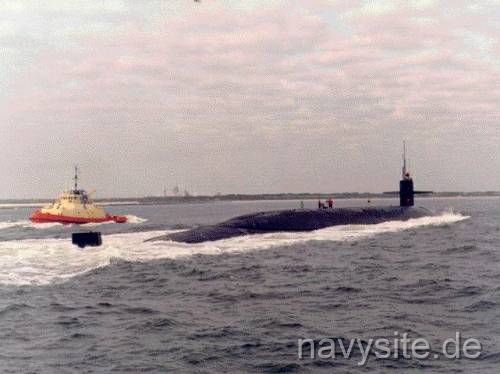
USS HENRY M. JACKSON is the fifth OHIO-class Fleet Ballistic Missile Submarine and the only SSBN in the OHIO class named after a person.
| General Characteristics: | Keel Laid: January 19, 1981 |
| Launched: October 15, 1983 | |
| Commissioned: October 6, 1984 | |
| Builder: General Dynamics Electric Boat Division, Groton, Conn. | |
| Propulsion system: one nuclear reactor | |
| Propellers: one | |
| Length: 560 feet (171 meters) | |
| Beam: 42 feet (12.8 meters) | |
| Draft: 36,5 feet (11.1 meters) | |
| Displacement: Surfaced: approx. 16,765 tons Submerged: approx. 18,750 tons | |
| Speed: 20+ knots | |
| Armament: 24 tubes for Trident | |
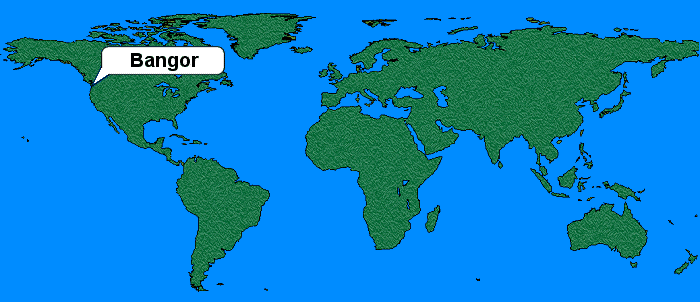
| Homeport: Bangor, Wash. | |
| Crew: 17 Officers, 15 Chief Petty Officers and 122 Enlisted (2 crews) |
Crew List:
This section contains the names of sailors who served aboard USS HENRY M. JACKSON. It is no official listing but contains the names of sailors who submitted their information.
Accidents aboard USS HENRY M. JACKSON:
| Date | Where | Events |
|---|---|---|
| November 6, 1987 | off Bangor, Wash | HENRY M. JACKSON collided with the fishing boat SOUTH PAW. The Navy paid $25,721. |
About the Submarine's Name, about Henry M. Jackson:
Henry M. Jackson served on Capitol Hill for 42 years, the last 31 of which he spent in the Senate. As a dominant member of the Senate Armed Services Committee, he led an important faction within the Democratic party in his support of a more aggressive role in world affairs. Senator Jackson was a strong proponent of the TRIDENT submarine program, a watchdog over U.S.-U.S.S.R. relations, and a critic of SALT. Held in the ship's library and dating back to 1955 is a set of point papers, newspaper articles, and speeches which give clear testimony to his firm commitment to rapid development of nuclear submarines and the POLARIS program (vessels which he often called "underwater satellites"); a greatly expanded attack submarine program to counter a rapidly growing Soviet fleet; emphasis upon arctic operations; and most recently, the TRIDENT program. In 1959, after riding the USS SKIPJACK (SSN 585) at sea with (then) VADM Rickover, Senator Jackson called for the establishment of a Deputy Chief of Naval Operations for Undersea Warfare because he believed submarines were "lost in a welter of naval bureaucracy."
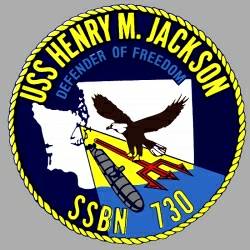
Senator Jackson was lauded as a true "Defender of Freedom" in a speech given on the Senate floor shortly after his death. These words are now, appropriately, found in the ship's insignia.
In a September 1973 Senate speech, Senator Jackson stated the following:
"If we choose the prudent course - to proceed without delay with the TRIDENT program - we can at least be certain that we will have done what we can do to support the effort of our negotiators to obtain an equitable SALT agreement if we can - and to protect our national security if we cannot."
This submarine bearing his name is a fitting tribute to the man who so labored to keep America strong and free.

USS HENRY M. JACKSON History:
USS HENRY M. JACKSON is an OHIO-class nuclear-powered ballistic missile submarine of the United States Navy and the only boat of her class not named for a U.S. state. She honors senator Henry M. "Scoop" Jackson of Washington (1912-1983), a powerful Cold War legislator closely associated with strong defense and human-rights-focused foreign policy. Conceived as part of the TRIDENT sea-based deterrent during the late 1970s arms competition with the Soviet Union, she has spent her career providing continuous strategic deterrent patrols from the Pacific Northwest, moving from Cold War operations into the post-Cold War and contemporary great-power competition eras.
The contract to build the submarine was awarded to the Electric Boat Division of General Dynamics at Groton, Connecticut, on June 6, 1977, when the hull was still intended to bear the name RHODE ISLAND. Her keel was laid at Electric Boat on January 19, 1981, making her the fifth hull in the OHIO-class. On September 1, 1983, senator Henry M. Jackson died suddenly while in office. In the months that followed, the Navy reassigned the name originally planned for the boat and redesignated SSBN 730 as USS HENRY M. JACKSON, transferring the name RHODE ISLAND to a later hull, SSBN 740.
The submarine was launched at Groton on October 15, 1983, sponsored by the senator's daughter Anna Marie Jackson. After fitting-out and pierside tests, she was commissioned on October 6, 1984, at Groton, with separate blue and gold crews under Captain R. Tindal (Blue) and Captain M. A. Farmer (Gold). From the outset, she was armed with TRIDENT I (C4) submarine-launched ballistic missiles and Mk-48 torpedoes, joining the Atlantic-based TRIDENT force at a time when the United States and Soviet Union were still deeply engaged in nuclear arms competition despite emerging arms-control efforts.
Immediately after commissioning, USS HENRY M. JACKSON entered the standard new-construction sequence of post-delivery trials, shakedown operations and missile system certification. On December 4, 1984, she conducted a Demonstration and Shakedown Operation (DASO) launch of a TRIDENT I (C4) missile, an event recorded as the 21st DASO firing for the C4 system and the 46th TRIDENT flight overall. This test, carried out under the oversight of the Navy's Strategic Systems Programs, was intended to prove the integration of her launch tubes, fire-control, navigation and crew procedures before she entered routine deterrent service. Photographs from late 1984 also show the boat launching a UGM-96A TRIDENT I missile, underlining her role in qualifying the class and missile system at sea.
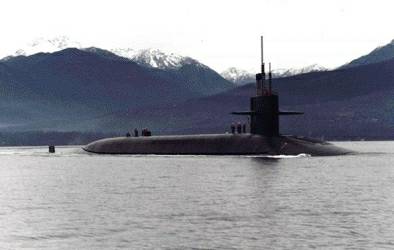
Following shakedown and post-shakedown availability, the submarine shifted her focus toward the Pacific, in line with the Navy's plan to base a substantial portion of the OHIO-class at the new TRIDENT facility at Naval Submarine Base Bangor, Washington. By May 1985, she was photographed at Bangor's magnetic silencing facility, undergoing deperming to optimize her acoustic and magnetic signatures for extended deterrent operations. In July 1985, another image shows her operating in Hood Canal, Washington, evidencing her integration into local waterways and the approach route to Bangor. During these years, she established the pattern that would characterize most of her career: alternating blue and gold crews taking the boat on extended submerged strategic patrols in the Pacific, interspersed with relatively short in-port refit and maintenance periods at Bangor.
Through the mid-1980s, USS HENRY M. JACKSON's operations reflected the final phase of the Cold War, as the United States deployed modern sea-based systems intended to survive any first strike and thus stabilize nuclear deterrence. In June 1987, she was photographed alongside at Naval Submarine Base Bangor, illustrating her status as a fully integrated unit of the Pacific TRIDENT force. That same year, the risks of operating a large submarine in congested coastal waters became evident. On November 6, 1987, while submerged off the Washington coast near Bangor, the submarine collided with the fishing vessel SOUTH PAW. Public records show that the Navy compensated the fishing-boat owners $25,721. The submarine suffered no significant damage, and there were no reports of injuries on board the SSBN. The incident took place during a period when TRIDENT patrols were being conducted at high tempo to ensure constant coverage against the Soviet Union, even as arms-control agreements such as the Intermediate-Range Nuclear Forces (INF) Treaty were being negotiated.
Even as she operated from Bangor, USS HENRY M. JACKSON periodically visited other ports for upkeep and training. Official imagery record her presence at Pearl Harbor, Hawaii, in September 1987 and again in July 1989, indicating that she used Pearl Harbor both for logistics and as a waypoint during patrols or post-deployment movements. These port calls, occurring while the Cold War was still active but entering its final years, underscore the boat's integration into the broader Pacific infrastructure supporting U.S. sea-based nuclear forces. Her missile-system testing also continued: open sources on TRIDENT I chronology record that on October 13, 1988, she carried out a Follow-on Operational Test firing of C4 missiles, contributing data to validate the missile’s performance at sea as the system matured.
With the collapse of the Soviet Union between 1989 and 1991, the strategic context of the boat's patrols changed, but the basic pattern of her operations did not. During the early 1990s, USS HENRY M. JACKSON continued to conduct regular strategic deterrent patrols in the Pacific and mid-Pacific areas, now aimed at ensuring a survivable nuclear force while the United States and Russia implemented treaties such as START I and adapted their force structures to post-Cold War realities. Public details of individual patrols in this period remain classified, but official summaries later noted that from 1990 onward, the submarine was assigned primarily to Pacific patrols, operating from Bangor as part of the continuous at-sea deterrent posture maintained by the U.S. strategic triad.
In the mid-1990s, as the Navy cautiously increased the visibility of some TRIDENT activities, USS HENRY M. JACKSON made at least one high-profile public port visit. A technical study on submarine logistics records that the boat visited San Francisco Bay during Fleet Week in October 1995, appearing alongside surface combatants in a demonstration of naval presence shortly after the end of the Cold War. At the same time, she continued her routine pattern of submerged patrols and Bangor refits. Navy records summarized in secondary sources indicate that by 1996 the boat's performance had earned squadron-level recognition, including a Battle Efficiency "E" and a Strategic "S" award, reflecting superior readiness and consistent completion of assigned deterrent missions during that period.
Toward the end of the decade the wear of constant patrols required more substantial maintenance than the normal refit between deployments. Command histories, as synthesized in later summaries, describe an extended refit period at the Trident Refit Facility Bangor in the late 1990s, during which the submarine underwent extensive sonar, mechanical and habitability work to reset her material condition for the second half of her service life. Although the exact day-by-day schedule remains in classified or archival documents, the effect was to concentrate several years of incremental maintenance into a single, longer availability, after which USS HENRY M. JACKSON resumed deterrent patrols with refurbished non-nuclear systems and updated sensors suited to the quieter operating patterns required in the post-Cold War environment.
In the early 2000s, the submarine entered her mid-life Engineered Refueling Overhaul (ERO) at Puget Sound Naval Shipyard in Bremerton, Washington. Navy and analytical sources indicate that this overhaul, begun in the early 2000s and completed before April 2007, included replacement of the nuclear reactor core, major inspection of the pressure hull and structural components, and modernization of propulsion and auxiliary systems to support an extended 42-year service life.
On October 1, 2004, while at Puget Sound, USS HENRY M. JACKSON entered a TRIDENT II (D5) backfit period, converting her missile-handling and fire-control systems from the original TRIDENT I (C4) configuration to the newer D5 system. This upgrade, carried out in parallel with similar conversions on other OHIO-class SSBNs, ensured that the boat could carry the longer-range, higher-accuracy D5 missiles that became the backbone of U.S. sea-based nuclear forces in the 21st century. By the time she completed her ERO and backfit, she returned to operations as a D5-equipped platform, ready for another two decades of patrols.
After refueling and conversion, USS HENRY M. JACKSON resumed regular deterrent patrols from Bangor. Across the late 2000s, her blue and gold crews alternated deployments that typically kept the submarine submerged for months at a time, with only brief returns to port for turnover and maintenance. In this phase her operations supported evolving U.S. strategic policy, which increasingly emphasized maintaining a smaller but highly survivable triad under the constraints of treaties such as the Moscow Treaty and New START. In 2010, U.S. Strategic Command publicly noted that the submarine had completed her 75th strategic deterrent patrol, highlighting her long-term contribution to the continuous at-sea deterrent posture.
Photographs from January 21, 2012, show the boat moored at Naval Base Kitsap-Bangor (the successor to Naval Submarine Base Bangor) after a strategic deterrent patrol, illustrating the routine cycle of deployments and returns that framed her later career. On May 15, 2012, USS HENRY M. JACKSON reached a notable milestone: she became the first Ohio-class SSBN to complete 80 TRIDENT strategic deterrent patrols, a fact formally noted in U.S. Navy public releases. This achievement underscored both the durability of her design and the intensity of her operational use since the mid-1980s. At that point she had spent much of nearly three decades cycling between submerged patrols in the Pacific and Middle Pacific and short periods in Bangor for maintenance and crew exchange, largely unseen by the public except when transiting Hood Canal or appearing in occasional photographs.
In 2014, the submarine and her crews marked the 30th anniversary of her commissioning. The anniversary fell on October 6, 2014, and commemorative events included Navy public-affairs coverage and a special pictorial postmark issued by the Keyport, Washington, post office recognizing "USS HENRY M. JACKSON SSBN 730 - 30th Commissioning Anniversary".
The ship's sponsor, Anna Marie-Laurence, daughter of senator Jackson, spoke at a ceremony honoring three decades of service. At roughly the same time, photographs from Naval Base Kitsap-Bangor show USS HENRY M. JACKSON moored alongside fellow TRIDENT boat USS LOUISIANA (SSBN 743), emphasizing her place within a larger Pacific SSBN squadron. In 2013 and 2014, she is repeatedly documented departing Bangor for sea trials and returning from patrols, reflecting the continued high tempo of her deterrent mission in an era when U.S. planners were increasingly focused on Pacific security dynamics involving China and North Korea.
The mid-2010s brought further visible evidence of both sustained operations and life-extension work. On May 5, 2015, USS HENRY M. JACKSON arrived home at Naval Base Kitsap-Bangor after a strategic deterrent patrol, a return captured in official imagery and press captions. On February 15, 2016, photographs show the gold crew transiting Hood Canal on the way back to Bangor following another routine deterrent patrol, with the submarine framed against the Olympic Mountains - an image later reused in multiple Navy and analytical publications to illustrate OHIO-class operations.
In August 2017 the boat was documented sitting in dry dock at Bangor while the Intermediate Maintenance Facility carried out "extensive maintenance, upgrades and refurbishments to extend the life of the boat", part of the broader effort to sustain early-commissioned OHIO-class SSBNs through 42 years of service while the COLUMBIA-class replacement program proceeded.
In the late 2010s and early 2020s, USS HENRY M. JACKSON continued to operate on a steady cycle of strategic patrols. Public imagery and Navy social-media releases periodically show her transiting Puget Sound and Hood Canal or arriving at Bangor after deterrent patrols, reinforcing the pattern of continuous deployment under Submarine Group 9 and Submarine Squadron 17 administrative control. The submarine also participated in emerging logistics and readiness experiments. Navy and Pacific Fleet releases describe OHIO-class SSBNs, including USS HENRY M. JACKSON, working with a U.S. Air Force C-17 Globemaster III and Marine Corps units in vertical replenishment and unmanned aerial-systems demonstrations, exploring new ways to deliver small loads of supplies to submarines at sea without requiring them to enter port or surface for extended periods. These tests reflected the increasing emphasis on dispersed, resilient operations in a Pacific region characterized by improving anti-submarine capabilities among potential adversaries.
A major operational milestone came in 2020. On May 21, 2020, Navy photographs from Silverdale, Washington, record the gold crew deploying aboard USS HENRY M. JACKSON as the submarine set out on her 100th strategic deterrent patrol. The patrol itself, later highlighted in Navy and local media, marked the first time an OHIO-class SSBN had reached 100 deterrent patrols, and the event coincided with what would have been senator Jackson's 108th birthday. The boat returned to Bangor on August 5, 2020, after completing the patrol, closing out a sequence of one hundred extended, largely unseen deployments over more than three decades.
In the same year, the submarine's crews received multiple distinctions: she was awarded the 2020 Battle Efficiency "E" for Submarine Squadron Seventeen; her blue crew earned the Hugh McCracken Award for the best chief petty officer mess in the Pacific submarine force; and U.S. Strategic Command honored the boat with the Omaha Trophy for her contribution to the strategic deterrence mission.
Operational demands remained high even as the submarine aged. In July 2021, the gold crew conducted a change of command ceremony at sea while the submarine was underway, an unusual but deliberate demonstration that administrative transitions could be accomplished without interrupting deterrent patrol schedules. Navy reports noted that this approach reflected a broader effort to "think, act and operate differently" to meet strategic tasking while still completing required ship-lifecycle events.
In 2022, OHIO-class SSBNs in the Pacific, including USS HENRY M. JACKSON, were again highlighted in Navy public-affairs material for joint vertical-replenishment events that paired them with aircraft and unmanned systems, aligning submarine logistics with emerging distributed-maritime-operations concepts.
The human cost of sustained undersea operations also came into view. In November 2023, regional reporting from Kitsap County noted the death by suicide of a sailor assigned to USS HENRY M. JACKSON's blue crew at Naval Base Kitsap-Bangor, one of several such tragedies in the local naval community that year. The Navy responded with investigations and broader discussions about mental-health support and resilience programs for submarine crews, even as the boat continued her operational cycle. Official statements emphasized that strategic readiness remained intact while leadership focused on supporting sailors and families.
As she moved toward her planned fourth decade of service, USS HENRY M. JACKSON remained fully active. In May 2025, DVIDS and Navy captions documented the submarine transiting Hood Canal and passing through the Hood Canal Bridge on May 15, 2025, returning to Naval Base Kitsap-Bangor after another routine strategic deterrent patrol. U.S. Coast Guard and Military Sealift Command vessels escorted her along the confined waterway, a standard security practice for SSBN movements in the region. This patrol took place against a backdrop of renewed global tension, including Russian nuclear signaling during the Ukraine war and continued modernization of Chinese strategic forces, underscoring the continued relevance of Pacific-based sea-launched ballistic missile submarines.
From a programmatic standpoint, USS HENRY M. JACKSON was originally designed for a 30-year hull life, but the combination of her Engineered Refueling Overhaul and structural assessments extended her planned service to roughly 42 years. Navy analyses and public statements in the mid-2010s identified her as the first OHIO-class SSBN expected to reach that 42-year mark, implying a notional retirement around 2027, aligned with the phased introduction of the new COLUMBIA-class strategic submarines. However, persistent schedule and cost challenges in the COLUMBIA program led the Navy to consider limited life extensions for several OHIO-class boats, including USS HENRY M. JACKSON, to ensure there was no gap in the at-sea deterrent force as new hulls delivered.
USS HENRY M. JACKSON Image Gallery:
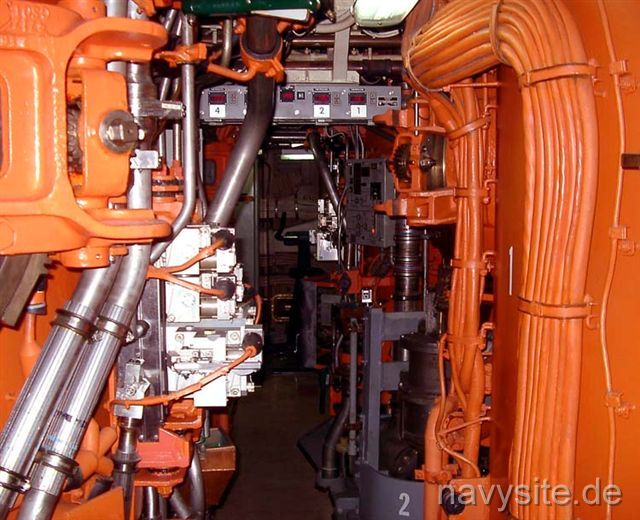
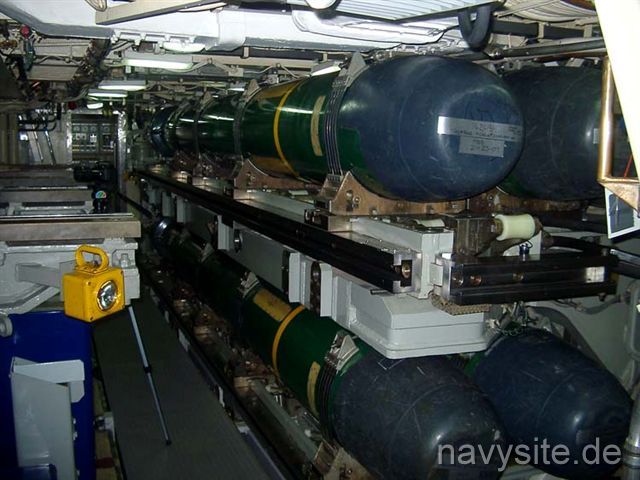
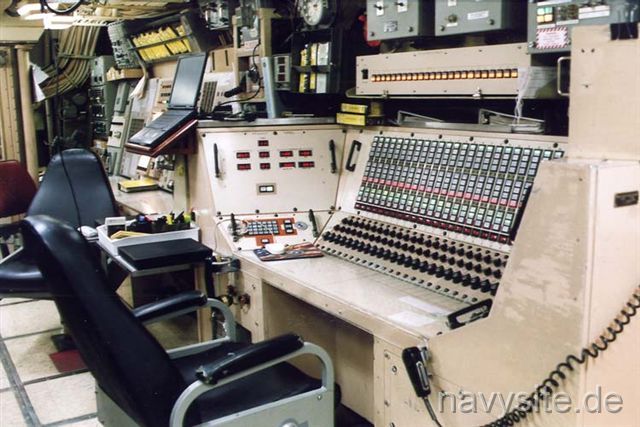
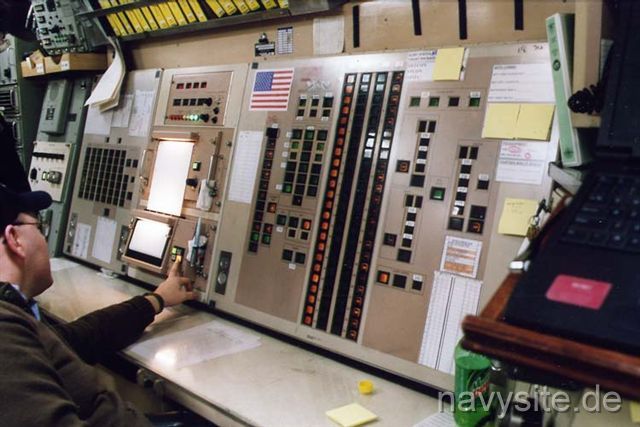
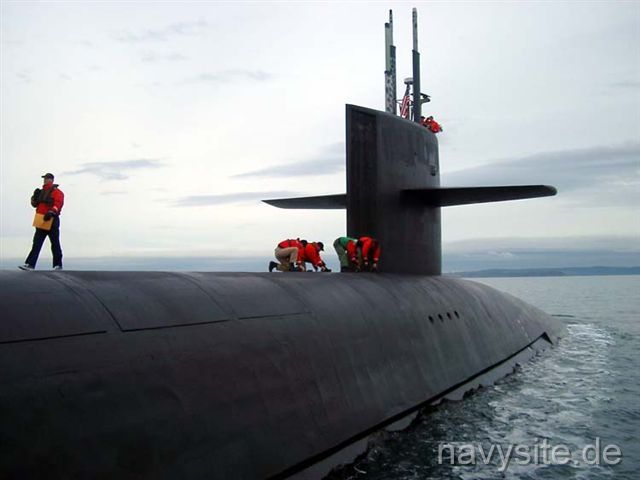
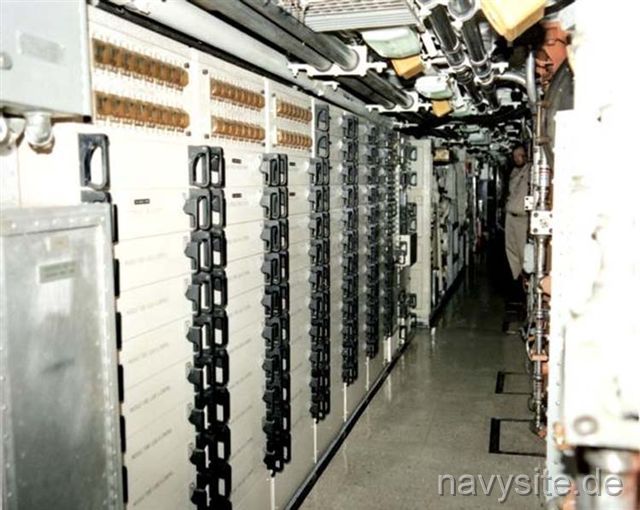
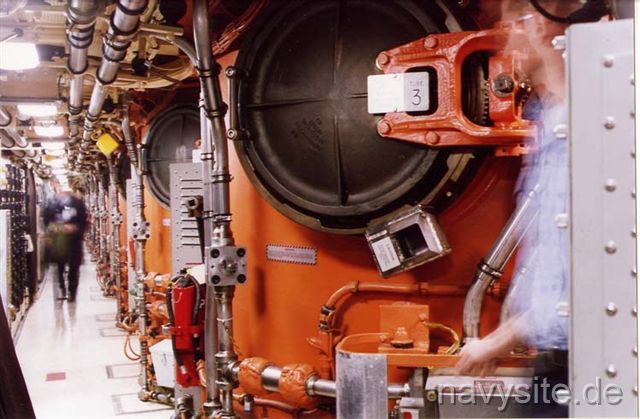
The photos below were taken by Jim Goodall during his visit aboard the HENRY M. JACKSON on January 8, 2004.
Back to Ballistic Submarines list.
Back to ships list.
Back to selection page.
Back to 1st page.