![]() |
Search the Site with
|


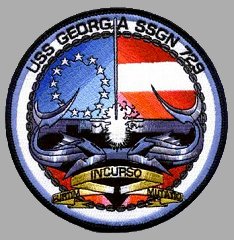
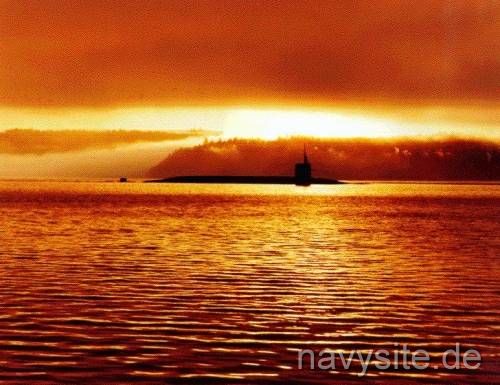
USS GEORGIA is the fourth OHIO - class submarine and the third ship to bear the name of this grand state, one of the thirteen original states of the Union.
In October 2005, conversion started to modify the USS GEORGIA to carry 154 conventional cruise missiles instead of 24 Trident missiles. After completion of the conversion, GEORGIA was redesignated SSGN 729. As an SSGN, GEORGIA is also able to support operations of up to 66 Special Forces Personnel for up to 90 days.
| General Characteristics: | Keel Laid: April 7, 1979 |
| Launched: November 5, 1982 | |
| Commissioned: February 11, 1984 | |
| Builder: General Dynamics Electric Boat Division, Groton, Conn. | |
| Propulsion system: one nuclear reactor | |
| Propellers: one | |
| Length: 560 feet (171 meters) | |
| Beam: 42 feet (12.8 meters) | |
| Draft: 36,5 feet (11.1 meters) | |
| Displacement: Surfaced: approx. 16,765 tons Submerged: approx. 18,750 tons | |
| Speed: 20+ knots | |
| Armament: Tomahawk missiles, | |
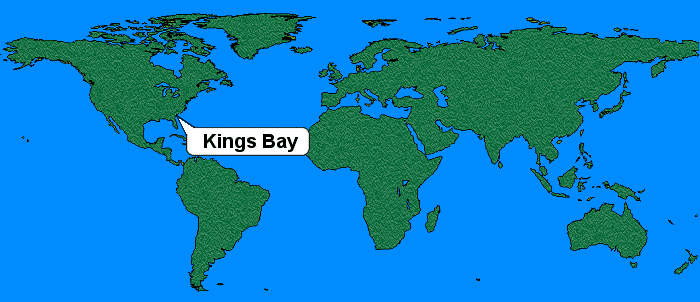
| Homeport: Kings Bay, Georgia | |
| Crew: 17 Officers, 15 Chief Petty Officers and 122 Enlisted |
Crew List:
This section contains the names of sailors who served aboard USS GEORGIA. It is no official listing but contains the names of sailors who submitted their information.
History of USS GEORGIA:
The story of USS GEORGIA begins with the decision to expand the fleet of OHIO-class ballistic missile submarines during the Cold War. The contract to build the submarine was awarded on February 20, 1976 to the Electric Boat Division of General Dynamics at Groton, Connecticut, reflecting the United States Navy's long-term commitment to sea-based nuclear deterrence. Her keel was laid down at Groton on April 7, 1979, at a ceremony presided over by Rosalynn Carter, whose initials were welded into the keel and remain part of the boat's structure. GEORGIA was launched at Groton in early November 1982, with Sheila M. Watkins, wife of the then Chief of Naval Operations Admiral James D. Watkins, acting as sponsor. After fitting-out and acceptance activities, she was commissioned as a fleet ballistic missile submarine on February 11, 1984, at Naval Submarine Base New London, with Captain A. W. Kuester commanding the Blue crew and Captain M. P. Gray commanding the Gold crew, entering service as the fourth TRIDENT-class ballistic missile submarine.
Immediately after commissioning, USS GEORGIA began the typical OHIO-class pattern of post-delivery trials and Demonstration and Shakedown Operations. From March to April 1984, she conducted her shakedown cruise, which included a test launch of a Trident I (C4) missile on April 7, 1984, on the Eastern Test Range, demonstrating that the new weapons system, crew, and platform could perform the nuclear deterrent mission as designed.
In November 1984, she arrived at her first operational home port, Bangor, Washington, then the principal Pacific base for the TRIDENT force. On December 3, 1984, she completed her first strategic weapons loadout at Strategic Weapons Facility Pacific (SWFPAC) at Bangor and deployed from the Pacific Northwest. On January 26, 1985, she began her first strategic deterrent patrol, inaugurating what would become a long sequence of patrols in the Pacific under the dual-crew system, with Blue and Gold crews alternating deployments and refit periods.
During 1985, USS GEORGIA combined routine deterrent patrols with a series of missile test events that further validated the Trident I system. On May 26, 1985, she launched four Trident I (C4) missiles in a series of follow-on operational test firings, and on September 12 and 13, 1985, she conducted two more C4 test launches, again on the Eastern Test Range.
These launches took place against the background of continuing Cold War tensions and were part of the broader U.S. program to verify reliability and accuracy of sea-based strategic missiles under operational conditions. At the same time, GEORGIA's routine patrols from Bangor placed her within Task Unit 14.7.1, for whose activities from September 1983 to May 1986 she and her associated units were awarded a Meritorious Unit Commendation, with a second Meritorious Unit Commendation recognizing submarine operations between February and August 1986.
A major incident in USS GEORGIA's early career occurred on March 22, 1986, near Midway Island in the central Pacific. While operating three miles south of Midway, she conducted a personnel transfer with harbor tug USS SECOTA (YTM 415). After taking aboard a crewman from GEORGIA who was departing on emergency leave, SECOTA reportedly lost power and drifted onto GEORGIA's starboard stern plane while the submarine's propeller continued to turn. SECOTA was holed and sank within about two minutes. Ten people, including the transferred submariner, were rescued, but two SECOTA crewmen trapped in the engine room were lost. Public Navy statements at the time described GEORGIA as undamaged, but later command history material indicates that after returning survivors to Hawaii, the submarine underwent emergency repairs for minor damage before resuming operations.
Through the late 1980s, USS GEORGIA continued a steady pattern of strategic deterrent patrols in the Pacific, interspersed with maintenance and training periods at Bangor and occasional port visits. Photographic records show her alongside at Pearl Harbor in March 1988 and again in November 1989, visits that reflected both routine logistics and the integration of TRIDENT-class submarines into broader Pacific Fleet activities at a time when the United States was managing the final years of the Cold War and its immediate aftermath.
Throughout this period, she remained assigned to Submarine Squadron 17 (SUBRON 17), operating from Naval Submarine Base Bangor, and gradually accumulated a growing total of deterrent patrols that made her a significant element of U.S. strategic posture in the Pacific.
In the early 1990s, with the Cold War over but strategic deterrence still central to U.S. policy, USS GEORGIA's operations continued to follow the established cycle of TRIDENT patrols. During these years, she conducted repeated deployments from Bangor, spending long periods submerged on deterrent patrols in the Pacific, while undergoing scheduled maintenance and training during refit periods. In 1993, she was featured with her crew in the Discovery Channel documentary "Submarines: Sharks of Steel", which provided one of the few public glimpses of life aboard a TRIDENT-class SSBN and reflected the interest in showing how the submarine force adapted to the post-Cold War environment.
A notable technical and operational milestone came in early 1994, when USS GEORGIA was selected to conduct the first Pacific Fleet SSBN Follow-on Commander-in-Chief Evaluation Test (FCINCET) in the Atlantic theater. From February to March 1994, she shifted from her usual Pacific operating areas to the Atlantic, where she performed a series of evaluation activities culminating on March 28, 1994 in the launch of four Trident I C4 missiles as part of the FCINCET program. These launches were designed to confirm that reliability and accuracy parameters remained within required limits over the service life of the weapon system, and the fact that a Pacific-based boat executed the test in the Atlantic illustrated the growing flexibility in how the remaining TRIDENT I inventory was managed as strategic forces were adjusted after the end of the Cold War.
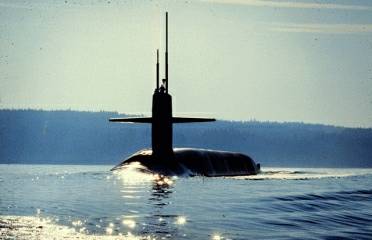
In the mid-1990s, USS GEORGIA continued to rotate through deterrent patrols and maintenance in the Pacific. A photograph from January 1997 shows her underway in Hood Canal, Washington, near Bangor, during local operations. Between March and July 1997, she underwent what sources describe as the first TRIDENT Extended Refit Period, a longer-than-usual maintenance and modernization interval intended to keep the platform and its systems fully effective while the overall number of SSBNs was being reduced under arms control agreements.
Through the late 1990s, she remained homeported at Bangor under SUBRON 17 and continued adding to her count of strategic patrols as the United States consolidated its ballistic-missile submarine force around the TRIDENT platform. By the early 2000s, USS GEORGIA had become one of the most heavily patrolling boats in the Pacific TRIDENT force. Her Gold crew earned the Commander, Submarine Squadron 17 Battle Efficiency "E" award for 2001, indicating superior performance across tactical, engineering, navigation, and administrative readiness metrics among the squadron's submarines. On October 30, 2003, she returned from her 65th and final strategic deterrent patrol, completing a patrol record that reflected nearly two decades of continuous service in the sea-based nuclear deterrent.
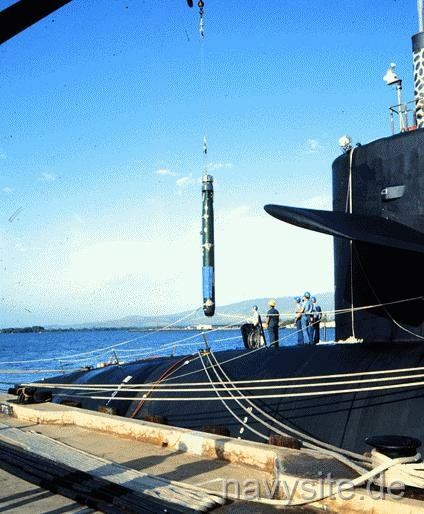
Shortly afterwards, on November 7, 2003, USS GEORGIA was involved in a serious but non-nuclear accident during missile offload at Bangor. While her Trident I C4 missiles were being removed at SWFPAC, the handling team opened missile tube 16, lowered a ladder into the tube so a sailor could attach a hoist, and then left the ladder in place when they took a break. On returning, they began hoisting the missile without first removing the ladder. The missile's nose struck the ladder, which punctured a roughly nine-inch hole in the nose cone before the operation was halted. No nuclear warheads were breached and no radioactive material was released, but the missile was damaged. Three enlisted members of the handling team faced courts-martial, and SWFPAC was shut down for a comprehensive inspection, which it initially failed. The facility's commanding officer, Captain Keith Lyles, was relieved of command on December 19, 2003, followed by his executive officer, weapons officer, and command master chief. SWFPAC was reopened after passing inspection on January 9, 2004 under new leadership. USS GEORGIA's crew was not held responsible for the incident and the boat herself remained available for further work.
As part of a broader reconfiguration of the U.S. strategic force and the transition from Trident I (C4) to Trident II (D5), USS GEORGIA was removed from strategic service on January 1, 2004, in preparation for conversion from a ballistic-missile to a guided-missile configuration.
On March 1, 2004, she was formally redesignated from SSBN 729 to SSGN 729, marking her future role as a guided-missile submarine capable of carrying large numbers of Tomahawk cruise missiles and supporting special operations forces. In October 2004, she took part as the command node in Exercise Silent Hammer, a concept demonstration for the SSGN program that showcased how an SSGN could act as an information and command hub for joint operations, integrating submarines with Marine and special operations forces ashore and afloat.
In early 2005, the submarine moved to the East Coast for conversion. In March 2005, she entered Norfolk Naval Shipyard at Portsmouth, Virginia, for an Engineered Refueling Overhaul and SSGN conversion carried out concurrently, following preparatory movements recorded in late 2004 and early 2005 photographs showing her at Norfolk and en route to the shipyard. Over the next several years, USS GEORGIA's ballistic-missile tubes were modified into multiple all-up-round canisters capable of launching Tomahawk cruise missiles, and spaces were reconfigured to support embarked special operations personnel and equipment, including the ability to carry dry deck shelters on her hull for swimmer delivery vehicles. The conversion and refueling work was completed in February 2008.
After leaving the shipyard, USS GEORGIA shifted her homeport from Bangor to Kings Bay, Georgia, under Submarine Squadron 16. She departed Norfolk in December 2007 and arrived at Naval Submarine Base Kings Bay later that month. On March 28, 2008, she was formally welcomed back into service at Kings Bay in a return-to-service ceremony attended by the governor of Georgia, Sonny Perdue, marking her transition from a ballistic-missile to a guided-missile role on the U.S. East Coast.
In the months that followed she conducted post-conversion trials and training at sea in the Atlantic and off Kings Bay, testing her new weapons-handling systems and dry deck shelter configurations while integrating into the Atlantic Fleet's operational plans.
By mid-2009, USS GEORGIA was ready for operational deployment as an SSGN. In July 2009, she was photographed at Port Canaveral, Florida, and underway in the Atlantic, reflecting pre-deployment operations from Kings Bay. In August 2009, she departed Kings Bay on her first SSGN deployment, initially operating in the Atlantic and then entering the U.S. Sixth Fleet area. During that deployment, she made port calls at Naples, Italy, and at Souda Bay, Crete, in August 2009, supporting NATO and U.S. presence missions in the Mediterranean. Her ability to carry large numbers of Tomahawk missiles and to embark special operations forces made her a flexible asset for regional contingencies, even though specific operational missions remained classified.
In early 2010, USS GEORGIA shifted toward the U.S. Fifth Fleet region. Photographs from February 2010 show her at Diego Garcia in the British Indian Ocean Territory, a key logistics and support hub for Indian Ocean and Middle East operations, and a further visit to Souda Bay, Crete, took place in July 2010 during the same general deployment cycle. In January 2010, reflecting her performance during 2009, she received the Squadron Sixteen Battle Efficiency "E" award, along with Engineering "E" and Navigation "N" awards, recognizing excellence in her first full year as an SSGN.
At the end of 2010 USS GEORGIA experienced a significant engineering mishap. During a routine inspection of her main reduction gears in December 2010, a bolt was inadvertently left inside the gear housing. When the propulsion shaft was rotated during subsequent testing, crew members heard an abnormal "whump" sound but continued to operate the shaft at varying speeds over a period of days while attempting to diagnose the issue. The loose bolt caused progressive damage to the gears, ultimately resulting in approximately $2.2 million in damage and forcing the submarine into about three months of repairs in dry dock, delaying a planned deployment. A later Navy investigation concluded that the mishap was avoidable and cited failures in procedural compliance, supervision, and risk awareness. One officer and several enlisted sailors in the engineering department were disciplined, and several others received administrative measures.
After repairs, USS GEORGIA returned to operations from Kings Bay. By September 2011, she was again forward deployed; photographs show her alongside USS EMORY S. LAND (AS 39) at Diego Garcia, using the tender's maintenance and logistics support while operating in the Indian Ocean. In July 2012, she was recorded returning to Kings Bay at the conclusion of another deployment, having sustained a pattern of rotations that took her repeatedly to the Mediterranean and Indian Ocean in support of U.S. Central Command and U.S. European Command maritime presence and contingency options.
The 2013-2014 period saw USS GEORGIA maintain this deployment rhythm. In May 2013, she visited Souda Bay, Crete, and later in 2013 she again operated from Diego Garcia, where she was photographed in August and multiple times in December 2013, sometimes moored alongside USS EMORY S. LAND, indicating repeated use of the Indian Ocean base as a logistics hub. In April 2014, she was once more at Diego Garcia, and by September 2014 she was documented returning to Kings Bay, closing another extended deployment cycle that had tied together Mediterranean and Indian Ocean operations at a time when U.S. naval forces were engaged in counter-piracy, regional stability, and contingency planning in response to unrest across North Africa and the Middle East.
On November 25, 2015, USS GEORGIA was involved in a navigation accident while entering Kings Bay. During the inbound transit she struck a channel buoy and subsequently grounded, suffering damage to her exterior but with no reported compromise of the pressure hull. The submarine was placed in dry dock for inspection and repairs costing about $1 million. Following the investigation, the commanding officer of the Blue crew at the time, Captain David Adams, was relieved of command on January 4, 2016, by Rear Admiral Randy B. Crites for loss of confidence in his ability to command. After repairs, photographs show USS GEORGIA again departing Kings Bay in March 2016, indicating her return to full operational status.
In the latter half of the 2010s USS GEORGIA continued to operate as a forward-deployed SSGN. On March 22, 2019 she exited dry dock at Kings Bay following an extended refit period, an availability that combined routine maintenance, inspections, and updates necessary to keep an aging OHIO-class hull in effective service as a guided-missile and special-operations platform.
By March 2020, she was again photographed returning to Kings Bay from sea, signaling the completion of another deployment or extended at-sea period. In July 2020, GEORGIA left Kings Bay on her fifth SSGN patrol. On August 9, 2020, she was photographed on the surface near Naval Station Rota, Spain, operating under U.S. 6th Fleet and taking on parts from Commander, Submarine Group 8 in the approaches to the base. From the Eastern Atlantic she continued through the Mediterranean and the Suez Canal into the Indian Ocean. On September 25, 2020, tugboats guided GEORGIA into Naval Support Facility Diego Garcia, British Indian Ocean Territory, where she moored to conduct a crew swap. Navy photographs and captions describe this as a formal crew exchange, with line-handling teams from the base working the submarine alongside and Diego Garcia identified as providing the logistics, services and administrative support for forward-deployed forces in the Indian Ocean and Arabian Gulf.
Following the crew swap and maintenance availability at Diego Garcia, GEORGIA moved northwest toward the Arabian Sea and the Gulf of Oman as tensions between the United States and Iran remained elevated in the wake of earlier tanker incidents and the January 2020 killing of Qasem Soleimani. On December 21, 2020, the Navy took the unusual step of publicly announcing that GEORGIA had transited the Strait of Hormuz on the surface from the Gulf of Oman into the Arabian Gulf. She made the passage escorted by the guided-missile cruisers USS PORT ROYAL (CG 73) and USS PHILIPPINE SEA (CG 58). Press reporting emphasized that this was the first time in eight years an OHIO-class guided-missile submarine had entered the Gulf and interpreted the highly visible transit as a deliberate signal toward Iran in the closing weeks of the Trump administration.
Once inside the Arabian Gulf, GEORGIA continued under U.S. 5th Fleet. Between December 23 and December 27, 2020, she conducted a sustainment and logistics visit at Manama, Bahrain. Navy Central Command imagery shows her inbound through the Gulf of Bahrain on December 23, 2020, en route to the port call and outbound again on December 27 after completing the visit. The Navy described this as her first port visit while operating in the Arabian Gulf, linked to 5th Fleet's mission of ensuring maritime stability and security in the Central Region, which connects the Mediterranean and Pacific through the Western Indian Ocean and three key chokepoints including the Strait of Hormuz and Bab-el-Mandeb.
Through the first half of 2021, GEORGIA remained tasked in and around the Arabian Sea and Arabian Gulf, as U.S. forces continued maritime security and deterrence missions directed at Iran and regional non-state actors. On July 19, 2021, the Navy reported a major anti-submarine warfare exercise in the Arabian Sea involving the RONALD REAGAN (CVN 76) Carrier Strike Group and GEORGIA. In this evolution, USS RONALD REAGAN, the cruiser USS SHILOH (CG 67), the destroyer USS HALSEY (DDG 97), aircraft from Carrier Air Wing 5, and maritime patrol and reconnaissance aircraft from Patrol and Reconnaissance Wing 1 and Task Force 57 trained with GEORGIA in complex undersea tracking and engagement scenarios. The exercise underlined the dual role of an SSGN as both a strike platform and, when desired, a sophisticated participant in fleet-level anti-submarine warfare training.
By early 2022, GEORGIA had shifted her focus back toward the Mediterranean under U.S. 6th Fleet. On January 15, 2022, U.S. Naval Forces Europe-Africa publicly released images of the submarine near Limassol, Cyprus, noting that the visit occurred close to the city though without disclosing the exact berth. Defense analysis later pointed to this unusually open publicity as part of a broader pattern of the U.S. Navy making some submarine movements more visible as a signaling tool toward Russia and other competitors in the European theater.
During the first half of 2022 GEORGIA continued her extended forward presence in the European and adjacent theaters. The 790-day deployment, as later summarized by the Navy, included transits of the Straits of Sicily and Gibraltar, the Suez Canal and Bab-el-Mandeb Strait, reflecting repeated moves between the Mediterranean, Red Sea and Indian Ocean, and port stops in Souda Bay, Greece; Gibraltar; Oman; Diego Garcia; Faslane, Scotland; and Bahrain.
On April 13, 2022, she arrived in Gibraltar and moored at the British naval base there, a visit that triggered a formal protest from the Spanish Foreign Ministry, which objected to the presence of a U.S. nuclear-powered submarine at the enclave. Regional reporting highlighted that the submarine had previously anchored off Rota in August 2020 and framed the Gibraltar visit in the context of Spain's longstanding sensitivity to nuclear-armed or nuclear-powered vessels calling at the Rock.
GEORGIA also used Souda Bay on Crete as an important logistics and support hub. On May 28, 2022, the Blue Crew held a change of command ceremony pier-side at Naval Support Activity Souda Bay, with Capt. Geoffry Patterson relieving Capt. Patrick Clark. The DVIDS report notes that, under Clark's leadership from April 2020, the Blue Crew had executed three extended deployments and multiple international strait transits and that GEORGIA received the 2020 and 2021 Battle Efficiency "E" for Commander, Submarine Squadron 16, along with Communications Green "C" and Weapons "W" awards, capped by the 2020 Arleigh Burke Fleet Trophy as the most improved ship in the fleet in battle efficiency.
In the northern European theater, GEORGIA's presence was equally visible. On July 6, 2022 she arrived at His Majesty's Naval Base Clyde at Faslane, Scotland, for a scheduled three-day port call, drawing local media coverage as the second American nuclear submarine to visit Scotland in that period. Observers noted the boat's transit in and out of the Firth of Clyde past Gourock and Dunoon, underlining how an OHIO-class hull dwarfed many of the local vessels. A later U.S. Navy summary and independent defense reporting both record that during 2022, the Navy even released a graphic indicating GEORGIA's presence in or near the Faroe Islands, an unusual public acknowledgment of an OHIO-class submarine operating in the high-latitude North Atlantic approaches that are central to NATO maritime strategy.
As the 790-day forward deployment drew toward its end, GEORGIA continued to cycle between the Mediterranean, Red Sea, Indian Ocean and North Atlantic. On September 22, 2022, she finally returned to Naval Submarine Base Kings Bay, Georgia, for the first time in 790 days. The Navy's account of the homecoming emphasized that during this extended absence from homeport, the submarine had sailed more than 100,000 nautical miles - more than four times around the world - while supporting operations for U.S. Africa Command, Central Command and European Command and making port calls in Souda Bay, Gibraltar, Oman, Diego Garcia, Faslane and Bahrain. The same report noted how the Blue and Gold crews alternated aboard the submarine, with four crew turnovers during the period, one crew deployed with the ship while the other returned to Kings Bay for simulator-based training at the Trident Training Facility.
After the dramatic length and geographic scope of the 2020-2022 deployment, GEORGIA's activities in late 2022 and into 2023 receded from detailed public view. Open sources focus mainly on her status as one of the two guided-missile OHIO-class submarines based at Kings Bay and on the continued role of Kings Bay's Trident Refit Facility in sustaining the SSGN and SSBN force, rather than on specific patrols or port visits. There is no openly available, day-by-day record of her individual operations in 2023, which reflects the general opacity surrounding contemporary submarine schedules.
In 2024, GEORGIA once again moved to the forefront of publicly discussed U.S. naval deployments as the conflict in Gaza and the risk of wider regional war intensified. In the summer of 2024, she operated again in the Mediterranean under 6th Fleet. Ship-spotter photography, reposted by defense-focused social media accounts, documented the submarine alongside at Souda Bay, Crete, on August 5, 2024, underscoring that this Greek base had effectively become a recurring logistics node for her SSGN operations. On August 12, 2024 the Pentagon announced that Defense Secretary Lloyd Austin had ordered the guided-missile submarine USS GEORGIA to move to the Middle East and had directed the carrier USS ABRAHAM LINCOLN (CVN 72) and its strike group to accelerate their transit toward U.S. Central Command. Pentagon Press Secretary Maj. Gen. Pat Ryder explained that the deployment of ABRAHAM LINCOLN and GEORGIA was intended as a deterrence measure amid fears that Iran and Hezbollah might launch major retaliatory strikes against Israel following the assassinations of senior Hezbollah commander Fuad Shukr in Beirut and Hamas political leader Ismail Haniyeh in Tehran.
In the weeks that followed, GEORGIA remained in the eastern Mediterranean as part of a broader U.S. effort to bolster regional deterrence while diplomatic efforts sought to prevent escalation along Israel's northern front. According to an analysis published on September 10, 2024, the Pentagon confirmed that GEORGIA had spent several weeks in the Mediterranean and then passed southbound through the Suez Canal, after operating in the region in the wake of Hezbollah's and Iran's threats of retaliation. The same reporting noted that she had made a port visit to Naples, Italy, before the canal transit. The submarine's Tomahawk cruise-missile payload, multiplied by the number of tubes available, was highlighted as significantly augmenting U.S. precision-strike capacity near Iranian shores at a time when Israel and Hezbollah were trading large-scale drone and rocket attacks.
By August and September 2024, official U.S. statements consistently grouped GEORGIA with the ABRAHAM LINCOLN Carrier Strike Group and other air and naval reinforcements as part of a package of "force-posture adjustments" designed to defend Israel and to deter a wider regional conflict. Ryder publicly stated that GEORGIA was moving into the Central Command region alongside the carrier group and that these moves were intended both to strengthen force protection and to ensure the United States was prepared to respond to a range of contingencies if deterrence failed.
Into 2025, GEORGIA remained a part of this wider pattern of undersea presence linking the Mediterranean, Red Sea, Arabian Sea and Indian Ocean. Public, fine-grained details of her day-to-day operations are sparse, but imagery and reporting continue to place her periodically at key forward bases. Social-media reposts of Defense Department photography, for example, indicate that the submarine was again at Naval Support Facility Diego Garcia on August 13, 2025, in connection with base activities captured in a DVIDS feature on a fuel-spill drill there, underscoring the continuing importance of Diego Garcia as a hub for sustaining OHIO-class deployments across the Indian Ocean and Arabian Gulf.
Accidents aboard USS GEORGIA:
| Date | Where | Events |
|---|---|---|
| March 22, 1986 | off Midway Island, Pacific | USS SECOTA (YTM 415) loses power and collides with the stern planes of USS GEORGIA and sinks just after completing a personnel transfer. Ten crew are rescued, but two drown. GEORGIA receives light damage and proceeds to Pearl Harbor, Hi., for repairs. A video of the accident can be found on YouTube. |
| November 7, 2003 | Bangor, Wash. | While USS GEORGIA's Trident I C4 missiles were being removed at Strategic Weapons Facility Pacific in Bangor, the handling team opened missile tube 16, lowered a ladder into the tube so a sailor could attach a hoist, and then left the ladder in place when they took a break. On returning, they began hoisting the missile without first removing the ladder. The missile's nose struck the ladder, which punctured a roughly nine-inch hole in the nose cone before the operation was halted. No nuclear warheads were breached and no radioactive material was released, but the missile was damaged. Three enlisted members of the handling team faced courts-martial, and SWFPAC was shut down for a comprehensive inspection, which it initially failed. The facility's commanding officer, Captain Keith Lyles, was relieved of command on December 19, 2003, followed by his executive officer, weapons officer, and command master chief. SWFPAC was reopened after passing inspection on January 9, 2004, under new leadership. USS GEORGIA's crew was not held responsible for the incident and the boat herself remained available for further work. |
| December 2010 | Kings Bay, Ga. | During a routine inspection of USS GEORGIA's main reduction gears, a bolt was inadvertently left inside the gear housing. When the propulsion shaft was rotated during subsequent testing, crew members heard an abnormal "whump" sound but continued to operate the shaft at varying speeds over a period of days while attempting to diagnose the issue. The loose bolt caused progressive damage to the gears, ultimately resulting in approximately $2.2 million in damage and forcing the submarine into about three months of repairs in dry dock, delaying a planned deployment. A later Navy investigation concluded that the mishap was avoidable and cited failures in procedural compliance, supervision, and risk awareness. One officer and several enlisted sailors in the engineering department were disciplined, and several others received administrative measures. |
| November 25, 2015 | off Kings Bay, Ga. | During the inbound transit to Kings Bay, USS GEORGIA struck a channel buoy and subsequently grounded, suffering damage to her exterior but with no reported compromise of the pressure hull. The submarine was placed in dry dock for inspection and repairs costing about $1 million. Following the investigation, the commanding officer of the Blue crew at the time, Captain David Adams, was relieved of command on January 4, 2016, by Rear Admiral Randy B. Crites for loss of confidence in his ability to command. |

USS GEORGIA Image Gallery:
![]() | ![]() |
Back to Ballistic Submarines list.
Back to ships list.
Back to selection page.
Back to 1st page.