Search the Site with 
General Characteristics Crew List Memorabilia Accidents aboard the Ship About the Ship's Name History Image Gallery to end of page

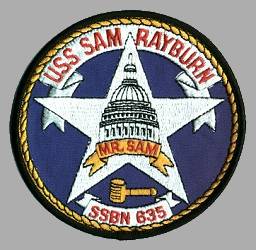
USS Sam Rayburn (SSBN 635)

- decommissioned -

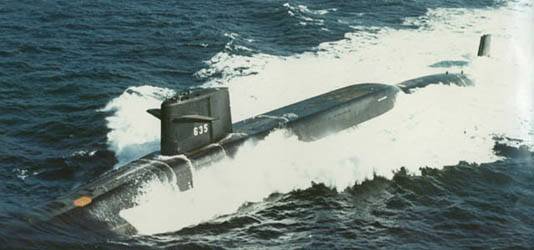
USS SAM RAYBURN was the 18th LAFAYETTE - class nuclear powered fleet ballistic missile submarine and the first ship in the Navy to bear the name.

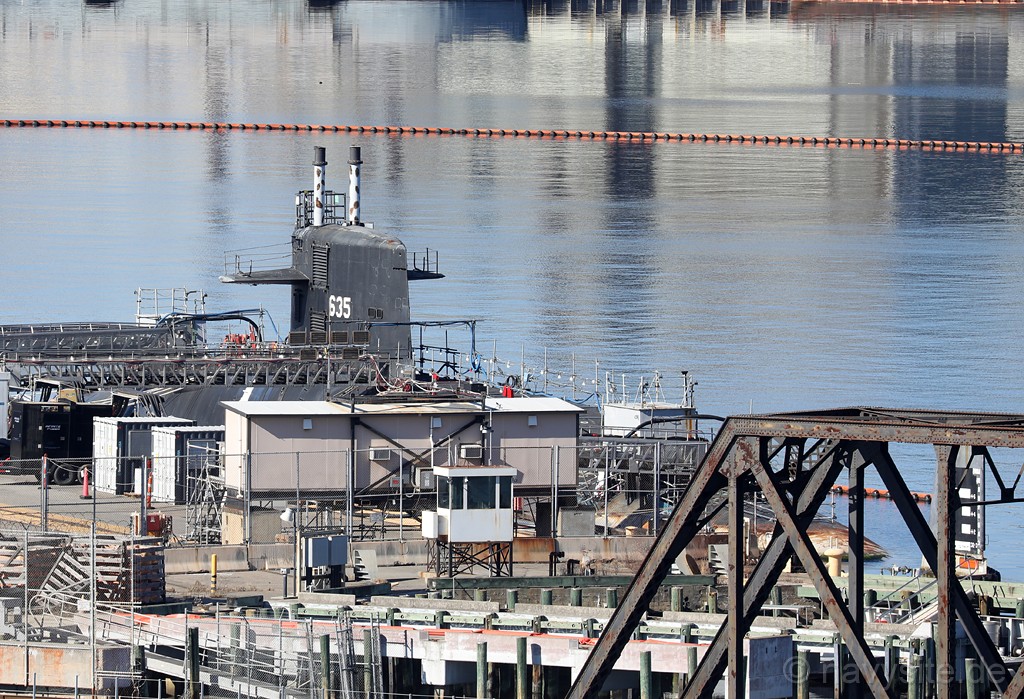
Deactivated while still in commission on September 16, 1985, SAM RAYBURN was decommissioned and stricken from the Navy list on July 31, 1989, and reclassified a moored training ship (MTS 635) located at Naval Nuclear Power Training Unit, Charleston, SC. She served as a moored training ship until 2021. On April 1, 2021, she was towed to the Norfolk Naval Shipyard, Portsmouth, Va., where she entered a complex inactivation and defueling availability. Defueling and inactivation of MTS SAM RAYBURN were successfully completed on November 6, 2024, and in spring 2025, she was towed to the Puget Sound Naval Shipyard and Intermediate Maintenance Facility in Bremerton, Wash., arriving there on May 6, 2025.

General Characteristics:Awarded: July 20, 1961
Keel laid: December 3, 1962
Launched: December 20, 1963
Commissioned: December 2, 1964
Decommissioned: July 31, 1989
Builder: Newport News Shipbuilding and Dry Dock Co., Newport News, Va.
Propulsion system: one S5W nuclear reactor
Propellers: one
Length: 425 feet (129.6 meters)
Beam: 33 feet (10 meters)
Draft: 31.5 feet (9.6 meters)
Displacement: Surfaced: approx. 7,250 tons; Submerged: approx. 8,250 tons
Speed: Surfaced: 16 - 20 knots;Submerged: 22 - 25 knots
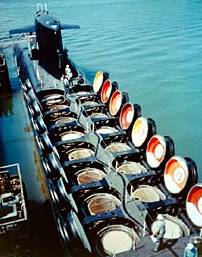
Armament: 16 vertical tubes for Polaris or Poseidon missiles, four 21" torpedo tubes for Mk-48 torpedoes, Mk-14/16 torpedoes, Mk-37 torpedoes and Mk-45 nuclear torpedoes
Crew: 13 Officers and 130 Enlisted (two crews)


Back to topback to top  go to endgo to the end of the page


Back to topback to top  go to endgo to the end of the page

Crew List:

This section contains the names of sailors who served aboard USS SAM RAYBURN. It is no official listing but contains the names of sailors who submitted their information.


back to top  go to the end of the page


Back to topback to top  go to endgo to the end of the page

Accidents aboard USS SAM RAYBURN:

DateWhereEvents
April 2, 1984Holy Loch, ScotlandThe Glasgow Herald reports the US Navy at Holy Loch, Scotland, admits that the paint on the USS SAM RAYBURN was mildly radioactive when it returned from patrol in February 1984. The Navy says this is very low-level radioactivity, so low that it could not be detected by a Geiger counter. Reports about the radiation had been circulating for a month, leading to claims that the SAM RAYBURN had been in a collision sometime in the fall of 1983 which had caused the ship to leak or become contaminated with radiation. The Navy's statements serve to add to the controversy.


Back to topback to top  go to endgo to the end of the page

About the Ship's Name:
Samuel Taliaferro Rayburn, born on 6 January 1882 in Roane County, Tenn., graduated from Mayo College (now East Texas State University), at Commerce, Tex. After a year teaching school, he won election to the State Legislature. During his third two-year term in the Legislature, he was elected Speaker of the House at the age of 29. The next year, he won election to the U.S. House of Representatives. He went to Congress on 4 March 1913 at the beginning of Woodrow Wilson’s administration and served without interruption for over 48 years. On 16 September 1940, at the age of 58, he became Speaker of the House. When his career as Speaker was interrupted during the sessions of 1947-1948 and 1953-1954 during Republican control of the House, Rayburn served as minority leader. He usually worked quietly in the background in the shaping of legislation. As Speaker, he won a reputation for being fair in his rulings and for forgetting politics when he handled the gavel. He had served as Speaker more than twice as long as any predecessor when he died of cancer in Bonham, Tex., on 16 November 1961.


Back to topback to top  go to endgo to the end of the page

USS SAM RAYBURN History:

USS SAM RAYBURN was conceived in the early 1960s as part of the United States Navy's expanding force of fleet ballistic missile submarines that underpinned the sea-based leg of the strategic nuclear deterrent during the Cold War. Ordered on July 20, 1961 from Newport News Shipbuilding and Dry Dock Company at Newport News, Virginia, she belonged to the JAMES MADISON-class, a development of the LAFAYETTE-class, designed to carry 16 Polaris submarine-launched ballistic missiles while remaining as quiet and survivable as possible in the open ocean.

Newport News laid down the keel of SAM RAYBURN on December 3, 1962, on a building ways that had just seen the launch of earlier Polaris boats. Over the following year, her pressure hull, missile compartment, machinery spaces and twin-decked operations and accommodation areas took shape, along with the distinctive "hump" of the 16-tube missile compartment abaft the sail. She slid down the ways into the James River on December 20, 1963, sponsored by Mrs. S. E. Bartley and Mrs. W. A. Thomas. During 1964, yard workers completed her fitting-out: installing the S5W pressurized-water reactor plant, the geared steam turbines on a single shaft, sonar and fire-control systems, and the Polaris A-3 missile launch system. Builder's sea trials on the U.S. east coast, recorded in contemporary photographs as taking place "off the United States East Coast, probably while on sea trials", tested propulsion, diving characteristics and weapons systems before the Navy accepted her for service.

On December 2, 1964 SAM RAYBURN was commissioned, with Captain Oliver H. Perry Jr. in command of the Blue Crew and Commander William A. Williams III in command of the Gold Crew, reflecting the dual-crew manning model adopted for fleet ballistic missile submarines to maximize time on patrol. Immediately after commissioning she entered a period of demonstration and shakedown operations on the Atlantic Missile Range. In these operations, first the Blue Crew and then the Gold Crew took the boat through intensive drills in navigation, submerged operations, reactor plant casualty procedures, and missile launch drills, culminating in Demonstration and Shakedown Operations (DASO) firings that proved the integration of ship, missile and crew before she was released for strategic duty.

With shakedown complete, SAM RAYBURN joined Submarine Squadron 18 at Charleston, South Carolina, which acted as her administrative and logistics homeport on the U.S. east coast. From there she deployed on her first Polaris deterrent patrol in the summer of 1965, taking up station in the Atlantic as part of the United States' continuous at-sea nuclear deterrent. In August 1965, she was reassigned to Submarine Squadron 16, the forward-deployed Polaris squadron operating from Rota, Spain. Operating out of Rota, she conducted seven successive deterrent patrols, cycling between ocean patrol areas and refit periods alongside the squadron's submarine tender, with one crew on patrol while the other rested and trained ashore. These patrols took place against the backdrop of an intensifying Cold War naval competition in the North Atlantic and Norwegian Sea, as U.S. and NATO forces sought to ensure survivable second-strike capability while the Soviet Navy expanded its own ballistic-missile forces. In December 1966, SAM RAYBURN returned to Charleston and again came under Submarine Squadron 18.

Through 1967, she completed her eighth through eleventh Polaris deterrent patrols, continuing the established pattern of dual-crew operations: one crew taking the boat to sea for lengthy submerged patrols while the other remained ashore for training and leave. In 1968, she executed her twelfth, thirteenth and fourteenth deterrent patrols, maintaining what was by then a mature strategic posture in which "41 for Freedom" ballistic missile submarines provided nearly continuous coverage in designated patrol areas. During 1969 she remained continuously assigned to Submarine Squadron 18, alternating patrol and refit cycles from the Charleston base until the Navy scheduled her for overhaul and modernization as part of the broader move to the new Poseidon missile system.

In December 1969, SAM RAYBURN proceeded north to Portsmouth Naval Shipyard at Kittery, Maine, to begin a major overhaul. On January 19, 1970 she formally commenced overhaul and conversion to carry the new UGM-73 Poseidon C3 missile, becoming the last of four submarines funded in the Fiscal Year 1970 Poseidon conversion program. The yard refueled her S5W reactor, carried out extensive maintenance on propulsion and auxiliary systems, upgraded sonar and navigation equipment, and enlarged and modified the missile tubes, fire-control systems and associated equipment to accept the wider, heavier Poseidon missile with multiple independently targetable re-entry vehicles (MIRVs). This conversion took place as the United States sought to increase the warhead capacity and flexibility of its sea-based deterrent, while negotiations leading to the Strategic Arms Limitation Talks (SALT I) framed future numerical limits on strategic systems.

Portsmouth Naval Shipyard completed SAM RAYBURN's overhaul in late spring 1971. A U.S. Navy historical summary records completion on May 27, 1971, after which she began a post-overhaul period of operations along the U.S. east coast to validate the ship's systems and retrain crews.

As part of the Poseidon program record, her conversion was noted as complete on September 2, 1971, marking her as the eighth SSBN to achieve full Poseidon C3 capability. In these months, she conducted local operations, weapons system checks and work-ups from ports including Groton, Connecticut and Charleston, integrating the more complex missile system into routine crew procedures and exercising launch-control and fire-control drills in line with updated strategic plans. After this work-up phase, SAM RAYBURN departed Groton and returned to Charleston, then left on what official summaries describe as an extended period of "special operations" beginning in the early 1970s.

Open sources do not give specific patrol areas or dates for these missions, reflecting the high level of classification surrounding ballistic missile submarine operations, but they indicate that from 1972 through at least mid-1974 the submarine remained heavily employed. She operated under the Atlantic Fleet, alternating between lengthy submerged patrols in the Atlantic and periods in port for refit and crew turnover, now carrying Poseidon missiles that formed a central part of the U.S. strategic posture after SALT I was signed in 1972.

By June 1974, publicly available Navy summaries still described SAM RAYBURN as engaged in special operations. Through the late 1970s and early 1980s, she continued in this role as a Poseidon-armed deterrent platform. In these years the broader geopolitical context included the transition from Polaris and Poseidon to the newer Trident system, improvements in Soviet anti-submarine warfare capabilities, and renewed arms control efforts. While detailed patrol-by-patrol records remain classified or unpublished, it is clear that SAM RAYBURN remained part of the Atlantic Fleet's ballistic missile submarine force, conducting repeated deterrent patrols and periodic maintenance periods as the Navy began shifting some strategic focus toward the newer OHIO-class submarines and the Trident I C4 missile.

Arms control decisions in the 1980s directly shaped the final phase of SAM RAYBURN's career as an operational SSBN. Under the framework established by the SALT II agreement, the United States decided to reduce the number of ballistic-missile launchers and MIRVed systems in service, even though the treaty was never formally ratified. To comply with these limits while bringing newer systems into service, the Navy selected older ballistic missile submarines for deactivation and modification. SAM RAYBURN, by then one of the earlier Poseidon-conversion boats, was chosen as a platform on which her 16 ballistic missile launch tubes would be rendered inoperable. Contemporary accounts note that she was deactivated while still in commission on September 16, 1985, at Charleston. During this process her missile tubes were filled with concrete and the missile hatches removed, physically demonstrating that she no longer counted as an operational strategic launcher under arms-control counting rules.

Rather than proceed directly to disposal, the Navy decided to convert SAM RAYBURN into the first moored training ship for nuclear-power training. She entered Charleston Naval Shipyard on February 1, 1986, to begin this extensive modification. Shipyard workers removed her entire ballistic-missile compartment and fabricated new structures to connect the forward and aft hull sections, creating a shorter hull better suited to permanent mooring and classroom use. Additional platforms, access trunks, and special mooring fittings - including a "water brake" mechanism to absorb power from the main propulsion shaft during training - were installed, allowing students to operate and monitor a live reactor plant without the ship ever getting underway. This work took place as the U.S. Navy continued to expand its nuclear-powered submarine fleet and needed reliable, shore-based platforms to train large numbers of reactor operators and supervisors.

On July 31, 1989, SAM RAYBURN was formally decommissioned as a fleet ballistic missile submarine and simultaneously reclassified as a moored training ship with the hull number MTS-635; on the same date she was struck from the Naval Vessel Register as an active warship. She then completed final testing for her new role, including reactor operations at the pier, and in August 1989, she arrived at the Naval Nuclear Power Training Unit (NPTU) at what is now Naval Support Activity Charleston near Goose Creek, South Carolina.

Positioned alongside the pier as a permanently moored training platform, MTS-635 provided a live S5W reactor plant and submarine engineering spaces for officer and enlisted nuclear students. From 1989 through early 2021, MTS SAM RAYBURN served at NPTU Charleston as one of the Navy's two original moored training ships, paired with MTS DANIEL WEBSTER (MTS-626).

Thousands of prospective nuclear propulsion operators and supervisors cycled through her engineering spaces, learning watchstanding, casualty response, and maintenance procedures on an operational reactor plant under controlled pier-side conditions. Over these three decades, she remained secured to the pier at Charleston, her role no longer strategic deterrence at sea but providing the practical training foundation for crews of nuclear-powered surface ships and submarines across the fleet. As the nuclear training program evolved, the Navy planned a transition to newer moored training ships converted from LOS ANGELES-class attack submarines, which would provide more modern reactor plants and machinery layouts.

That transition drove the final phase of SAM RAYBURN's long service. With MTS LA JOLLA (MTS-701) and USS SAN FRANCISCO (SSN 711), themselves converted into moored training ships, ready to assume the training load, the Navy scheduled MTS-635 for inactivation.

On April 1, 2021, she departed her long-time berth at NPTU Charleston under tow, marking the end of more than thirty years as an active training platform. Norfolk Naval Shipyard at Portsmouth, Virginia, welcomed the moored training ship SAM RAYBURN on April 3, 2021, in advance of inactivation work. At Norfolk, she entered a complex inactivation and defueling availability that involved cutting access openings ("hull cuts") in the pressure hull, removing the superstructure, extracting the spent nuclear fuel, and preparing the hull for a later tow to the Pacific for long-term storage and eventual recycling. Norfolk Naval Shipyard reported that the defueling and inactivation of MTS SAM RAYBURN were successfully completed on November 6, 2024, describing this as the Navy's first inactivation of a moored training ship.

More than 400 personnel took part at the project's peak, carrying out defueling, extensive structural work and preparations for the ocean tow. To ensure the integrity of the aged hull during the transit and subsequent storage, shipyard teams installed more than 250 lap plates on the non-pressure hull where corrosion was found and performed significant welding and reinforcement of hull and piping systems. They also installed and tested towing arrangements designed to keep the unmanned hull safe during its voyage to the west coast.

In spring 2025, MTS SAM RAYBURN left Norfolk under tow for Puget Sound Naval Shipyard and Intermediate Maintenance Facility in Bremerton, Washington, where the Navy concentrates the storage and final dismantlement of decommissioned nuclear-powered ships. A public statement from Puget Sound Naval Shipyard recorded that MTS SAM RAYBURN, formerly USS SAM RAYBURN (SSBN 635), arrived there on May 6, 2025. She joined other decommissioned nuclear submarines in a controlled storage status pending eventual reactor-compartment disposal and hull recycling under the Navy's Nuclear-Powered Ship and Submarine Recycling Program.


Back to topback to top  go to endgo to the end of the page


Back to topback to top


Back to Ballistic Submarines list. Back to ships list. Back to selection page. Back to 1st page.