Search the Site with 
General Characteristics Crew List Memorabilia Accidents aboard the Ship About the Ship's Name History to end of page

USS Ulysses S. Grant (SSBN 631)

- decommissioned -

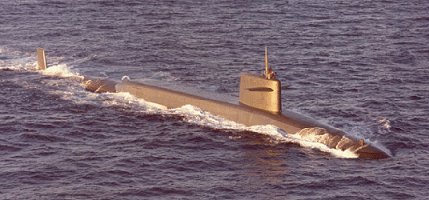
USS ULYSSES S. GRANT was the 14th LAFAYETTE - class nuclear powered fleet ballistic missile submarine and the first ship in the Navy to bear the name. Both decommissioned and stricken from the Navy list on June 12, 1992, the ULYSSES S. GRANT subsequently entered the Navy’s Nuclear Powered Ship and Submarine Recycling Program at the Puget Sound Naval Shipyard, Bremerton, Wash. Recycling was finished on March 29, 1993.

General Characteristics:Awarded: July 20, 1961
Keel laid: August 18, 1962
Launched: November 2, 1963
Commissioned: July 17, 1964
Decommissioned: June 12, 1992
Builder: Electric Boat Division of General Dynamics Corp., Groton, CT.
Propulsion system: one S5W nuclear reactor
Propellers: one
Length: 425 feet (129.6 meters)
Beam: 33 feet (10 meters)
Draft: 31.5 feet (9.6 meters)
Displacement: Surfaced: approx. 7,250 tons; Submerged: approx. 8,250 tons
Speed: Surfaced: 16 - 20 knots;Submerged: 22 - 25 knots
Armament: 16 vertical tubes for Polaris or Poseidon missiles, four 21" torpedo tubes for Mk-48 torpedoes, Mk-14/16 torpedoes, Mk-37 torpedoes and Mk-45 nuclear torpedoes
Crew: 13 Officers and 130 Enlisted (two crews)


Back to topback to top  go to endgo to the end of the page


Back to topback to top  go to endgo to the end of the page

Crew List:

This section contains the names of sailors who served aboard USS ULYSSES S. GRANT. It is no official listing but contains the names of sailors who submitted their information.


back to top  go to the end of the page


Back to topback to top  go to endgo to the end of the page

Accidents aboard USS ULYSSES S. GRANT:

DateWhereEvents
August 30, 1968PacificA petty officer's arm is crushed under a periscope during heavy seas associated with Typhoon Wendy. The ship's doctor, Lieutenant Robert G. Wallace, performed a lengthy emergency operation in rough conditions and, together with several enlisted corpsmen and ratings, was later commended. The medical team received Navy Commendation Medals and letters of commendation for saving the sailor's life.
April 7, 19873 miles off Portsmouth, NH.Heavy seas swept two sailors from the missile deck into 41-degree water. Lieutenant (junior grade) David Jimenez was recovered by a Coast Guard boat but could not be revived and was pronounced dead at a local hospital. Chief Torpedoman Larry V. Thompson, tethered to the submarine but unable to be recovered safely in twelve-foot seas, was cut free by a crewman crawling along the deck and was subsequently lost despite intensive search efforts by multiple Coast Guard craft. A memorial service for both men was held at Portsmouth Naval Shipyard on April 20, 1987.


Back to topback to top  go to endgo to the end of the page

About the Ship's Name:

Ulysses Simpson Grant - born on 27 April 1822 at Point Pleasant, Ohio - graduated from the United States Military Academy on 1 July 1843. He served with distinction in the war with Mexico - under Generals Zachary Taylor and Winfield Scott, taking part in the battles of Resaca de la Palma, Palo Alto, Monterrey, and Vera Cruz. He was twice breveted for bravery: at Molino del Rey and Chapultepec. After growing restive during frontier duty in the peacetime Army, he resigned his commission in 1854 and attempted to pursue careers in business and farming.

Shortly after the outbreak of the Civil War, Grant was commissioned a colonel in the 21st Illinois Volunteer Infantry. He later became brigadier general of volunteers on 7 August 1861. Following the captures of Fort Henry and Fort Donelson in February 1862, President Abraham Lincoln promoted Grant to major general of volunteers. These victories opened Tennessee to federal forces, and earned Grant the nickname of "unconditional surrender."

He doggedly pursued the Confederate Army and won impressive - but costly - victories at Shiloh, Vicksburg and Chattanooga. His willingness to fight and ability to win impressed President Lincoln who appointed Grant lieutenant general and gave him overall comm and of the Army.

Grant left Major General William T. Sherman in immediate charge of all boons in the west and moved his headquarters to Virginia where he turned his attention to the long frustrated Union effort to take Richmond. Despite heavy losses and difficult terrain, the Army of the Potomac kept up a relentless pursuit of General Robert E. Lee's troops and won bloody contests in the Wilderness, at Spotsylvania, at Cold Harbor, and at Petersburg. His relentless pressure finally forced Lee to evacuate Richmond early in April 1865 and forced him to surrender at Appomattox Courthouse on 9 April 1865. Within a few weeks, the War between the States was over.

Grant became interim Secretary of War on 12 August 1867 - when Johnson suspended Secretary Stanton - and held the office until early the next year. He ran for the presidency on the Republican ticket in 1868 and won the election. His two terms were marred by economic, social, and political turmoil, but Grant himself was not involved in the scandals, and his personal reputation emerged untarnished.

He devoted his twilight years to writing and completing his two volumes of Personal Memoirs which were published the year of his death. Grant died on 23 July 1885, at Mt. McGregor, N.Y.


Back to topback to top  go to endgo to the end of the page

USS ULYSSES S. GRANT History:

USS ULYSSES S. GRANT was one of the ten JAMES MADISON-class fleet ballistic missile submarines that formed part of the United States Navy's "Forty-One for Freedom" force during the Cold War. She was ordered on July 20, 1961, from the Electric Boat Division of General Dynamics at Groton, Connecticut, as the fourteenth LAFAYETTE-/JAMES MADISON-series Polaris boat to be built there. Her keel was laid at Groton on August 18, 1962. The submarine was launched at Groton on November 2, 1963, into the Thames River. The sponsor was Edith Grant Griffiths, a great-granddaughter of President Ulysses S. Grant and wife of Colonel David W. Griffiths (retired). The launching ceremony, attended by senior Electric Boat officials and Admiral Harold P. Smith, then Commander-in-Chief, Atlantic Forces and Supreme Allied Commander, Atlantic, underlined the boat's role in the growing NATO-linked Polaris deterrent. ULYSSES S. GRANT was the fifth nuclear submarine launched by Electric Boat in 1963, a year in which the yard set a production record for nuclear boats. Her initial test depth was 1,300 feet. Following a later dry-docking incident that slightly bent the keel, the authorized test depth was reduced to about 700 feet, but she remained fully capable for deterrent patrols.

Sea trials began in May 1964, with Admiral Hyman G. Rickover, the head of the Navy's nuclear propulsion program, embarked to observe. The submarine carried out full-power runs surfaced and submerged, testing propulsion, maneuvering and diving systems to his satisfaction. After successful trials, she was formally commissioned at Groton on July 17, 1964, with Captain J. L. From Jr. in command of the Blue Crew and Commander C. A. K. McDonald designated for the Gold Crew. The commissioning ceremony, held in hot summer weather, drew senior officers from the Atlantic submarine force and the local civilian leadership. Telegrams from senior flag officers praised Electric Boat for completing SSBN 631 ahead of schedule.

Immediately after commissioning, ULYSSES S. GRANT moved to the Naval Weapons Annex near Charleston, South Carolina, up the Cooper River, to take aboard her first load of Polaris A-3 missiles. With her missile tubes loaded she sailed to the Atlantic Missile Range off Cape Canaveral for demonstration and shakedown operations (DASO). Both Blue and Gold Crews conducted test launches of Polaris A-3 missiles in the range, each crew observing the other's shot from the destroyer USS AULT (DD 698), which served as an observation ship. These early launches were among the first of eleven Cape Canaveral firings the submarine would conduct over her career, beginning with a Polaris test on September 5, 1964, and ending with a Poseidon test on July 31, 1987.

During these initial operations, the submarine and her escort rode out heavy seas associated with hurricane-force weather, an early test of the boat's seakeeping and the crews' endurance. After the Gold Crew's successful missile firing, the boat made a short liberty call at Fort Lauderdale before returning to the shipyard for final preparations.

At the end of 1964, the newly commissioned submarine was assigned to the Pacific ballistic-missile submarine force. Late in December, she departed the east coast, transited the Panama Canal on December 31, 1964, and headed for her new operating area in the Pacific. In company with USS STONEWALL JACKSON (SSBN 634), which followed her through the canal, she continued on to Pearl Harbor, arriving in January 1965. There, she was welcomed with shore-side ceremonies before beginning the pattern of dual-crew operations that would characterize most of her career.

From 1965, ULYSSES S. GRANT operated primarily from Pearl Harbor and the forward Polaris base at Apra Harbor, Guam, in the Mariana Islands. After loading stores and receiving final training at Pearl Harbor, one crew would take the submarine to sea on deterrent patrol in the Pacific, while the off-crew flew back to Oahu. Off-crew personnel lived mainly on Ford Island, where the Polaris submarine command offices, training simulators and a mock-up control room and missile tube were located. There, they carried out weapons, engineering and damage-control training, including Steinke-hood escape drills and small-arms qualification, while the on-crew remained on patrol. Every three months the submarine would return to Apra Harbor, moor outboard of the submarine tender USS PROTEUS (AS 19), and carry out refit and crew turnover.

During her first four years in the Pacific, ULYSSES S. GRANT completed eighteen Polaris deterrent patrols while operating from Guam. These patrols took place at the height of the Vietnam War and a period of intense Cold War rivalry in the Pacific. The submarine's mission, however, was global nuclear deterrence rather than direct involvement in regional combat operations. While one crew patrolled, the other used the facilities at Pearl Harbor and Ford Island to maintain a high standard of readiness. In June 1965, command of the Blue Crew passed from Captain From to Commander Robert W. Dickieson in ceremonies on Ford Island, while Commander McDonald continued to lead the Gold Crew until mid-1967, when he was relieved by Commander Raymond E. Engle.

Life on board and ashore during these Pacific years left many traces in the ship's record. Crew award ceremonies on Ford Island became routine after each patrol, recognizing advancements in rate, good-conduct awards and re-enlistments. Re-enlistment rates on the boat were notably high for the period, reflecting a stable, experienced crew core. In August 1966, a particularly visible symbol of the boat's namesake arrived: Commander and Mrs. D. V. Gorman, whose own ship USS ERNEST G. SMALL (DD 838) was home-ported at Pearl Harbor, donated a derringer pistol that had belonged to General Ulysses S. Grant. The derringer was formally presented to the commanding officers of both crews at a change-of-command ceremony in Guam and was carried in a wardroom display case aboard the submarine for the rest of her career, tying the modern nuclear boat directly to her nineteenth-century namesake.

Operations in 1968-1969 illustrated both the routine and the hazards of extended submerged patrols. In 1968, the submarine's food service was recognized when, according to contemporary accounts, she became the first submarine ever to reach the finals of the Navy's NEY food-service excellence competition. Later that year, on August 30, a serious accident occurred when a petty officer's arm was crushed under a periscope during heavy seas associated with Typhoon Wendy. The ship's doctor, Lieutenant Robert G. Wallace, performed a lengthy emergency operation in rough conditions and, together with several enlisted corpsmen and ratings, was later commended. The medical team received Navy Commendation Medals and letters of commendation for saving the sailor's life.

In 1969, the crew continued to develop morale and education programs during patrols. An "Art Appreciation" program brought reproductions and study materials aboard, allowing sailors to follow lectures and study famous paintings on Sunday afternoons, informally dubbing the passageways the "National Gallery Pacific Undersea Annex". In Guam, where families could not easily travel from Hawaii, the crew arranged a "dependents' cruise" using dependents of Guam-based support personnel as guests. They toured the forward compartments and watched a water-slug torpedo demonstration. After completing her nineteenth deterrent patrol in 1969, ULYSSES S. GRANT returned to Pearl Harbor and then headed to the Puget Sound Naval Shipyard at Bremerton, Washington, entering the yard in late 1969 for her first major overhaul and weapons-system conversion.

During this Puget Sound overhaul, the submarine's ballistic-missile system was upgraded from Polaris A-3 to Poseidon C-3, with associated changes to fire-control equipment, and her nuclear reactor was refueled. The Poseidon C-3, a heavier, more capable missile with multiple independently targeted re-entry vehicles, substantially increased the boat's potential contribution to strategic deterrence. After completion of the yard period, in 1970 ULYSSES S. GRANT again transited the Panama Canal and shifted her homeport to Charleston, South Carolina. She conducted a DASO shakedown cruise in the Atlantic, including at least one Poseidon test launch at sea, becoming the fourth submarine to fire the new Poseidon missile after USS VON STEUBEN (SSBN 632), USS JAMES MADISON (SSBN 627) and USS DANIEL BOONE (SSBN 629). For her performance in the late Polaris era and the transition to Poseidon, ULYSSES S. GRANT received a Meritorious Unit Commendation as part of Submarine Squadron 15 for the period July 1, 1968, through October 1, 1970, recognizing the unit's contribution to Cold War intelligence and deterrence operations.

By 1971, operating Poseidon missiles, the submarine began deterrent patrols from the advanced base at Holy Loch, Scotland, while administratively home-ported in Charleston. From Holy Loch she conducted a sequence of North Atlantic and Norwegian Sea patrols through the early and mid-1970s, working closely with NATO forces in an era that saw the Strategic Arms Limitation Talks (SALT I) and a gradual shift from Polaris to more capable missile systems, but continued high readiness for potential confrontation with the Soviet Union.

Routine patrols from Holy Loch were interspersed with public-relations and allied-engagement events. In June 1973, while berthed at Holy Loch, the Blue Crew hosted a tour for the 8th Greenock Company of the Boys' Brigade, a local youth organization, demonstrating the interior of a ballistic-missile submarine to visitors from the surrounding Scottish community. Two years later, in February 1975, the boat informally "adopted" an unusual mascot when a 12-year-old Clydesdale drum horse named Cicero, from the Royal Household Cavalry, was designated as a symbolic ship's mascot. A photograph of the horse, who normally carried kettle drums during ceremonial duties at Buckingham Palace, was displayed aboard, another sign of close Anglo-American ties in the Holy Loch era.

In August 1975, Commander Thomas E. Hutt relieved a previous commanding officer in Charleston and took ULYSSES S. GRANT back to Holy Loch, where he completed three deterrent patrols before leaving the ship in May 1977. Under his command the submarine took part in exercises with the Royal Navy, visited Rosyth, Scotland, and supported training for at least one U.S. aircraft carrier and another submarine, showing how the ballistic-missile fleet also supported broader NATO anti-submarine and operational training. At about this time, the crew carried out a technically demanding repair to the reactor plant, recorded as a significant maintenance achievement.

After completing her forty-second patrol, and twenty-three patrols in the Atlantic phase of her career, ULYSSES S. GRANT entered Newport News Shipbuilding in Virginia in 1976 for an extensive overhaul, following a $3.8-million preparation contract awarded earlier that year.

The mid-1970s yard period further modernized the ship's systems for continued Poseidon operations. Once the work was completed and new crews assembled, the submarine returned to sea and, in early 1979, began a new DASO series in the Atlantic. In January 1979, Commander Donald E. Watkins took command of the Gold Crew, while in February Commander Winfred G. Ellis relieved Commander Frederick N. Jerding as Blue Crew commanding officer during ceremonies at Port Canaveral, Florida.

The post-overhaul shakedown in 1979 was intensive. The Gold Crew conducted MK 48 torpedo certification at the Atlantic Underwater Test and Evaluation Center in the Tongue of the Ocean, Bahamas, demonstrating the boat's ability to employ modern heavyweight torpedoes with accurate fire-control solutions. After this phase, the crew enjoyed liberty at Port Everglades, Florida, before returning to the Cape Canaveral area for ballistic-missile testing coordinated with the Navy's Special Projects Office and the Naval Ordnance Test Unit. On May 26, 1979, ULYSSES S. GRANT launched a submerged Poseidon C-3 missile in the Eastern Test Range, an event observed by members of Congress, senior Defense Department and Navy officials, and dependents aboard the range ship USNS RANGE SENTINEL (T-AGM 22). The missile launch capped a two-month shakedown that also included inspections of nuclear-weapons handling, reactor operations and overall ship readiness.

Later in 1979, the Blue Crew conducted its own shakedown operations. On July 17, 1979, exactly fifteen years after commissioning, the submarine returned to Groton/New London, Connecticut, now designated as her homeport and assigned to Submarine Squadron 14. A family cruise on July 21 allowed dependents to see the boat underway, look through the periscopes and observe the ship maneuver submerged. By December 1979, the Gold Crew had completed the forty-third deterrent patrol, the first patrol following the Newport News overhaul. Of 143 crew members, 94 were on their first patrol and 54 qualified in submarines during that deployment.

In 1980, ULYSSES S. GRANT continued Poseidon patrols from Holy Loch with a pattern that combined high-level inspections and visible port visits. Before starting the forty-fifth patrol in late March 1980, the Gold Crew successfully passed an unscheduled Defense Nuclear Security Inspection and a Nuclear Weapons Technical Proficiency Inspection, receiving high marks in both. During the associated refit, the boat made a brief dry-dock visit at Holy Loch and then sailed for a series of NATO port calls. In early May, she visited Wilhelmshaven, Germany, followed by a four-day visit to La Spezia, Italy, from May 6. This was recorded as the first visit by a U.S. ballistic-missile submarine to an Italian port, underlining improved NATO cooperation in the Mediterranean.

Later that year, the Blue Crew took ULYSSES S. GRANT to Portland, England, arriving on July 4, 1980. The ship was welcomed with a band on the pier and British ships dressed overall, each flying a large U.S. flag in honor of American Independence Day. The Royal Navy fired a 21-gun salute, answered by an honor guard on the submarine. Crew members toured British warships and took organized excursions to Salisbury, Stonehenge, Bath and London, while the submarine's outbound passage included an exchange of well-wishes with a passing German destroyer via flashing-light signal. On the same general cycle, crew and families of the Gold Crew traveled to New York City on July 23, 1980, to visit Grant's Tomb on the 95th anniversary of the President's death. A wreath was laid at the memorial and several sailors re-enlisted at the site, further emphasizing the boat's historical namesake.

Through 1981-1983, the submarine remained based at New London for training and crew turnover while continuing to deploy to Holy Loch for deterrent patrols. In June 1981, Commander Charles T. Weaver relieved Commander Ellis as Blue Crew commanding officer during ceremonies at the Shepherd of the Sea Chapel in Groton, while the Gold Crew, under Commander Watkins and then Commander Wesley M. Sherer from August 1981, completed patrols that included a refit alongside the submarine tender USS HOLLAND (AS 32) at Holy Loch. During one of these patrols, in December 1981, the boat made a port call at Rosyth, Scotland, where the crew was hosted by the British ballistic-missile submarine HMS REVENGE, further underscoring close cooperation between U.S. and Royal Navy deterrent forces.

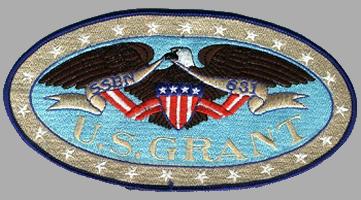
In April 1982, the families of the Blue and Gold Crews collaborated on a large banner bearing the submarine's seal, a morale symbol that accompanied later deployments. During patrol 53 in the early 1980s, five midshipmen from the U.S. Naval Academy embarked for at-sea training and all completed submarine qualification by the end of the patrol. The Gold Crew's weapons department earned an "Outstanding" grade on a Navy Weapons Technical Proficiency Inspection during patrol 55. On June 23, 1983, Commander Joseph F. Sabatini relieved Commander Weaver as Blue Crew commanding officer, and later that year the Blue Crew returned ULYSSES S. GRANT to New London after patrol 58 to prepare for another major overhaul.

In February 1984, the submarine entered Portsmouth Naval Shipyard at Kittery, Maine, for a lengthy refueling overhaul. Both crews were administratively combined under Commander Sabatini, and the boat remained in the yard for more than three years while her reactor was refueled and systems were modernized for continued Poseidon service into the late Cold War.

Sea trials began on April 6, 1987, and the exit from Portsmouth was marked by a serious accident. Heavy seas three miles off Portsmouth swept two sailors from the missile deck into 41-degree water. Lieutenant (junior grade) David Jimenez was recovered by a Coast Guard boat but could not be revived and was pronounced dead at a local hospital. Chief Torpedoman Larry V. Thompson, tethered to the submarine but unable to be recovered safely in twelve-foot seas, was cut free by a crewman crawling along the deck and was subsequently lost despite intensive search efforts by multiple Coast Guard craft. A memorial service for both men was held at Portsmouth Naval Shipyard on April 20, 1987.

After sea trials and completion of the overhaul, ULYSSES S. GRANT returned to operational status in June 1987. On June 9, 1987, Commander William R. Hansell relieved Commander Sabatini as Blue Crew commanding officer in ceremonies at Portsmouth Naval Shipyard, while on July 1, 1987, Commander Michael P. McBride relieved Commander Sabatini as Gold Crew commanding officer. The submarine then resumed deterrent patrols, again operating out of Holy Loch with New London as administrative homeport.

Following an extensive shakedown, the boat was back on patrol in early 1988. In this period, the Cold War was entering its final phase, with arms-control agreements and political change in Eastern Europe, but U.S. strategic forces remained on station. ULYSSES S. GRANT continued Poseidon-armed patrols from Holy Loch and conducted further missile tests, the last of her eleven Cape Canaveral launches taking place on July 31, 1987, confirming the continuing reliability of her missile system.

In 1989, after a crew turnover while moored alongside the submarine tender USS FULTON (AS 11), the Gold Crew took the submarine back to Holy Loch to continue deterrent operations.

On March 30, 1990, Commander Kevin J. Carroll assumed command of the Gold Crew at the Shepherd of the Sea Chapel in Groton, and on August 10, 1990, Commander Bruce L. Bullough relieved Commander Hansell as Blue Crew commanding officer. Bullough brought extensive experience from earlier service in ballistic-missile and attack submarines, including USS GEORGE C. MARSHALL (SSBN 654) and others, reflecting the maturity of the deterrent force at the end of the Cold War.

By 1990-1991, arms-control measures and defense budget reductions were beginning to reshape the strategic submarine force. In March 1991, the supply department of ULYSSES S. GRANT received the Squadron 14 Blue "E" award for fiscal year 1990, recognizing logistics excellence. On October 1, 1991, the ballistic-missile systems of ULYSSES S. GRANT, USS KAMEHAMEHA (SSBN 642) and eight other Poseidon-equipped submarines on patrol were formally deactivated as part of planned force reductions and arms-limitation measures. At the same time, Holy Loch, which had supported U.S. Polaris and Poseidon submarines for nearly three decades, was being closed. ULYSSES S. GRANT and KAMEHAMEHA, the last two ballistic-missile submarines to depart Holy Loch, completed their final strategic patrols and returned to New London in October 1991, with local headlines noting that the Poseidon submarines were "coming in from the cold". Upon arrival, ULYSSES S. GRANT had completed seventy-two strategic deterrent patrols.

On November 7, 1991, Commander Carroll, then commanding officer of the Gold Crew, assumed command of the combined single crew that would man the submarine through deactivation, as the two-crew system was no longer needed once missile operations ceased. On December 19, 1991, at a ceremony at the New London Submarine Base, Vice Admiral Roger Bacon delivered the official message deactivating ULYSSES S. GRANT from the ballistic-missile force and addressed the crew on the boat's role in helping to bring the Cold War to a close. Rear Admiral Howard W. Habermeyer, Commander Submarine Group Two, and Frank Williams, president of the Ulysses S. Grant Historical Society, also spoke at the deactivation ceremony. At this event, the derringer pistol donated in 1966 by Commander and Mrs. Gorman was formally presented to Williams so that it could be placed on display at Grant's Tomb in New York, closing the circle between the boat and her namesake. Missile-tube identification plates were fabricated into plaques for officers and enlisted specialists of the final crew as mementos of the submarine's 27 years of service.

Early in 1992, the now-deactivated submarine again transited the Panama Canal, this time bound for Puget Sound Naval Shipyard at Bremerton, Washington, to enter the Navy's Ship-Submarine Recycling Program. On June 12, 1992, ULYSSES S. GRANT was formally decommissioned and stricken from the Naval Vessel Register, ending her commissioned service. The recycling process, which involved defueling the reactor, cutting up the hull and disposing of radioactive components under strict environmental controls, was completed on October 23, 1993.


Back to topback to top


Back to Ballistic Submarines list. Back to ships list. Back to selection page. Back to 1st page.