
Search the Site with

|
Search the Site with
|
 General Characteristics Crew List Memorabilia Accidents aboard the Ship About the Submarine's Name History Image Gallery to end of page
 | 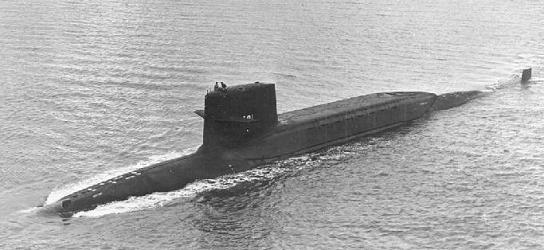 |
USS ROBERT E. LEE was the fourth GEORGE WASHINGTON - class nuclear-powered fleet ballistic missile submarine and the first ship in the Navy to bear the name. The ROBERT E. LEE was built using components initially assembled for a SKIPJACK - class nuclear attack submarine. In the early 1980s, the ROBERT E. LEE was redesignated as SSN 601 and her missile launch capability was disabled to comply with the SALT I treaty. The ROBERT E. LEE mainly conducted training exercises in her new role before she was decommissioned on December 1, 1983. The submarine spent the following years berthed at the Puget Sound Naval Shipyard awaiting her turn in the Navy's Nuclear Powered Ship and Submarine Recycling Program. Recycling of the ROBERT E. LEE was finished on September 30, 1991.
| General Characteristics: | Awarded: July 30, 1958 |
| Keel laid: August 25, 1958 | |
| Launched: December 18, 1959 | |
| Commissioned: September 16, 1960 | |
| Decommissioned: December 1, 1983 | |
| Builder: Newport News Shipbuilding, Newport News, Va. | |
| Propulsion system: one S5W nuclear reactor | |
| Propellers: one | |
| Length: 381.6 feet (116.3 meters) | |
| Beam: 33.1 feet (10.1 meters) | |
| Draft: 28.9 feet (8.8 meters) | |
| Displacement: approx. 6,700 tons submerged | |
| Speed: Surfaced: 15 knots, Submerged: 20 knots | |
| Armament: 16 vertical tubes for Polaris missiles, six 21" torpedo tubes | |
| Crew: 12 Officers and 128 Enlisted (two crews) |
 back to top go to the end of the pageback to top go to the end of the page
Crew List:
This section contains the names of sailors who served aboard USS ROBERT E. LEE. It is no official listing but contains the names of sailors who submitted their information.
back to top go to the end of the pageback to top go to the end of the page
Accidents aboard USS ROBERT E. LEE:
| Date | Where | Events |
|---|---|---|
| April 9, 1968 | Irish Sea | USS ROBERT E. LEE snags the nets of the French trawler LORRAINE-BRETAGNE in the Irish Sea, causing the trawler to lose considerable amounts of fishing equipment. The ROBERT E. LEE does not suffer any damage. |
back to top go to the end of the pageAbout the Submarine's Name:
Robert Edward Lee, born at Stratford, Va., on 19 January 1807, entered the U.S. Military Academy in 1825; graduated second in his class; and was commissioned second lieutenant in the Engineer Corps on 1 July 1829. Advanced to the rank of captain by 1838, he served as chief engineer under General Wool and General Scott during the Mexican War. According to General Scott the fall of Veracruz was due in part to Lee's "skill, valor, and undaunted energy." By the end of the war he had risen to the rank of colonel.
After serving as Superintendent of West Point from 1852 to 1855, Lee was assigned to duty in Texas. He refused to aid the rebellion and returned to Virginia. After Fort Sumter was fired upon, Lee was offered command of the Federal Army. He declined, and following Virginia's secession on 19 April 1861, resigned his commission the following day, to accept command of Virginia forces.
After organizing and equipping the troops of his State, he served as adviser to President Jefferson Davis. Succeeding to command of the Army of Northern Virginia when General Joseph E. Johnston was seriously wounded, Lee, with inferior forces, forced MeClellan to retreat from the outskirts of Richmond, then marched north to push Union forces toward the Potomac. General Lee's advance ended in the Battle of Antietam on 17 September 1862. He repulsed northern thrusts at Fredericksburg on 13 December 1862 and at Chancellorsville 2 to 4 May 1863, then marched north again until forced to turn back after the battle of Gettysburg.
In March 1864, General Grant, appointed to the supreme command of the Federal Armies, engaged Lee several times in an advance from the Rappahannock to Petersburg. On 2 April 1865, Lee abandoned his lines around Richmond in hope of uniting with Johnston in North Carolina but Grant pursued the retreating Southern Army and forced Lee to surrender at Appomattox Court House on 9 April.
Noble in peace as in war, Lee devoted his remaining years to rebuilding Washington College (now Washington and Lee) at Lexington, Va., where he died on 12 October 1870.
back to top go to the end of the page
History of USS ROBERT E. LEE:
ROBERT E. LEE was laid down 25 August 1958 by the Newport News Shipbuilding & Dry Dock Co., Newport News, Va.; launched 18 December 1959; sponsored by Mrs. Hanson E. Ely II; and commissioned 16 September 1960, Comdr. Reuben F. Woodal (Blue Crew) and Comdr. Joseph Williams, Jr. (Gold Crew) in command.
The third nuclear-powered ballistic missile submarine to join the fleet, and the first nuclear-powered ship built in the South, ROBERT E. LEE operated in and out of Newport News until 2 December 1960, when she got underway for the Narragansett Bay Operating Area for torpedo firing tests. Following the successful firing of five torpedoes on 6 December ROBERT E. LEE sailed for Cane Kennedy, arriving on the 12th. The submarine then loaded Polaris test missiles and 10 days later conducted her first missile launch. The Polaris ran "hot and true."
In January 1961, she conducted additional simulated missile launches and on the 15th departed for the Bermuda Operating Area. There, joined by TORSK (SS 423) on the 25th, she engaged in antisubmarine training. Returning to Norfolk on 30 January, ROBERT E. LEE entered the Newport News drydock on 3 February for a month of yardwork. She departed Newport News on 17 March, loaded torpedoes at Yorktown on the 25th, and got underway for Cape Kennedy, arriving 9 April.
The nuclear-powered submarine conducted "special operations" out of Cape Kennedy during May and June, and in late June sailed for Holy Loch, Scotland, where she joined Submarine Squadron 14 on 10 July. She conducted practice torpedo firing during the first week of August and departed Holy Loch 9 August on her first deterrent patrol.
During the next 2 years ROBERT E. LEE completed nine more deterrent patrols. On 10 September 1963, the submarine entered the floating drydock LOS ALAMOS (AFDB 7) and on 4 October resumed her normal patrol schedule. Continuing to operate out of Holy Loch into 1964, the ballistic missile submarine got underway on 27 November for her 16th patrol which terminated on 28 January 1965 at Mare Island, Calif.
On 22 February, ROBERT E. LEE entered the Mare Island Division of the San Francisco Bay Naval Shipyard for her first overhaul. Major items of work included refueling the reactor, reengineering of many ship systems to provide greater safety and reliability, modernization of the navigation system, and modification to the weapons system to give the submarine the capability of launching the improved MK 3 Polaris missile.
Emerging from overhaul after nearly a year and a half of work, ROBERT E. LEE got underway for sea trials on 12 July 1966. Sound trials and weapons system accuracy trials were conducted during the latter half of July, and on 5 August she entered San Diego harbor for a 5-day visit. Underway for the east coast on 10 August, ROBERT E. LEE transited the Panama Canal 20 August and arrived at Charleston, S.C., on 4 September.
During the remainder of September and the first week of October, the fleet ballistic submarine conducted shakedown operations off Cape Kennedy, Fla. On 10 October, with the Under Secretary of the Navy on board as an observer, ROBERT E. LEE successfully fired a nontactical Polaris A-3 missile. She returned to Charleston to commence a predeployment upkeep period at the Cooper River Site. On 4 December, she sailed from Charleston on her 17th deterrent patrol, which terminated at Holy Loch on 30 January 1967.
By 4 October, ROBERT E. LEE had completed three more patrols. Then drydocked in LOS ALAMOS for minor repairs and hull surveillance, she resumed her patrol schedule on 1 November; completed her 21st patrol before entering drydock on 22 November for 2 weeks of repairs. She departed Holy Loch on 26 December for another patrol.
ROBERT E. LEE remained attached to Submarine Squadron 14 throughout 1969 and 70. Continuing to operate out of Holy Loch, she completed her 33d deterrent patrol by 1 January 1971.
ROBERT E. LEE was drydocked for her second overhaul 27 January 1971 at Puget Sound Naval Shipyard. She did not leave the drydock until 11 December and, afterward remained berthed at Puget Sound for the remainder of 1971. For the first seven months of 1972, ROBERT E. LEE was engaged in post-overhaul trials and exercises on the west coast. In mid-August she transited the Panama Canal and arrived in Charleston, S.C., 14 September. She continued normal operations, this time on the east coast, throughout 1972 and for the first seven months of 1973. Transiting the Panama Canal early in August, she arrived in San Diego on the 17th and then moved on to Pearl Harbor, arriving 5 September. After a month in Hawaii, she sailed for Apra, Guam, and continued operations in that area into 1974.
back to top go to the end of the pageUSS ROBERT E. LEE Image Gallery:
 |
back to top Back to Ballistic Submarines list. Back to ships list. Back to selection page. Back to 1st page.