![]() |
Search the Site with
|
![]() | ![]() | ![]() |
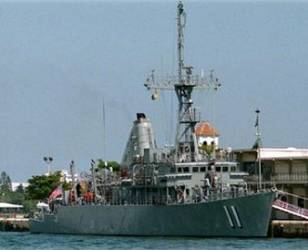
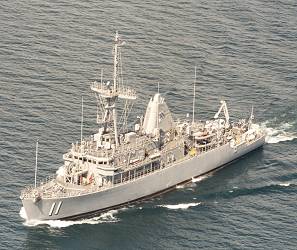
USS GLADIATOR was the 11th AVENGER - class Mine Countermeasures Ship and the third ship in the Navy to bear the name. In January 2007, the ship was transported to Bahrain as one of two Mine Countermeasures Ships newly forward deployed to the Persian Gulf to replace the two forward deployed coastal minehunters CARDINAL (MHC 60) and RAVEN (MHC 61) which were decommissioned in December 2006. On September 4, 2025, USS GLADIATOR was officially decommissioned during a ceremony at Mina Salman Port in Manama, Bahrain.
| General Characteristics: | Awarded: February 14, 1989 |
| Keel laid: May 7, 1990 | |
| Launched: June 29, 1991 | |
| Commissioned: September 18, 1993 | |
| Decommissioned: September 4, 2025 | |
| Builder: Peterson Shipbuilders, Sturgeon Bay, Wis. | |
| Propulsion System: four diesels | |
| Propellers: two | |
| Length: 224 feet (68.28 meters) | |
| Beam: 39 feet (11.89 meters) | |
| Draft: 11,5 feet (3.5 meters) | |
| Displacement: 1,312 tons | |
| Speed: 14 knots | |
| Armament: Mine neutralization system, two .50 caliber machine guns | |
| Crew: 8 Officers, 76 Enlisted |
Crew List:
This section contains the names of sailors who served aboard USS GLADIATOR. It is no official listing but contains the names of sailors who submitted their information.
About the Ship's Coat of Arms:
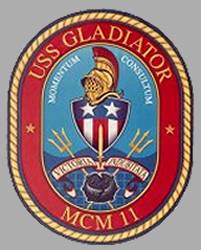
In ancient times warriors used the Coat of Arms as a method of unit identity and as a means of showing the history of their family and battles that they have fought. GLADIATOR's crest has followed in the same traditions of yesteryear in the design of its crest.
The crest was designed in stages, first of which is the outer blue ring with gold rope. This has two meanings, first the blue and gold are the colors of standard Naval tradition and the gold continuous loop rope which signifies perfection in continuity and teamwork. This is followed by a bold red ring bearing the ships name, class and two stars. The color red is a symbol of committment and power and the two gold stars exemplify past battles of other U.S. Naval vessels which bore the name GLADIATOR.
The center of the crest uses symbols and wording to explain to others how things were in the past and how we feel about the future. The latin words "Momentum Consultum," meaning "Deliberate Urgency," is the way the ship will act in an actual minefield and "Victoria Indubitata," meaning "Certain Victory," is a metaphor for the ship's conviction to emerge triumphant from combat. The tridents and the net are symbols of both past and present, in the past the trident and net were used as weapons of ancient gladiators. Today the trident is a symbol of Naval education and sea power and the net is used to symbolize the sweepgear used by GLADIATOR when sweeping for mines. The wooden sword is a rudis, an ancient icon awarded to gladiators who continuously demonstrated feats of bravery and strength and no longer had to compete in the arena. The rudis is also raised in victory over a shattered mine, recognizing certain victory.
The center shield depicts the colors on the American flag, and denotes American patriotism and pride. The three red stripes recognize that the ship is the third U.S. ship to bear the name GLADIATOR. Finally the helmet, symbolizes a strong defense and the classic valor and courage displayed by gladiators in the arenas of old.
USS GLADIATOR History:
USS GLADIATOR, the 11th AVENGER-class mine countermeasures ship and the third United States Navy ship to bear the name, was ordered as part of the post-Cold War recapitalization of dedicated mine warfare forces. The ship's contract was awarded on February 14, 1989. Her keel was laid on May 7, 1990, at Peterson Builders in Sturgeon Bay, Wisconsin, and she was launched on June 29, 1991. After completion and delivery on June 4, 1993, USS GLADIATOR was commissioned on September 18, 1993, during a ceremony at Naval Station Newport, Rhode Island, and began the demanding "new-construction to operational unit" pipeline that characterized AVENGER-class ships: propulsion plant certifications, acoustic and degaussing workups, combat systems qualification trials, mine hunting and sweeping performance events, inspections, and repeated at-sea periods to build the small-ship proficiency needed for precise operations in constrained waters.
From January 17-27, 1994, USS GLADIATOR was underway for routine training in the Corpus Christi operating area, followed by an Operational Propulsion Plant Examination from February 1-3. From February 24 through March 21, she conducted acoustic trials associated with mine warfare signature management in the Port Everglades, Florida, area, and from April 11 through June 10 she operated from Panama City, Florida, for Combat Systems Ship's Qualification Trials. She followed with final contract trials from July 18-22 and then got underway again from August 29-September 1 for Mine Readiness Certification Inspection events that validated core mine countermeasures capabilities.
On September 3, 1994, USS GLADIATOR departed Naval Station Ingleside, Texas, for a Post Shakedown Availability at American Shipbuilding in Newport, Rhode Island, then departed Newport on September 30. She conducted additional acoustic work at Port Everglades on October 11 and returned to Ingleside on October 16. On October 19, she entered the Peterson Builders facility in Ingleside to continue that availability and complete remaining post-shakedown work.
Early 1995 showed the practical side of Gulf Coast operations for a mine warfare ship: from February 18-23, USS GLADIATOR was underway for search-and-rescue operations supporting the effort to locate a downed T-34 aircraft from Naval Air Station Corpus Christi. On February 24, 1995, she departed Ingleside for her first major deployment to the United States 6th Fleet area of responsibility, sailing in company with USS DEFENDER (MCM 2), USS PIONEER (MCM 9), and USS WARRIOR (MCM 10). En route she made a brief refueling stop at Naval Station Mayport, Florida, from March 1-2. On March 6, USS GLADIATOR arrived at Naval Weapons Station Charleston, South Carolina, to offload magnetic material, then conducted degaussing runs on the Cooper River Range and completed upkeep at Naval Station Charleston from March 10-16. She continued to Naval Annex, Bermuda, arriving March 21 and remaining in port through March 24. On April 10, she pulled into Portsmouth, England, for an eight-day upkeep, then visited Aarhus, Denmark, from April 20-24 before participating in the North Atlantic Treaty Organization exercise Blue Harrier '95 in the Baltic Sea from April 24-28 - training that reflected alliance concerns about maritime access and sea control in northern European waters. On May 5, USS GLADIATOR arrived in St. Petersburg, Russia, for a five-day port visit noted at the time as the first by a United States Navy ship in two decades, a visible marker of the still-fluid post-Soviet security environment and the cautious opening of naval-to-naval contacts.
She refueled in Lisbon, Portugal, from May 21-22 and made a brief stop in Palma de Mallorca, Spain, on May 25. After participating in exercise Tridente, USS GLADIATOR arrived at La Spezia, Italy, on June 2 for a five-day port call, then conducted a Fleet Maintenance Availability in Cartagena, Spain, from June 10-21, followed by a return to Palma de Mallorca from June 22-27 and a short refueling stop at Malaga, Spain, from June 30-July 1. She arrived again at Lisbon on July 3 for a six-day Independence Day-period visit. A key leadership transition followed on July 8, when Lt. Cmdr. Alfred Collins relieved Lt. Cmdr. Christopher D. Noble as commanding officer. On August 1, USS GLADIATOR made a brief refueling stop at the Coast Guard station in Key West, Florida, and on August 5 she returned to Naval Station Ingleside after more than five months deployed.
The remainder of 1995 and 1996 were dominated by the training-and-readiness cadence typical for a mine countermeasures ship rotating through inspection gates. USS GLADIATOR was underway from October 1-6, 1995, for routine training in the Corpus Christi operating area. She then emergency sortied from October 10-13 to avoid Hurricane Roxanne. She executed Tailored Ship's Training Availability periods from October 14-20, October 23-27, and October 30-November 10, then operated in support of Operation Drumstick from November 15-20 - an event associated with airborne mine countermeasures integration and the broader mine warfare mission set. She remained active with local operations from November 21-29. In early 1996, she conducted Operational Propulsion Plant Examination preparations from January 11-12 and January 16-17, then completed the examination on January 24.
USS GLADIATOR arrived in Galveston, Texas, on February 9, 1996, for a 10-day visit tied to Mardi Gras festivities, returned home February 21, then got underway again for routine training from March 4-7 and March 11-15. From March 25-29 she supported another search-and-rescue effort for a downed T-44 aircraft from Naval Air Station Corpus Christi, and from April 23-26 she conducted a Final Evaluation Period. On May 13, she entered Peterson Builders for a two-month Planned Maintenance Availability, followed by sea trials on July 10.
She returned to routine operations quickly: July 16-17 for training and July 29-August 2 for MP-3 operational testing. On August 9, USS GLADIATOR departed Ingleside for SSQ-94 operational evaluation testing in Panama City. She moored at Wolfenberg Park in downtown New Orleans on August 12 for a week-long visit, then returned to Panama City from August 22-September 6. After additional port calls at Naval Air Station Pensacola and Tampa, Florida, she returned to Ingleside in mid-September. In October, she supported a carrier battle group workup for USS THEODORE ROOSEVELT (CVN 71) during a joint training fleet exercise, and later in October and through much of November she continued at-sea testing and training associated with sonar and system upgrades relevant to mine hunting. Another command change followed on December 12, 1996, when Lt. Cmdr. Richard B. Landolt relieved Lt. Cmdr. Alfred Collins.
From 1997 through 2001, publicly listed milestones emphasize command turnovers and steady operational activity rather than named major deployments. Lt. Cmdr. David D. Bruhn assumed command on February 28, 1997; Lt. Cmdr. Jeffery R. Howlett did so on December 5, 1997; Lt. Cmdr. Brian J. Shanahan relieved Lt. Cmdr. Howlett on August 17, 1998; Lt. Cmdr. Donald H. Hodge relieved Lt. Cmdr. Shanahan on December 5, 1998; and on October 1, 1999, Lt. Cmdr. Shanahan again took command, at which point USS GLADIATOR became the permanent home for the Mine Force's rotational crew Alpha. The ship's tempo remained active in the Corpus Christi operating area with repeated short underways in October and November 1999, including a difficult late-November tow operation for USS SHRIKE (MHC 62) back to Ingleside in heavy seas from November 23-26. On January 13, 2000, Lt. Cmdr. Dominic Descisciolo relieved Lt. Cmdr. Shanahan, and USS GLADIATOR continued a dense cycle of Tailored Ship's Training Availability events, mine recovery operations, and port visits that functioned as both readiness building and presence for a small specialized community.
She visited Mobile, Alabama, beginning March 2, 2000, for Mardi Gras; Tampa, Florida, from March 31-April 3; and Panama City multiple times in early April. She arrived in Miami on July 3, 2000, then visited Naval Air Station Key West from July 9-13, Naval Air Station Pensacola from July 18-20, and New Orleans from July 22-27, returning to Ingleside July 31. She conducted a Dependent's Day Cruise on August 3, followed by a structured sequence of Tailored Ship's Training Availability phases through September, and entered Southwest Marine in Ingleside for a 10-week Planned Maintenance Availability on September 25, 2000, with sea trials on December 7. On August 24, 2001, Lt. Cmdr. Everett S. Pratt relieved Lt. Cmdr. Descisciolo.
In the immediate post-September 11 security environment, USS GLADIATOR's operations aligned with the renewed emphasis on force protection, expeditionary readiness, and rapid deployment validation. On January 2, 2002, she departed Ingleside to support the USS JOHN F. KENNEDY (CV 67) battle group's Joint Task Force Exercise 02-1 off the East Coast from January 19-26, integrating mine countermeasures proficiency into the larger strike group workup model. During 2003, she continued a readiness-heavy schedule in the Gulf of Mexico: routine training from February 14-21; additional underways from February 24-27 and March 3-9; independent steaming exercises from March 28-29; and additional readiness events in April, including an inspection assessment underway on April 29. She conducted routine training from May 12-14 and then participated in the Gulf of Mexico exercise 03-2 from May 19-28. On June 26, 2003, Lt. Cmdr. Lyle D. Stuffle relieved Lt. Cmdr. Pratt. USS GLADIATOR then completed late-June and July training and evaluation underways, including a Final Evaluation Period from July 7-10 and local operations later in July and in mid-August.
A major geographic shift followed as the ship began an eastern Pacific deployment. On August 18, 2003, USS GLADIATOR departed homeport; she arrived in Belize City, Belize, on August 24 for a three-day visit and then, on September 1, moored at Vasco Nunez de Balboa Naval Base for an eight-day call after transiting the Panama Canal. She continued to the West Coast, arriving at Naval Station San Diego for a port call from September 23-29 and visiting Alameda, California, from October 1-4. On October 6, she arrived at Naval Submarine Base Bangor, Washington, for a 16-day upkeep. She returned to Alameda twice (October 30-November 3 and November 8-11), then conducted further upkeep in San Diego from November 17-19 and November 21-December 5, followed by underway operations off southern California from December 5-14. On January 10, 2004, USS GLADIATOR departed San Diego after a 26-day upkeep, visited Balboa Naval Base again from January 26-30, and anchored off Belize City from February 5-9 before returning to Naval Station Ingleside on February 15, 2004, completing a six-month deployment.
The year 2004 then returned the ship to Gulf-centered training and community engagement. USS GLADIATOR was underway from April 13-20 for mine shape recovery and independent steaming exercises, got underway again April 27-29 and May 4-5, and moored in downtown Corpus Christi, Texas, on May 7 for a three-day visit tied to a maritime festival. She conducted mine shape placement and recovery from May 11-13 and local operations from May 26-27, then executed a midshipmen cruise from June 1-2 and a friends-and-family day cruise on June 4. A Planned Maintenance Availability began on July 13, 2004, at Southwest Marine, followed by sea trials from September 14-15. In September 2004, her crew shifted from Mine Countermeasures Squadron 3 to Mine Countermeasures Squadron 2 and her crew designation changed. She then conducted test and certification underways including a range period from October 3-6, a Cart II event from November 3-4, and additional local operations across November and December.
In 2005, USS GLADIATOR's mine warfare sensors and small-ship handling proved relevant to domestic maritime recovery operations after major hurricanes. On September 10, 2005, she was among the mine warfare ships working off Louisiana with interagency partners to identify storm debris and hazards that could clog or obstruct waterways after Hurricane Katrina, operating alongside USS DEFENDER, USS SCOUT (MCM 8), and USS FALCON (MHC 59). On September 29, 2005, she was underway with USS AVENGER (MCM 1) and USS PIONEER conducting unit-level training and sonar calibration while also standing by to support survey operations associated with Hurricane Rita recovery efforts in the Galveston and Houston approaches, helping assess safe-water conditions for deep-draft traffic.
The next strategic turning point came with forward deployment to the Persian Gulf region at a time when mine threats remained a central concern for maritime access - particularly given the region's dense commercial shipping, narrow chokepoints, and the continuing security implications of conflicts in Iraq and the broader counterterrorism campaign. On December 7, 2006, USS GLADIATOR departed Naval Station Ingleside after being loaded onto the Military Sealift Command-chartered heavy-lift ship M/V CONDOCK V for transport, a move designed to reduce the wear of an open-ocean transit on a specialized wooden-hulled mine countermeasures ship. After the heavy-lift voyage - which included at least one brief stop during the transit - USS GLADIATOR arrived in Bahrain on January 23, 2007, establishing her new operational posture as one of the AVENGER-class ships forward deployed from Manama and replacing recently decommissioned coastal mine hunters.
From her Bahrain base she entered the steady rhythm of Gulf mine warfare: minesweeping and mine hunting operations, bilateral and multinational exercises, and periodic shipyard periods conducted locally. On June 2, 2007, she concluded the eight-day exercise Nautical Union 2007 with Saudi Arabian forces in the Arabian Gulf. On August 27, 2007, she participated in mine countermeasures exercise activity connected to the USS BONHOMME RICHARD (LHD 6) expeditionary strike group while operating in the region. A command change followed in May 2008, when Lt. Cmdr. Hans E. Lynch relieved Lt. Cmdr. William S. Switzer.
Publicly documented highlights in the subsequent years show USS GLADIATOR repeatedly operating with coalition and partner mine warfare forces as the United States Navy emphasized securing maritime routes in the Arabian Gulf, Gulf of Oman, and approaches to the Strait of Hormuz. On April 4, 2010, USS GLADIATOR - embarking personnel from Explosive Ordnance Disposal Mobile Unit 1 - was conducting minesweeping and mine hunting operations in the central Arabian Gulf. On April 22, 2011, she operated in the multinational exercise Arabian Gauntlet 11 alongside RFA LYME BAY, HMS GRIMSBY, HMS PEMBROKE, HMS CHIDDINGFOLD, PNS MUNSIF, and PNS MUHAFIZ. On August 24, 2011, she conducted bilateral training with Royal Navy mine countermeasures ships, and on October 24, 2011, she participated in a mine countermeasures exercise with the Japan Maritime Self-Defense Force ship JS URAGA (MST 463). On March 1, 2012, she joined USS CHIEF (MCM 14) and multiple Royal Navy ships for another mine countermeasures exercise in the Arabian Gulf. On May 13, 2013, USS GLADIATOR departed Manama to participate in the at-sea phase of the International Mine Countermeasures Exercise 2013, reflecting the region-wide priority placed on coalition interoperability in mine response, sweeping doctrine, and maritime security procedures.
In the mid-2010s, USS GLADIATOR cycled through command changes, dry-dock periods, and a demanding exercise schedule. In August 2014, Lt. Cmdr. Corey D. Odom relieved Lt. Cmdr. Robert M. Laird, Jr., as commanding officer. On September 15, 2014, USS GLADIATOR entered the floating dry-dock at Basrec in Manama for a Drydocking Selected Restricted Availability and undocked in early December, returning her to full operational status. On February 15, 2015, Lt. Cmdr. Christopher M. Causee relieved Lt. Cmdr. Odom. In August 2015, USS GLADIATOR returned to Manama after a two-month underway period. A tragic personnel event occurred on September 27, 2015, when Seaman Philip Frazier Manes died aboard the ship from a non-hostile gunshot wound while USS GLADIATOR was moored at Mina Salman Port. On April 11, 2016, USS GLADIATOR departed homeport to participate in the at-sea phase of the International Mine Countermeasures Exercise 2016. From July 30-August 5, 2016, she conducted the joint mine countermeasures exercise Squaddex-16 with USS SENTRY (MCM 3), RFA LYME BAY, HMS PENZANCE, and HMS BANGOR. On September 11, 2016, she departed Mina Salman Port for a Surface Warfare Advanced Tactical Training exercise with embarked mine warfare trainers. On October 19, 2016, she departed for a combined United States-United Kingdom mine countermeasures exercise identified as Mcmex 17-1, visited Mina Zayed in the United Arab Emirates in mid-November, and returned to Bahrain around November.
The year 2017 maintained the same operational pattern: short-notice underways, coalition exercise participation, and port calls that supported both logistics and diplomacy. On February 2, 2017, USS GLADIATOR returned to Mina Salman Port after a two-day underway for the multilateral exercise Unified Trident. A change-of-command occurred in April 2017 involving Lt. Cmdr. Roosevelt B. White and Cmdr. Francisco X. Garza at Naval Support Activity Bahrain. USS GLADIATOR then moored at Jubail Commercial Port, Saudi Arabia, on April 29, 2017, to participate in the bilateral multidimensional exercise Nautical Union, getting underway for the at-sea phase on May 2. On May 27, 2017, she commenced the trilateral mine countermeasures exercise Artemis Trident alongside USS DEXTROUS (MCM 13), HMS BANGOR, HMS MIDDLETON, FS ANDROMEDE, and FS CASSIOPEE while operating off Qatar. She visited Muscat, Oman, on August 21, 2017, for a three-day port call and returned to Muscat again from September 8-11. On December 7, 2017, she participated in another combined United States-United Kingdom mine countermeasures exercise identified as Mcmex 17-2.
On July 11, 2018, USS GLADIATOR held a formal change-of-command ceremony in Bahrain in which Lt. Cmdr. Rebecca E. Wolf relieved Lt. Cmdr. Roosevelt B. White. Soon afterward, on August 20, 2018, the ship entered the Arab Shipbuilding and Repair Yard facility in Manama for a Selected Restricted Availability. After months of industrial work she was moved "dead-stick" from the yard back to Mina Salman Port on December 11. On January 21, 2019, USS GLADIATOR departed homeport for sea trials after having remained pierside for an extended period. She continued to rebuild readiness through the year: on March 18, 2019, she moored at Mina Salman after a four-day underway for routine training and got underway again on March 31. On April 4, 2019, she conducted a replenishment-at-sea with USNS ALAN SHEPARD (T-AKE 3) while operating in the Arabian Gulf. On May 3, 2019, she returned to Mina Salman after getting underway for Mine Warfare Readiness Certification Inspection events. She then conducted a Final Battle Problem from May 7-9 and entered a Manama shipyard later in May. On June 26, 2019, she departed Mina Salman for Board of Inspection and Survey preparations. On July 6 she participated in a photo exercise with USS MASON (DDG 87), USS SENTRY, USS DEVASTATOR (MCM 6), and USS DEXTROUS while operating off Bahrain, and in July she visited Muscat from July 12-18. On November 4, 2019, USS GLADIATOR departed homeport to participate in the International Maritime Exercise 2019, a major regional event designed around coalition integration for maritime security, including mine response and protection of sea lines of communication.
In the early 2020s, USS GLADIATOR remained a working Bahrain-based mine warfare ship amid recurring tensions in the Gulf and Red Sea approaches, where the threat of mines and explosive hazards continued to shape maritime risk calculations for both naval forces and global commerce. On October 10, 2020, she participated in a Surface Warfare Advanced Tactical Training exercise while underway in the Arabian Gulf. A command change occurred in March 2021, when Lt. Cmdr. Ann M. Rahall relieved Lt. Cmdr. William J. Golden. On April 20, 2021, USS GLADIATOR departed homeport for the exercise Artemis Trident 21 with French and Royal Navy ships. On September 22, 2021, she conducted a photo exercise with RFA LYME BAY, HMS BANGOR, HMS MIDDLETON, and HMS CHIDDINGFOLD at the conclusion of another combined United States-United Kingdom mine countermeasures exercise.
In October 2021, she expanded her operating pattern beyond the Gulf: on October 16, she moored in Djibouti for a one-day refueling stop. On October 18 she transited the Bab el-Mandeb Strait northbound escorted by USS O'KANE (DDG 77) and she returned to Djibouti on October 30. After a six-week patrol, USS GLADIATOR moored outboard USS SENTRY at Mina Salman on November 16, 2021, and in December entered the floating dry-dock at Basrec in Manama for a Drydocking Selected Restricted Availability. During that dry-dock period, a change-of-command occurred in April 2022, when Lt. Cmdr. William D. Goodyear relieved Lt. Cmdr. Rahall. In 2024, USS GLADIATOR was reported to have been involved in a harbor collision in Bahrain that caused damage to the British minehunter HMS BANGOR.
After more than three decades of service spanning the post-Cold War drawdown, the global war on terrorism era, and the long-term return of naval focus to chokepoint security and coalition maritime operations, USS GLADIATOR reached the end of her operational life in Bahrain. On September 4, 2025, USS GLADIATOR was officially decommissioned during a ceremony at Mina Salman Port in Manama, closing the ship's active-service chapter as one of the forward-deployed AVENGER-class mine countermeasures ships that had provided persistent mine response capability in a region where maritime access remains strategically and economically consequential.
USS GLADIATOR Image Gallery:
![]() | ![]() | ![]() | ![]() | ![]() |
Back to Mine Countermeasure Ships site.
Back to ships list.
Back to selection page.
Back to 1st page.