
Search the Site with

|
Search the Site with
|
 General Characteristics Crew List Memorabilia Accidents aboard the Ship History Image Gallery to end of page
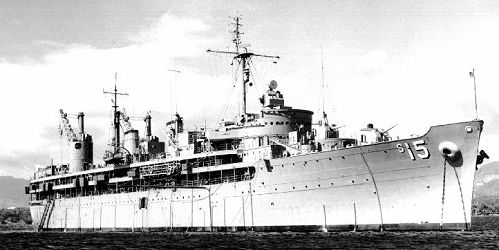 | 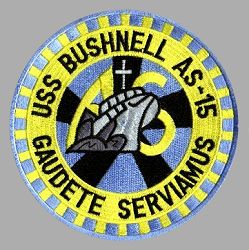 |
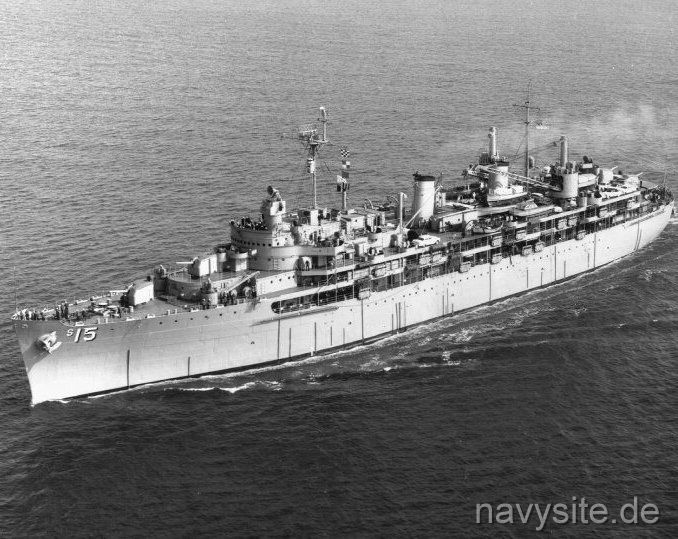
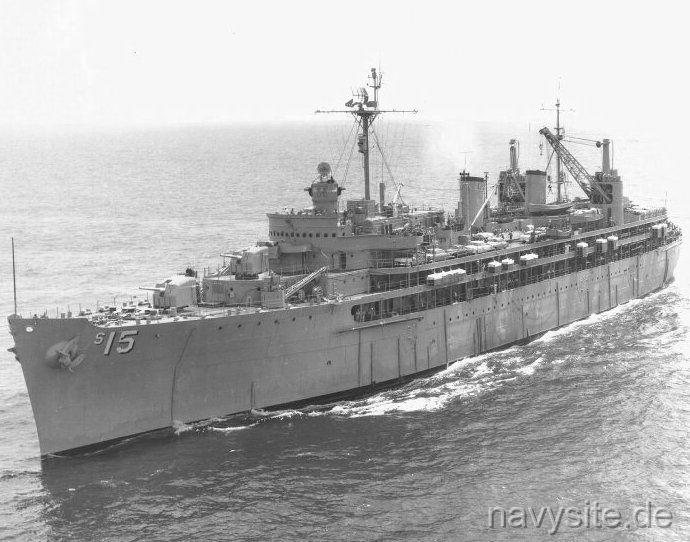
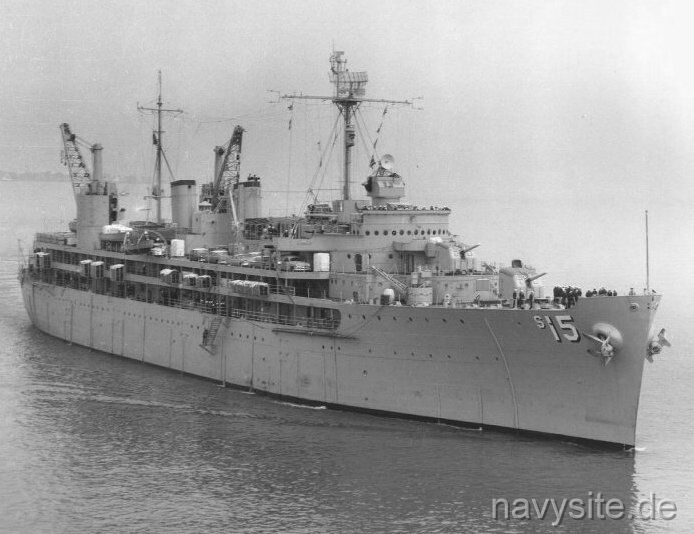
USS BUSHNELL was the third FULTON - class submarine tender. Decommissioned on June 20, 1970, the BUSHNELL subsequently joined the National Defense Reserve Fleet, James River, Fort Eustis, Va. While there, she was stricken from the Navy list on November 15, 1980. On June 3, 1983, the BUSHNELL was finally sunk as a target at 35° 34.7 North, 73° 18.6 West using Mk-48 torpedoes from the USS ATLANTA (SSN 712) and USS FINBACK (SSN 670).
| General Characteristics: | Keel laid: 1941 |
| Launched: September 14, 1942 | |
| Commissioned: April 10, 1943 | |
| Decommissioned: June 20, 1970 | |
| Builder: Mare Island Naval Shipyard, Vallejo, Calif. | |
| Propulsion System: Diesel electric | |
| Propellers: two | |
| Length: 530.5 feet (161.7 meters) | |
| Beam: 73 feet (22.3 meters) | |
| Draft: 25.6 feet (7.8 meters) | |
| Displacement: approx. 9,800 tons; approx. 18,000 tons full load | |
| Speed: 15 knots | |
| Armament: four 20mm guns | |
| Crew: approx. 1200 |
 back to top go to the end of the pageback to top go to the end of the page
Crew List:
This section contains the names of sailors who served aboard USS BUSHNELL. It is no official listing but contains the names of sailors who submitted their information.
back to top go to the end of the pageback to top go to the end of the pageAccidents aboard USS BUSHNELL:
| Date | Where | Events |
|---|---|---|
| December 6, 1965 | Gulf of Mexico | USS BUSHNELL suffers a major fire while operating in the Gulf of Mexico. The fire is extinguished with the aid of the USS PENGUIN (ASR 12). |
| early 1970 | Key West, Fla. | A high-pressure air line in one of USS BUSHNELL's bilges ruptures, atomizing oil and other flammable liquids. The resulting explosion and fire causes extensive damage. The fire leaves BUSHNELL damaged beyond economic repair, even though she remained afloat and under control. The accident led to BUSHNELL's decommissioning later in 1970. |
back to top go to the end of the pageUSS BUSHNELL History:
USS BUSHNELL was a FULTON-class submarine tender built for the rapidly expanding American submarine force of the Second World War and later became one of the characteristic Cold War tenders of Key West. Ordered on October 3, 1940, she was laid down at Mare Island Navy Yard in California on December 23, 1941, only weeks after the attack on Pearl Harbor had pushed the United States fully into the war. She was launched on September 14, 1942, sponsored by Mrs. Luther Gibson, and commissioned on April 10, 1943, with commander C. T. Bonney in command. Designed at around 9,800 tons displacement and 530 feet in length, BUSHNELL was one of the largest tenders of her era, purpose-built to serve as a mobile repair and logistics base for submarines operating far from established shore facilities.
After fitting out and shakedown along the U.S. West Coast, BUSHNELL departed the Pacific coast on June 27, 1943, bound for Pearl Harbor, where she arrived on July 3, 1943. At the submarine base there, the Navy assembled Submarine Squadron 14 (SubRon 14), with BUSHNELL serving both as tender and as staff headquarters for the squadron and division staffs. In this role she provided repair, overhaul, torpedo handling, supply and administrative support to boats preparing for or returning from war patrols in the central Pacific. She remained at Pearl Harbor through the summer, then in September 1943 steamed to Midway Island carrying provisions and structural materials to strengthen that forward base. After completing this logistics mission she returned to Pearl Harbor in December 1943 and resumed a constant cycle of refitting submarines through the first months of 1944, at a time when the U.S. submarine campaign against Japanese shipping was sharply intensifying.
On April 27, 1944, BUSHNELL left Pearl Harbor for Majuro Atoll in the Marshall Islands, laden with provisions, fuel and construction materials. Majuro was being developed as a new forward submarine operating base following the U.S. capture of the Marshalls, and for a time the base there was almost entirely dependent on BUSHNELL and other tenders for repair capacity, berthing support and stores. Among the submarines she refitted at Majuro was USS TILEFISH (SS 307), which completed a war patrol there at the end of May 1944. After BUSHNELL's refit, TILEFISH departed Majuro on June 22, 1944 as part of a coordinated attack group with USS SAWFISH (SS 276) and USS ROCK (SS 274), heading for the Luzon Strait to interdict Japanese traffic between the Philippines and the home islands. The sequence of TILEFISH's arrival, refit and departure provides a concrete example of how BUSHNELL's maintenance and logistics work underpinned submarine offensive operations in mid-1944.
BUSHNELL remained at Majuro into early 1945, supporting successive waves of submarines as the focus of the Pacific war shifted through the Marianas, the Philippines and toward the Japanese home waters. On February 5, 1945, she returned to Pearl Harbor after this extended forward deployment. Later that spring, on May 29, 1945, she steamed to Midway to refit submarines arriving there from late-war patrols. Through the summer of 1945, BUSHNELL continued this work at Midway, overhauling and repairing boats that had been operating in the increasingly heavily defended seas around Japan in support of the final U.S. carrier and surface operations and of the continued submarine campaign against Japanese shipping. She remained engaged in this role until the end of hostilities in August 1945.
With the war over, BUSHNELL shifted to support the rapid demobilization and reorganization of the submarine force. From September to December 1945, she operated in the San Diego area as a repair ship for submarines being overhauled, decommissioned or reassigned in the transition to peacetime. In January 1946, she moved to Guam to serve as tender for submarines involved in occupation duty in the western Pacific and in the early post-war presence around Japan and its former possessions. This Guam deployment lasted into April 1946, after which BUSHNELL was recalled to Pearl Harbor and assigned to Submarine Squadron 1. From the spring of 1946 until May 24, 1947, she supported SubRon 1 from Pearl Harbor, providing the familiar mix of mechanical, electrical and weapons maintenance, supply, and crew services to submarines now largely engaged in training and peacetime operations. On May 24, 1947, BUSHNELL departed for Mare Island for overhaul. Returning to Pearl Harbor on September 10, 1947, she briefly resumed her SubRon 1 duties, but by December 1947, she was again back at Mare Island, this time to begin inactivation. On April 30, 1948 BUSHNELL was placed out of commission in reserve.
The onset of the Korean War and the general expansion of Cold War naval forces led to BUSHNELL's return to active service. She was recommissioned on February 21, 1952. After intensive refresher training and exercises along the West Coast she departed for the Atlantic on May 7, 1952, transiting the Panama Canal on May 21, 1952, and then continued to Key West, Florida, where she became the primary tender for Submarine Squadron 12. From this point onward, Key West served as her main home port for nearly two decades. SubRon 12 operated a mix of fleet submarines and later radar-picket and other specialized boats, and BUSHNELL provided repair, overhaul and support facilities, as well as staff spaces for squadron command, at the North Mole and other Key West piers.
Throughout the 1950s, BUSHNELL's pattern of operations centered on this role in Key West. Contemporary photographs and local archives show her alongside Navy piers at Key West with submarines moored outboard, and underway off the Florida Keys with "SUBRON 12" prominently associated with her. One image from the period shows several submarines alongside BUSHNELL at Naval Station Key West, emphasizing her function as a floating maintenance and support complex. Another photograph from the 1960s shows USS SEA POACHER (AGSS 406) alongside BUSHNELL at the Mole Pier, illustrating how she continued to serve as the primary support ship for the older diesel-electric boats of the squadron into the Cold War era.
In addition to her routine work in Key West, BUSHNELL periodically left Florida for overhauls and short deployments. Veterans' recollections and a 1950s film reel show her visiting Havana, Cuba, where she served as host and backdrop for at least one submarine change-of-command ceremony, reflecting the pre-1960 U.S. Navy presence in Cuban waters. She also occasionally provided services at Norfolk, in keeping with official summaries that describe her as operating primarily from Key West while conducting brief periods of service at Norfolk and short cruises into the Caribbean. Within these Caribbean deployments she supported both submarine and escort operations and participated in various antisubmarine warfare training evolutions typical of the era.
During the late 1950s, BUSHNELL also had a small brush with popular culture. The final scene of the 1959 submarine comedy film Operation Petticoat was shot in Key West, and contemporary accounts from naval and film enthusiasts identify BUSHNELL as the submarine tender in the background of the closing sequence, moored behind a BALAO-class submarine portraying the fictional SEA TIGER. The film itself even mentions a submarine tender named "BUSHNELL" in its dialogue, although in a historically inaccurate context set in 1941, before the real BUSHNELL had been commissioned. These details tie the ship to one of the best-known submarine films of the Cold War era.
By the early 1960s, age and heavy use made a comprehensive modernization necessary. In mid-1962, BUSHNELL went to the Charleston Naval Shipyard for an extensive overhaul that included a Fleet Rehabilitation and Modernization (FRAM) conversion, improving her machinery, workshops and habitability to keep pace with the needs of more modern submarines and prolonged deployments. This overhaul was completed on January 4, 1963, after which BUSHNELL conducted sea trials from Charleston and then returned to Key West. An article in the Navy's All Hands magazine from this period shows Navy tugs assisting BUSHNELL as she left Charleston for trials and later depicts her conducting a high-line replenishment drill with the destroyer escort USS JOSEPH K. TAUSSIG (DE 1030) during a Caribbean cruise, indicating that she combined post-refit shakedown with active training and support work in regional waters.
After her FRAM modernization, BUSHNELL resumed her established duties as tender to SubRon 12 at Key West. Crew lists and veterans' descriptions from the mid-1950s note improvements such as the installation of air conditioning in berthing compartments in about 1954, a welcome change given the climate in the Florida Keys. Through the mid-1960s, she continued to provide full repair support to the squadron's diesel-electric submarines and to participate in the Atlantic Fleet's antisubmarine warfare training efforts. Official and veteran sources summarize this period by emphasising her steady pattern of operations: primarily at Key West, performing repairs, overhauls and logistics for submarines, with occasional visits to ports such as New Orleans, Mobile, Fort Lauderdale and Kingston, Jamaica and with brief service periods at major East Coast naval facilities such as Norfolk.
On December 6, 1965, BUSHNELL suffered one of the most serious incidents of her career. While operating in the Gulf of Mexico, she experienced a major fire associated with her propulsion and electrical-generation system. Veteran accounts specify that the fire began in one of the engine-room or electrical-generation spaces. Although there was only one minor injury, the event was serious enough to become a defining episode in the ship's history and led directly to her lasting nickname "the Burning Bush", widely used by former crew members in later years. The fire did not put her permanently out of action, and after repairs she continued in service.
Following this accident and subsequent repair work, BUSHNELL returned to Key West in 1967 to continue supporting the submarine fleet. In 1968, she marked her twenty-fifth year since commissioning, a milestone commemorated in a "25th Year" certificate preserved by veterans. Around this time, she maintained her pattern of servicing SubRon 12 and acting as a support ship for other vessels in the Caribbean and Gulf of Mexico, with regular port visits to New Orleans, Mobile, Fort Lauderdale and Kingston, as mentioned in patch descriptions and veterans' notes. These cruises reflected the broader Cold War emphasis on training and readiness in the Atlantic and Caribbean, with BUSHNELL providing logistic depth and repair capability during exercises and patrols.
In August 1969, BUSHNELL played a documented humanitarian role in the aftermath of Hurricane Camille, one of the most powerful storms ever to strike the Gulf Coast. As she was sailing from New Orleans back toward Key West, the ship received an emergency request for assistance from the small community of Pilottown, Louisiana, near the mouth of the Mississippi River, which had been devastated by storm surge and wind. Official Navy photographic and historical material and broader federal relief reports describe how BUSHNELL diverted to Pilottown, where she provided urgently needed supplies, medical care, fresh water, housing and meals for local residents, highway department workers and electrical repair crews. Her commanding officer, Captain David F. Purinton, later remembered for his leadership during the event, obtained permission to keep BUSHNELL at Pilottown to serve as a base for relief operations, and her crew volunteered to rebuild the pier used by the river pilots' boats so that normal river traffic could resume. The ship's role is noted in Navy museum documentation, broader federal disaster reviews, and in retrospective accounts of Purinton's career. All describe BUSHNELL as the Navy's response ship for Hurricane Camille at Pilottown.
Unfortunately, the nickname "Burning Bush" would be reinforced by another serious casualty not long afterward. In early 1970, a high-pressure air line in one of BUSHNELL's bilges ruptured, atomizing oil and other flammable liquids. The resulting explosion and fire caused extensive damage. Summary histories of the ship agree that this second major fire left BUSHNELL damaged beyond economic repair, even though she remained afloat and under control. Her crew carried out the decommissioning preparations themselves rather than having the work done in a shipyard, an unusual measure that underlined the Navy's decision not to invest in a full rebuild of the aging tender. During this period, BUSHNELL's role at Key West as tender for SubRon 12 was taken over by her sister ship USS HOWARD W. GILMORE (AS 16), ensuring continuity of support for the submarine squadron.
USS BUSHNELL was placed out of commission on June 20, 1970, ending her active naval service. She was then towed from Key West to Norfolk, Virginia, where she was turned over to the Reserve Fleet and used as a floating headquarters facility. Official ship data and general references agree that she remained in this static role through the 1970s. On November 15, 1980 she was stricken from the Naval Vessel Register, clearing the way for disposal.
Her final chapter came a few years later as part of a weapons-testing and disposal exercise. On May 31, 1983, the salvage and rescue ship USS EDENTON (ATS 1) took BUSHNELL in tow and brought her approximately 175 nautical miles off the U.S. East Coast to a designated deep-water target area at about 35° 34.7 North, 73° 18.6 West. On June 3, 1983, the attack submarine USS ATLANTA (SSN 712), with USS FINBACK (SSN 670) in company, fired two Mk 48 torpedoes that struck and sank the unmanned tender, sending the former "Burning Bush" to the ocean floor as a target.
back to top go to the end of the pageUSS BUSHNELL Image Gallery:
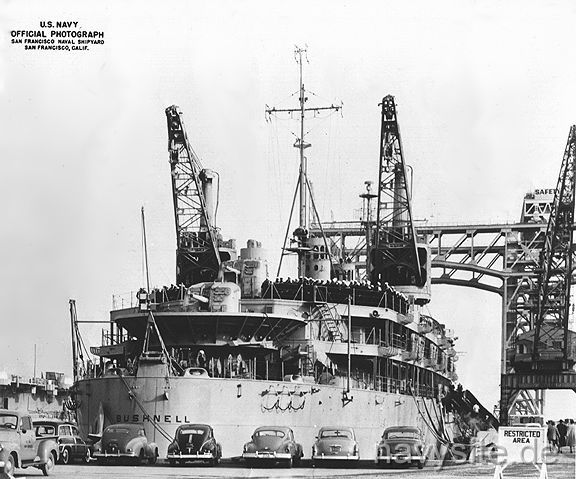 | 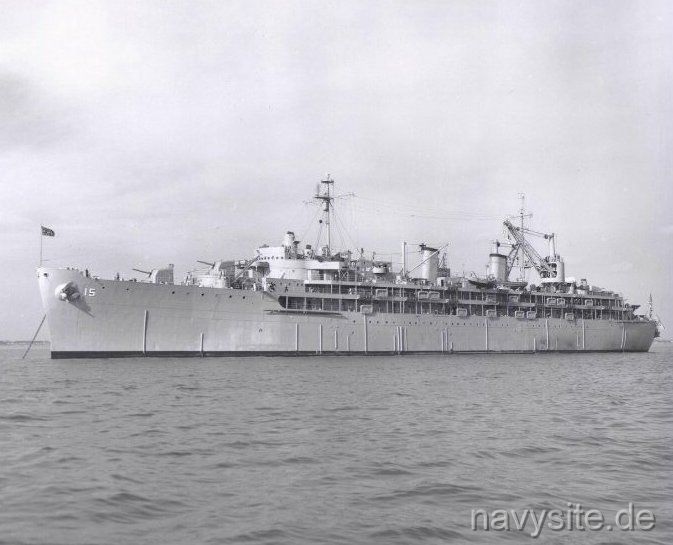 |  |  |  |
 |  |
back to top Back to Submarine Tenders list. Back to Ships list. Back to selection page. Back to 1st page.