Search the Site with 
General Characteristics Crew List Memorabilia Cruise Books About the Ship's Coat of Arms About the Ship's Name History Image Gallery to end of page

USS Reid (FFG 30)

- decommissioned -

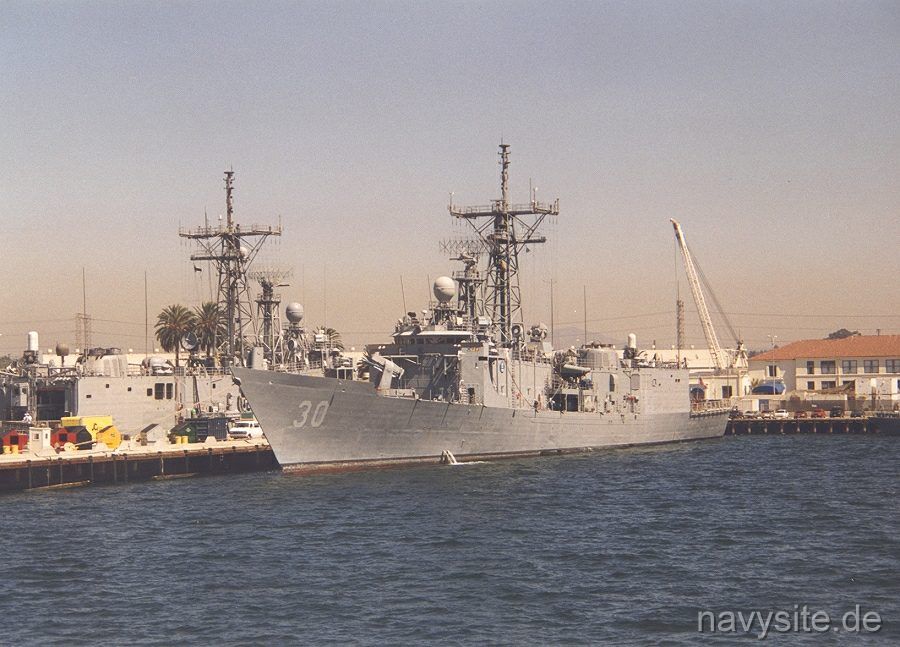
USS REID was one of the short-hull versions in the OLIVER HARZARD PERRY class of guided missile frigates. She was last homeported in San Diego, CA. After decommissioning the frigate was transfered to the Turkish Navy on January 5, 1999 and was renamed GELIBOLU.

General Characteristics:Awarded: January 23, 1978
Keel Laid: October 8, 1980
Launched: June 27, 1981
Commissioned: February 19, 1983
Decommissioned: September 25, 1998
Builder: Todd Pacific Shipyards Co., Los Angeles Division, San Pedro, Ca.
Propulsion system: two General Electric LM 2500 gas turbines, two 350 Horsepower Electric Drive Auxiliary Propulsion Units
Propellers: one
Blades on each Propeller: five
Length: 445 feet (133.5 meters)
Beam: 45 feet (13.5 meters)
Draft: 24,6 feet (7.5 meters)
Displacement: 4,100 tons
Speed: 28+ knots
Aircraft: one SH-2F (LAMPS 1)
Armament: one Mk 13 guided missile launcher (36 Standard (MR) and 4 Harpoon missiles), one Mk 75 76mm/62 caliber rapid firing gun, MK 32 ASW torpedo tubes (two triple mounts), one Phalanx CIWS
Crew: 17 Officers and 198 Enlisted


Back to topback to top  go to endgo to the end of the page


Back to topback to top  go to endgo to the end of the page

Crew List:

This section contains the names of sailors who served aboard USS REID. It is no official listing but contains the names of sailors who submitted their information.


back to top  go to the end of the page


Back to topback to top  go to endgo to the end of the page

USS REID Cruise Books:


Back to topback to top  go to endgo to the end of the page

About the Ship's Coat of Arms:

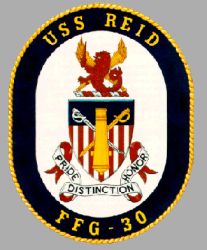
On the seal the red, white and blue refer to the national flag, and thus to the suggestion made by Sailing Master Samuel Chester Reid which was incorporated into the Act of 1818 governing the United States flag design providing for the retention of the original thirteen stripes and the addition of a new star for each new state. The cannon denotes firepower and marksmanship. The swords and cannon allude to the gallant action of Sailing Master Reid at Fayal, in the Azores, during the War of 1812 at which time the vessel in his command inflicted severe damage to a powerful British invasion fleet, delaying their arrival at New Orleans, thus contributing to the American victory there. The swords are adapted from the Officer and Enlisted Surface Warfare Badges and are crossed satirewise to indicate strength and readiness.

The torches, symbolic of light, refer to the signal code system and the lightship off Sandy Hook that Sailing Master Reid established while Harbor Master of New York. The armed sea lion, a Philippine symbol, is a personification of naval courage representing the previous USS REID (DD 369) and her crew, who fought and died so bravely during the liberation of the Philippine Islands. The enflamed torches also allude to the kamikaze attacks in which she went down. The sea lion is red to signify this wartime service.


Back to topback to top  go to endgo to the end of the page

About the Ship's Name:

USS REID commemorates the name borne by three former destroyers in honor of Sailing Master Samuel Chester Reid, U.S. Navy (1783-1861), hero of the War of 1861 and designer of the United States flag in its present form. He received the thanks of the New York State Legislature for gallantry in command of the New York privateer brig GENERAL ARMSTRONG which inflicted such casualties and damage to a powerful British squadron at Fayal, Azores, that it delayed the arrival of the British invasion fleet off New Orleans sufficiently to aid General Andrew Jackson's defense preparations for victory.

His design for a national ensign to include thirteen stripes and a star for each state was adopted by Congress on 4 April 1818. Congress appointed him a Sailing Master in the U.S. Navy on 3 June 1843. As the harbor master of New York, he made notable contributions in improving the pilot-boat service and established a lightship off Sandy Hook.


Back to topback to top  go to endgo to the end of the page


Back to topback to top  go to endgo to the end of the page

USS REID History:

USS REID, a short-hull OLIVER HAZARD PERRY-class guided missile frigate, was awarded on January 23, 1978 and built by Todd Pacific Shipyards, Los Angeles Division, at San Pedro, California. She was laid down on October 8, 1980, launched on June 27, 1981, and photographed on sea trials off the California coast on December 7, 1982. USS REID was commissioned at Long Beach on February 19, 1983. As an early short-hull ship of her class, she did not have the later long-hull two-SH-60 helicopter arrangement associated with later units of the class. In her first years in commission she entered the normal Pacific Fleet cycle of training, readiness work, and deployment preparation. A dated photographic record places her at Pearl Harbor on June 15, 1984. Another record from 1985 places her in Sydney, and a separate contemporary reference notes that on May 16, 1985, the combat stores ship USS KANSAS CITY (AOR 3) joined USS BROOKE (FFG 1) and USS REID, indicating her participation in the broader Western Pacific operating pattern of the period.

A more clearly documented forward deployment began on February 17, 1987, when USS REID departed on a six-month deployment to the Western Pacific and Persian Gulf. This cruise took place during the final phase of the Iran-Iraq War, when attacks on merchant shipping in the Gulf had already drawn in substantial outside naval involvement. On May 17, 1987, after the Iraqi missile attack on USS STARK (FFG 31), USS REID was among the ships that assisted the damaged frigate. She returned to the Middle East again from September 16, 1988 to March 16, 1989 as part of the continued U.S. naval presence in the region after the tanker war. By then, her service had settled into the repeated Pacific-to-Indian Ocean and Gulf deployment rhythm typical of many Pacific Fleet frigates in the late Cold War.

USS REID deployed again from March 16, 1990 to October 12, 1990 to the Western Pacific and Persian Gulf. During that deployment, Iraq invaded Kuwait on August 2, 1990, and the United States rapidly began building the naval screen that supported sanctions enforcement and the wider military response. In August 1990, USS REID was operating in the southern Persian Gulf on picket duty with USS ENGLAND (CG 22) and USS BARBEY (FF 1088). On August 18, 1990, she fired warning shots across the bow of an Iraqi tanker that refused orders to alter course, an incident later described in Navy historical summaries as the first shots of Operation Desert Shield. Contemporary reporting associated the tanker with AL KHANAQIN. USS REID remained involved in the opening maritime interception effort that enforced the embargo imposed after Iraq's occupation of Kuwait. She returned to the Middle East once more from August 4, 1992 to April 7, 1993, continuing her part in the long postwar naval containment mission built around sanctions enforcement, escort duties, and the routine U.S. surface presence in the Gulf region.

After that deployment, USS REID entered a maintenance period in San Diego. On July 16, 1993, she was photographed in a floating dry dock at Southwest Marine during what was described as a routine overhaul. Her service in the Gulf resumed during her 1994 Western Pacific deployment. In October 1994 she intercepted and diverted the tanker KATERINA P. in international waters about 15 miles off the Iranian coast on suspicion of carrying Iraqi oil in violation of United Nations sanctions. Boarding personnel found approximately 19,000 metric tons of suspected Iraqi oil aboard the tanker. After the diversion, roughly 10 percent of USS REID's crew was transferred temporarily to KATERINA P. and remained aboard for eight days while the merchant vessel was taken under escort. The episode was one of the more unusual and concrete sanction-enforcement actions of her career and showed how frequently frigates such as USS REID were used in legally and politically sensitive maritime interception work during the years after the liberation of Kuwait.

Her command chronology during the 1990s reflected the ship's continuing operational tempo. Cmdr. Leslie Roy Carter took command on April 5, 1991, followed by Cmdr. Craig Wendal Patten on December 3, 1992, Cmdr. David Ziemba on July 1, 1994, Cmdr. Robert R. Senter Jr. on August 25, 1995, and Jeremiah D. Foster on April 25, 1997. Another major deployment began on October 11, 1996, when USS REID deployed with the USS KITTY HAWK (CV 63) battle group. During this deployment the battle group operated in the Western Pacific, the Indian Ocean, and the Arabian Gulf. A dated photographic record places USS REID in the Northern Arabian Gulf on January 19, 1997 while attached to the USS KITTY HAWK battle group. During the Gulf phase of that cruise the group supported Operation Southern Watch and the continuing sanctions and maritime security framework directed against Iraq.

USS REID began her eighth and final deployment on April 23, 1998. This last cruise shifted away from the Gulf and toward counter-narcotics operations in the Eastern Pacific, where U.S. Navy and U.S. Coast Guard forces worked together under interagency direction against cocaine trafficking routes from Central and South America. On June 17, 1998, she was recorded as continuing counter-narcotics operations in the Pacific for another month. During that final deployment, she seized a total of 3,160 pounds of cocaine; contemporary reporting described more than 3,000 pounds of cocaine taken off the coast of Costa Rica. After returning from this deployment, USS REID was decommissioned and stricken on September 25, 1998. Her U.S. Navy career had spanned a little more than fifteen years, from the later Cold War through the sanctions and containment era that followed the 1991 Gulf War. On January 5, 1999 she was transferred to Turkey and renamed GELIBOLU, ending her service as USS REID and beginning a new career under the Turkish flag.


Back to topback to top  go to endgo to the end of the page


Back to topback to top


Back to Frigates list. Back to ships list. Back to selection page. Back to 1st page.