
Search the Site with

|
Search the Site with
|
 General Characteristics Crew List Memorabilia Cruise Books About the Ship's Name History Image Gallery to end of page
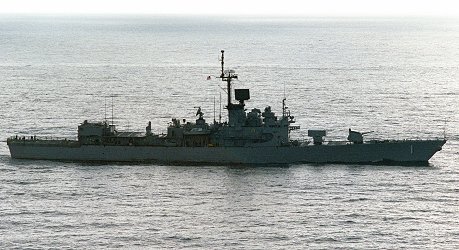 |  |
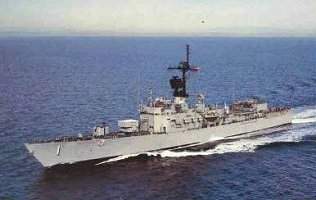
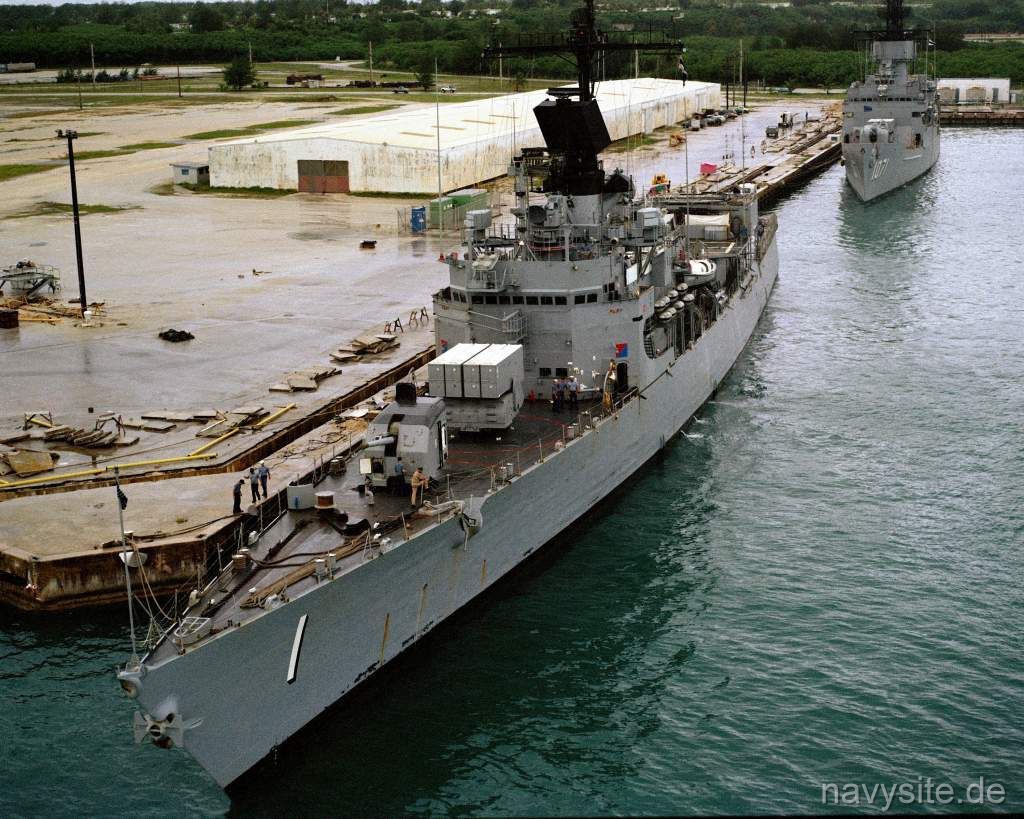
USS BROOKE was the US Navy's first guided missile frigate. Decommissioned on September 16, 1988, BROOKE was transferred to Pakistan in February 1989 where the ship was renamed KHAIBAR. The ex-BROOKE was returned to the US Navy in Singapore on November 14, 1993. There, the ship was sold for scrapping on March 29, 1994.
| General Characteristics: | Awarded: January 4, 1962 |
| Keel Laid: December 19, 1962 | |
| Launched: July 19, 1963 | |
| Commissioned: March 12, 1966 | |
| Decommissioned: September 16, 1988 | |
| Builder: Lockheed Shipbuilding & Construction Co., Seattle, Wash. | |
| Propulsion system: 2 Foster Wheeler 1,200 psi boilers, 1 GE steam turbine, 1 shaft, 35,000 total horsepower | |
| Propellers: one | |
| Length: 414,4 feet (126.3 meters) | |
| Beam: 45 feet (13.5 meters) | |
| Draft: 26 feet (7.9 meters) | |
| Displacement: 3,425 tons | |
| Speed: 27 knots | |
| Aircraft: one | |
| Armament: one Mk 22 Mod. 0 guided missile launcher for 16 Standard SM-1 MR, one Mk 30 5-inch/12.7cm gun, MK 32 ASW torpedo tubes (two triple mounts), one Mk 16 ASROC missile launcher | |
| Crew: 17 Officers, 219 Enlisted |
 back to top go to the end of the page
 back to top go to the end of the pageback to top go to the end of the page
Crew List:
This section contains the names of sailors who served aboard USS BROOKE. It is no official listing but contains the names of sailors who submitted their information.
back to top go to the end of the pageback to top go to the end of the pageUSS BROOKE Cruise Books:
back to top go to the end of the pageAbout the Ship's Name:
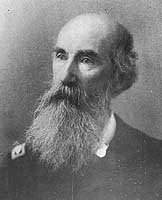 John Mercer Brooke was born at Tampa Bay, Florida, on 18 December 1826, the son of an Army officer. He became a US Navy Midshipman in 1841, graduated from the US Naval Academy in 1847 and achieved the rank of Lieutenant in 1855. His Navy career was marked by sea duty and scientific assignments. While stationed at the Naval Observatory in Washington, D.C., during the early 1850s, he developed a device for accurately mapping the deep sea floor. He also took part in surveying and exploring expeditions in the Pacific during the middle and later parts of the decade and helped instruct officers of the fledgling Japanese Navy.
As the secession crisis deepened, Brooke resigned his commission in April 1861 and "went south", joining the Confederate Navy soon after as a Lieutenant. He was deeply involved in the conversion of the burned steam frigate MERRIMACK into the ironclad CSS VIRGINIA and in the design and production of heavy rifled guns for the Southern war effort. Promoted to Commander in September 1862, he became Chief of the Confederate Navy's Bureau of Ordnance and Hydrography in March 1863 and served in that post until the Civil War ended more than two years later.
After the war, Brooke became a professor at the Virginia Military Institute, at Lexington, Va., while continuing his technological pursuits. After a long career of teaching, he retired in 1899 and made his home in Lexington until his death on 14 December 1906.
back to top go to the end of the pageUSS BROOKE History:
USS BROOKE, the lead ship of the BROOKE class, was built by Lockheed Shipbuilding and Construction Co. at Seattle, Washington. Her keel was laid on December 19, 1962, she was launched on July 19, 1963, and she was commissioned on March 12, 1966, at Puget Sound Naval Shipyard, Bremerton, Washington, as USS BROOKE (DEG 1). She entered service as a guided missile escort rather than as an FFG; the redesignation to USS BROOKE (FFG 1) came later, on June 30, 1975. In her early service, she was assigned to the Pacific Fleet and operated from San Diego, where she settled into the anti-submarine and anti-air warfare role for which the class had been designed. By May 28, 1966, she was already documented in Canadian waters off Vancouver, and by June 15, 1969, she was photographed under way in the Pacific with the auxiliary submarine USS BLUEGILL (AGSS 242), showing that she had already entered the regular cycle of Pacific operations that would define most of her U.S. Navy career.
On January 5, 1970, BROOKE departed San Diego for a Western Pacific deployment in company with HORNE (DLG 30), BRADLEY (DE 1041), JOHN A. BOLE (DD 755), and FECHTELER (DD 870). She stopped at Pearl Harbor from January 10 to January 12, continued west by way of Midway and Guam, and arrived at Subic Bay on January 27 for final preparations. From February 4 to February 15 she served on Yankee Station in the Gulf of Tonkin with RANGER (CVA 61) as part of the carrier screen, providing anti-submarine and anti-air warfare support and performing rescue-destroyer duties. She then shifted north to Buckner Bay, Okinawa, where a change of command took place on February 18, and immediately afterward joined RAMSEY (DEG 2), ALBERT DAVID (DE 1050), BENNER (DD 807), and patrol aircraft in Aswex 3-70. After that exercise she called at Keelung on February 25 for five days, entered Sasebo on March 4 for upkeep through March 10, reached Hong Kong on March 14 for a visit lasting through March 19, and then returned to operations connected with the carrier force in the Gulf of Tonkin. Heavy-weather transit carried her back to Sasebo on March 25 for a longer upkeep period that lasted until May 2. She then served on the southern search-and-rescue station from May 7 to May 14, returned to Subic Bay from May 17 to June 15, and finally arrived back at San Diego on July 2. A regular overhaul followed at Long Beach Naval Shipyard beginning on August 19, 1970.
By 1973, BROOKE was again deeply involved in the Seventh Fleet operating pattern that still surrounded the final phase of direct U.S. naval participation in the Vietnam War. She opened the year in the Gulf of Tonkin as a unit of Task Unit 77.0.2, acting as "shotgun" for the PIRAZ ship TRUXTUN (DLGN 35). She then transited through the Formosa Strait to Sasebo, where she remained from February 1 to February 13 for upkeep, visited Yokosuka from February 15 to February 19, trained in the Yankee Station destroyer training area, and from February 27 to March 13 served as the northern search-and-rescue escort in Task Unit 77.0.1. She spent March 15 to March 22 in Hong Kong for rest and recreation, then resumed anti-submarine work in the Subic Bay operating area, including exercises with HARDER (SS 568), before returning to Gulf of Tonkin duties on March 26. During that period she operated in the screen around ENTERPRISE (CVAN 65) and later in destroyer training formations linked to HENDERSON (DD 785) and GOLDSBOROUGH (DDG 20). From April 11 to April 14, she took part in the joint Japanese-American exercise Aswex-73 in the Kirin operating area with Japanese Maritime Self-Defense Force units and U.S. ships under Commander Destroyer Squadron 17 embarked in LEONARD F. MASON (DD 852).
In 1974, she shifted from deployment to major maintenance. On January 8, 1974, she departed San Diego for Puget Sound Naval Shipyard, stopping at Monterey on January 10, off-loading fuel at Manchester on January 14, and entering dry dock on January 16. Her regular overhaul included major engineering work, sonar improvements, missile-system modernization, and habitability upgrades. During that period, her homeport was temporarily shifted from San Diego to Bremerton. She undocked on June 14, passed light-off examinations on August 22 and August 23, completed dock and acceptance trials on November 2, and returned to San Diego on November 28, after which she resumed local operations and qualification work in the southern California operating areas in December.
In 1975, BROOKE rebuilt fleet readiness after overhaul and then undertook another major Western Pacific deployment. She passed her operational propulsion plant examination from March 5 to March 7, completed refresher training and COMPTUEX, took part in Fleetex 2-75 from June 17 to June 27, and loaded WestPac ammunition at Seal Beach in July. On August 1, 1975, she departed westbound in company with BAGLEY (DE 1069), ROARK (DE 1053), LEONARD F. MASON, and Commander Destroyer Squadron 31. After Pearl Harbor on August 9, she reached Subic Bay on August 25. The remainder of the year and the opening of 1976 formed one continuous Seventh Fleet cycle: readiness exercise 1-76 in the Subic Bay and Poro Point areas from August 27 to September 3; missile exercise 1-76 from September 4 to September 6; Seventh Fleet operations from September 9 to September 22; additional training periods in October and November; multiplex 1-76 from November 19 to November 22; missile exercise 2-76 from November 23 to November 24; a Manila port visit from December 18 to December 21; a Hong Kong holiday call from December 24 to December 29; and arrival at Kaohsiung on December 31. BROOKE remained in Kaohsiung until January 3, 1976, moved on to Guam, stayed there through mid-February after a special-operations period, crossed to Pearl Harbor from February 16 to February 25, and returned to San Diego on March 2, 1976. The rest of that year was spent mainly in the southern California training cycle, including plane-guard duty for ENTERPRISE from April 2 to April 4, for RANGER from October 8 to October 10, and for CONSTELLATION (CV 64) from October 12 to October 14, as well as Readiex 1-77 from October 15 to October 22.
The late 1970s continued that pattern of intense readiness work. In 1978, BROOKE opened the year in San Diego, completed Comptuex 1-78 from January 16 to January 20 and Readiex 2-78 from January 25 to February 1, then sailed north to San Francisco. On February 8, while in the San Francisco area after a missile exercise at the Pacific Missile Test Center and an ammunition off-load at Seal Beach, she was driven against the pier in severe weather and suffered significant damage to her starboard side. That forced a repair period in dry dock at Long Beach Naval Shipyard from April 11 to May 25. Once back in service she resumed the normal workup sequence with engineering and combat certifications, ammunition loading, an operational propulsion plant examination from July 31 to August 3, Comptuex 3-78 from August 7 to August 11, Fleetex 2-78 from August 17 to August 28, a Canadian workup at Esquimalt from September 9 to September 18, a Seattle port visit from September 20 to September 24, interim refresher training in October, Readiex 1-79 from November 3 to November 10, and Fleetex 1-79 from December 4 to December 15. The next especially well-documented overseas cruise came in 1983.
After dry-docking in San Diego from January 15 to March 20 to repair a crack in the sonar dome rubber window, she successfully intercepted an MQM-74C drone with an SM-1 missile on March 24 and completed naval gunfire support qualification on March 31 off San Clemente Island. She then departed San Diego on April 13, 1983, for a seven-month WestPac deployment, reached Pearl Harbor on April 21, operated in the South China Sea from April 25 through May 21, and from May 8 to May 14 took part in Balikatan Tangent Flash with Philippine forces. During that same deployment, she also rendezvoused with Battle Group Charlie for Cape Thunder and served as a long-range anti-submarine picket for CORAL SEA (CV 43). Her port and upkeep pattern that year included Subic Bay from May 22 to May 26, Chinhae on May 29, Pusan from June 4 to June 8, Sasebo from June 16 to June 26, and a long upkeep at Subic Bay from July 12 to September 13. After the destruction of Korean Air Lines Flight 007 on September 1, 1983, she operated in Republic of Korea waters and the northern Sea of Japan during the following weeks in connection with the salvage effort, visited Yokosuka on October 8 and again on October 25, paused at Pearl Harbor on November 10 and November 11, and returned to San Diego on November 19.
In her last years of U.S. service, BROOKE remained active but increasingly within a readiness, test, and training framework rather than a heavy overseas deployment cycle. Her 1986 command history records 47 days under way and 318 days in port. That year included machinery condition analysis in March, work at the Pacific Missile Test Range from March 31 to April 5 in support of a Chief of Naval Operations Tomahawk-related test project with HOUSTON (SSN 713), repeated independent steaming exercises, a command inspection in May, an embarkation by SEAL Team 5 for an amphibious training exercise on May 19, a type commander inspection in early June, plane-guard duty for KITTY HAWK (CV 63) on July 21 and July 22, naval gunfire support work in August, an ammunition off-load at Concord on September 17, and a San Francisco visit from September 18 to September 22 before a docking phased maintenance availability began on October 6.
In 1987, she remained in that maintenance period through March 27, conducted sea trials from March 28 to March 30, resumed combat-systems qualifications and weapons training, completed training-readiness evaluation in August, interim refresher training from September 30 to October 14, and Kernal Usher 1-88 from November 13 to November 18. Her final year, 1988, opened with holiday upkeep and tactical training in San Diego, followed by operational propulsion plant re-examination on February 9 and February 10 and participation in Fleetex 88-2 from April 8 to April 22 as part of Orange Force. She visited Vancouver from April 28 to May 1, off-loaded ammunition at Concord on May 5, stopped at San Francisco on May 6, and visited Avalon from June 11 to June 12. During June and July, she repeatedly served as a Cortramid lead ship for midshipman training cruises, and on July 22 she conducted a dependents' cruise on what the ship's final command history described as her last day under way. A decommissioning restricted availability followed in San Diego from July 25 to September 16, 1988. BROOKE was decommissioned on September 16, 1988. She was then transferred to Pakistan in early February 1989 and commissioned there as KHAIBAR on February 8, 1989. She was returned to U.S. custody at Singapore on November 14, 1993, sold for scrapping on March 29, 1994, and her long Pacific-centered Cold War service was brought to a close.
back to top go to the end of the pageUSS BROOKE Image Gallery:
 |
back to top Back to Frigates list. Back to ships list. Back to selection page. Back to 1st page.